


Lebanon Says Army to Take at Least 4 Months for Next Stage of Hezbollah Disarmament Plan 

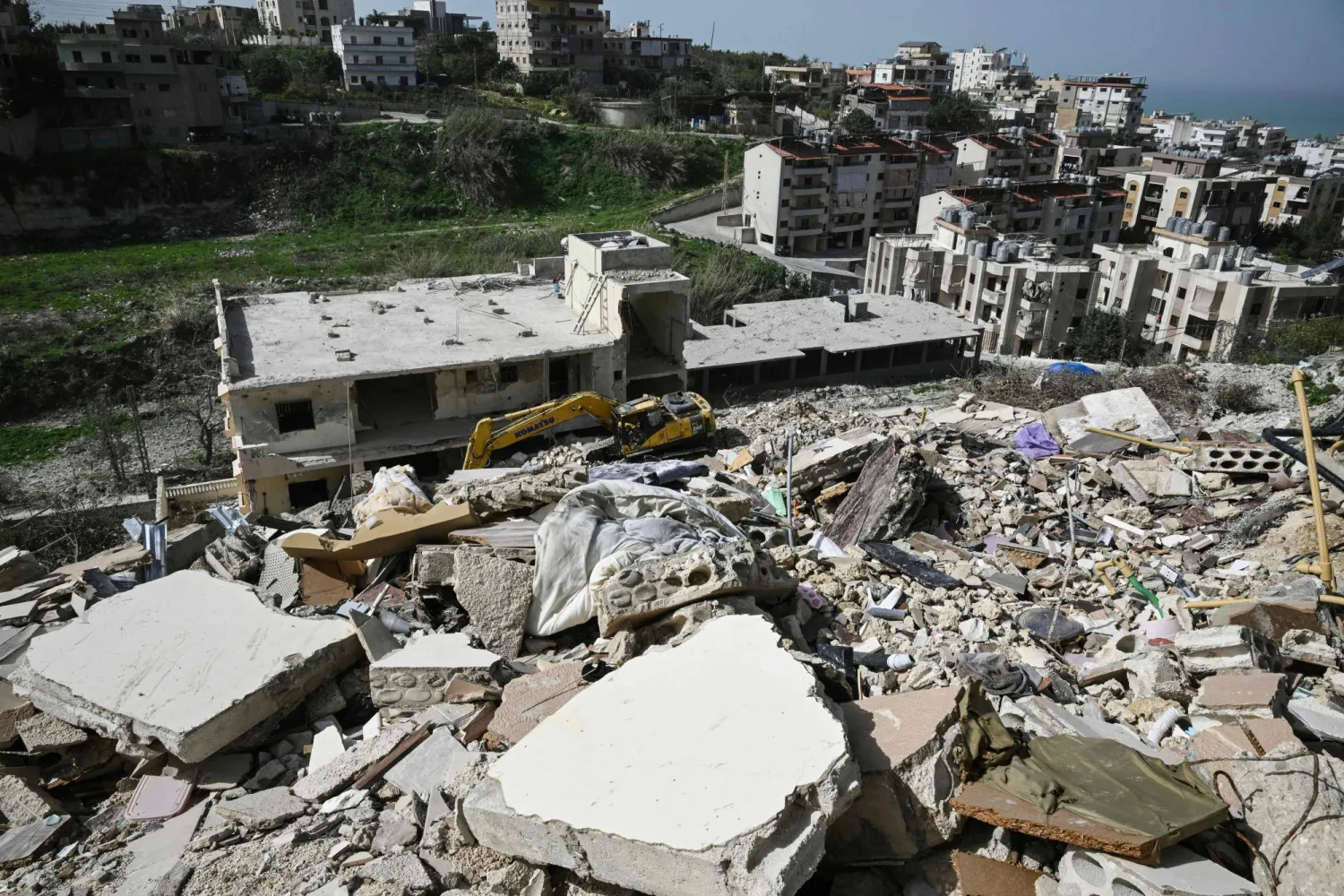
A damaged excavator sits on the rubble of a building that was hit in January by an Israeli strike in the southern Lebanese village of Qannarit, on February 16, 2026. (AFP)
TT

Lebanon Says Army to Take at Least 4 Months for Next Stage of Hezbollah Disarmament Plan 

A damaged excavator sits on the rubble of a building that was hit in January by an Israeli strike in the southern Lebanese village of Qannarit, on February 16, 2026. (AFP)

Lebanon's government said Monday that the army would need at least four months to implement the second phase of the military's plan to disarm Hezbollah in the country's south.

Lebanon's government last year committed to disarming Iran-backed Hezbollah, which was badly weakened in a recent war with Israel, and tasked the army with drawing up a plan to do so.

The military said last month said it had completed the first phase of the plan, covering the area between the Litani River and the Israeli border about 30 kilometers (20 miles) farther south.

The second phase concerns the area between the Litani and the Awali rivers, around 40 kilometers south of Beirut.

Information Minister Paul Morcos told a news conference after a cabinet session that the government "took note of the army leadership's presentation" on the second stage of the plan.

"There is a timeframe of four months, extendable depending on available capabilities, Israeli attacks and hindrances on the ground," he said.

Israel, which accuses Hezbollah of rearming, has criticized the army's progress as insufficient, and has kept up regular strikes on Lebanon despite a November 2024 ceasefire that sought to end more than a year of hostilities with the Iran-backed group.

Israel has also kept troops in five south Lebanon areas it deems strategic, while Hezbollah has rejected calls to surrender its weapons north of the Litani.

Lebanon's health ministry said Israeli strikes on Monday on the country's south killed two people, while the Israeli army said it struck Hezbollah operatives.

Also Monday, before the cabinet session, Hezbollah chief Sheikh Naim Qassem said that "what the Lebanese government is doing in focusing on disarmament is a grave sin, because this issue serves the goals of the Israeli aggression".

"Stop all action to restrict weapons," he added in a televised address, saying the government's "successive concessions" were partly to blame for Israel's persistent attacks.



Iraqi PM to Visit Tehran This Week

Iraqi Prime Minister Ali al-Zaidi attends a meeting with US President Donald Trump (not pictured) in the Oval Office of the White House in Washington, DC, USA, 14 July 2026. (EPA)
TT

Iraqi PM to Visit Tehran This Week

Iraqi Prime Minister Ali al-Zaidi attends a meeting with US President Donald Trump (not pictured) in the Oval Office of the White House in Washington, DC, USA, 14 July 2026. (EPA)

Iraqi Prime Minister Ali al-Zaidi will visit Tehran ‌within ‌the coming ‌week, ⁠the Iraqi state ⁠news agency reported on ⁠Sunday.

During ‌the visit, ‌the prime minister will ‌sign memoranda of ⁠understanding in ⁠Tehran in areas of cooperation.

Al-Zaidi had visited the United States earlier this week where he met with President Donald Trump.

Trump praised the new PM, saying the US is “going to have a long-term relationship with Iraq. We're going to have a long-term relationship with a man that will be a great leader.”

“It's a great honor to have the Prime Minister of Iraq with us. He's been a great fighter, and he's been a great fan of America,” he went on to say.

Iraq signed 48 agreements and partnerships with American companies, many in the oil sector, during al-Zaidi's visit.

Al-Zaidi, a businessman, came to power this year with US blessing after Trump vetoed another candidate.

He has vowed to boost Iraq's fragile economy and disarm pro-Iran armed groups in Iraq that have targeted US facilities.

Iraq has long walked a tightrope between the competing influences of allies the United States and neighboring Iran.


Rubio Hails Lebanon for Peace Efforts After Meeting Aoun

Lebanese President Joseph Aoun attends a press conference, at the presidential palace, in Baabda, Lebanon January 17, 2025. (Reuters)
TT

Rubio Hails Lebanon for Peace Efforts After Meeting Aoun

Lebanese President Joseph Aoun attends a press conference, at the presidential palace, in Baabda, Lebanon January 17, 2025. (Reuters)

US Secretary of State Marco Rubio met with Lebanese President Joseph Aoun in Washington on Sunday, praising the country for its "move towards peace" after the latest round of Lebanon-Israel talks. 

It was the first trip to the US capital by a Lebanese head of state since Michel Suleiman was received by Barack Obama in 2009. 

Aoun and Rubio held talks at the State Department, and Lebanese officials said Aoun is due to meet with President Donald Trump on Tuesday. 

Rubio commended the Lebanese government for its "determined effort to reclaim Lebanon's sovereignty, disarm Hezbollah and dismantle its terrorist infrastructure, and move towards peace," the State Department said following the talks. 

Lebanon and Israel, which do not have formal diplomatic relations, began US-sponsored negotiations in April aimed at reaching a peace deal and permanently ending the Israel-Hezbollah war. 

On June 26, they reached a framework agreement in Washington under which the Israeli military is to withdraw from southern Lebanon and the Lebanese army is to deploy, starting with two "pilot zones." 

But the agreement is contingent on the disarmament of Iran-backed group Hezbollah, which has flatly rejected both the deal and the Israel-Lebanon negotiations that underpin it. 

Following the latest round of talks last week in Rome, Israel and Lebanon agreed on the structure and guidelines for implementing the pilot zones, according to the United States. 

Rubio said Washington was committed "to supporting the successful implementation of the Trilateral Framework and to backing the Government of Lebanon's efforts to deliver peace, economic recovery, and a better future for the Lebanese people." 

Hezbollah pulled Lebanon into the Middle East war on March 2, when it began striking Israel in support of its backer Iran. 

Israel responded with airstrikes and a ground invasion, and despite a ceasefire it continues sporadic attacks and holds territory in the south in what it describes as a "security zone." 

While in Washington, Aoun planned talks "on the situation in Lebanon and ways to strengthen the ceasefire" as well as on "the withdrawal of Israel from the Lebanese regions it occupies," his office said earlier. 

The United States carried out airstrikes on Sunday to "punish" Iran after the first US military deaths since open hostilities rekindled the Middle East war. 


Jordan Summons Iranian Diplomat Over ‘Unjustified’ Attacks

The Jordanian capital, Amman. Petra file photo
TT

Jordan Summons Iranian Diplomat Over ‘Unjustified’ Attacks

The Jordanian capital, Amman. Petra file photo

Jordan has summoned Iran's charge d'affaires in Amman over what it ‌called "unjustified ‌and blatant Iranian ‌attacks" ⁠and "provocative and inflammatory ⁠statements targeting the Kingdom's territory," Jordan's ministry of foreign affairs ⁠said in ‌a ‌statement on ‌Sunday. 

Over the ‌last week, Jordan has repeatedly said that ‌it has intercepted Iranian missiles flying ⁠over ⁠its territory, including three that it shot down on Sunday, according to the country's military.