

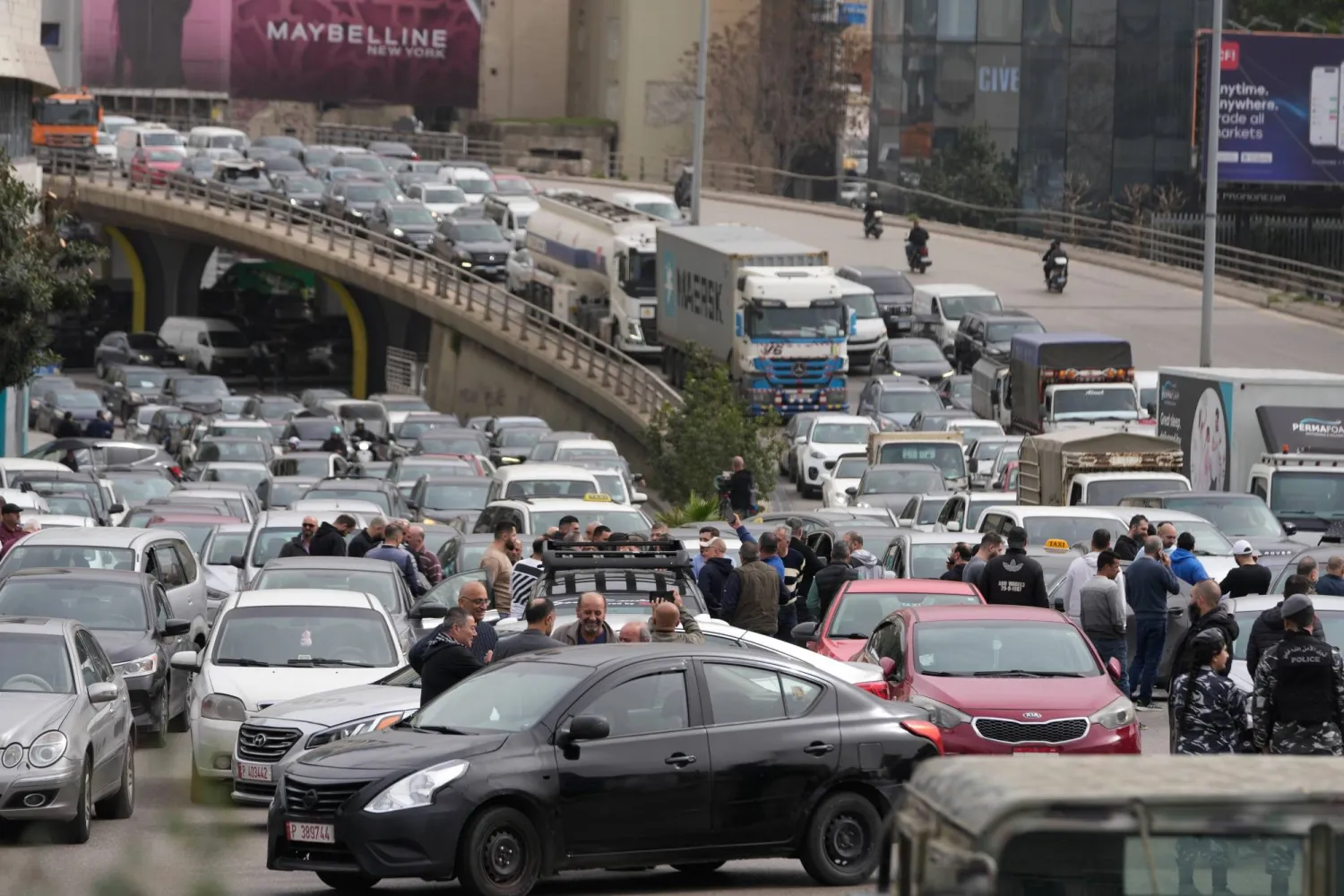

Protesters Block Beirut Roads after Cabinet Approves New Taxes that Raise Fuel Prices

Taxi drivers, foreground, block a main highway with their cars during a protest against the increased taxes and gasoline prices issued by the Lebanese Cabinet on Monday, in Beirut, Lebanon, Tuesday, Feb. 17, 2026. (AP Photo/Hussein Malla)
TT

Protesters Block Beirut Roads after Cabinet Approves New Taxes that Raise Fuel Prices

Taxi drivers, foreground, block a main highway with their cars during a protest against the increased taxes and gasoline prices issued by the Lebanese Cabinet on Monday, in Beirut, Lebanon, Tuesday, Feb. 17, 2026. (AP Photo/Hussein Malla)

Protesters blocked main roads in and around Beirut on Tuesday after Lebanon’s Cabinet approved new taxes that raise fuel prices and other products to fund public pay hikes.

The Cabinet approved a tax of 300,000 Lebanese pounds (about $3.30) on every 20 liters (5.3 gallons) of gasoline on Monday. Diesel fuel was exempted from the new tax, as most in Lebanon depend on it to run private generators to make up for severe shortages in state electricity.

The government also agreed to increase the value-added tax on all products already subject to the levy from 11 to 12%, which the parliament still has to approve, The Associated Press said.

The tax increases are to support raises and pension boosts of public employees, after wages lost value in the 2019 currency collapse, giving them the equivalent of an additional six months’ salary. Information Minister Paul Morcos said the pay increases were estimated to cost about $800 million.

Though the Mediterranean country sits on one of the largest gold reserves in the Middle East, it suffers ongoing inflation and widespread corruption. The cash-strapped country also suffered about $11 billion in damages in the 2024 war between Israel and the Hezbollah militant group.

Anger over fuel hike Ghayath Saadeh, one of a group of taxi drivers who blocked a main road leading into downtown Beirut, said the country’s leaders “consider us taxi drivers to be garbage.”

“Everything is getting more expensive, food and drinks, and Ramadan is coming,” he said. “We will block all the roads, God willing, if they don’t respond to us.”

When the Lebanese government proposed new taxes in 2019, including a $6 monthly fee for using internet calls through services such as WhatsApp, mass protests broke out that paralyzed the country for months. Demonstrators called for the country’s leaders to step down over widespread corruption, government paralysis and failing infrastructure, and for an end to the country’s sectarian power-sharing system.

Lebanon has been under international pressure to make financial reforms for years, but has so far made little progress.

Weapons plan discussed

Also Monday, the cabinet received a report from the Lebanese army on its progress on a plan to disarm non-state militant groups in the country, including Hezbollah.

Last month, the army announced it had completed the first phase of the plan, covering the area south of the Litani River, near the border with Israel. The second phase of the plan will cover segments of southern Lebanon between the Litani and the Awali rivers, which includes the port city of Sidon.

Morcos, the information minister, said following the cabinet session that the second stage is expected to take four months but could be extended “depending on the available resources, the continuation of Israeli attacks and the obstacles on the ground.”

The disarmament plan comes after a US-brokered ceasefire nominally ended a war between Hezbollah and Israel in November 2024. Since then, Israel has accused Hezbollah of rebuilding and has continued to launch near-daily strikes in Lebanon and to occupy several hilltop points on the Lebanese side of the border.

Hezbollah has insisted that the ceasefire deal only requires it to disarm south of the Litani and that it will not discuss disarming in the rest of the country until Israel stops its strikes and withdraws from all Lebanese territory.



Israeli Strikes Damage Hospital in Lebanon

File photo: Destroyed houses that were hit in an Israeli airstrike in Saksakiyeh village, south Lebanon, Friday, April 3, 2026. (AP Photo/Hussein Malla)
TT

Israeli Strikes Damage Hospital in Lebanon

File photo: Destroyed houses that were hit in an Israeli airstrike in Saksakiyeh village, south Lebanon, Friday, April 3, 2026. (AP Photo/Hussein Malla)

A hospital in the coastal Lebanese city of Tyre was damaged by Israeli airstrikes on nearby buildings that wounded 11 people, the health ministry said on Saturday.

The director of the Lebanese Italian Hospital told the state-run National News Agency (NNA) that it would "remain open to provide the necessary medical care" despite the damage.

Strikes destroyed two buildings nearby, an AFP correspondent saw, shattering windows and causing suspended ceilings to collapse in the hospital, the facility's management said.

A series of attacks hit the Tyre region on Saturday, including one on its port that struck a small boat and damaged others moored nearby, the AFP correspondent said.

Israel has been carrying out strikes across Lebanon and launched a ground invasion in the south after Hezbollah entered the war in the Middle East on the side of its backer Iran on March 2.

Tens of thousands of people have left Tyre, but around 20,000 remain, including 15,000 displaced from surrounding villages, despite Israeli evacuation warnings covering most of the city and a broad swathe of southern Lebanon.

The NNA also reported that Israeli forces abducted a man in Shebaa, near the Israeli border in the east, at around 3:00 am on Saturday.


Indonesia Slams 'Unacceptable' Peacekeeper Casualties in Lebanon

FILE PHOTO: UNIFIL vehicles drive on a main road in Qlayaa, amid escalating hostilities between Israel and Hezbollah, as the US-Israel conflict with Iran continues, in Qlayaa, southern Lebanon, March 27, 2026. REUTERS/Karamallah Daher/File Photo
TT

Indonesia Slams 'Unacceptable' Peacekeeper Casualties in Lebanon

FILE PHOTO: UNIFIL vehicles drive on a main road in Qlayaa, amid escalating hostilities between Israel and Hezbollah, as the US-Israel conflict with Iran continues, in Qlayaa, southern Lebanon, March 27, 2026. REUTERS/Karamallah Daher/File Photo

The Indonesian government on Saturday slammed as "unacceptable" an explosion that injured three of its peacekeepers in Lebanon within days of three other blue helmets from the Southeast Asian nation being killed.

The United Nations Interim Force in Lebanon (UNIFIL) said three peacekeepers were wounded in a blast that occurred inside a UN facility near Adaisseh on Friday afternoon, and rushed to hospital.

Two were seriously wounded.

The UN Information Center in Jakarta said the "origin of the explosion" was unknown but identified the injured soldiers as Indonesian.

"Repeated attacks or incidents of this kind are unacceptable," the Indonesian foreign ministry said in a statement.

"Regardless of their cause, these events underscore the urgent need to strengthen protection for UN peacekeeping forces amid an increasingly dangerous conflict situation."

The government urged the UN Security Council to investigate the events and "to immediately convene a meeting of troop-contributing countries to UNIFIL to conduct a review and take measures to enhance the protection of personnel serving with UNIFIL".

Friday's incident came just days after an Indonesian peacekeeper died when a projectile exploded on March 29 in southern Lebanon, where Israel and Hezbollah have been fighting since Lebanon was drawn into the Middle East war.

A UN security source told AFP on condition of anonymity Tuesday that fire from an Israeli tank was responsible for that attack.

A day later, two more Indonesian peacekeepers died after an explosion struck a UNIFIL logistics convoy, also in southern Lebanon.

The father of one of the two fallen soldiers, 33-year-old Zulmi Aditya Iskandar, said this week he was shocked that peacekeepers were losing their lives in the conflict.

"We were really sad and regretful, because this is a UN troop, a peacekeeping troop, not deployed for war," 60-year-old Iskandarudin told reporters at his house in West Java province.

The bodies of the three peacekeepers are scheduled to arrive in Jakarta on Saturday evening, according to the military.

The Indonesian National Armed Forces has said it will deploy more than 750 personnel to Lebanon next month as part of the scheduled UNIFIL peacekeeping troop rotation.


Strike Kills One Iraqi Fighter near Syria Border

Mourners attend the funeral of members of Iraq's Hashed al-Shaabi, who were killed in an airstrike in the town of al‑Qaim near the Syrian border, amid heightened regional tensions due to the US-Israel conflict with Iran, in Baghdad, Iraq, March 12, 2026. REUTERS/Stringer
TT

Strike Kills One Iraqi Fighter near Syria Border

Mourners attend the funeral of members of Iraq's Hashed al-Shaabi, who were killed in an airstrike in the town of al‑Qaim near the Syrian border, amid heightened regional tensions due to the US-Israel conflict with Iran, in Baghdad, Iraq, March 12, 2026. REUTERS/Stringer

An attack killed one fighter from the former paramilitary coalition Hashed al-Shaabi on Saturday, the alliance said, blaming the US and Israel.

Iraq has been dragged into the war between the United States, Israel and Iran, with strikes targeting both US interests and pro-Iran groups in the country, reported AFP.

"This treacherous attack resulted in the martyrdom of one PMF fighter and the wounding of four others, as well as a member of the ministry of defense," said a short statement from the group, which is also known as the Popular Mobilization Forces (PMF), adding it was a "Zionist-American attack".

The PMF is a coalition of armed groups -- formed in 2014 to fight extremists-- that is now part of Iraq's regular army, but also contains pro-Iran factions who have a reputation for acting independently.

PMF positions have been repeatedly targeted since the outbreak of war, with the group consistently blaming the attacks on the US and Israel.

According to the group's statement, the latest attack targeted a position in western Anbar province of the 45th Brigade, which belongs to the US-blacklisted, pro-Iran Kataeb Hezbollah group.

Kataeb Hezbollah is part of the umbrella movement known as the Islamic Resistance in Iraq, which has been claiming daily attacks since the start of the war on US interests in Iraq and the region.

The Pentagon has said helicopters have carried out strikes against pro-Iran armed groups in Iraq during the war.

Washington has strongly denied claims it has targeted Iraqi security forces.