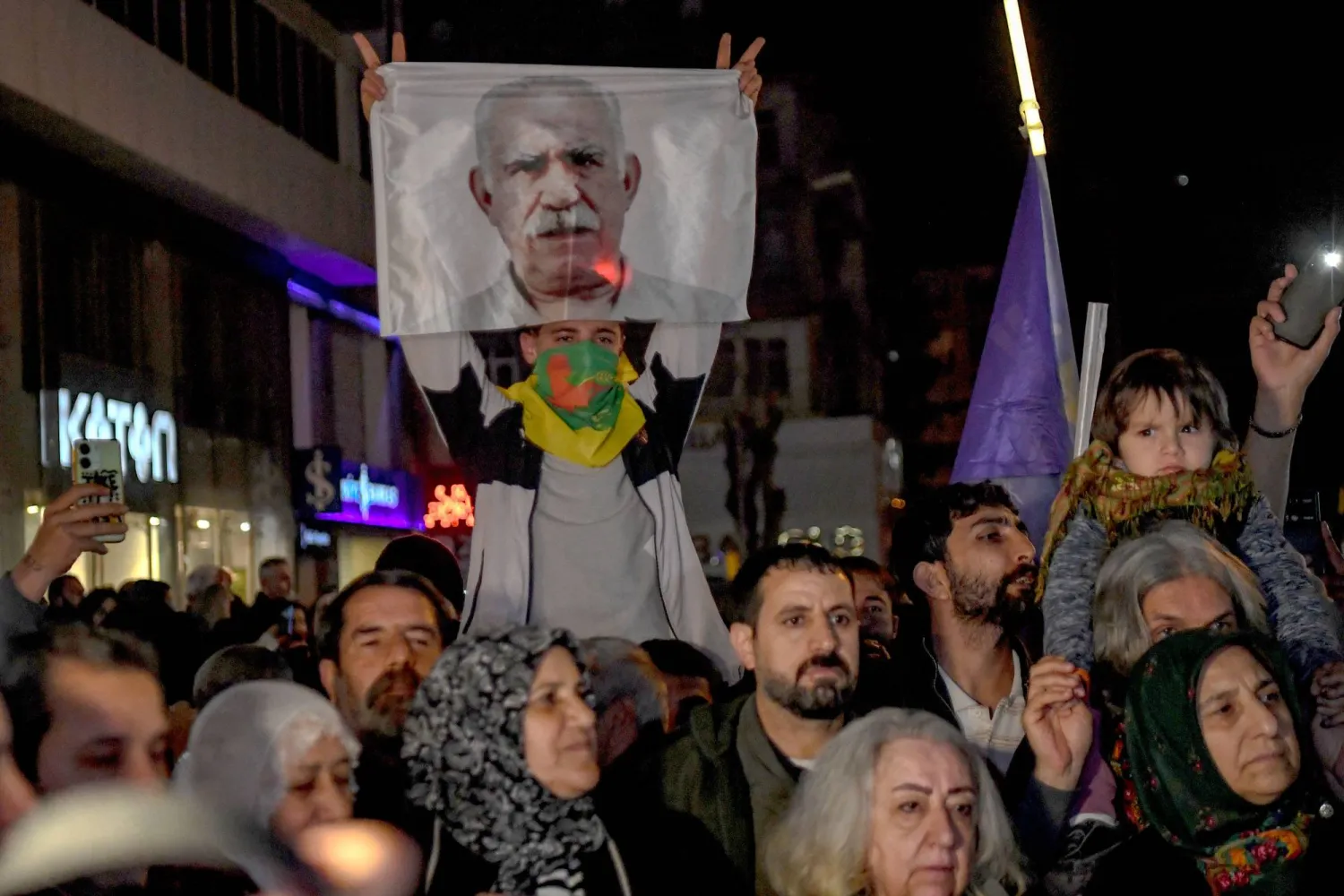
Türkiye: Ocalan Announces ‘Integration Phase’

Members of the Kurdish community take part in a protest calling for the release of convicted Kurdistan Worker's Party (PKK) leader Abdullah Ocalan in Diyarbakir on February 15, 2026. (Photo by Ilyas AKENGIN / AFP)
TT

Türkiye: Ocalan Announces ‘Integration Phase’

Members of the Kurdish community take part in a protest calling for the release of convicted Kurdistan Worker's Party (PKK) leader Abdullah Ocalan in Diyarbakir on February 15, 2026. (Photo by Ilyas AKENGIN / AFP)

The jailed leader of the Kurdistan Workers Party, Abdullah Ocalan, has said that the Ankara-PKK peace process has entered its “second phase,” as the Turkish parliament sets the stage to vote on a draft report proposing legal reforms tied to peace efforts.

A delegation from the pro-Kurdish Peoples' Equality and Democracy Party (DEM Party), including lawmakers Pervin Buldan, Mithat Sancar, and Ocalan’s lawyer Ozgur Faik, met with the jailed PKK leader on Monday on the secluded Imrali island.

Sancar said that the second phase will be focused on democratic integration into
Türkiye’s political system.

According to the lawmaker, the PKK leader considered the first phase the “negative dimension” concerned with ending the decades-old conflict between the armed group and Ankara.

“Now we are facing the positive phase,” Ocalan said, “the integration phase is the positive phase; it is the phase of construction.”

For the second phase to be implemented, Ocalan called on Turkish authorities to provide conditions that would allow him to put his “theoretical and practical capacity” to work.

The 60-page draft report on peace with the PKK was completed by a five-member writing team, which is chaired by Parliament Speaker Numan Kurtulmuş, and is scheduled for a vote on Wednesday.

The report is organized into seven sections.

In July last year, Ocalan said the group's armed struggle against Türkiye has ended and called for a full shift to democratic politics.


Hegseth Asked US Army Chief of Staff to Step Down

US Secretary of Defense Pete Hegseth attends a briefing held with Chairman of the Joint Chiefs of Staff General Dan Caine (not pictured), amid the US-Israeli conflict with Iran, at the Pentagon in Washington, DC, US, March 31, 2026. (Reuters)
TT

Hegseth Asked US Army Chief of Staff to Step Down

US Secretary of Defense Pete Hegseth attends a briefing held with Chairman of the Joint Chiefs of Staff General Dan Caine (not pictured), amid the US-Israeli conflict with Iran, at the Pentagon in Washington, DC, US, March 31, 2026. (Reuters)

Secretary of Defense Pete Hegseth has asked General Randy George to step down as chief of staff of the US Army, an official said Thursday.

The official, who spoke on condition of anonymity, confirmed a report from US broadcaster CBS that said George had been asked to take immediate retirement.

The reason for the request was not immediately known, but CBS quoted a source as saying Hegseth wanted someone who would implement his and President Donald Trump's vision for the Army.

Pentagon spokesman Sean Parnell later posted a statement on X that said George "will be retiring from his position... effective immediately," without specifying a reason.

George is the latest senior military officer to be ousted during Trump's second term, and his removal as the top Army officer comes with the United States engaged in a war with Iran that the president has indicated could last for several more weeks.

During a nearly four-decade military career, George deployed to Iraq and Afghanistan multiple times and also served in positions including vice chief of staff of the Army and senior military assistant to Pentagon chief Lloyd Austin during Joe Biden's term as president.

- Military purge -

General David Hodne and Major General William Green Jr. were also removed alongside George, according to The Washington Post and CBS.

Hodne led the Army's Transformation and Training Command while Green was in charge of the Army's Chaplain Corps. AFP has contacted the Pentagon for comment.

Trump has overseen a purge of top military officers, including the chairman of the Joint Chiefs of Staff, general Charles "CQ" Brown, whom he fired without explanation in February 2025.

Other senior officers dismissed include the heads of the Navy and Coast Guard, the general who headed the National Security Agency, the vice chief of staff of the Air Force, a Navy admiral assigned to NATO, and three top military lawyers.

The chief of staff of the Air Force also announced his retirement without explanation just two years into a four-year term, while the head of the US Southern Command retired a year into his tenure.

Hegseth has insisted the president is simply choosing the leaders he wants, but Democratic lawmakers have raised concerns about the potential politicization of the traditionally neutral US military.

Last year, the Pentagon chief additionally ordered at least a 20 percent cut in the number of active-duty four-star generals and admirals in the US military, as well as a 10 percent cut in the overall number of general and flag officers.


South Korea, France Agree to Deepen Defense Cooperation Amid Middle East Conflict

 French President Emmanuel Macron (L) shakes hands with South Korean President Lee Jae-myung (R) prior to a toast during a state lunch in Seoul on April 3, 2026. (AFP)
French President Emmanuel Macron (L) shakes hands with South Korean President Lee Jae-myung (R) prior to a toast during a state lunch in Seoul on April 3, 2026. (AFP)
TT

South Korea, France Agree to Deepen Defense Cooperation Amid Middle East Conflict

 French President Emmanuel Macron (L) shakes hands with South Korean President Lee Jae-myung (R) prior to a toast during a state lunch in Seoul on April 3, 2026. (AFP)
French President Emmanuel Macron (L) shakes hands with South Korean President Lee Jae-myung (R) prior to a toast during a state lunch in Seoul on April 3, 2026. (AFP)

South Korean President Lee Jae Myung and French President Emmanuel Macron said on Friday they planned to boost defense cooperation and work together to address the economic and energy crises triggered by the war in Iran.

Macron arrived in South Korea on Thursday for a two-day state visit after also visiting Japan, and held a summit in Seoul on Friday.

It is the first state visit by a French president since 2015, and French officials have said the trip aims to strengthen France's strategic and economic role in the region at a time of "strong international and regional tensions."

"President Macron and I agreed to share policy-related experiences and strategies in order to jointly address the economic and energy crises triggered by the ‌Middle East war," Lee ‌said after the summit.

The leaders also confirmed their commitment to bolstering energy security ‌including ⁠by collaborating to ⁠secure safe maritime transport routes through the Strait of Hormuz, he said.

Like other Asian economies, South Korea relies heavily on energy imports, including through the Strait of Hormuz. Iran has effectively shut down the waterway in retaliation for US-Israeli attacks that began on February 28, driving up energy prices and stoking fears of a global recession.

Macron said on Thursday that it would be unrealistic to launch a military operation to force open the strait, after US President Donald Trump challenged US allies to work towards reopening it.

DEFENCE TIES

Macron said after Friday's summit that the countries, both major ⁠arms manufacturers, would strive to boost their defense ties.

"What we want to do ‌is give this cooperation a contemporary dimension," Macron said, citing joint ‌exercises and more cooperation in production and in critical military capabilities.

"On both sides, we want to equip ourselves with greater strategic ‌depth in military production."

Lee also said the countries will further expand cooperation in security fields such as ‌aerospace and defense.

South Korea and France are due to sign a number of preliminary agreements to cooperate in sectors including critical minerals, semiconductors, quantum technologies, nuclear energy and wind power, Lee's office said.

The countries also aimed to increase bilateral trade to $20 billion by 2030 from $15 billion in 2025, Lee said.

Lee highlighted memoranda of understanding to be signed between South Korea's state-run ‌Korea Hydro & Nuclear Power and French companies Orano and Framatome, saying this would help secure fuel supplies for Korean nuclear power plants and lay the foundation for ⁠joint entry into the ⁠global nuclear market.

LUNCH AND KPOP

The two leaders will have a lunch after their summit, accompanied by about 140 government officials and business executives from both countries. Felix, a member of the Kpop boy band Stray Kids who has been named an honorary ambassador to France, will also attend, Lee's office said.

On Thursday, a banquet attended by the leaders and their wives was served by chef Son Jong-won, who was on Netflix's popular "Culinary Class Wars", the Blue House said. Signed CDs from top Kpop acts like BTS, Stray Kids and G-DRAGON were also prepared as gifts for France's First Lady Brigitte Macron.

The French president is scheduled to deliver a speech at Yonsei University in Seoul after the summit, and attend a business forum alongside Prime Minister Kim Min-seok, according to the Blue House.

Macron is scheduled to meet the CEOs of Samsung, Naver and Hyundai Motor during the trip as he seeks to boost French exports to South Korea and attract Korean investment into France’s industrial and technology sectors, according to the Elysee.


No Sign of War Winding Down in Mideast as Friday Dawns with Attacks across Region

Smoke rises from the site of a strike in Tehran on April 1, 2026.  (Photo by AFP) /
Smoke rises from the site of a strike in Tehran on April 1, 2026. (Photo by AFP) /
TT

No Sign of War Winding Down in Mideast as Friday Dawns with Attacks across Region

Smoke rises from the site of a strike in Tehran on April 1, 2026.  (Photo by AFP) /
Smoke rises from the site of a strike in Tehran on April 1, 2026. (Photo by AFP) /

There was little sign Friday of the war in the Mideast winding down as Israel said it faced incoming fire from Iran, Kuwait and Bahrain reported being under attack, and Iran said eight people were killed while celebrating the close of Persian new year near a major bridge hit by a US strike.

Tehran continued to demonstrate its ability to strike its neighbors even as US President Donald Trump claimed the threat from the country was nearly eliminated and cheered the collapse of the bridge on Thursday, reportedly the tallest in the Middle East.

Iran decried the strike on the bridge, which also injured 95 people celebrating Nature Day, when Iranians gather for picnics and other celebrations outdoors on the last day of Nowruz, the Persian new year.

“Striking civilian infrastructure only conveys the defeat and moral collapse of an enemy in disarray,” Iran’s Foreign Minister Abbas Araghchi wrote Thursday in a post on X.

Iran’s attacks on Gulf states along with its chokehold on the Strait of Hormuz have disrupted the world’s energy supplies with effects far beyond the Middle East. That has proved to be Iran’s greatest strategic advantage in the war. Britain held a call with nearly three dozen countries about how to reopen the strait once the fighting is over.

Trump has insisted the strait can be taken by force — but said it is not up to the US to do that. In an address to the American people Wednesday night, he encouraged countries that depend on oil from Hormuz to “build some delayed courage” and go “take it.”

Before the US and Israel started the war on Feb. 28 with strikes on Iran, the waterway was open to traffic and 20% of all traded oil passed through it.

Iran continues to strike Israel and Gulf countries

Iran responded defiantly to Trump’s speech, in which the American president claimed US military action had been so decisive that “one of the most powerful countries” is “really no longer a threat.”

A spokesman for Iran’s military, Lt. Col. Ebrahim Zolfaghari, insisted Thursday that Tehran maintains hidden stockpiles of arms, munitions and production facilities. He said facilities targeted so far by US strikes are “insignificant.”

Trump, in his address, said US “core strategic objectives are nearing completion.”

Iran state media reported the attack on the B1 bridge, which was still under construction, citing authorities in Alborz province.

Trump posted footage on social media showing what he said was the collapse of Iran's biggest bridge and threatening, “Much more to follow.” It was not immediately clear if the footage Trump shared was the B1 bridge.

In Lebanon — where Israel has launched a ground invasion against Iran-backed Hezbollah militants — Israeli strikes killed 27 people over 24 hours, the Health Ministry said.

More than 1,900 people have been killed in Iran during the war, while 19 have been reported dead in Israel. More than two dozen people have died in Gulf states and the occupied West Bank, while 13 US service members have been killed.

More than 1,300 people have been killed and more than 1 million displaced in Lebanon. Ten Israeli soldiers have also died there.

Nearly three dozen nations talk about securing the Strait of Hormuz Iranian attacks on about two dozen commercial ships, and the threat of more, have halted nearly all traffic in the waterway that connects the Arabian Gulf to the open ocean.

Since March 1, traffic through the strait has dropped 94% over the same period last year, according to the Lloyds List Intelligence shipping data firm. Two ships are confirmed to have paid a fee, the firm said, while others were allowed through based on agreements with their home governments.

Saudi Arabia piped about 1 billion barrels of oil away from the Strait of Hormuz in March, according to maritime data firm Kpler, while Iraq said Thursday that it had started to truck oil across Syria to avoid the strait.

The 35 countries that spoke Thursday signed a declaration last month demanding Iran stop blocking the strait.

Thursday’s talks were focused on political and diplomatic measures, but British Foreign Secretary Yvette Cooper said military planners from an unspecified number of countries will also plot ways to ensure security once fighting ends, including potential mine-clearing work and “reassurance” for commercial shipping.

No country appears willing to try to open the strait by force while the war is raging. French President Emmanuel Macron, while on a visit to South Korea, called a military operation to secure the waterway “unrealistic.”

But there is a concern that Iran might limit traffic through the waterway even after US and Israeli attacks cease.

Oil prices rise again even as Trump suggests the war could end soon

The conflict is driving up prices for oil and natural gas, roiling stock markets, pushing up the cost of gasoline and threatening to make a range of goods, including food, more expensive.

Oil prices remained elevated, however, at $111.54 for a barrel of US crude, having soared following Trump’s address. That's up about 50% from Feb. 28.

Though the oil and gas that typically transits the strait is primarily sold to Asian nations, Japan and South Korea were the only two countries from the region joining Thursday's call about the strait. The supply of jet fuel has also been interrupted, with consequences for travel worldwide.