


Deep-sea Fish Break the Mold with Novel Visual System

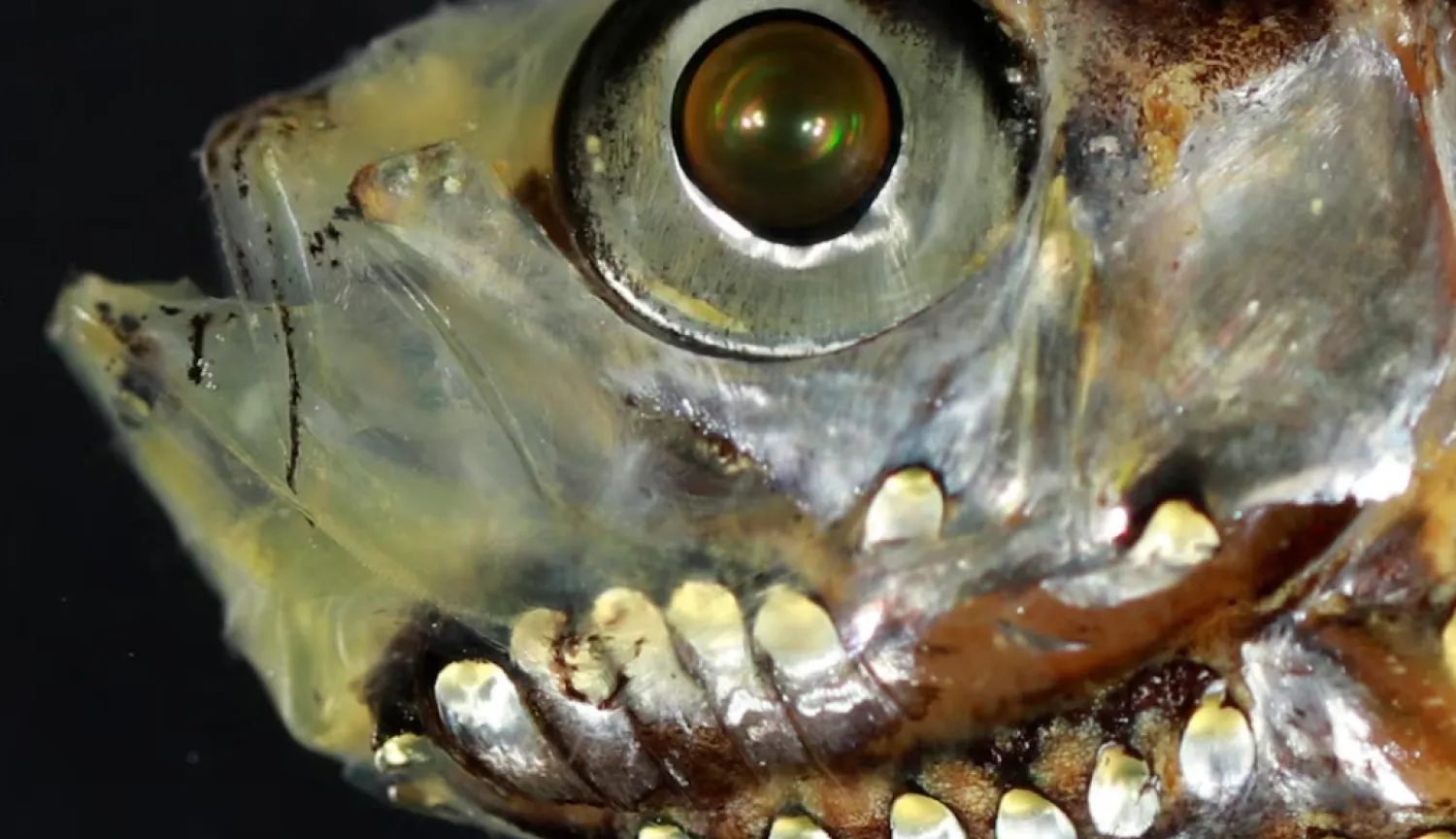
A close-up showing the shiny silver-green photophores (light organs) on the lower head of the deep-sea fish Maurolicus muelleri from the Red Sea, seen in this photograph released on February 11, 2026. Dr. Wen-Sung Chung/Handout via REUTERS
TT

Deep-sea Fish Break the Mold with Novel Visual System

A close-up showing the shiny silver-green photophores (light organs) on the lower head of the deep-sea fish Maurolicus muelleri from the Red Sea, seen in this photograph released on February 11, 2026. Dr. Wen-Sung Chung/Handout via REUTERS

For more than a century, biology textbooks have stated that vision among vertebrates - people included - is built from two clearly defined cell types: rods for processing dim light and cones for bright light and color. New research involving deep-sea fish shows this tidy division is, in reality, not so tidy.

Scientists have identified a new type of visual cell in deep-sea fish that blends the shape and form of rods with the molecular machinery and genes of cones. This hybrid type of cell, adapted for sight in gloomy light conditions, was found in larvae of three deep-sea fish species in the Red Sea, Reuters reported.

The species studied were: a hatchetfish, with the scientific name Maurolicus mucronatus; a lightfish, named Vinciguerria mabahiss; and a lanternfish, named Benthosema pterotum. The hatchetfish retained the hybrid cells throughout its life. The other two shifted to the usual rod-cone dichotomy in adulthood.

All three are small, with adults measuring roughly 1-3 inches (3-7 cm) long and the larvae much littler. They inhabit a marine realm of twilight conditions, with sunlight struggling to penetrate into the watery depths.

The vertebrate retina, a sensory membrane at the back of the eye that detects light and converts it into signals to the brain, possesses two main types of light-sensitive visual cells, called photoreceptors. They are named for their shape: rods and cones.

"The rods and cones slowly change position inside the retina when moving between dim and bright conditions, which is why our eyes take time to adjust when we flick on the light switch on our way to the restroom at night," said Lily Fogg, a postdoctoral researcher in marine biology at the University of Helsinki in Finland and lead author of the research published in the journal Science Advances.

"We found that, as larvae, these deep-sea fish mostly use a mix-and-match type of hybrid photoreceptor. These cells look like rods - long, cylindrical and optimized to catch as many light particles - photons - as possible. But they use the molecular machinery of cones, switching on genes usually found only in cones," Fogg said.

The researchers examined the retinas of fish larvae caught at depths from 65 to 650 feet (20 to 200 meters). In the type of dim environment they inhabit, rod and cone cells both are usually engaged in the vertebrate retina, but neither works very well. These fish display an evolutionary remedy.

"Our results challenge the longstanding idea that rods and cones are two fixed, clearly separated cell types. Instead, we show that photoreceptors can blend structural and molecular features in unexpected ways. This suggests that vertebrate visual systems are more flexible and evolutionarily adaptable than previously thought," Fogg said.

"It is a very cool finding that shows that biology does not fit neatly into boxes," said study senior author Fabio Cortesi, a marine biologist and neuroscientist at the University of Queensland in Australia. "I wouldn't be surprised if we find these cells are much more common across all vertebrates, including terrestrial species."

All three species emit bioluminescence using small light-emitting organs on their bodies, mostly located on the belly. They produce blue-green light that blends with the faint background light from the sun above. This strategy, called counterillumination, is a common form of camouflage in the deep sea to avoid predators.

"Small fish like these fuel the open ocean. They are plentiful and serve as food for many larger predatory fishes, including tuna and marlin, marine mammals such as dolphins and whales, and marine birds," Cortesi said.

These kinds of fish also engage in one of the biggest daily migrations in the animal kingdom. They swim near the surface at night to feed in plankton-rich waters, then return to the depths - 650 to 3,280 feet (200 to 1,000 meters) - during daytime to avoid predation.

"The deep sea remains a frontier for human exploration, a mystery box with the potential for significant discoveries," Cortesi said. "We should look after this habitat with the utmost care to make sure future generations can continue to marvel at its wonders."



British Royals to Mark What Would Have Been Late Queen’s 100th Birthday

King Charles in April 2025. (Getty Images)
TT

British Royals to Mark What Would Have Been Late Queen’s 100th Birthday

King Charles in April 2025. (Getty Images)

King Charles will visit an exhibition dedicated to his late mother's fashion on Monday, the first in a number of events which the British royals will attend to mark what would have been the late Queen Elizabeth's 100th birthday on Tuesday.

Elizabeth, Britain's longest-reigning and longest-lived monarch, was born on April 21, 1926, going on to spend 70 years on the throne before her death in September 2022 at the age of 96.

Such is ‌her enduring ‌impact that a YouGov survey last week found that ‌81% ⁠of those polled ⁠had a positive opinion of her, more than any living member of the royal family.

"I don't think I've ever seen anybody have a sense of duty like she had," Charles' wife, Queen Camilla, told a BBC documentary broadcast on Sunday.

"It must have been so difficult, being surrounded by much older men," Camilla said of Elizabeth's accession to the throne in ⁠1952 aged 25. "There weren't women prime ministers or ‌women presidents. She was the only one, ‌so I think she carved her own role."

To mark the anniversary of her ‌birth, Charles and Camilla will visit a new exhibition, "Queen Elizabeth II: ‌Her Life in Style", which is currently being held at Buckingham Palace.

More than 300 items, ranging from the late queen's wedding dress to the outfit she wore for her cameo appearance at the opening of the London 2012 Olympics, ‌are on display in the largest-ever exhibition of her wardrobe.

Famed for wearing bright colors and matching hats, ⁠she once quipped: "I have ⁠to be seen to be believed."

On Tuesday, the king and other royals will visit the British Museum to view the final designs for a national memorial to his mother, while Charles' sister, Princess Anne, will officially open the Queen Elizabeth II Garden in London's Regent’s Park.

In the evening, Charles and Camilla will host a reception featuring representatives from charities his mother supported as well as a number of people who will be celebrating their 100th birthday.

The royals' commemorations come after the government announced on Sunday that a new independent charity, the Queen Elizabeth Trust, was being launched to focus on restoring shared spaces in communities, backed by 40 million pounds ($54 million) with the king as its patron.


Briton in Russia Revives Soviet-Era Watches for Luxury Market

An employee demonstrates a watch at the Raketa Watch Factory in Peterhof, part of Saint Petersburg, Russia, April 1, 2026. (Reuters)
TT

Briton in Russia Revives Soviet-Era Watches for Luxury Market

An employee demonstrates a watch at the Raketa Watch Factory in Peterhof, part of Saint Petersburg, Russia, April 1, 2026. (Reuters)

When David Henderson-Stewart first visited Russia's Raketa watch factory, its few remaining watchmakers were huddled in winter coats over vintage equipment.

The British former lawyer knew nothing about watches, but his love of Soviet design led him to see potential in the ailing enterprise, which once employed 7,000 workers and produced timepieces for astronauts and the mass market.

President Vladimir Putin now wears a watch made by its bespoke offshoot, Imperial Peterhof Factory.

"I would never have found something as interesting as Raketa in the West," said Henderson-Stewart, who did not wear a watch until he took over the factory outside St Petersburg with a partner in 2010.

A yearning to ‌live abroad drove ‌Henderson-Stewart to move to Russia to work in law after ‌studying ⁠at Oxford and ⁠at Paris's Sorbonne University. He has stayed, raising three children, who all have Russian citizenship.

Under his leadership, Raketa's pivot to high-end watches with an emphasis on their "Made in Russia" credentials has paid off.

Western sanctions imposed over the war in Ukraine squeezed trade and shuttered foreign luxury stores in Russia from 2022, but domestic demand rose for the largely unsanctioned company, while sales continued to Europe and the Middle East. Its own supply chain was little affected.

"We don't depend on the ⁠West for components. We produce most of them ourselves," Henderson-Stewart said ‌at the revamped Raketa facility, whose industrial roots date ‌to 1721. "That's what our community likes ... that it's a Russian-made watch."

PUTIN BOOST

In the factory, some of the ‌over 200 employees use refurbished machinery to fashion tiny cogs, wheels and springs, continuing the ‌rare practice of making all mechanical parts in-house. Elsewhere, watchmakers with magnifying eyepieces work painstakingly, pop music blaring in the background.

Raketa received a boost in 2022 when Putin was spotted wearing his Imperial Peterhof Factory watch. Some local media read it as a signal of support for domestic production after ‌the invasion of Ukraine.

Putin has since worn the watch regularly, spurring demand for similar designs, said Henderson-Stewart.

"We were told that it would ⁠be better not ⁠to replicate this exact model," he added.

Public records show Raketa posted profit of 109 million roubles ($1.43 million) in 2025, over 15% more than in 2024.

Priced from around $700 to $3,500, Raketa watches are mostly based on Soviet designs, including the steely-faced Baikonur, named after the cosmodrome from which Moscow still launches crewed space flights.

The hands of another of its watches sweep counter-clockwise. This unique model has become a bestseller since it was brought to Henderson-Stewart's attention by head engineer Lyudmila Voynik, 86, who has worked at the factory since the 1950s.

Voynik pulled out a hand-inked technical drawing, patched with tape, from a filing cabinet - one of many she kept safe throughout Raketa's post-Soviet troubles.

"Our Raketas remain the same. Maybe some small changes in details here and there," she said. "I have lived my life here. I am proud that we managed to revive it all once again."


Skydiver Left Dangling When Parachute Snags on Stadium Video Board

In this image from video, personnel on a lift work to secure a skydiver that crashed into the Lane Stadium scoreboard before Virginia Tech’s spring NCAA college football game, Saturday, April 18, 2026, in Blacksburg, Va. (Ben Walls/WRIC8 via AP)
TT

Skydiver Left Dangling When Parachute Snags on Stadium Video Board

In this image from video, personnel on a lift work to secure a skydiver that crashed into the Lane Stadium scoreboard before Virginia Tech’s spring NCAA college football game, Saturday, April 18, 2026, in Blacksburg, Va. (Ben Walls/WRIC8 via AP)

A skydiver ‌trailing a large American flag drifted off course and became tangled in the video board at a US college football game on Saturday, leaving him suspended above the field by his parachute until he was rescued.

Viral videos from inside ‌Virginia Tech's ‌Lane Stadium, confirmed ‌by ⁠Reuters, showed two ⁠skydivers descending into the arena before the school's spring game, when one of them missed the designated landing area, hit the electronic scoreboard and ⁠became entangled.

Fans watched in ‌distress as ‌the skydiver, whose name was not ‌immediately released, was left hanging ‌for 15 to 20 minutes before emergency crews using an aerial ladder brought him to safety.

"We ‌are grateful to report that the skydiver was safely ⁠secured ⁠and is currently stable. Our primary focus remains on their well-being," Virginia Tech officials posted on X.

"We extend our sincere appreciation to the first responders, event staff, and medical personnel for their swift, coordinated and professional response."

No injuries were reported during the incident.