

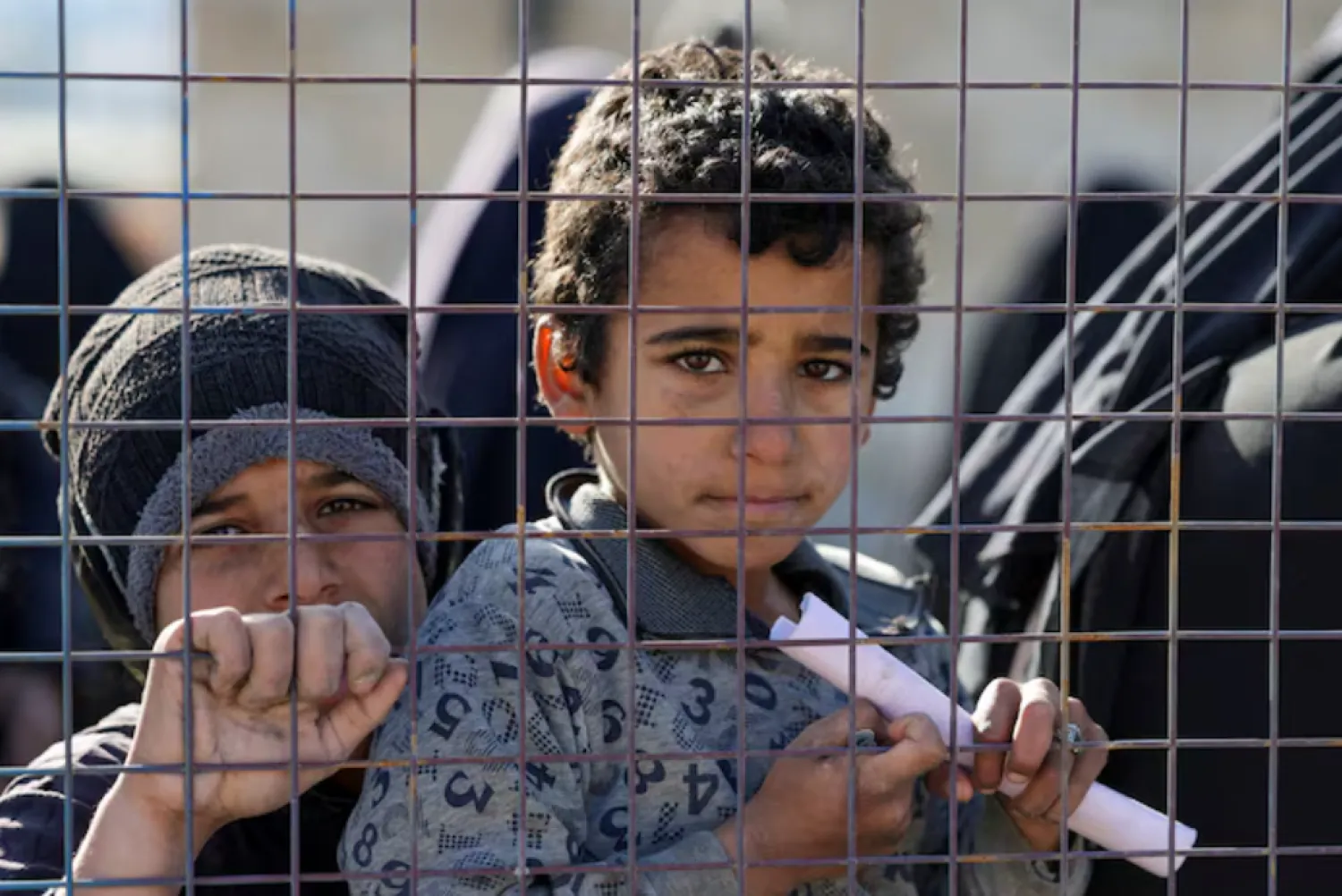

Few People Left at Syria Camp that Held ISIS Families, Former Director Says

Children, part of a group of detainees, look through a fence at al-Hol camp after the Syrian government took control of it following the withdrawal of Syrian Democratic Forces (SDF), in Hasaka, Syria, January 21, 2026. REUTERS/Khalil Ashawi
TT

Few People Left at Syria Camp that Held ISIS Families, Former Director Says

Children, part of a group of detainees, look through a fence at al-Hol camp after the Syrian government took control of it following the withdrawal of Syrian Democratic Forces (SDF), in Hasaka, Syria, January 21, 2026. REUTERS/Khalil Ashawi

Fewer than 1,000 families remain at a camp where relatives of suspected ISIS militants had been held in Syria's northeast, the camp's former director said on Wednesday, with thousands having fled last month as government forces seized control of the area from Kurdish-led fighters.

Al-Hol, near the Iraqi border, was one of the main detention camps for relatives of suspected ISIS militants who were detained during the US-backed campaign against the terrorist group in Syria.

Control of the camp changed hands last month when government forces under President Ahmed al-Sharaa seized swathes of the northeast from the Kurdish-led Syrian Democratic Forces, including several jails holding ISIS militants. The US military said last week it had completed a mission to transfer 5,700 adult male ISIS detainees to Iraq.

Jihan Hanna, the former director who still coordinates with international agencies and the Syrian government, told Reuters the remaining families were Syrian nationals and were being transferred to a camp in Aleppo. Most of the camp’s foreign nationals had fled, she said.

The Syrian government did not immediately respond to requests for comment.

According to the latest camp data obtained by Reuters, dated January 19 - a day before the government took control of the camp - its population was 6,639 families comprising 23,407 people, mostly Syrians and Iraqis, as well as 6,280 foreigners from more than 40 nationalities.

UNHCR, the UN refugee agency, said it had observed "a significant decrease in the number of residents in al-Hol camp in recent weeks," adding in a statement to Reuters that there were no confirmed figures on the remaining population.

"Over the weekend the camp administration advised UNHCR not to enter the camp due to the unrest and anxiety in the camp," UNHCR added.

The Syrian government accused the SDF of withdrawing from al-Hol on January 20 without any coordination.

The SDF, in a statement that day, said its forces had been "compelled to withdraw from al-Hol camp and redeploy to areas surrounding cities in northern Syria that are facing increasing risks and threats."

A Syrian government security source said most people in the camp fled that day during a five-hour period when it was unguarded, and that some had left with men who came to take their relatives to unknown destinations.

The security source and a source from a non-governmental organization working there said a section of the camp that housed its most dangerous residents, known as the annex, was empty.

The security source said the escapees had spread throughout Syria and that security authorities, working in cooperation with international partners, had established a unit to "follow up on the matter and pursue those who are wanted."

Some have left Syria.

In Lebanon, the army has questioned more than a dozen Lebanese who crossed illegally from Syria after leaving al-Hol, a Lebanese security source said.

The Syrian government’s Directorate of International Cooperation said on Tuesday that hundreds of people, mostly women and children, had been transferred from al-Hol to a newly prepared camp near the town of Akhtarin in northern Aleppo.



Israel Threatens to Strike Ambulances in Lebanon in Hezbollah Fighting

Rescue workers carry a body from an apartment destroyed in an Israeli airstrike in the southern port city of Sidon, Lebanon, Saturday, March 14, 2026. (AP Photo/Mohammad Zaatari)
TT

Israel Threatens to Strike Ambulances in Lebanon in Hezbollah Fighting

Rescue workers carry a body from an apartment destroyed in an Israeli airstrike in the southern port city of Sidon, Lebanon, Saturday, March 14, 2026. (AP Photo/Mohammad Zaatari)

The Israeli military warned on Saturday that it may strike ambulances and medical facilities which it said were being used unlawfully by Hezbollah in Lebanon, though it did not provide evidence for the claim.

"As part of its terrorist activities, Hezbollah is using ambulances extensively for military purposes," the Israeli military's Arabic spokesman Avichai Adraee said on X, adding that such use must immediately stop, AFP reported.

"If this practice does not stop, Israel will act in accordance with international law against any military activity carried out by the terrorist group Hezbollah using these facilities and ambulances," Adraee said.

A Hezbollah official said that the group was not using ambulances and medical facilities for military purposes.

The Israeli military did not immediately respond to a request to provide evidence that Hezbollah was using medical facilities or ambulances unlawfully.

At least 26 medics and first responders have been killed in Israeli strikes since March 2 according to the Lebanese Health Ministry. The Israeli military says it takes precautions to try to reduce any harm to civilians.

On Friday, Israeli aircraft dropped flyers over Beirut threatening to inflict damage on Lebanon similar to the devastation wrought on Gaza during Israel's two-year war with Palestinian militant group Hamas. Much of Gaza has been reduced to rubble and its population largely displaced.

On Friday Israel bombed a bridge in southern Lebanon which it said was being used by Hezbollah and Israeli Defense Minister Israel Katz threatened to strike national infrastructure exploited by Hezbollah.

Israel has deployed more troops to its northern border with Lebanon, and has signalled it is planning for a long campaign.

An Israeli official told Reuters on Friday that the campaign against Hezbollah would likely be intensified and continue even after strikes on Iran die down.

The official said that attacks on civilian infrastructure were being debated by the decision-makers.

Hezbollah leader Naim Qassem said on Friday that his group was prepared for a long confrontation.


UN Chief Says 'Diplomatic Avenues' Available to Stop War in Lebanon

Israeli soldiers work on the belts for their tanks at a staging area in the Upper Galilee in northern Israel near the border with Lebanon on March 13, 2026.  (Photo by Odd ANDERSEN / AFP) /
Israeli soldiers work on the belts for their tanks at a staging area in the Upper Galilee in northern Israel near the border with Lebanon on March 13, 2026. (Photo by Odd ANDERSEN / AFP) /
TT

UN Chief Says 'Diplomatic Avenues' Available to Stop War in Lebanon

Israeli soldiers work on the belts for their tanks at a staging area in the Upper Galilee in northern Israel near the border with Lebanon on March 13, 2026.  (Photo by Odd ANDERSEN / AFP) /
Israeli soldiers work on the belts for their tanks at a staging area in the Upper Galilee in northern Israel near the border with Lebanon on March 13, 2026. (Photo by Odd ANDERSEN / AFP) /

UN chief Antonio Guterres said Saturday on a visit to Beirut that diplomatic channels remained open to end the war between Israel and Iran-backed Hezbollah and urged the international community to support Lebanon.

"There is no military solution, only diplomacy, dialogue and full implementation of the UN Charter and Security Council resolutions. The diplomatic avenues are available, including through my special coordinator for Lebanon... and through key member states," he said.

Lebanon was dragged into the Middle East war last week when militant group Hezbollah attacked Israel in response to the killing of Iranian supreme leader Ali Khamenei in US-Israeli strikes.

"We are doing everything we can now to bring about an immediate de-escalation and the cessation of hostilities," Guterres told reporters.

"My special coordinator is engaging with all actors around the clock to bring the parties to the table and UNIFIL peacekeepers... remain in position," he said, referring to the UN Interim Force in Lebanon.

He said attacks against peacekeepers and positions were "completely unacceptable and they must stop. They are in breach of international law and may constitute war crimes".

Three peacekeepers serving with the Ghanaian contingent were wounded earlier this month in south Lebanon.

Guterres arrived in Beirut on Friday for what he called a "solidarity" visit, and launched a $325 million humanitarian appeal to support Lebanon as it responds to the displacement crisis.

On Saturday, he urged support for the Lebanese government, which last year committed to disarming Hezbollah.

"My message to the international community is simply step up your engagement, empower the Lebanese state and support the Lebanese Armed Forces to secure the capabilities and resources they need. Respond generously to the humanitarian appeal," he said.

The Israeli army has issued sweeping evacuation orders to residents of south Lebanon and Beirut's southern suburbs, with the Norwegian Refugee Council saying they cover 14 percent of Lebanese territory.

"Evacuation orders in a situation where so many vulnerable populations exist in the areas that are asked to be evacuated does not create enough security for civilians, and whatever does not create enough security for civilians inevitably becomes in violation of international humanitarian law," Guterres said.


Palestinians Say Five Injured in Israeli Settler West Bank Attack

TOPSHOT - Israeli soldiers patrol a street during a military operation in the Askar refugee camp in eastern Nablus, Israeli-occupied West Bank, on March 2, 2026. (Photo by Jaafar ASHTIYEH / AFP)
TT

Palestinians Say Five Injured in Israeli Settler West Bank Attack

TOPSHOT - Israeli soldiers patrol a street during a military operation in the Askar refugee camp in eastern Nablus, Israeli-occupied West Bank, on March 2, 2026. (Photo by Jaafar ASHTIYEH / AFP)

Israeli settlers injured five Palestinians, including two with gunshot wounds, in a fresh attack against a village in the occupied West Bank, a Palestinian official said Saturday, while the military reported a 'violent confrontation' in the area.

Palestinian news agency WAFA said a group of settlers attacked in the area of Rashayda, near the village of Kisan, "firing live ammunition".

Musa Abayat, the mayor of the area east of Bethlehem, told AFP that two people were hospitalized with gunshot wounds and three others beaten with sharp objects or hit by stones.

"The settlers also stole 100 sheep," Abayat said, decrying "daily attacks" by settlers in this part of the West Bank.

The Israeli military said there was a "violent confrontation" involving Israeli civilians who fired toward Palestinians.

"As a result of the incident, an Israeli civilian was injured and evacuated to the hospital for medical treatment," it said in a statement to AFP.

"Two additional Palestinians were evacuated by the Red Crescent for medical treatment."

Israeli police had detained two Israeli civilians who fired their weapons, while three Palestinians were also apprehended, the military added.

There has been a spike in deadly settler attacks in the West Bank in recent days, with at least five Palestinians killed since the start of March, according to Palestinian authorities and the United Nations.

Violence more broadly in the West Bank, which Israel has occupied since 1967, has also risen sharply since the October 7, 2023 Hamas attack on Israel triggered the Gaza war. It has continued despite a ceasefire since October 10.

Israeli troops or settlers have killed at least 1,045 Palestinians, many of them militants, but also scores of civilians, in the West Bank since the start of the Gaza war, according to an AFP tally based on Palestinian health ministry figures.

At least 45 Israelis, including both soldiers and civilians, have been killed in Palestinian attacks or during Israeli military operations, according to official Israeli figures.