


Japan's Traditional Kimonos Are Being Repurposed in Creative Ways

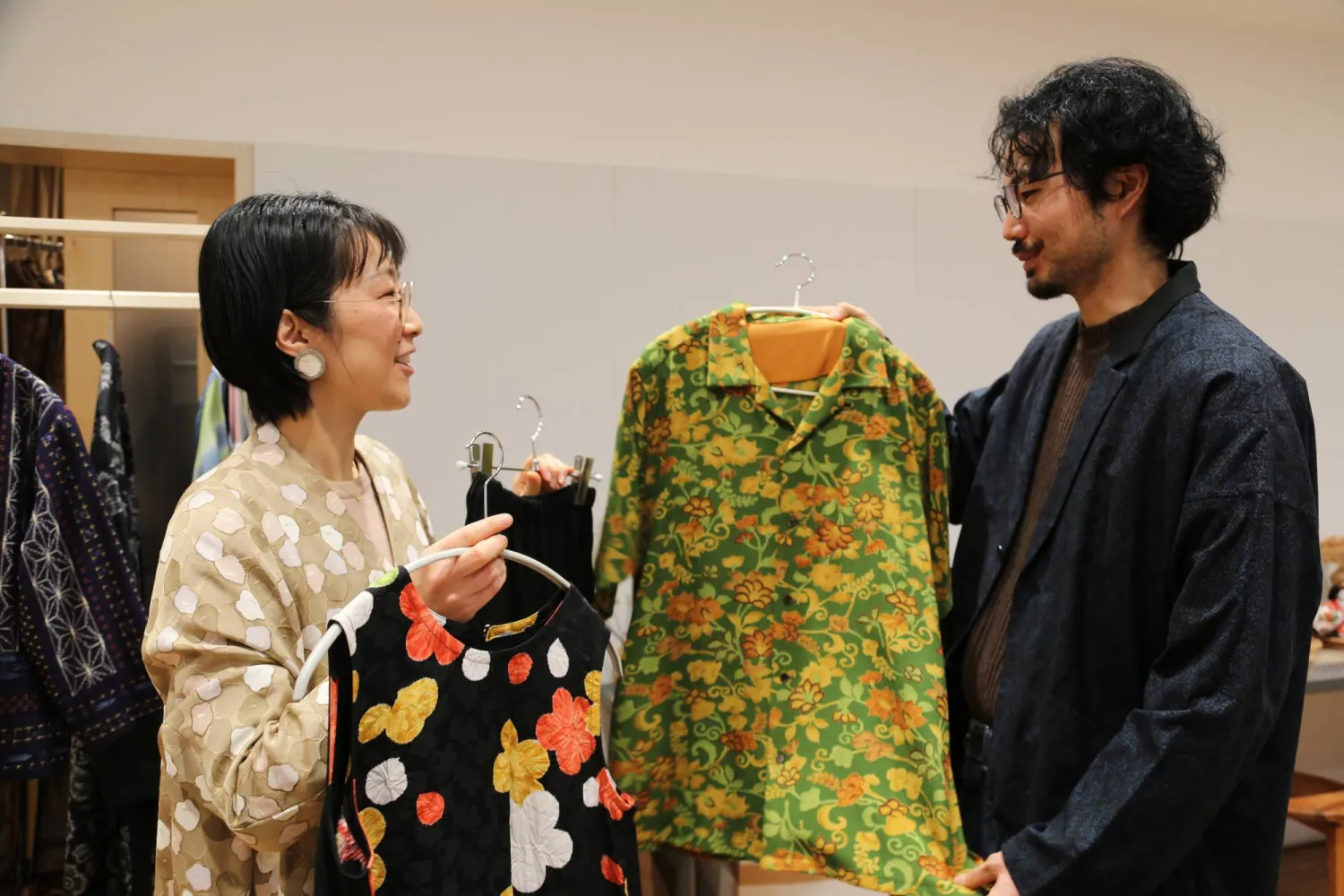
Designer Tomoko Ohkata, left, and her assistant Koki Unami hold Ohkata's designs made from old kimono, in Tokyo, on Jan. 15, 2026. (AP Photo/Yuri Kageyama)
TT

Japan's Traditional Kimonos Are Being Repurposed in Creative Ways

Designer Tomoko Ohkata, left, and her assistant Koki Unami hold Ohkata's designs made from old kimono, in Tokyo, on Jan. 15, 2026. (AP Photo/Yuri Kageyama)

The kimono, that elaborate, delicate wrap-around garment worn by geisha and samurai from centuries back, is getting a vibrant remake, appreciated these days for a virtue that’s more relevant than ever: sustainability.

A genuine silk kimono, which literally means “worn thing,” lasts a hundred years or more. In a Japanese family, it’s handed down over generations like heirloom jewelry, artworks and military medals.

It never goes out of style.

The design of the kimono and accompanying “obi” sash has remained basically the same since the 17th century Edo period depicted in Akira Kurosawa samurai movies.

But today, some people are taking a different creative approach, refashioning the traditional kimono, and also taking apart and resewing them as jackets, dresses and pants.

“I noticed that a lot of beautiful kimono is just sleeping in people’s closets. That’s such a waste,” said Mari Kubo, who heads a kimono-remake business called K’Forward, pronounced “K dash forward.”

Hers is among a recent surge in such services, which also turn old kimono into tote bags and dolls.

The most popular among Kubo’s products are “tomesode,” a type of formal kimono that is black with colorful, embroidered flowers, birds or foliage at the bottom, The Associated Press reported.

She also creates matching sets, or what she calls “set-ups.” A tomesode is turned into a jacket with its long, flowing sleeves intact, and its intricate patterns placed at the center in the back. She then takes a kimono with a matching pattern to create a skirt or pants to go with the top. Sometimes, an obi is used at the collar to add a pop of color.

Kubo said many of her customers are young people who want to enjoy a kimono without the fuss.

A remade kimono at K’Forward can cost as much as 160,000 yen ($1,000) for a “furisode,” a colorful kimono with long sleeves meant for young unmarried women, while a black tomesode goes for about 25,000 yen ($160).

What Tomoko Ohkata loves most about the products she designs using old kimonos is that she doesn’t have to live with a guilty conscience, and instead feels she is helping solve an ecological problem.

“I feel the answer was right there, being handed down from our ancestors,” she said.

Recycling venues in Japan get thousands of old kimonos a day as people find them stashed away in closets by parents and grandparents. These days, Japanese generally wear kimonos just for special occasions like weddings. Many women prefer to wear a Western-style white wedding dress rather than the kimono, or they wear both.

Many of Ohkata’s clientele are people who have found a kimono at home and want to give it new life. They care about the story behind the kimono, she added.

Her small store in downtown Tokyo displays various dolls, including a figure of an emperor paired with his wife, who are traditionally brought out for display in Japanese homes for the Girls’ Day festival every March 3. Her dolls, however, are exquisitely dressed in recycled kimonos, tailored in tiny sizes to fit the dolls. They sell for 245,000 yen ($1,600) a pair.

The original old-style kimono is also getting rediscovered.

“Unlike the dress, you can arrange it,” says Nao Shimizu, who heads a school in Japan’s ancient capital of Kyoto that teaches people how to wear a kimono and how to carry oneself while wearing it.

“In half a year, you can learn how to do it all by yourself,” she said, briskly demonstrating several ways to tie the obi to express different moods, from playful to understated.

Besides its durability, said Shimizu, that versatility also makes the kimono sustainable.

Younger Japanese are taking a more relaxed view, wearing a kimono with boots, for instance, she laughed. Traditionally, kimono is worn with sandals called “zori.”

Although it requires some skill to put on a kimono in the traditional way, one can take lessons from teachers like Shimizu, like learning a musical instrument. Professional help is also available at beauty parlors, hotels and some shops.

Most Japanese might wear a kimono just a few times in their lives. But wearing one is a memorable experience.

Sumie Kaneko, a singer who plays the traditional Japanese instruments koto and shamisen, often performs wearing flashy dresses made of recycled kimonos. The idea of sustainability is deeply rooted in Japanese culture, she says, noting that the ivory and animal hide used in her musical instruments are now hard to obtain.

She calls it “the recycling of life.”

“The performer breathes new life into them,” says the New York-based Kaneko.
“In the same way, a past moment — and those patterns and colors that were once loved — can come back to life.”

Zalando Posts Higher Quarterly Growth on AI-driven Efficiency Gains

05 May 2026, Hamburg: Co-CEO of Zalando David Schroeder speaks during the OMR digital trade show at the Hamburg Messe exhibition halls. Photo: Daniel Bockwoldt/dpa
TT

Zalando Posts Higher Quarterly Growth on AI-driven Efficiency Gains

05 May 2026, Hamburg: Co-CEO of Zalando David Schroeder speaks during the OMR digital trade show at the Hamburg Messe exhibition halls. Photo: Daniel Bockwoldt/dpa

European online fashion retailer Zalando on Wednesday reported stronger quarterly growth, citing investments in artificial intelligence that were improving its efficiency.

Gross merchandise volume (GMV), a key revenue metric measuring the value of all goods sold, rose 21.7% to 4.3 billion euros ($5.03 billion) in the first quarter, compared to 3.5 billion euros a year earlier, Reuters quoted the company as saying.

Zalando highlighted the impact of its "Zalando Assistant", a chat-based AI tool that acts like a fashion stylist, providing beauty advice ⁠and allowing customers ⁠to receive personalized product suggestions through conversations.

The company added that AI-generated images were also helping it bring new partner items online faster and improve quality, allowing it to publish about 85% more content.

"Our strong first quarter demonstrates the strength of our strategy. We are very ⁠satisfied with the progress we’re making in strategically scaling AI innovations and integrating ABOUT YOU,” Co-CEO Robert Gentz said in a statement.

Zalando is investing heavily in refining its offer to customers and strengthening its European logistics network, which it has also opened up to partners, as it seeks to drive growth amid faltering consumer spend and competition from fast-fashion retailers with cheaper offerings such as Shein.

It concluded its acquisition of About You last year, in ⁠a deal ⁠valuing its smaller rival at 1.13 billion euros.

Shares in Zalando were flat by mid-morning, after initially rising as much as 4.6% in early trading.

The company confirmed its full-year guidance for 2026.

"Given the relatively high short interest, we would expect the stock to move higher, although the lack of implied upgrades and ongoing concerns on the mid-term outlook from the development of agentic commerce, mean that any material move up is unlikely to be sustained in our view," analysts at J.P. Morgan said.


Stars Shine at Met Gala, Fashion’s Biggest Night

US musician Beyonce arrives for the 2026 Met Gala celebrating "Costume Art" at the Metropolitan Museum of Art, in New York, on May 4, 2026. (AFP)
TT

Stars Shine at Met Gala, Fashion’s Biggest Night

US musician Beyonce arrives for the 2026 Met Gala celebrating "Costume Art" at the Metropolitan Museum of Art, in New York, on May 4, 2026. (AFP)

The brightest stars in Hollywood, music, sports and style -- led by Beyonce, Madonna and Nicole Kidman -- hit the red carpet Monday for the Met Gala, the Manhattan charity ball that doubles as fashion's biggest night.

The A-listers were asked to dress for the theme "Fashion is Art," which dovetails with the exhibit "Costume Art" at the Metropolitan Museum of Art's Costume Institute.

And while not everyone followed the guidelines to the letter, the gala -- traditionally held on the first Monday in May -- certainly delivered as one of the world's top red carpets, with blinding star power.

Beyonce, one of the event's co-chairs who was making her first appearance in a decade, was one of the last to arrive, but she did not disappoint, stunning the crowd in a bejeweled skeleton gown topped with a dramatic feather coat and a headpiece.

Her rap mogul husband Jay-Z -- in a tuxedo with tails -- and daughter Blue Ivy Carter, in a white strapless gown and sparkling heels -- joined her.

Earlier, the singer's fellow co-chairs, tennis legend Venus Williams and Oscar-winning actress Nicole Kidman, kicked off the proceedings.

Kidman stunned in a shimmering red long-sleeved Chanel column dress with wide feather cuffs, while Williams glistened in a black crystal Swarovski gown with an elaborate neck plate.

From there, the stars kept on coming. Rock royalty Madonna, Cher and Stevie Nicks joined music's new generation of stars in Sabrina Carpenter, Doja Cat and Tyla.

Rihanna and A$AP Rocky were hours late, as per usual, making a grand entrance.

Bad Bunny, who is having a blockbuster 2026 with major Grammy wins and the Super Bowl halftime show under his belt, wore prosthetics and a white wig to explore how he would look as an old man, according to Vogue.

Rapper Doja Cat, one of several members of a gala "host committee," wore a draped latex Saint Laurent gown with a demure neckline -- but slit up to her waist.

Donatella Versace, Tom Ford, Stella McCartney, Anthony Vaccarello and Haider Ackermann were among the many fashion designers on hand for the evening.

Olympic gold medalists Alysa Liu and Eileen Gu -- whose dress had a built-in bubble maker -- led a strong contingent of athletes to the red carpet, along with NFL superstar Russell Wilson and several men's and women's basketball stars.

And actress Blake Lively made a surprise appearance at the gala, just hours after she settled a major court case over her film "It Ends with Us" with her co-star and director Justin Baldoni.

Of course, the entire evening is overseen by Vogue's global editorial director Anna Wintour -- the ultimate tastemaker in US fashion who has helmed the event for 30 years.

The gala is a fundraiser for the Met's Costume Institute, and this year has raised a record $42 million (after $31 million in 2025), the museum's CEO Max Hollein told reporters early Monday.

This year's exhibit juxtaposes elegant fashion looks with paintings and sculpture: think a Saint Laurent design next to Van Gogh's "Irises", or a John Galliano gown for Maison Margiela paired with an antique statue.

"When I think about the show, if there's one word to describe it, I suppose it would be equitability or equivalency, equivalency between artworks," the Costume Institute's curator Andrew Bolton told AFP.

"So there's no hierarchy between sculpture, painting, fashion, photography and no hierarchy between bodies, between the classical body or the disabled body."

The Met Gala was first organized in 1948 and for decades was reserved for New York high society -- until Wintour transformed the party into a high-profile catwalk for the rich and famous in the 1990s.

The "Costume Art" exhibit, which opens on May 10 at the venerable museum in Manhattan, will seek to explore the "dressed body" in artworks across the centuries.


Hugo Boss Tops Quarterly Profit Estimates Despite Geopolitical Uncertainty

An employee displays suits at the Hugo Boss section of the Central Universal Department Store (TsUM), in Kyiv, Ukraine January 25, 2021. (Reuters)
TT

Hugo Boss Tops Quarterly Profit Estimates Despite Geopolitical Uncertainty

An employee displays suits at the Hugo Boss section of the Central Universal Department Store (TsUM), in Kyiv, Ukraine January 25, 2021. (Reuters)

German fashion group Hugo Boss reported quarterly operating profit above expectations on Tuesday, despite a challenging market environment.

The company posted first-quarter earnings before interest and taxes (EBIT) of 35 million euros, down from 61 million euros a year earlier, but above analyst's forecast of 30 million euros in a company-provided poll.

The German firm reported ‌revenue of ‌905 million euros for the period, exceeding ‌analysts' ⁠forecast of 887 ⁠million euros.

"Following our successful finish to 2025, we entered the year with a clear roadmap. However, the market environment has become more challenging over the course of the first quarter, caused by recent developments in the Middle East," CEO Daniel Grieder ⁠said in a statement.

The war in ‌the Middle East has ‌roiled global markets, driving oil prices higher and re-igniting concerns ‌over global inflation and growth, with the vital ‌Strait of Hormuz remaining closed.

The company said the conflict in the region led to a notable decline in store traffic in the region from March onwards, while global ‌consumer sentiment stayed muted throughout the quarter, having a negative impact of around 1% ⁠on ⁠group sales in the first quarter.

However, Grieder said the firm had made progress streamlining product assortments and refining its global distribution footprint despite the geopolitical uncertainty.

"Against an increasingly challenging external backdrop, we remain firmly focused on executing our strategy, actively managing the business with flexibility and discipline," he added.

Hugo Boss has sought to boost the popularity of its brand through selected marketing investments, while increasing profits by limiting costs, despite weakening consumer demand.

The company confirmed its full-year guidance for 2026.