


Despite Drop in 2025, Russian Oil Exports Exceed Pre-war Volumes

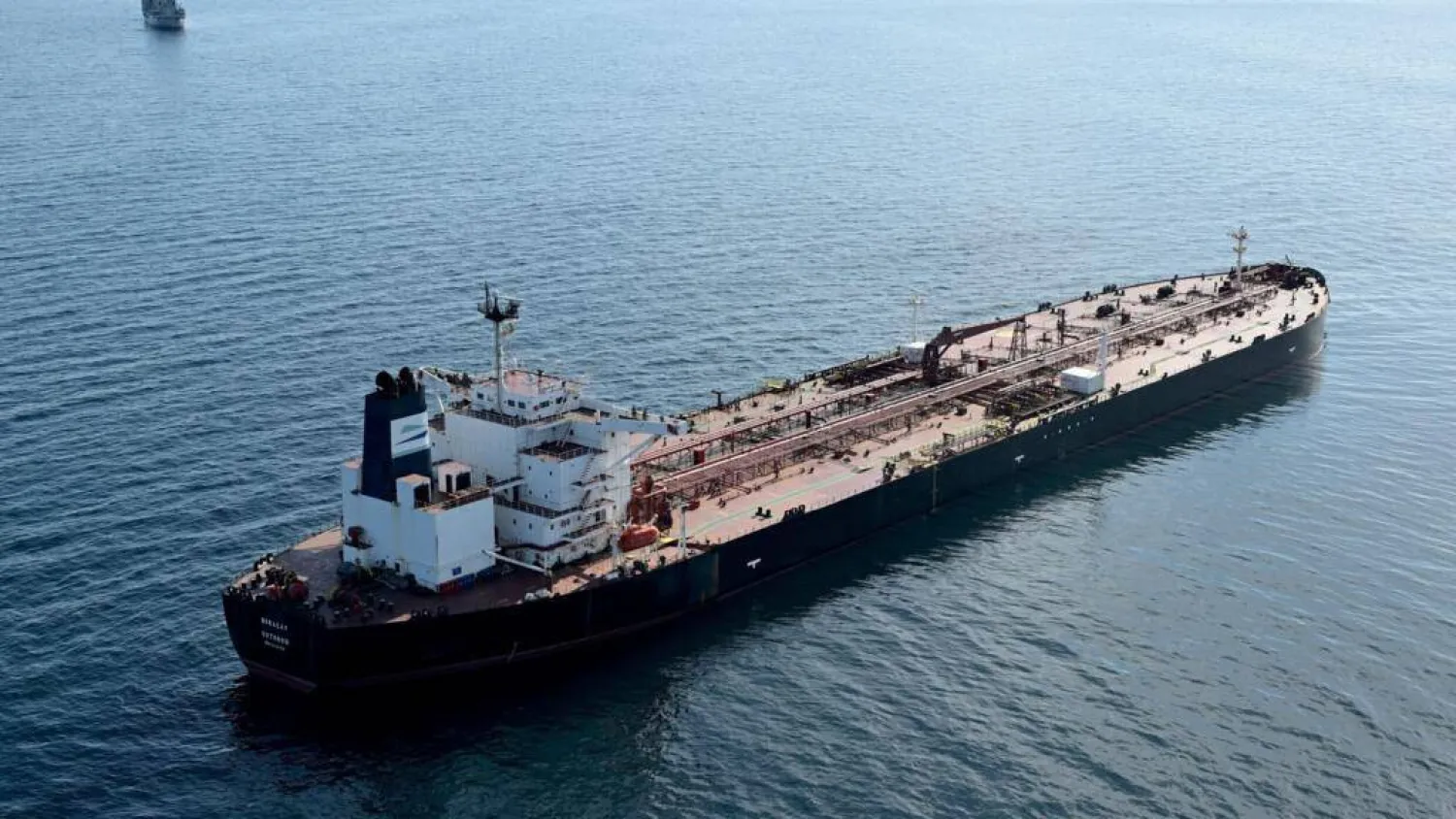
Russia relies on a shadow fleet of tankers to get past Western restrictions on its oil exports. Damien MEYER / AFP/File
TT

Despite Drop in 2025, Russian Oil Exports Exceed Pre-war Volumes

Russia relies on a shadow fleet of tankers to get past Western restrictions on its oil exports. Damien MEYER / AFP/File

While Russian oil exports dropped last year, Russia is still exporting higher volumes than before its invasion of Ukraine in 2022, researchers said Tuesday, calling for stricter sanctions enforcement.

The volume of Russian crude oil exports remained six percent above pre-invasion levels in the fourth year of the war, despite Western sanctions aimed at curbing Russia's "shadow fleet," according to a report by Finnish think tank Center for Research on Energy and Clean Air (CREA).

Russia's shadow fleet consists of ageing tankers, with often opaque ownership, used to circumvent sanctions imposed by the European Union, the United States and the G7 group of nations.

However, oil revenues, which are fueling Moscow's war chest, have dropped below pre-invasion levels, as Russia has been forced to adopt price discounts, the report said.

"We've seen a significant drop in Russian fossil fuel export earnings as a result of new measures and greater enforcement," Isaac Levi, a CREA analyst and co-author of the report, told AFP.

But he added that "there are still significant loopholes and areas that have been unaddressed by sanctioning countries", allowing volumes to remain high.

Loopholes include the false flagging of ships but also the issue of re-exportation of refined fuels made from Russian crude oil to sanctioning countries.

"We propose a ban of imports from any refinery or storage terminal that has received a shipment of Russian oil in the previous six months," Levi said.

- Crude to China, India, Türkiye-

Russian revenues from crude oil exports -- one of Russia's main exports -- decreased by 18 percent to 85.5 billion euros in the 12 months leading up to February 24, compared to the year before, according to the report.

Meanwhile volumes fell by six percent to 215 million tons, for the same period, according to the report.

Ninety-three percent of Russian crude was exported to China, India and Türkiye.

The report urged the EU and UK to "detain Russian shadow fleet vessels that pose huge environmental and security threats to European and UK coastlines".

The European Union lists 598 vessels suspected of being part of the "shadow fleet" that are banned from European ports and maritime services.

It also called for an end to Hungary's and Slovakia's continued imports of Russian crude oil.

The two countries, which were exempted from EU sanctions on Russian oil imports, imported 11 percent more Russian crude oil in the first 10 months of 2025 compared to the same period a year earlier, the report stated.



Saudi Arabia Unifies Competitiveness, Business Under Agile Governance

A beneficiary looks at a brochure for the Saudi Business Center (Asharq Al-Awsat)
TT

Saudi Arabia Unifies Competitiveness, Business Under Agile Governance

A beneficiary looks at a brochure for the Saudi Business Center (Asharq Al-Awsat)

Saudi Arabia is moving ahead with restructuring its institutional framework to keep pace with the speed of economic transformation after the Cabinet decided to merge the National Competitiveness Center and the Saudi Business Center under the umbrella of the Saudi Center for Competitiveness and Business.

The move reshapes the business environment, accelerates reforms and strengthens governance to support a more attractive economy.

Commerce Minister Dr. Majid Al-Qasabi said following the Cabinet decision that the merger represents a pivotal regulatory step reflecting a strategic direction toward enhancing institutional integration, improving the efficiency of monitoring business environment challenges and speeding up reforms to facilitate doing business.

The step supports private sector empowerment and contributes to boosting the Kingdom’s competitiveness.

According to several specialists, the decision is not merely a cosmetic change, but a unification of direction and intensification of efforts toward a single goal: a more efficient, faster and globally competitive investment environment.

They said the merger reshapes the business landscape and accelerates reforms in the Kingdom.

Unifying the track

The move comes as the Kingdom continues restructuring its institutions to match the pace of transformation, most recently by merging the two centers to serve entrepreneurs and foreign investors alike in terms of efficiency, speed and competitiveness.

Specialists told Asharq Al-Awsat that the step is distinctly strategic and reflects the Kingdom’s adoption of “agile governance.”

They said merging the National Competitiveness Center with the Saudi Business Center is not just a change of name, but a unification of direction and consolidation of efforts to serve one objective: a global investment environment.

Institutional integration

Shura Council member Fadl bin Saad Al-Buainain told Asharq Al-Awsat that there is a close link between competitiveness and business, noting that competitiveness outcomes ultimately serve economic activities through support, incentives, facilitation and addressing challenges.

Al-Buainain said the decision to merge the National Competitiveness Center and the Saudi Business Center under the name Saudi Center for Competitiveness and Business aims to enhance institutional integration by reorganizing and combining two independent entities.

He added that the step will improve the quality and alignment of outputs, help achieve competitiveness targets and support the business sector simultaneously.

It will also enhance work efficiency, enable direct identification of challenges without the need to refer them to another entity, and accelerate completion, which in itself is a strategic objective that strengthens institutional efficiency, boosts the Kingdom’s competitiveness and supports the business sector.

Corrective decisions

Al-Buainain described the merger as a healthy regulatory process that contributes to reducing costs, focusing efforts and ensuring high-quality outputs aligned with strategic targets.

He stressed that the move followed a considerable period of independent operation and performance measurement before the merger decision was taken based on administrative and executive considerations.

He added that continuous review is a key feature of government work, enabling corrective strategic decisions that achieve overall benefit.

The step could mark the beginning of merging other interrelated government entities across sectors and services, contributing to more dynamic operations, faster completion, higher-quality outputs and better handling of challenges.

Shared factors

Osama bin Ghanem Al-Obaidi, adviser and professor of international commercial law, told Asharq Al-Awsat that the decision comes at an ideal time to achieve the goals of Vision 2030 by unifying efforts, simplifying procedures and creating a more efficient and globally competitive business environment.

Al-Obaidi said several shared factors made the merger a logical step, most notably improving the business environment, supporting the private sector, working with government entities to develop regulations, linking with competitiveness indicators, supporting economic transformation and implementing reforms, as well as relying on studies and economic analysis.

He added that the core common factor was that both entities were working along nearly the same axis of raising the competitiveness of the Saudi economy and facilitating doing business, albeit from complementary angles, which explains their consolidation into a single entity.


IMF Says Syria Ended 2025 with a Small Budget Surplus

The International Monetary Fund logo is seen outside the headquarters building in Washington, US September 4, 2018. REUTERS/Yuri Gripas/File Photo
TT

IMF Says Syria Ended 2025 with a Small Budget Surplus

The International Monetary Fund logo is seen outside the headquarters building in Washington, US September 4, 2018. REUTERS/Yuri Gripas/File Photo

The International Monetary Fund said on Wednesday that the Syrian government ended 2025 with a small budget surplus and that its revenue projections were ambitious but feasible, as the agency's staff concluded a visit to Damascus.


"Syria’s economy continues to show signs of recovery, with activity increasing at an accelerating pace as consumer and investor sentiment continues to improve," the IMF said in its statement.


Oil Hovers Near Seven-month Highs Ahead of US-Iran Talks

FILE PHOTO: Chevron-chartered Ionic Anax oil tanker sits anchored in Lake Maracaibo, near the Bajo Grande crude port operated by state oil company PDVSA, in Maracaibo, Venezuela, February 9, 2026. REUTERS/Marco Bello/File Photo
TT

Oil Hovers Near Seven-month Highs Ahead of US-Iran Talks

FILE PHOTO: Chevron-chartered Ionic Anax oil tanker sits anchored in Lake Maracaibo, near the Bajo Grande crude port operated by state oil company PDVSA, in Maracaibo, Venezuela, February 9, 2026. REUTERS/Marco Bello/File Photo

Oil prices edged higher on Wednesday, as investors weighed the threat of military conflict between the US and Iran that could disrupt supply and a big build in US crude inventories.

Brent futures were up 6 cents at $70.83 per barrel at 0957 GMT. WTI futures rose 4 cents to $65.67 per barrel.

Brent prices reached their highest since July 31 on Friday, while WTI hit its highest since August 4 on Monday, as the US positioned military ‌forces in ‌the Middle East to try to compel Iran to ‌negotiate ⁠an end to ⁠its nuclear and ballistic missile program.

An extended conflict could disrupt supplies from Iran, the third-biggest crude producer in the Organization of the Petroleum Exporting Countries, and other countries in the key Middle East producing region.

Supporting oil prices, US President Donald Trump briefly laid out his case for a possible attack on Iran in his State of the Union speech on Tuesday, saying he would ⁠not allow a country he described as the world's biggest ‌sponsor of terrorism to have a nuclear ‌weapon.

"This uncertainty means the market will continue to price in a large risk premium ‌and remain sensitive to any fresh developments," ING commodities strategists said on ‌Wednesday.

US envoys Steve Witkoff and Jared Kushner are due to meet an Iranian delegation for a third round of talks on Thursday in Geneva.

Iran's Foreign Minister Abbas Araqchi said on Tuesday that a deal with the US was "within reach, but ‌only if diplomacy is given priority.”

"Trump has warned that without a deal, there will be 'very bad consequences'. Whether (Iran's) concessions ⁠will meet ⁠the US's 'zero enrichment' red line remains to be seen," Tony Sycamore, IG market analyst, said in a note.

Amid the heightened tensions, Iran has accelerated talks to purchase Chinese anti-ship cruise missiles, according to Reuters sources, which could target the US naval forces that have assembled near the Iranian coast.

While geopolitical tensions have supported prices, the market is also contending with concerns of large inventory gains as global supply exceeds demand.

According to market sources, the American Petroleum Institute late on Tuesday reported a massive increase in US oil stockpiles of 11.43 million barrels in the week ended February 20.