


IMF Approves $8.1 Billion Loan for Ukraine, with $1.5 Billion to Go Immediately

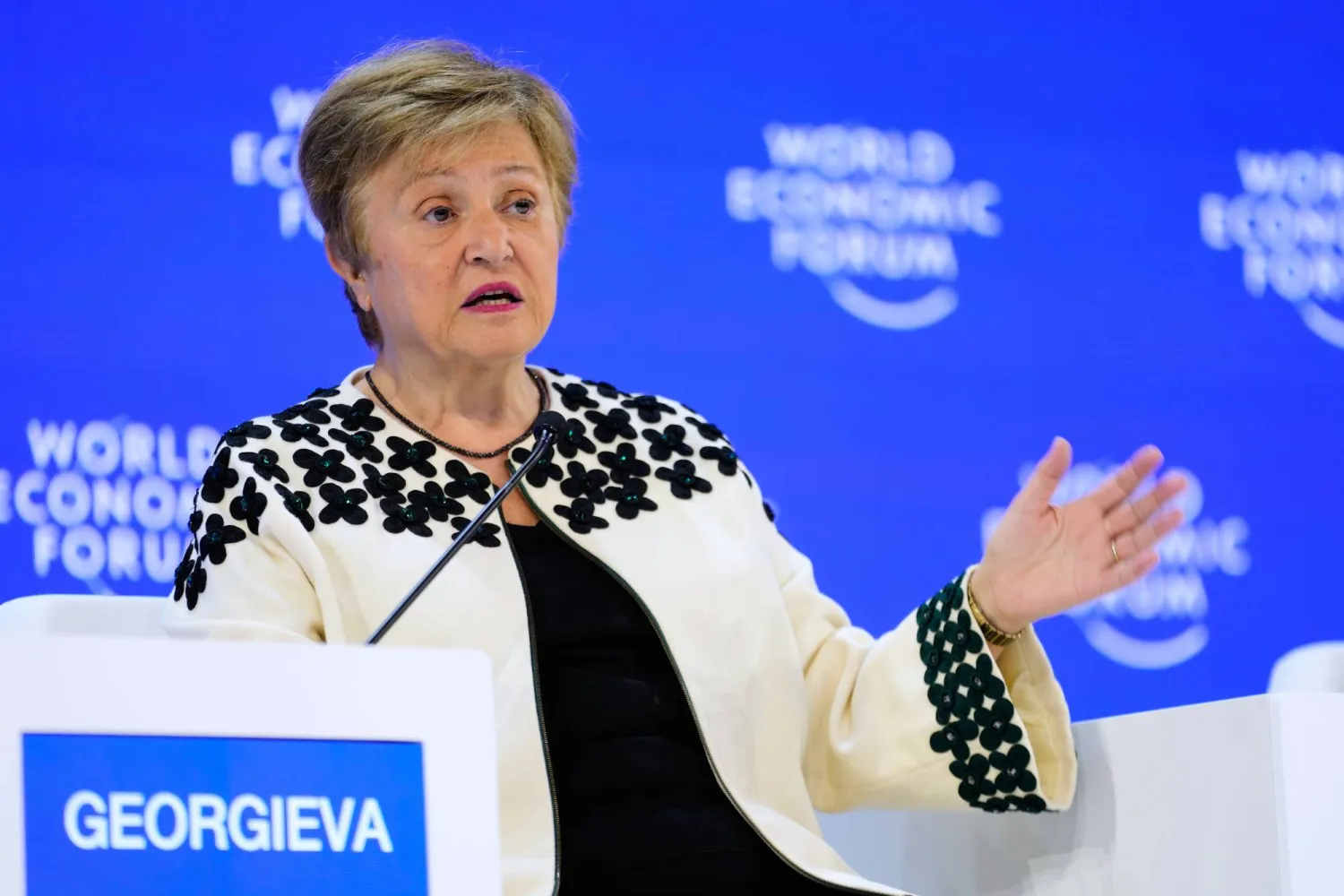
FILE - Kristalina Georgieva, Managing Director of the International Monetary Fund, attends the Annual Meeting of the World Economic Forum in Davos, Switzerland, Jan. 23, 2026. (AP Photo/Markus Schreiber, File)
TT

IMF Approves $8.1 Billion Loan for Ukraine, with $1.5 Billion to Go Immediately

FILE - Kristalina Georgieva, Managing Director of the International Monetary Fund, attends the Annual Meeting of the World Economic Forum in Davos, Switzerland, Jan. 23, 2026. (AP Photo/Markus Schreiber, File)

The International Monetary Fund's executive board on Thursday approved an $8.1 billion, four-year loan for Ukraine, with $1.5 billion to be disbursed immediately to help keep the government running as its war against Russia's invasion drags into a fifth year.

The IMF said the new Extended Fund Facility arrangement for Ukraine would help anchor a $136.5 billion international support package for the war-torn country, which this week marked the fourth anniversary of Russia's full-scale invasion.

The new loan, which replaces a $15.5 billion program that was approved in 2023, will help Kyiv to maintain economic stability and keep public spending flowing, Reuters quoted the IMF as saying.

Ukrainian Prime Minister Yulia Svyrydenko hailed the IMF loan as part of a broader financial framework that would cover an estimated budget shortfall of $136.5 billion over four years, including a 90-billion-euro loan from the European Union.

"It is very important for us that in the fifth year of the full-scale war, against the backdrop of systematic attacks on the energy sector, Ukraine ‌has guaranteed international financial ‌support from partners and the resources for the stable functioning of the state," she ‌wrote ⁠on Telegram.

The World ⁠Bank, European Union, United Nations and the Ukrainian government this week issued a new report that put the cost of rebuilding Ukraine at $588 billion over the next decade.

According to Reuters, IMF Managing Director Kristalina Georgieva said the IMF loan would resolve Ukraine’s balance of payments problem and restore medium-term external viability, while boosting prospects for reconstruction and growth after the war ended and help to facilitate Ukraine's steps to join the European Union.

“Ukraine and its people have weathered a long and devastating war for over four years with remarkable resilience," she said in a statement, lauding work by Ukrainian authorities to maintain overall macroeconomic and financial stability, boost domestic revenues and advance some critical reforms.

She ⁠said officials were committed to "tackling longstanding bottlenecks to growth," including through continued efforts to combat ‌corruption, address tax avoidance and evasion, reform energy markets, and strengthen financial market ‌infrastructure.

The program would be "promptly recalibrated" in the case of successful peace negotiations, she said in a statement.

Georgieva, who ‌paid a surprise visit to Ukraine last month, said the war had taken a toll on economic and social ‌conditions, despite efforts by authorities to stabilize the economy, contain inflation and restructure private sector debt. The new loan aimed to deepen structural reforms, she said.

That meant growth was slowing and the economic outlook remained "subject to exceptionally high uncertainty," she said.

The IMF now projects that Ukraine's economy will grow by 1.8% to 2.5% in 2026, after growth of an estimated 1.8% to 2.2% in 2025. Inflation was expected to be ‌around 6.1% this year, half the 12.7% rate recorded in 2025, the IMF said.

Ukraine's estimated financing gap of $52 billion in 2026 would be filled through disbursements under the newly ⁠approved IMF program, European Union arrangements, ⁠funds from the Group of Seven advanced economies and bilateral support, the IMF said.

Georgieva said a large number of IMF members, including the US, Germany, Canada, Britain and Japan, had reaffirmed their recognition of the IMF's preferred creditor status in respect to the money it owed the Fund, and agreed to "adequate financial support" to ensure Ukraine could repay its debts to the IMF.

Other countries backing Ukraine were Austria, Belgium, Denmark, Estonia, Finland, France, Greece, Iceland, Ireland, Italy, Lithuania, Luxembourg, the Netherlands, Norway, Poland, Portugal, Spain and Sweden, she said.

The Group of Creditors of Ukraine, which holds the majority of Ukraine’s official bilateral debt, also agreed to extend the current debt standstill and complete a definitive debt treatment after the resolution of the current state of "exceptionally high uncertainty," the IMF said in its statement.

Georgieva said the risks to the loan were exceptionally high and the program's success would depend on continued international support, as well as the authorities' "steadfast determination" to implement ambitious structural reforms.

A staff report noted that progress on reforms had been mixed under the previous program, with Kyiv completing some important milestones, but missing two end-December benchmarks related to public investment management and valuation standards.

Ukraine's progress on the program will be reviewed quarterly, with nine reviews planned over the next four years.



Barclays Says Brent Crude Oil Could Reach $100 a Barrel

FILE PHOTO: A map showing the Strait of Hormuz and Iran is seen behind a 3D printed oil pipeline in this illustration taken June 22, 2025. REUTERS/Dado Ruvic/Illustration/File Photo
TT

Barclays Says Brent Crude Oil Could Reach $100 a Barrel

FILE PHOTO: A map showing the Strait of Hormuz and Iran is seen behind a 3D printed oil pipeline in this illustration taken June 22, 2025. REUTERS/Dado Ruvic/Illustration/File Photo

Barclays boosted its Brent crude oil futures price forecast to around $100 per barrel on Saturday, up from $80 on Friday, after the United States and Israel bombed several sites in Iran.

"Oil markets might have to face their worst fears on Monday. As things stand right now, we think Brent could hit $100 (per barrel), as the market grapples with the threat of a ⁠potential supply disruption amid ⁠a spiraling security situation in the Middle East," the bank said in a report.

The United States and Israel attacked Iran on Saturday, targeting its top leaders and calling for the overthrow ⁠of its government, while Iran responded with missiles fired at Israel and neighboring Gulf countries.

Oil prices rose about 2% on Friday, with traders bracing for supply disruptions as nuclear talks between the US and Iran had yet to reach an agreement.

Brent settled at $72.48 a barrel.

About a fifth of the oil consumed globally passes through the Strait of ⁠Hormuz between ⁠Oman and Iran, making any disruptions in the area a major risk to global oil supplies.


Oil Prices Set for Swings Next Week as US-Israel Strikes Raise Supply Uncertainty

Markets are anticipating movements in oil prices after the American-Israeli attack on Iran (Reuters)
TT

Oil Prices Set for Swings Next Week as US-Israel Strikes Raise Supply Uncertainty

Markets are anticipating movements in oil prices after the American-Israeli attack on Iran (Reuters)

Oil markets currently closed for the weekend are set to see price swings next week as the impact from the US and Israeli strikes on oil supplies from the Middle East remains unclear.

Scenarios before the latest conflict with Iran foresaw a quick price spike that fades if the attacks didn't affect oil shipping and infrastructure such as Iranian pipelines and its Kharg island terminal. However, there would be a bigger price spike and longer-lasting impact if oil infrastructure or supplies were interrupted, for instance because of disruption of tanker traffic through the Strait of Hormuz.

Oil prices have already risen on war fears. International benchmark Brent crude closed at a seven-month high of $72.87 on Friday, Reuters reported.

Iran exports some 1.6 million barrels of oil a day, most of it going to China, where privately owned refineries are less concerned about the US sanctions that prevent Iran from selling its oil elsewhere. If that supply is disrupted, Chinese customers would look elsewhere for oil on the global market, potentially driving up prices.

Another question is around the Strait of Hormuz, through which 20% of global oil supply pass through each day. Middle East exporters Saudi Arabia, Iraq and the United Arab Emirates send most of their exports through the strait. However analysts say Iran has no incentive to try to close the strait because it would cut off its own exports and hurt its only big customer, China.

Limited strikes on Iran’s nuclear program and the Revolutionary Guard that avoid regime change or all-out war could see prices jump $5-$10 based on fear alone, according to Rystad Energy in a prewar scenario.

A wider war involving Iranian disruption of tanker traffic could see crude push past $90 per barrel and US gas prices “well above” $3 per gallon, according to another prewar scenario from Clayton Seigle at the Center for Strategic & International Studies. US gas prices averaged $2.98 per gallon last week according to US motoring club AAA.


Israel Shuts Down Gas Fields After US-Israel Strikes on Iran

The gas platform for Leviathan, Israel's largest gas field is seen from a helicopter near Haifa bay, northern Israel, August 1, 2023. REUTERS/Ari Rabinovitch
TT

Israel Shuts Down Gas Fields After US-Israel Strikes on Iran

The gas platform for Leviathan, Israel's largest gas field is seen from a helicopter near Haifa bay, northern Israel, August 1, 2023. REUTERS/Ari Rabinovitch

The Israeli Energy Ministry has ordered the temporary shutdown of parts of the country's natural gas reservoirs after Israel and the United States launched strikes on Iran on Saturday.

The Leviathan gas field offshore Israel, operated by Chevron has been shut down, three sources told Reuters. Energean’s production vessel that serves several Israeli fields has also been shut down, the company said in a statement.

Israel’s ministry said the decision was based on “the current situation and in accordance with security assessments”, Reuters reported.

It said country’s energy needs would be met through alternative sources and that the electricity sector was prepared to operate power stations using alternative fuels if necessary.