

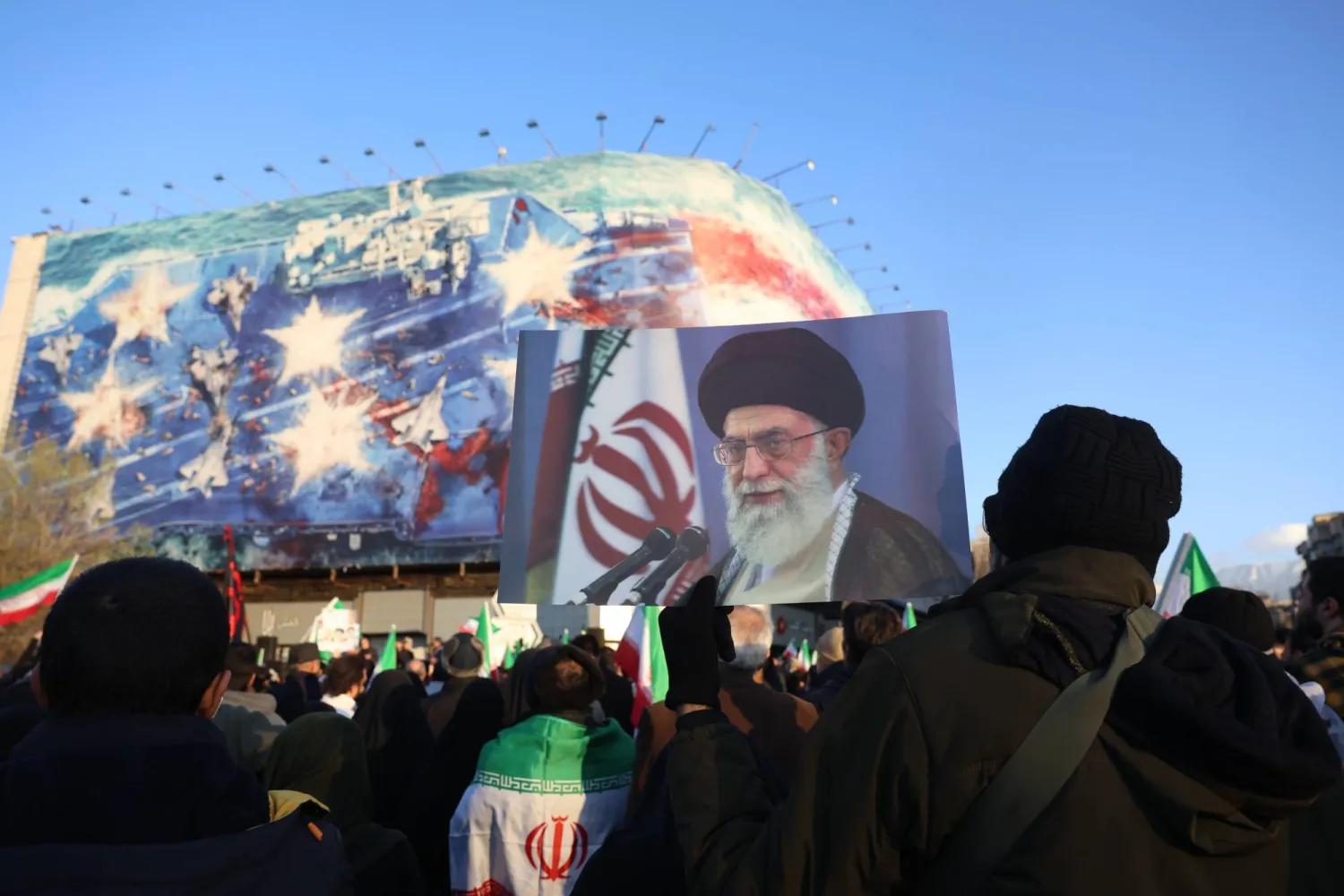

More Strikes Aimed at Iran After US, Israeli Assault Kills Khamenei

Mourners react following the death of Iranian Supreme Leader Ali Khamenei, at Enqelab Square in Tehran, Iran, 01 March 2026. (EPA)
TT

More Strikes Aimed at Iran After US, Israeli Assault Kills Khamenei

Mourners react following the death of Iranian Supreme Leader Ali Khamenei, at Enqelab Square in Tehran, Iran, 01 March 2026. (EPA)

Israel said it launched another wave of strikes on Iran on Sunday, as Iranians grappled with uncertainty after the killing of their supreme leader in US and Israeli attacks that threaten to destabilize the wider Middle East.

Hours after both nations said an air strike killed Ali Khamenei in the most ambitious series of attacks on Iran in decades, the country's state media confirmed the 86-year-old leader's death on Saturday.

US President Donald Trump said the air strikes aimed to end a decades-long threat from Iran and ensure it could not develop a nuclear weapon, as he sought to justify a risky gambit that seemed to contradict his professed opposition to American involvement in complex overseas conflicts.

"This is not only Justice for the people of Iran, but for all Great Americans, and those people from many Countries throughout the World, that have been killed or mutilated by Khamenei and his gang of bloodthirsty THUGS," Trump wrote on Truth Social after Khamenei's body was found.

Experts said that while the deaths of Khamenei and other Iranian leaders would deal the country a major blow, it would not necessarily spell the end of Iran's entrenched clerical rule or the Revolutionary Guards' sway over the population.

Israel's military said it targeted Iran’s ballistic missile and ‌air defense systems with ‌strikes on Sunday morning.

Iran's armed forces would soon retaliate again with their biggest offensive against US bases and ‌Israel, ⁠Revolutionary Guard Corps ⁠vowed in a statement on Sunday.

Shortly after 6 a.m., air raid sirens repeatedly sounded across Israel, warning residents of an incoming attack. In Tel Aviv, a series of explosions were heard as Israel’s sophisticated air defense system sought to intercept the latest Iranian offensive. There was no immediate report of any damage or injuries.

Witnesses in the Gulf cities of Dubai and Doha heard several loud blasts.

Iran had responded to Saturday's initial attacks by launching hundreds of missiles and drones targeting US troops and cities in Israel and Arab countries, prompting widespread cancellations of Middle East flights.

The Pentagon said there were no US deaths or injuries, but the strikes raised concerns of new risks for Americans.

A senior US intelligence official told Reuters that while the largest threat stemming from the attack was against US military personnel in the region, cyber attacks could ⁠also target critical US infrastructure.

IRAN POUNDS KEY REGIONAL FACILITIES IN RESPONSE

Major Middle Eastern airports, including Dubai, the world’s busiest international ‌travel hub, were shut on Saturday after the strikes on Iran's missile retaliation unleashed one of global ‌aviation's most severe disruptions in years.

Dubai's landmark Burj Al Arab hotel and the airport, which handles more than 1,000 flights a day, were damaged in an overnight attack on ‌sites across the Arab Gulf states that also hit airports in Abu Dhabi and Kuwait.

On Saturday, Tehran warned that it had closed the Strait of Hormuz, ‌the narrow conduit for about a fifth of global oil consumption, raising expectations of a sharp jump in oil prices.

Hundreds of civilians were killed and injured in the US and Israeli strikes, Iran's ambassador to the United Nations, Amir Saeid Iravani, told an emergency meeting of the UN Security Council on Saturday.

Iravani called Iran's retaliatory attacks a matter of self-defense, describing the bases of hostile forces as legitimate military targets.

In his remarks, UN Secretary-General Antonio Guterres, who urged an immediate cessation of hostilities, said he deeply regretted that an opportunity for ‌diplomacy had been "squandered."

SUPREME LEADER KILLED

Witnesses said some Iranians took to the streets in Tehran, the nearby city of Karaj and the central city of Isfahan to celebrate after reports of Khamenei's death emerged.

Videos posted on social ⁠media, which Reuters was unable to immediately ⁠verify, also showed celebrations elsewhere.

Israel and the United States timed the attacks to coincide with a meeting of Khamenei and his top aides, said two US sources and a US official familiar with the matter.

Khamenei was working in his office at the time of Saturday's attack, state media said, which also killed his daughter, grandchild, daughter-in-law and son-in-law.

In a statement, the Revolutionary Guards mourned the loss of "a great leader."

Trump and Israeli Prime Minister Benjamin Netanyahu called on Iranians to rise up and overthrow their government after the attacks, which took out at least seven senior military commanders, Israel's military said.

FAILED NEGOTIATIONS

Israeli military operations over the past two years had already killed some of Iran's senior military officials and severely weakened several of Tehran's once-feared proxy forces across the Middle East.

After Israel pounded Iran in a 12-day air war in June, joined by the United States, both warned they would strike again if Iran persisted with nuclear and ballistic missile programs.

During the UN meeting, envoys from Russia and China criticized both countries for launching the strikes while Tehran was negotiating with Washington.

Iran had been "stabbed in the back," said Russian UN envoy Vasily Nebenzya, disputing the US justification of the attacks as preventing Iran from acquiring a nuclear weapon.

China called for an immediate ceasefire, urging all sides to avoid escalation and resume talks, while the official Xinhua news agency criticized the attacks on Sunday as "brazen aggression against a sovereign nation".

Senior US officials said the latest talks showed Iran was unwilling to give up its ability to enrich uranium, saying it was wanted for nuclear energy, although US officials said it would enable the country to build a nuclear bomb.



Türkiye’s Trade Minister Says Day-trip Crossings Halted at Iranian Border

Iranian nationals arrive in Türkiye through the Razi-Kapikoy border crossing with Iran, in the province of Van, eastern Türkiye on March 1, 2026. (Photo by Ali IHSAN OZTURK / AFP)
TT

Türkiye’s Trade Minister Says Day-trip Crossings Halted at Iranian Border

Iranian nationals arrive in Türkiye through the Razi-Kapikoy border crossing with Iran, in the province of Van, eastern Türkiye on March 1, 2026. (Photo by Ali IHSAN OZTURK / AFP)

Türkiye’s trade minister said on Monday that day-trip passenger crossings at three Turkish customs gates at the Iranian border have been mutually suspended ‌but Türkiye is allowing ‌its ⁠own citizens and third-country ⁠nationals to enter from Iran.

Minister Omer Bolat said in a statement ⁠on X that ‌Iran ‌was permitting its own ‌citizens to enter ‌Iran via Türkiye, adding that commercial cargo transits at all three ‌gates continued under controlled conditions.

"All our ⁠units ⁠continue to perform their duties on high alert to ensure the uninterrupted continuation of Türkiye’s border crossing services and trade flows," Bolat said.


Iran's Larijani Says 'Will Not Negotiate' with US

13 August 2025, Lebanon, Beirut: Ali Larijani, Secretary of Iran's Supreme National Security Council, speaks during a press conference after meeting with Lebanese Speaker of the Parliament Nabih Berri in Beirut. Photo: Marwan Naamani/ZUMA Press Wire/dpa
TT

Iran's Larijani Says 'Will Not Negotiate' with US

13 August 2025, Lebanon, Beirut: Ali Larijani, Secretary of Iran's Supreme National Security Council, speaks during a press conference after meeting with Lebanese Speaker of the Parliament Nabih Berri in Beirut. Photo: Marwan Naamani/ZUMA Press Wire/dpa

Iran "will not negotiate with the United States", Ali Larijani, the head of Tehran's Supreme National Security Council said on Monday.

In a post on X, Larijani denied media reports that Iranian officials had sought to initiate talks with the Trump administration following a wave of US-Israeli strikes on Iran, which came after Tehran and Washington held nuclear negotiations.

US President Donald Trump's "delusional fantasies" have plunged the Middle East into chaos, he said.

"Trump plunged the region into chaos with his 'delusional fantasies' and now fears more American troop casualties," Larijani wrote on X.


Argentina's Milei Wants 'Strategic Alliance' with US to be State Policy

Argentinian President Javier Milei speaks during the opening of the 144th Ordinary Session of the National Congress in Buenos Aires, Argentina, 01 March 2026. EPA/JUAN IGNACIO RONCORONI
TT

Argentina's Milei Wants 'Strategic Alliance' with US to be State Policy

Argentinian President Javier Milei speaks during the opening of the 144th Ordinary Session of the National Congress in Buenos Aires, Argentina, 01 March 2026. EPA/JUAN IGNACIO RONCORONI

Argentina President Javier Milei said Sunday that he wants to make the "strategic alliance" with the United States led by ally President Donald Trump a "state policy."

In a state of the nation address to parliament, the Argentine leader said "the South Atlantic is the strategic battleground of the coming decades," arguing Argentina must be a "player" in the region.

"We must create the century of the Americas: Make Americas Great Again, from Alaska to Tierra del Fuego," he added, according to AFP.

Devoting the majority of his speech to his government's macroeconomic successes over the past two years, particularly in combating inflation, Milei said he wanted to press his reforms further.

He announced an ambitious package of 90 reforms in an address to parliament on Sunday, which he said would "redesign" Argentina "for the next 50 years."

The reforms are expected to address the economy, taxes, the criminal code, the electoral system, education, justice and defense, Milei said in his address, which was marked by verbal clashes with opposition lawmakers.

There will be "nine uninterrupted months of structural reforms that will reshape the institutional architecture of the New Argentina," he said.

President since 2023, Milei begins this parliamentary year in a position of political strength, bolstered by his electoral success in the midterm elections in October.