


Airspace Closed, Flights Cancelled as US-Iran Conflict Flares

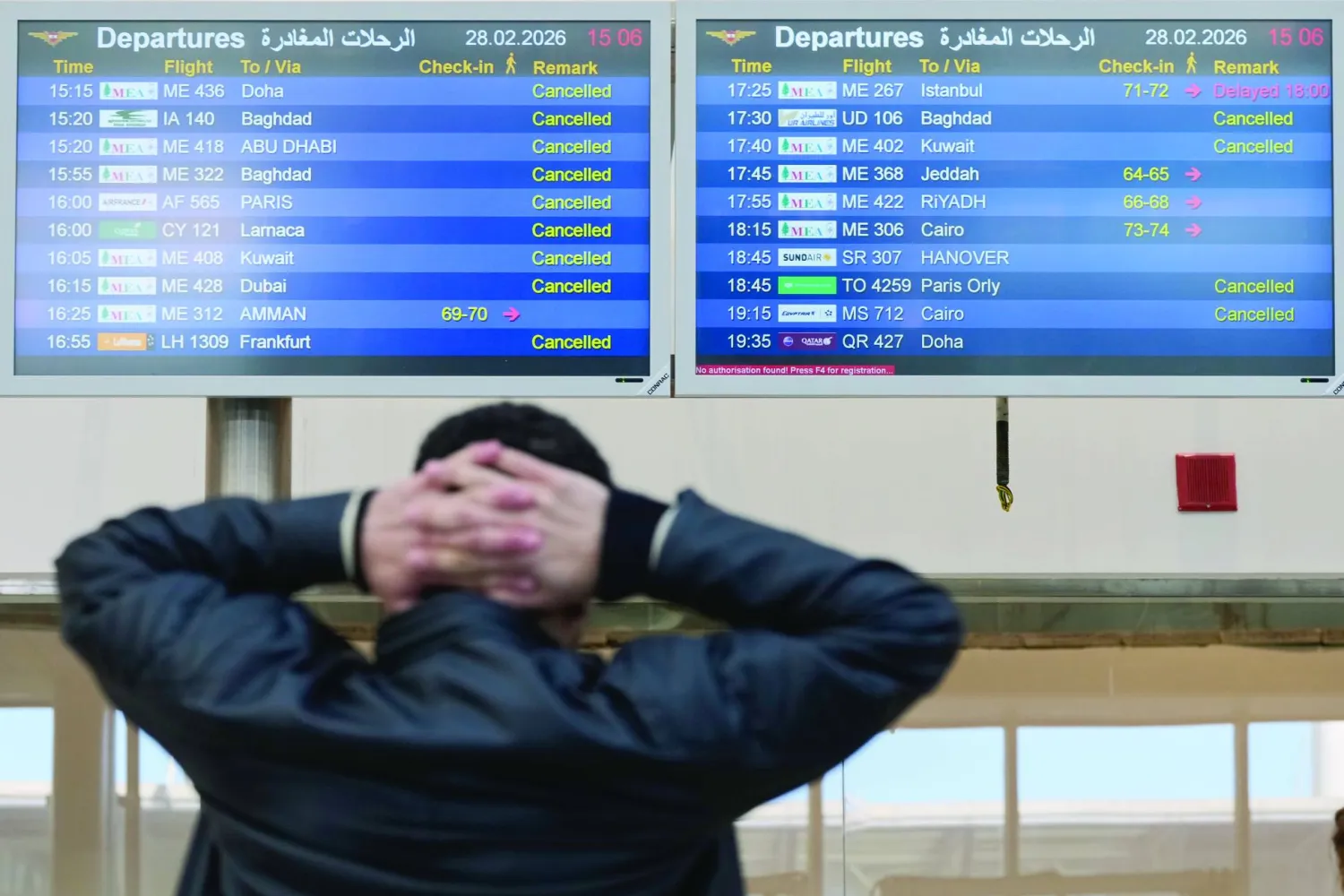
A traveler checks departure times as many flights are cancelled at Beirut Rafik Hariri International Airport in Beirut, Lebanon, Saturday, Feb. 28, 2026, as many airlines canceled flights due to the conflict involving the United States, Israel and Iran. (AP Photo/Hassan Ammar)
TT

Airspace Closed, Flights Cancelled as US-Iran Conflict Flares

A traveler checks departure times as many flights are cancelled at Beirut Rafik Hariri International Airport in Beirut, Lebanon, Saturday, Feb. 28, 2026, as many airlines canceled flights due to the conflict involving the United States, Israel and Iran. (AP Photo/Hassan Ammar)

Thousands of flights have been delayed or cancelled in the biggest disruption to global air transport since the Covid pandemic as airlines suspend services to the Middle East following the US and Israeli attacks on Iran.

Iran, Iraq, Israel, Syria, Kuwait and the United Arab Emirates all announced at least partial closures of their skies after Saturday's strikes and Iran launching missiles at capital cities around the Gulf region, said AFP.

Major carriers from the Middle East, Europe, Asia-Pacific and the United States announced widespread cancellations, leaving thousands of passengers stranded.

Notable airlines that cancelled services included Emirates, Etihad, Air France, British Airways, Air India, Turkish Airlines, and Lufthansa.

According to aviation analytics company Cirium, of around 4,218 flights scheduled to land in Middle Eastern countries on Saturday, 966 (22.9 percent) were cancelled, with the figure rising above 1,800 if also including outbound flights.

For Sunday, 716 flights out of 4,329 scheduled to the Middle East have been cancelled, Cirium said.

Flight tracking website FlightAware meanwhile said more than 19,000 flights had been delayed globally and more than 2,600 were cancelled as of 0230 GMT Sunday.

- Airspace closures -

Iran swiftly closed its airspace as the strikes began "until further notice", said the spokesman of Iran's Civil Aviation Organization, quoted by the Tasnim news agency.

Israel also closed its airspace to civilian flights, Transport Minister Miri Regev announced.

Qatar's civil aviation authority said it had temporarily closed the Gulf state's airspace.

Iraq shut down airspace, state media said.

The United Arab Emirates said it was closing its skies "partially and temporarily".

Syria closed part of its airspace in the south along the border with Israel for 12 hours, the Civil Aviation Authority said.

Jordan's air force was conducting drills to "defend the kingdom's skies", its military said.

Kuwait closed its airspace.

- Middle East and North Africa airlines -

Gulf carriers Emirates and Etihad cancelled 38 percent and 30 percent of their flights respectively, Cirium said.

Qatar Airways suspended all flights from Doha. It cancelled 41 percent of total flights, according to Cirium.

Syria Air, the country's national carrier, cancelled all flights until further notice.

Egypt's national airline, EgyptAir, announced the suspension of its flights to cities across the Middle East, including Dubai, Doha, Manama, Abu Dhabi, Beirut and Baghdad among others.

- European airlines -

Russia's air transport authority Rosaviatsia said all commercial flights to Israel and Iran were cancelled "until further notice".

Turkish Airlines cancelled flights to Lebanon, Syria, Iraq, Iran, and Jordan until March 2.

Air France cancelled its Dubai, Riyadh and Beirut flights for Saturday, and flights to Tel Aviv until Sunday.

British Airways said it was not flying to Tel Aviv and Bahrain until March 4, and cancelled flights to the Jordanian capital Amman on Saturday.

Swiss International Air Lines suspended flights to and from Tel Aviv until March 7, and cancelled flights from Zurich to Dubai scheduled for Saturday and Sunday.

Germany's Lufthansa, which comprises Swiss and ITA Airways, cancelled its flights to and from Tel Aviv, Beirut, Amman, Erbil and Tehran until March 7.

The airline group and its subsidiaries suspended flights to and from Dubai and Abu Dhabi until Sunday.

- North America airlines -

Delta Air Lines suspended New York-Tel Aviv flights until Sunday.

American Airlines "temporarily suspended" Doha-Philadelphia flights.

United flights to Tel Aviv are cancelled until Monday, and flights to Dubai until Sunday.

Air Canada said it cancelled flights from Canada to Israel until March 8 and to Dubai until March 3.

- Asia-Pacific airlines -

India's two largest private carriers IndiGo and Air India suspended flights to all destinations in the Middle East.

Pakistan International Airlines, the flag carrier of the country that borders Iran, said it had suspended flights to the UAE, Bahrain, Doha and Kuwait.

Hong Kong's Cathay Pacific suspended flights to Dubai and Riyadh.

Garuda Indonesia, Indonesia's flag carrier, temporarily suspended flights to and from Doha "until further notice", the company said in a statement Sunday.

Singapore Airlines and Singapore's Scoot cancelled six flight routes in the region until the end of Sunday, local media reported.

Philippine Airlines flights from Manila to Doha, Riyadh to Manila, and Dubai to Manila were cancelled on Saturday, as well as one Doha-Manila flight on Sunday.

Other major airlines including Australia's Qantas and Japan's All Nippon Airways did not announce any flight cancellations.

- Africa airlines -

Ethiopian Airlines cancelled its flights to Amman, Tel Aviv, Dammam, and Beirut.

Kenya Airways has suspended its flights to Dubai and Sharjah until further notice.


Iranian Leaders Want to Talk, Says Trump

US President Donald Trump delivers remarks during an event at the Port of Corpus Christi in Corpus Christi, Texas, US, February 27, 2026. (Reuters)
TT

Iranian Leaders Want to Talk, Says Trump

US President Donald Trump delivers remarks during an event at the Port of Corpus Christi in Corpus Christi, Texas, US, February 27, 2026. (Reuters)

US President Donald Trump said on Sunday that Iran's new leadership wants to talk to him and that he has agreed, according to an interview with the Atlantic magazine.

"They want to talk, and I have agreed to talk, so I will be talking to ‌them. They ‌should have done it ‌sooner. ⁠They should have given what ⁠was very practical and easy to do sooner. They waited too long," Trump said in the interview from his Florida residence.

Trump did not specify who he would be speaking with or say whether ⁠it would occur on Sunday ‌or Monday.

Iranian ‌President Masoud Pezeshkian said a leadership council composed of ‌himself, the judiciary head and a ‌member of the powerful Guardians Council had temporarily assumed the duties of supreme leader following the death of Ali Khamenei.

Trump said some ‌of the people who were involved in recent talks with the ⁠US are ⁠no longer alive.

"Most of those people are gone. Some of the people we were dealing with are gone, because that was a big - that was a big hit," he was quoted as saying in the interview with Atlantic staff writer Michael Scherer.

"They should have done it sooner, Michael. They could have made a deal. They should've done it sooner. They played too cute."


Iran Insists ‘No Limit’ Its Right to Self-Defense, Says FM

Iran's Foreign Minister Abbas Araghchi addresses a special session of the Conference on Disarmament at the United Nations, aside of US-Iran talks in Geneva, Switzerland, February 17, 2026. (Reuters)
TT

Iran Insists ‘No Limit’ Its Right to Self-Defense, Says FM

Iran's Foreign Minister Abbas Araghchi addresses a special session of the Conference on Disarmament at the United Nations, aside of US-Iran talks in Geneva, Switzerland, February 17, 2026. (Reuters)

A top Iranian official on Sunday rejected President Donald Trump's warning not to retaliate against massive US-Israel bombardments, saying there would be "no limit" to the country's self-defense.

"Nobody can tell us that you don't have any right to defend yourselves. We are defending ourselves whatever it takes, and we see no limit for ourselves to defend our people, to protect our people," Foreign Minister Abbas Araghchi told ABC News.

"What the United States is doing is an act of aggression. What we are doing is the act of self-defense. There are huge differences between these two," he said.


Three US Military Members Killed in Iran Operation

Aircraft attached to Carrier Air Wing (CVW) 9 sit on the flight deck of the US Navy Nimitz-class aircraft carrier USS Abraham Lincoln in support of the Operation Epic Fury attack on Iran, February 28, 2026. (US Navy/Handout via Reuters)
TT

Three US Military Members Killed in Iran Operation

Aircraft attached to Carrier Air Wing (CVW) 9 sit on the flight deck of the US Navy Nimitz-class aircraft carrier USS Abraham Lincoln in support of the Operation Epic Fury attack on Iran, February 28, 2026. (US Navy/Handout via Reuters)

The US military Sunday said three service members have been killed and five seriously wounded in the operation against Iran -- the first casualties of any kind announced on the US side.

The United States launched massive bombardments against Iran and killed its supreme leader Saturday, with attacks ongoing Sunday.

"Three US service members have been killed in action and five are seriously wounded as part of Operation Epic Fury. Several others sustained minor shrapnel injuries and concussions -- and are in the process of being returned to duty," US Central Command (CENTCOM) said in a statement.

"Major combat operations continue and our response effort is ongoing. The situation is fluid, so out of respect for the families, we will withhold additional information, including the identities of our fallen warriors, until 24 hours after next of kin have been notified."

US air and naval forces, together with Israeli forces, are heavily bombarding Iran and President Donald Trump has said the goal is to destroy the country's military capacity.

In response, Iran has fired missiles at targets in Israel and at US military facilities around the region.

Earlier Sunday, Iran's Revolutionary Guards said they had successfully hit the aircraft carrier USS Abraham Lincoln in the Gulf with four ballistic missiles.

However, CENTCOM said the aircraft carrier "was not hit."

"The missiles launched didn't even come close. The Lincoln continues to launch aircraft in support of CENTCOM's relentless campaign to defend the American people by eliminating threats from the Iranian regime," a statement said.
