


Israel Kills 31 in Lebanon, Vows to Expand Strikes after Hezbollah Fire

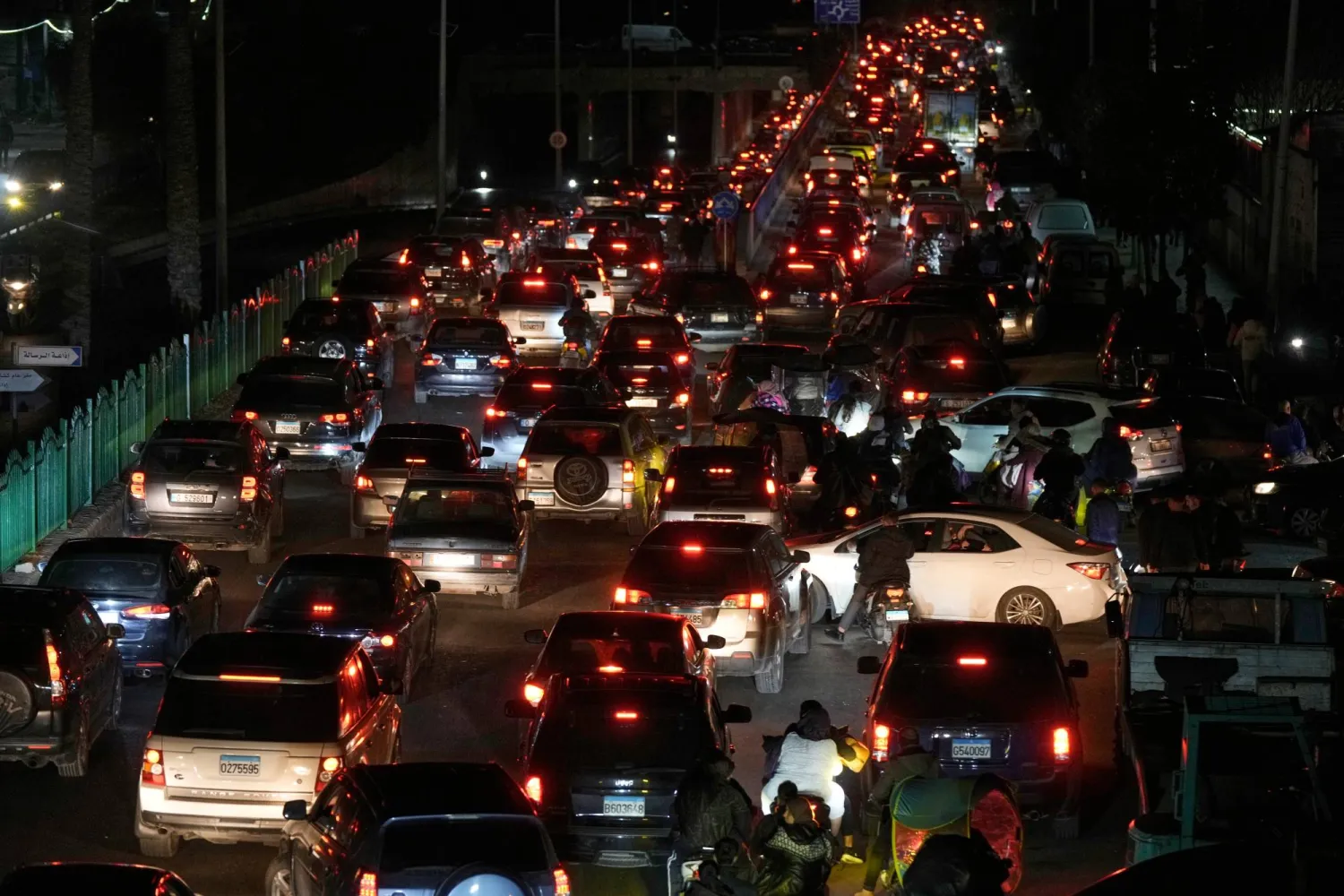
Cars sit in traffic as residents flee Israeli airstrikes in Dahiyeh, a southern suburb of Beirut, Lebanon, early Monday, March 2, 2026. (AP Photo/Bilal Hussein)
TT

Israel Kills 31 in Lebanon, Vows to Expand Strikes after Hezbollah Fire

Cars sit in traffic as residents flee Israeli airstrikes in Dahiyeh, a southern suburb of Beirut, Lebanon, early Monday, March 2, 2026. (AP Photo/Bilal Hussein)

Israeli strikes on Lebanon killed at least 31 people on Monday, authorities said, following rocket fire from Tehran-backed militant group Hezbollah after the killing of Iran's supreme leader. 

Israel's military vowed to intensify its attacks on the country and make Hezbollah pay a "heavy price" after launching several strikes on Beirut's southern suburbs and south Lebanon, areas where Hezbollah holds sway. 

The escalation came as Lebanese authorities, who have been trying to spare the country from any repercussions of the US-Israeli attack on Iran, said Hezbollah's rocket fire gave Israel "excuses" to ramp up its attacks. 

Hezbollah's attack on Israel overnight was the first time the Lebanese movement claimed responsibility for an operation against Israel since a November 2024 ceasefire sought to end over a year of hostilities between the two. 

The group announced around 3 am (0100 GMT) on Monday that it had targeted an Israeli army site south of Haifa city "with a barrage of high-quality missiles and a swarm of drones". 

It said the move was "retaliation for the pure blood" of Iran's supreme leader Ali Khamenei, blaming his death on Israel after it launched attacks in a joint operation with the United States on Saturday. 

"Hezbollah chose the Iranian regime over the State of Lebanon and initiated an attack on our civilians... they will pay a heavy price," said Rafi Milo, head of the Israeli military's Northern Command. 

"The strikes continue, their intensity will increase," he was quoted as saying in a military statement hours after the first strikes were fired. 

Lebanon's health ministry gave an "initial toll" of 31 killed in Israel's strikes, 20 in Beirut's southern suburbs and 11 in the south. It said at least 149 were wounded. 

In the capital's southern suburbs, strikes hit the top two floors of at least two buildings, according to an AFP photographer. 

A fire broke out in one of the targeted apartments. 

The bombings triggered a mass exodus from the area, according to AFP correspondents, with families hastily leaving their homes on motorcycles or in cars. 

Further south on the Mediterranean coast, an AFP journalist in Sidon saw huge lines of cars packed with families escaping the attacks. 

Israel's strikes hit several areas of the south including Kfur, Haris and Sultaniya. 

- Retaliation - 

Israel has carried out regular strikes on Lebanon since the 2024 ceasefire came into effect, usually saying it targets the militant group and accusing it of truce violations. 

Hezbollah has been weakened from conflict with Israel, which it entered to support Hamas following the Palestinian militant group's deadly attack on Israel in October 2023 and the subsequent war in the Gaza Strip. 

On Monday, a military statement said Israeli forces "precisely struck" senior Hezbollah members in the Beirut area, and another in the south. 

Israel then issued an evacuation warning to residents of about 50 towns and villages in Lebanon's south and east -- both Hezbollah strongholds. 

"For your safety, evacuate your homes immediately and move at least 1,000 meters (0.6 miles) away from your village to open areas," army spokeswoman Ella Waweya said in a statement on X. 

Around three hours before Hezbollah's statement, the Iranian Revolutionary Guard Corps' Telegram channel said that "Hezbollah officially entered the war". 

The Israeli military said that "several projectiles" fired from Lebanon on Monday "fell in open areas", with no immediate reports of damage or injuries. 

- 'Irresponsible' - 

Lebanese President Joseph Aoun said attacks from the country's territory risked drawing the country into regional conflict. 

Lebanese Prime Minister Nawaf Salam, whose government has pushed for Hezbollah's disarmament, called Monday's rocket fire "irresponsible". 

He vowed to "stop the perpetrators and protect the Lebanese people". 

Israeli military chief Eyal Zamir said, according to a statement, that "Hezbollah opened a campaign against Israel overnight, and is fully responsible for any escalation". 

Lebanese authorities had repeatedly said they do not wish to involve their country in the outbreak of conflict in the region, which started after a massive US-Israeli attack on Iran.  


RSF Drones Attack Sudan Capital for Second Day

People clear debris from a mosque that residents said was damaged in a drone strike in Khartoum, Sudan, Wednesday, Aug. 12, 2026. (AP)
TT

RSF Drones Attack Sudan Capital for Second Day

People clear debris from a mosque that residents said was damaged in a drone strike in Khartoum, Sudan, Wednesday, Aug. 12, 2026. (AP)

Paramilitary drones on Thursday attacked the Sudanese capital Khartoum for the second day in a row, an AFP correspondent and witnesses reported.

Since April 2023, Sudan has been ravaged by war between the Sudanese military, led by its chief Abdel Fattah al-Burhan, and the paramilitary Rapid Support Forces (RSF), commanded by Burhan's former deputy Mohamed Hamdan Daglo.

The latest attack comes a day after the RSF launched far-reaching coordinated drone strikes targeting five army-controlled cities hundreds of kilometers apart.

On Thursday, an AFP correspondent in the capital reported the firing of anti-aircraft missiles from Omdurman, Khartoum's twin city, followed by the sound of an explosion.

"Military air defenses engaged with the militia's drones and downed them," an army source told AFP.

Witnesses in central Khartoum and Khartoum North across the Nile river also reported seeing drones in the sky and hearing explosions.

Across the country, aid workers estimate more than 200,000 people have been killed in what the UN calls a "war of atrocities". The conflict has also caused the world's largest hunger and displacement crises.

Burhan and Daglo, allies until they fell out in a bitter power struggle, have spent most of the war in a relative stalemate, unwilling to hold negotiations while vying for a decisive battlefield advantage.

The RSF last year consolidated its hold on the vast western region of Darfur and has since pushed to seize territory in the southern Kordofan region and along the southeastern Ethiopian border.

The army holds Sudan's center, north and east, and last month clinched a victory in Kordofan by pushing the RSF off a key highway leading to the capital.

Daglo in the aftermath said he would "unleash" his fighters -- already accused of war crimes including genocide -- and his forces have since repeatedly threatened a large-scale retaliatory attack.


US Ambassador to Israel Denounces Settler Siege on Palestinians as ‘Terror’

 Israeli soldiers stand guard next to settlers in front of Palestinian homes that they have blockaded in the village of Qusra, south of Nablus, in the occupied West Bank, Wednesday, Aug. 12, 2026. (AP)
Israeli soldiers stand guard next to settlers in front of Palestinian homes that they have blockaded in the village of Qusra, south of Nablus, in the occupied West Bank, Wednesday, Aug. 12, 2026. (AP)
TT

US Ambassador to Israel Denounces Settler Siege on Palestinians as ‘Terror’

 Israeli soldiers stand guard next to settlers in front of Palestinian homes that they have blockaded in the village of Qusra, south of Nablus, in the occupied West Bank, Wednesday, Aug. 12, 2026. (AP)
Israeli soldiers stand guard next to settlers in front of Palestinian homes that they have blockaded in the village of Qusra, south of Nablus, in the occupied West Bank, Wednesday, Aug. 12, 2026. (AP)

The US ambassador to Israel, a staunch supporter of West Bank settlements, on Thursday denounced as "terror" a siege by settlers against Palestinians that drew an unsuccessful intervention by the army.

Settlers near Nablus since Sunday have blockaded Palestinian homes, including one owned by a US citizen, with residents saying they have been cut off from food and other supplies.

"Actions by those who carried out this horrific act of terror meant to intimidate and harass this family are disgusting," Mike Huckabee, the US ambassador in Jerusalem, wrote on X in response to criticism of the US response.

"No excuse for such thuggish behavior," he wrote.

Huckabee said Israel had intervened at the request of the United States, its crucial ally.

The remarks are especially striking from Huckabee, an evangelical Christian pastor who in the past has embraced Jewish settlement in the West Bank, which Israel has occupied since 1967, and rejected the idea of a Palestinian state.

The Israeli military on Wednesday sent in forces who took away a tent, but witnesses said settlers defiantly remained at the site with blankets.

The army announced later Wednesday that it would send a new battalion to try to impose order.

Violence against Palestinians by Israeli settlers in the West Bank has increased dramatically since the October 7, 2023, attack on Israel by Hamas from the Gaza Strip.

More than 500,000 Israelis live in settlements in the West Bank, which are illegal under international law, among some three million Palestinians in the territory.


Crisis Looms in Southern Iraq over Water, Electricity Shortages

People protest in Dhi Qar over frequent power outages. (Social media)
TT

Crisis Looms in Southern Iraq over Water, Electricity Shortages

People protest in Dhi Qar over frequent power outages. (Social media)

The worsening electricity crisis in Iraq continues to burden most of the population, amid rising temperatures that have surpassed 50 degrees Celsius in some southern governorates.

There are fears that the crisis could lead to local conflicts between some governorates, given that some receive up to 20 hours of power, while others receive only about 10 at best.

In Dhi Qar, a number of residents threatened to cut off water from the Al-Bidaa canal and prevent it from reaching the Basra Governorate in the far south if they do not receive more hours of electricity. A video showed dozens of citizens holding signs that read: "Water for electricity."

The canal is a main channel for drinking water to Basra, flowing from the Tigris River through Dhi Qar. Cutting it off may lead to a humanitarian and service crisis for millions of Basra residents, who already suffer from water salinity and irregular supply to their homes.

An official source in Dhi Qar dismissed the citizens' ability to cut off the water supply. The source told Asharq Al-Awsat that the protests reflect anger over deteriorating electricity services in the governorate, but it will not reach the stage of cutting off water or bartering it for electricity.

The source said the problem relates to the Al-Fuhoud and Al-Chibayish areas bordering Basra.

Al-Chibayish receives enough electricity from Basra, unlike the Al-Fuhoud, which receives around two hours for every four-hour cut from Dhi Qar, making the residents’ anger justified, added the source.

The official source said the crisis is not limited to Dhi Qar, but affects most of Iraq, especially the south.

Citizens in six governorates, including Baghdad, demonstrated a few days ago to protest the shortage of electricity.

In Wasit, which borders Dhi Qar, hundreds took to the streets over the past two days in protest against the power cuts.

The demonstrations led to clashes with police and anti-riot forces, who were forced to use water cannons and tear gas to disperse the protesters, prompting criticism from MPs who demanded a probe into the unrest.

Energy officials and experts warned that the crisis will likely continue for years due to the stark disparity between demand and production capacity. The country's needs are estimated at around 60,000 megawatts, while current production does not exceed 25,000 megawatts.
