


Oil Surges, Stocks Slide as Conflict Grips Middle East

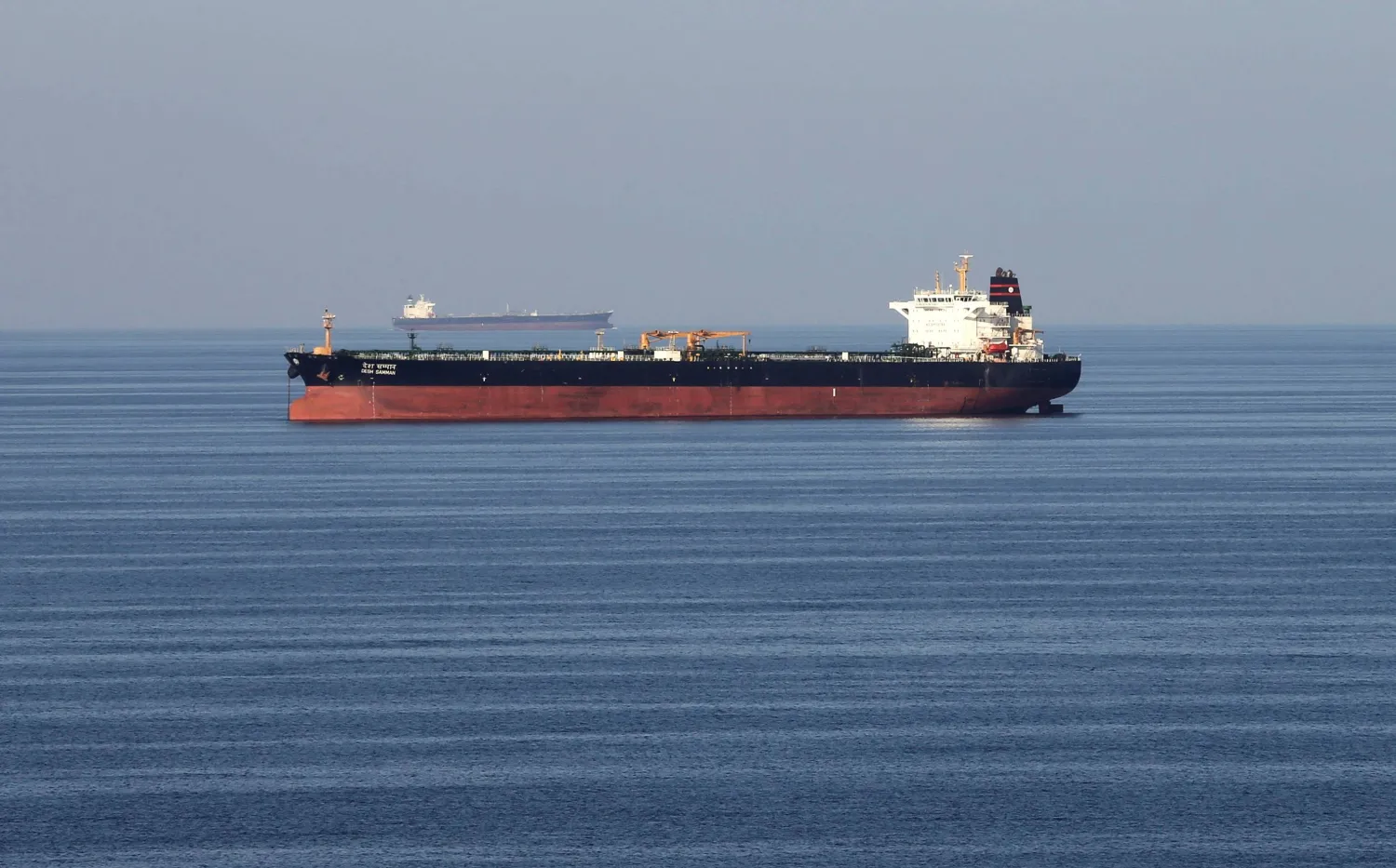
FILE PHOTO: Oil tankers pass through the Strait of Hormuz, December 21, 2018. REUTERS/Hamad I Mohammed/File Photo
TT

Oil Surges, Stocks Slide as Conflict Grips Middle East

FILE PHOTO: Oil tankers pass through the Strait of Hormuz, December 21, 2018. REUTERS/Hamad I Mohammed/File Photo

Oil prices surged on Monday and shares slid as military conflict in the Middle East looked set to last weeks, threatening to upend a global economic recovery and perhaps reignite inflation.

Brent jumped 6.4% to $77.57 a barrel, though it had briefly topped $82.00 at one stage, while US crude climbed 6.2% to $71.17 per barrel. Safe-haven gold rose 1.6% to $5,360 an ounce.

Military strikes by the United States and Israel on Iran showed no sign of lessening, while Iran responded with missile barrages across the region, risking dragging its neighbors into the conflict, reported Reuters.

President Donald Trump suggested to the Daily Mail the conflict could last for four more weeks, while posting that attacks would continue until US objectives were met.

All eyes were on the Strait of Hormuz where around a fifth of the world's seaborne oil trade flows and 20% of its ‌liquefied natural gas. While ‌the vital waterway has not yet been blocked, marine tracking sites showed tankers piling ‌up ⁠on either side ⁠of the strait wary of attack or maybe unable to get insurance for the voyage.

"The most immediate and tangible development affecting oil markets is the effective halt of traffic through the Strait of Hormuz, preventing 15 million barrels per day (bpd) of crude oil from reaching markets," said Jorge Leon, head of geopolitical analysis at Rystad Energy.

"Unless de-escalation signals emerge swiftly, we expect a significant upward repricing of oil."

A prolonged spike in oil prices would risk reigniting inflationary pressures globally, while also acting as a tax on business and consumers that could dampen demand.

OPEC+ did agree a modest oil output boost of 206,000 barrels per day for April on Sunday, ⁠but a lot of that product still has to get out of the Middle ‌East by tanker.

"The nearest historical analogue in our view is the Middle East ‌oil embargo of the 1970s, which increased oil prices by 300% to around $12/bbl in 1974," said Alan Gelder, SVP of refining, chemicals ‌and oil markets at Wood Mackenzie.

"That is only US$90/bbl in 2026 terms. Eclipsing this in today's market concerned about ‌significant losses of supply seems very achievable."

That would be expensive for Japan, which imports all its oil, sending the Nikkei down 1.3%, with airlines among the hardest hit.

Chinese blue-chips were off just 0.1%, though the country does get much of its seaborne oil imports from the Middle East. MSCI's broadest index of Asia-Pacific shares outside Japan fell 1.2%.

AND IT'S A BIG US DATA WEEK

In the Middle East, the ‌UAE and Kuwait temporarily closed their stock markets citing "exceptional circumstances".

For Europe, EUROSTOXX 50 futures shed 1.3% and DAX futures slid 1.4%. FTSE futures fell 0.6%.

On Wall Street, S&P 500 ⁠futures and Nasdaq futures both ⁠lost 0.8%.

The oil shock rippled through currency markets with the dollar a main beneficiary. The US is a net energy exporter and Treasuries are still considered a liquid haven in times of stress, shoving the euro down 0.2% to $1.1787.

While the Japanese yen is often a safe harbor, the country imports all of its oil making the flows more two-way. The dollar added 0.3% to 156.44 yen. 

In bond markets, 10-year Treasury yields steadied at 3.970%, having briefly touched an 11-month low of 3.926%. 

Bonds had gained a bid on Friday when UK mortgage lender MFS was placed into administration following allegations of financial irregularities. Its collapse stoked wider credit fears, with well-known big banks among its lenders. MFS had borrowed 2 billion pounds ($2.69 billion). 

The news slugged banking stocks and combined with jitters over AI-related stocks to hit Wall Street more broadly. 

Investors also have to weather a squall of US economic data this week, including the ISM survey of manufacturing, retail sales and the always vital payrolls report. 

Any weakness could shake confidence in the economy after a disappointing fourth quarter, but would also likely narrow the odds on rate cuts from the Federal Reserve. 

Markets currently imply a 50% chance of an easing in June and about 58 basis points of cuts this year. 


UAE Airlines to Resume Limited Number of Flights, Mainly for Repatriations

FILE PHOTO - Emirates Airline Boeing 777-300ER planes are seen at Dubai International Airport in Dubai, United Arab Emirates February 15, 2019. REUTERS/Christopher Pike
TT

UAE Airlines to Resume Limited Number of Flights, Mainly for Repatriations

FILE PHOTO - Emirates Airline Boeing 777-300ER planes are seen at Dubai International Airport in Dubai, United Arab Emirates February 15, 2019. REUTERS/Christopher Pike

Emirates, flydubai and Etihad Airways will resume a limited number of flights on Monday, mainly to help repatriate stranded passengers, as global carriers grapple with disruptions from the escalating Iranian conflict. Israeli and US attacks on Iran and Tehran's response forced the closure of airspace across parts of the Middle East, including the United Arab Emirates, and shut key airports such as Dubai and Doha.
he UAE civil aviation authority will begin operating "special flights" across the country's airports, state news agency WAM reported, to help some of the tens of thousands of passengers stranded in the region leave.

Dubai Airports said a limited resumption would begin later on Monday, with a small number of flights permitted from Dubai International (DXB) and Al Maktoum International (DWC). DXB, which handled nearly 100 million passengers last year, sustained minor damage on Sunday after it was hit along with other hubs by Iranian retaliatory attacks that have extended beyond US bases and interests.

Emirates and flydubai said they would resume a small number of flights on Monday evening.

flydubai said four flights to Russian destinations including Kazan would depart from DXB, while services from three Pakistani airports and from Hargeisa in Somaliland were scheduled to return to Dubai.

"Some repositioning, cargo and repatriation flights may operate in coordination with UAE authorities and subject to strict operational and safety approvals," Abu Dhabi-based Etihad said in a statement to Reuters, adding that all scheduled commercial services to and from Abu Dhabi remained cancelled.

The airline's website showed several flights had departed from Abu Dhabi's Zayed International Airport on Monday for destinations including London and Paris, with more scheduled.


QatarEnergy Halts LNG Production over Iran Attacks

QatarEnergy Halts LNG Production over Iran Attacks
TT

QatarEnergy Halts LNG Production over Iran Attacks

QatarEnergy Halts LNG Production over Iran Attacks

Qatar's state-run energy firm said on Monday it had halted liquefied natural gas production following Iranian attacks on facilities at two of its main gas processing bases.

"Due to military attacks on QatarEnergy's operating facilities in Ras Laffan Industrial City and Mesaieed Industrial City in the State of Qatar, QatarEnergy has ceased production of liquefied natural gas (LNG) and associated products," the company said in a statement.

Earlier, Qatar's defense ministry said one Iranian drone "targeted an energy facility in Ras Laffan Industrial City, belonging to QatarEnergy", referring to the firm's onshore gas processing base 80 kilometres (50 miles) north of Doha.

Another "targeted a water tank belonging to a power plant in Mesaieed", the statement said, referring to an area 40 kilometres (25 miles) south of the Qatari capital, which is also a key site for Qatar's natural gas production.

There were no reports of casualties, the defense ministry added.

The Dutch TTF natural gas contract, considered the European benchmark for LNG prices, jumped almost 45 percent to more than 46 euros ($54).

Jamie Ingram, managing editor of Middle East Economic Survey (MEES), said the halt was "an unprecedented development, with Ras Laffan the largest single LNG facility on the planet," warning there was "scope for prices to rise significantly".

He said the move was "made from an abundance of caution rather than one forced by the scale of the drone attack earlier today".

"It's possibly also intended to drum up international support," Ingram added.

Justin Alexander, an economic expert on Gulf issues and director of Khalij Economics, said it was "clearly a precautionary move" given strikes on Ras Laffan and risks to "extremely flammable gas facilities", adding the main market impact was "the closure of Hormuz", blocking nearly a quarter of global supply.

He added that the QatarEnergy suspension "could increase the delay to the resumption of normal supplies once Hormuz reopens".

While Iran has not officially closed the Strait of Hormuz, through which around 20 percent of global seaborne oil passes, its Revolutionary Guards have warned against transiting the waterway, leaving it effectively shut.


Energy Prices Soar, Stock Markets Slide on Iran War Fallout

Gas prices surged and stocks sank after US and Israeli forces began striking Iran at the weekend © - / US NAVY/US CENTRAL COMMAND/AFP
TT

Energy Prices Soar, Stock Markets Slide on Iran War Fallout

Gas prices surged and stocks sank after US and Israeli forces began striking Iran at the weekend © - / US NAVY/US CENTRAL COMMAND/AFP

Oil and gas prices soared, stock markets slid and the dollar firmed on Monday as the widening Iran war shook financial markets across the globe.

European natural gas prices rocketed more than 50 percent after Qatar's state-run energy firm said it had halted liquefied natural gas production following Iranian attacks on facilities at two of its main gas processing bases.

Meanwhile world crude futures surged nearly nine percent on fears of disruption to supplies.

Asian and European stock markets retreated as much as over two percent as investors exited trades in favour of the dollar and gold, seen as safer bets in times of economic unrest, according to AFP.

The greenback jumped nearly one percent against the British pound before paring gains, while the precious metal rose 3.1 percent to $5,410.70 an ounce.

There were sizeable gains to share prices of energy majors and defence companies, with BAE Systems jumping six percent in London.

"Investors are scuttling towards safe havens, seeking shelter as conflict widens in the Middle East," noted Susannah Streeter, chief investment strategist at Wealth Club.

After US and Israeli strikes on Iran over the weekend, Israel bombarded Lebanon on Monday following rocket fire from Hezbollah.

Several American warplanes crashed in Kuwait -- from friendly fire -- and Iran lashed out against the region with missiles as the war expanded.

The bombings have also seen the vital Strait of Hormuz -- through which around 20 percent of global seaborne oil passes -- effectively shut and several ships attacked.

Airline share prices took a battering as carriers were forced to cancel flights -- with Qantas and Singapore Airlines each losing around five percent.

British Airways owner IAG lost 5.8 percent Air France-KLM fell 8.3 percent.

However, energy firms rallied, with Australia's Woodside Energy jumping more than six percent, and PetroChina adding almost four percent.

Shell rose nearly three percent and TotalEnergies more than four percent.

"If higher oil prices persist, it raises the risk of stickier headline inflation," wrote Saxo Markets' Charu Chanana.

This could prove troublesome for US President Donald Trump, who has promised his electorate low prices, as the United States approaches mid-term elections in November.

Rising energy prices, increased shipping costs and loss of revenue for air transport could have "a harmful effect on growth", said economist Eric Dor from the IESEG School of Management in Paris.

"If it's a matter of three days, it's not serious. But if it's over a longer period, then it will have an additional recessionary effect," he told AFP.

In theory, oil-importing countries have reserves, with OECD members required to maintain 90 days' worth of stocks, but prices above $100 cannot be ruled out according to analysts.

If the disruption at Hormuz continues, "no matter how much spare capacity, (it) is not going to fill that gap. That gap is just too big," said Amena Bakr, head of Middle East and OPEC+ research at analysts Kpler.

Key members of the OPEC+ oil cartel on Sunday announced a greater-than-expected increase to production quotas.
