


‘Tactical Calm’ May Precede Long War in Iraq

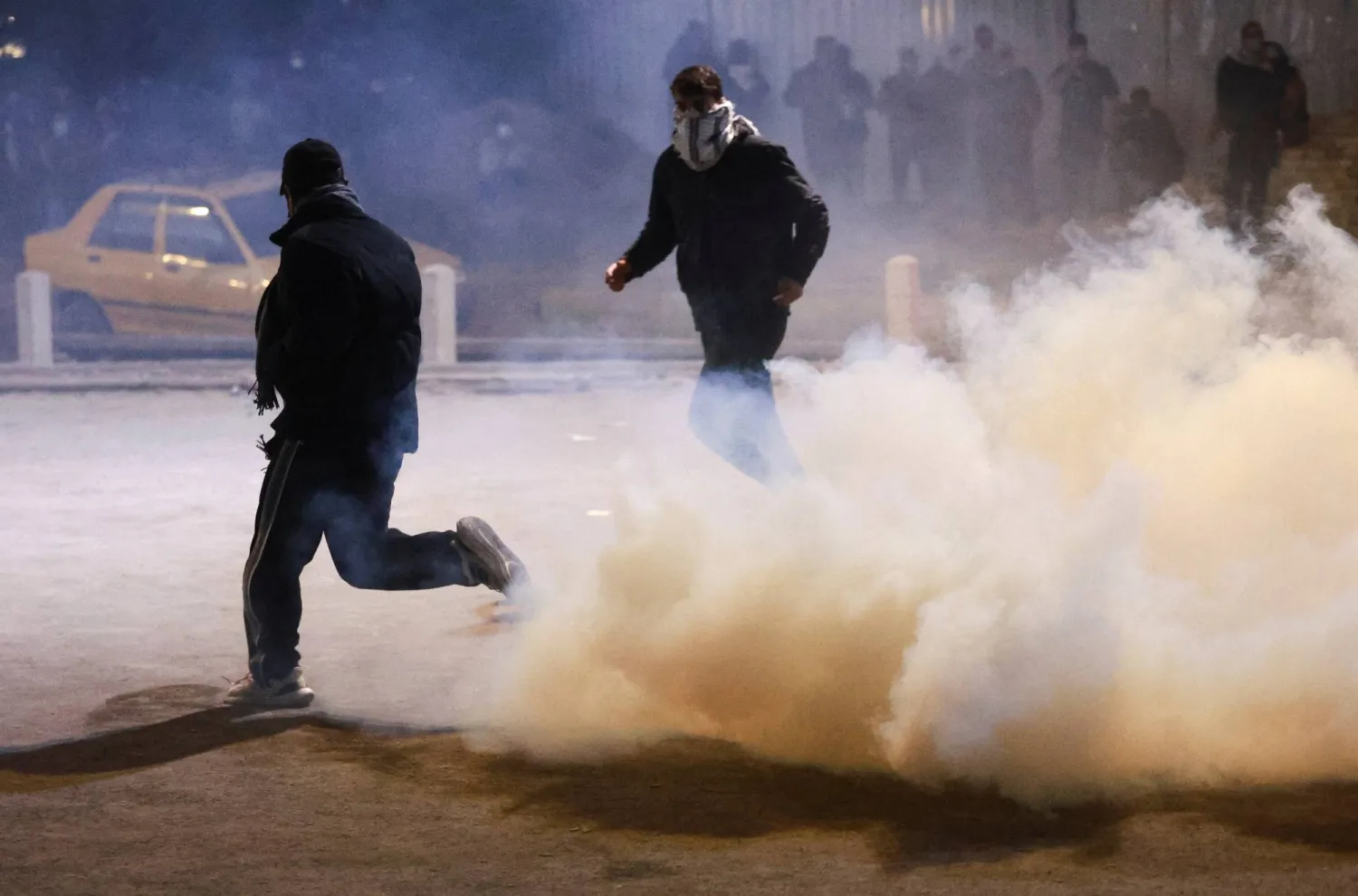
Demonstrators run amid tear gas as supporters of Iraqi Shiite armed groups attempt to move toward the US embassy located in Baghdad's Green Zone following the Israel and US strikes on Iran and the killing of Iran’s Supreme Leader Ali Khamenei, in Baghdad, Iraq, March 1, 2026. (Reuters)
TT

‘Tactical Calm’ May Precede Long War in Iraq

Demonstrators run amid tear gas as supporters of Iraqi Shiite armed groups attempt to move toward the US embassy located in Baghdad's Green Zone following the Israel and US strikes on Iran and the killing of Iran’s Supreme Leader Ali Khamenei, in Baghdad, Iraq, March 1, 2026. (Reuters)

The violent protests that erupted in Iraq among supporters of Iran’s slain Supreme Leader Ali Khamenei against US interests subsided on Monday.

It appears that a decision has been taken for the pro-Iran factions to rein in their reactions to give time for the resumption of communication with the Iranian Revolutionary Guards.

Restoring contacts will help put in place a plan for a possible long war against the US that covers a number of potential targets, some of which may be out of reach.

Influential leaderships ordered the angry protesters to withdraw from Baghdad’s Green Zone where they were trying to inch their way towards the American embassy. “An eerie calm has since been restored with the situation open for any scenario,” observers said.

The protesters had flooded the Green Zone soon after the confirmation of Khamenei’s death on Saturday. Security forces were clearly given an order to prevent them from reaching the US embassy, said an Iraqi official.

Overnight on Sunday, a number of protesters opened live fire at government forces. The Interior Ministry later said a “fifth column” had opened fire at security forces who were there to protect the protesters. Thirteen people were wounded in the unrest.

It did not detail how many were wounded by live fire shot by security forces, according to witnesses.

Various sources confirmed that the government, which is composed of various pro-Iran powers, had issued strict orders to prevent the protesters from breaching the embassy and to arrest any security leader who fails in preventing the launch of rockets and drones.

No leadership

Over the weekend, Iran’s supporters in Iraq acted without clear orders from their central command as the Revolutionary Guards were coming under Israeli and US attacks. What ensued were attacks against any target in Iraq and Kurdistan the factions could come up with.

American reports on Sunday said the Guards no longer have a central base for guiding operations, forcing allied factions to improvise in launching their retaliatory attacks.

Consequently, the factions hit the US Victoria base near Baghdad International Airport. In Basra, they attacked a system of radars; and in Nasiriyah, they fired booby-trapped drones at the Imam Ali base.

The capital of the Iraqi Kurdistan Region, Erbil, “paid the highest price” for Khamenei’s killing, said a Kurdish officer.

“The attacks have been countless. Drones are fired every hour,” he added.

The drone attacks focused on the new US consulate building and Harir military base, revealed American and Kurdish sources.

Calm

By Monday, the strict security measures around the Green Zone remained in place, but the angry factions, mostly Iran-aligned Popular Mobilization Forces, had retreated.

Observers believe Baghdad has entered a phase of “tactical calm” after the shock of Khamenei’s death. The Guards appear to be “catching their breath” and will begin resuming regular communication with their Iraqi agents.

Various sources said the Iraqi factions view Hezbollah’s attack against Israel overnight on Sunday as a sign that contacts had resumed between the Lebanese party and Iran. Tehran had ordered Hezbollah to act, and it did. A similar order will likely be issued to the factions in Iraq.

American estimates believe that the Iranian response to Khamenei’s killing will ease in the coming days due to logistical reasons or because Tehran will be preoccupied with the transition to post-Khamenei rule. Shiite circles in Iraq, however, believe that a long war is in store.

Secretary of Iran’s national security council Ali Larijani said his country has prepared itself for a long war more so than the US.

Target bank

Such a conflict demands a target bank that is not all within reach of the factions seeking to avenge Khamenei’s death, said a leading member of the pro-Iran Shiite Coordination Framework in Iraq.

The targets may include American interests that will harm Washington in the medium-term, such as the consulate and Harir base in Erbil and Victoria base in Baghdad.

In a longer war, the factions may target American investments in gas and oil fields across Iraq. An attack against the US embassy may be saved for a decisive moment in the conflict and will be decided by the Guards, said sources close to the factions.

The factions may also “relish” the idea of carrying out assassinations against the “enemies of Iran,” they added.

The unrest will pose the biggest challenge to Iraqi Prime Minister Mohammed Shia al-Sudani's caretaker government. It will find itself caught in the middle of Shiite factions that want to escalate the conflict against the US and an emerging Arab alliance that has been targeted by Iran’s attacks, said a former government official.


Israel Orders Evacuation of Swathe of South Lebanon as Katz Authorizes Military to Advance

Israeli tanks maneuver near the Israel-Lebanon border, in northern Israel, Wednesday, March 4, 2026. (AP Photo/Ariel Schalit)
TT

Israel Orders Evacuation of Swathe of South Lebanon as Katz Authorizes Military to Advance

Israeli tanks maneuver near the Israel-Lebanon border, in northern Israel, Wednesday, March 4, 2026. (AP Photo/Ariel Schalit)

The Israeli military ordered the evacuation of a swathe of southern Lebanon on Wednesday, telling residents to move north of the Litani River on a third day of full-blown hostilities with Hezbollah.

While Israel has already warned residents to leave dozens of villages in southern Lebanon, ⁠Wednesday's evacuation order ⁠was the broadest yet.

Israeli Defense Minister Israel said on Tuesday he had authorized the military to advance and take control of additional positions in Lebanon, where Israeli troops have held several hilltops since a war with Hezbollah in 2024.

Israeli strikes ⁠have killed dozens of people in Lebanon since Monday, according to the Lebanese health ministry. Many thousands of Lebanese have already fled their homes.

The war in the Middle East spread to Lebanon on Monday, when Hezbollah opened fire, saying it aimed to avenge the killing of Iranian Supreme Leader Ali Khamenei in the US-Israeli attack on Iran.

Hezbollah announced several attacks on Wednesday, including one using what it described as a precision-guided missile that it said was fired at a military facility in northern Israel.

Israeli military spokesperson Effie Defrin said the Israeli military had attacked more than 250 Hezbollah targets throughout Lebanon over a 48-hour period.


Aid Trucks Resume Crossing Egypt-Gaza Border After Closure

Internally displaced Palestinians scramble for an Iftar meal being distributed by a charity kitchen during the holy month of Ramadan, in Khan Younis, southern Gaza Strip, 26 February 2026. (EPA)
TT

Aid Trucks Resume Crossing Egypt-Gaza Border After Closure

Internally displaced Palestinians scramble for an Iftar meal being distributed by a charity kitchen during the holy month of Ramadan, in Khan Younis, southern Gaza Strip, 26 February 2026. (EPA)

More than 100 aid trucks crossed the Egyptian side of Gaza's Rafah border crossing on Tuesday, two sources told AFP.

Israel closed all crossings into the Gaza Strip on Saturday, after it launched a joint attack on Iran with the United States.

It agreed to reopen the Kerem Shalom crossing, where trucks from Egypt are inspected, for the "gradual entry of humanitarian aid".

"More than 100 United Nations aid trucks, including UNICEF's, entered the Rafah border crossing" on Tuesday, a source at the border told AFP on Wednesday on condition of anonymity.

An official with the Egyptian Red Crescent, which coordinates aid deliveries, said the trucks "went through Rafah to the Kerem Shalom crossing," where Israeli authorities did not send any back to Egypt -- their procedure when aid shipments are rejected.

Both sources said no Palestinians were allowed through the crossing on Tuesday.

The Rafah crossing, the only gateway for Gazans to the outside world that does not pass through Israel, had reopened for a trickle of people on February 2, nearly two years after Israeli forces seized it.

A statement from the Red Crescent on Tuesday said the convoy included hundreds of tons of food, relief supplies and "fuel products to operate hospitals and vital facilities".

The UN had warned its partners were "forced to ration fuel, prioritize life-saving operations" in the devastated Palestinian territory.

The Red Crescent official said another aid convoy was sent on Wednesday and was waiting to be allowed in.

The October peace deal between Israel and Palestinian group Hamas stipulates that 600 aid trucks should be allowed in per day.


Discussions With Board of Peace ‘On Hold’ Due to Iran War, Indonesia Says

Palestinians gather for iftar, the fast-breaking meal, during the holy month of Ramadan amid the rubble of destroyed buildings in Gaza City, Thursday, Feb. 26, 2026. (AP)
TT

Discussions With Board of Peace ‘On Hold’ Due to Iran War, Indonesia Says

Palestinians gather for iftar, the fast-breaking meal, during the holy month of Ramadan amid the rubble of destroyed buildings in Gaza City, Thursday, Feb. 26, 2026. (AP)

Indonesia's foreign minister ‌said talks on US President Donald Trump's Gaza "Board of Peace," of which the Southeast Asian nation is a key troop-contributing member, were on hold due to the Middle East war.

The US and Israeli air war against Iran has killed scores of civilians, thrown global air transport into chaos and sent oil prices surging after the effective closure of the Strait of Hormuz.

"All BoP discussions are on hold as all attention has shifted to the situation in Iran," Minister Sugiono, who ‌goes by one name, ‌said late on Tuesday in response ‌to ⁠a question on calls ⁠for Indonesia to exit the peace board in the aftermath of the fresh conflict in the Middle East.

"We will also consult with our friends and colleagues in the Gulf because they are also under attack," Sugiono told reporters after attending an event alongside President Prabowo Subianto.

The Indonesian Ulema Council, ‌a leading clerical body, said on March 1 that Indonesia should leave the board, citing Trump's attack on Iran as rendering the initiative ineffective.

Meanwhile, Nahdlatul Ulama, Indonesia's largest Muslim organization, said Jakarta should ‌use its position to press Israel and the United States to halt the violence.

Trump first ⁠proposed the ⁠board in September when he unveiled a plan to end Israel’s war in Gaza, later expanding its remit to address other global conflicts typically handled by the United Nations.

Sugiono also said Prabowo is willing to be a mediator in the Iran war in a bid "to cool down and de-escalate the situation in the region."

Indonesia is readying 1,000 troops for potential deployment in Gaza by early April as part of a proposed multinational peacekeeping force, its army said, as part of the UN-mandated International Stabilization Force. It has also been given the deputy commander role of the force.
