


Iranian Red Crescent Society Says at Least 787 People in Iran Killed in US-Israeli Airstrikes

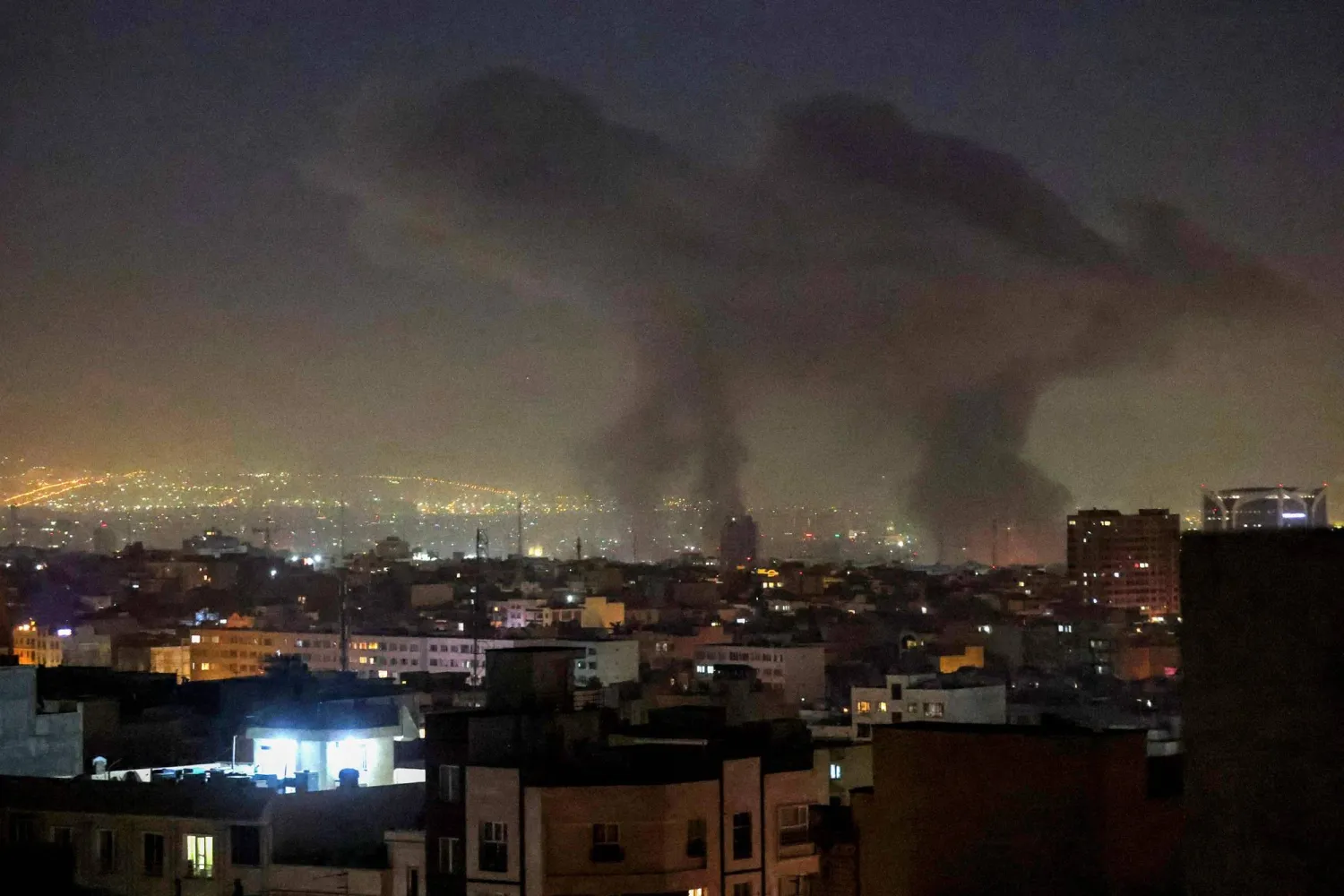
Plumes of smoke rise following reported explosions in Tehran early on March 3, 2026.  (Photo by ATTA KENARE / AFP)
Plumes of smoke rise following reported explosions in Tehran early on March 3, 2026. (Photo by ATTA KENARE / AFP)
TT

Iranian Red Crescent Society Says at Least 787 People in Iran Killed in US-Israeli Airstrikes

Plumes of smoke rise following reported explosions in Tehran early on March 3, 2026.  (Photo by ATTA KENARE / AFP)
Plumes of smoke rise following reported explosions in Tehran early on March 3, 2026. (Photo by ATTA KENARE / AFP)

Airstrikes by the United States and Israel have killed at least 787 people in Iran since the start of the war, the Iranian Red Crescent Society said Tuesday.

It offered the toll in a message on X.

Iran struck the US Embassy in Saudi Arabia’s capital with a drone early Tuesday as it kept hitting targets around the region, while the United States and Israel pounded Iran with airstrikes in what US President Donald Trump suggested was just the start of a relentless campaign that could last more than a month.

The attack from two drones on the US Embassy in Riyadh caused a “limited fire” and minor damage, according to Saudi Arabia’s Defense Ministry, and the embassy urged Americans to avoid the compound. It followed an attack on the US Embassy in Kuwait, which announced Tuesday it had been closed until further notice. The US State Department also ordered the evacuation of non-emergency personnel and family in Kuwait, as well as Bahrain, Iraq, Qatar, Jordan and the United Arab Emirates as a precaution.

Across Iran’s capital, explosions rang out throughout the night into the early morning, with witnesses describing hearing aircraft overhead. It was not immediately clear what had been hit. And in Lebanon, Israel launched more strikes on Hezbollah, the Iran-backed militia group. Explosions could be heard and smoke seen in a southern suburb of Beirut. Israel also said its soldiers are “operating in southern Lebanon.” Lebanon’s state-run National News Agency said the Lebanese army was evacuating some of its positions along the border.

The conflict could have far-reaching consequences

The expansion of Iranian retaliation across the Gulf and the intensity of the Israeli and American attacks, the killing of Iranian Supreme Leader Ali Khamenei and the lack of any apparent exit plan portend a possibly prolonged conflict with far-reaching consequences.

Iran has hit many countries deemed safe havens in the Mideast in retaliation for the US and Israeli strikes. Recent targets include two Amazon data centers in the UAE and a drone impact near another in Bahrain that caused damage, the company said Tuesday. Iran has also hit energy facilities in Qatar and Saudi Arabia, and attacked several ships in the of Strait of Hormuz, the narrow mouth of the Arabian Gulf through which a fifth of all oil traded passes, sending global oil and natural gas prices soaring.

“The Strait of Hormuz is closed," declared Iranian Brig. Gen. Ebrahim Jabbari, an adviser to the paramilitary Revolutionary Guard, threatening to set fire to any ships attempting to transit. “Don’t come to this region.”

US citizens urged to leave

The US State Department urged US citizens to leave more than a dozen Middle Eastern countries due to safety risks, as have many other countries, though with much of the airspace closed many remain stranded.

Trump said operations are likely to last four to five weeks but that he was prepared “to go far longer than that.” He later added that the US had a “virtually unlimited supply” of munitions and pre-positioned “high grade weaponry.”

“Wars can be fought ‘forever,’ and very successfully, using just these supplies,” he wrote on social media.



UN Watchdog Says No Damage to Iran Sites Housing Nuclear Material

A satellite image shows a closer view of the Natanz Nuclear Facility with new building damage, amid the US-Israeli conflict with Iran, near Natanz, Iran, March 2, 2026. (Vantor/Handout via Reuters)
TT

UN Watchdog Says No Damage to Iran Sites Housing Nuclear Material

A satellite image shows a closer view of the Natanz Nuclear Facility with new building damage, amid the US-Israeli conflict with Iran, near Natanz, Iran, March 2, 2026. (Vantor/Handout via Reuters)

The UN nuclear watchdog IAEA said Wednesday facilities housing nuclear material in Iran suffered no damage in the recent US-Israeli strikes and there was no risk of a radiation leak.

"Based on analysis of latest available satellite imagery, IAEA sees no damage to facilities containing nuclear material in Iran and therefore no radiological release risk at this time," the agency said on X.

Near the Natanz site near the central city of Isfahan, "damage is visible at two buildings" and there was "no additional impact detected" after "damage at entrances" reported on Tuesday, it said.

IAEA inspectors have had no access to the key Natanz site since it was targeted by bombings in June during the 12?day war triggered by an Israeli attack.

The IAEA reported "no impact at other nuclear sites, including Bushehr" in the southeast.

IAEA Director General Rafael Grossi repeated his call for "utmost restraint" in the conflict to avoid a radiation threat.


Iranian Govt Making Case for Demise with Indiscriminate Attacks, EU’s Kallas Says

European Union High Representative for Foreign Affairs and Security Policy Kaja Kallas attends a press conference after an informal meeting of Council of the Baltic Sea States in Warsaw, Poland, 04 March 2026. (EPA)
TT

Iranian Govt Making Case for Demise with Indiscriminate Attacks, EU’s Kallas Says

European Union High Representative for Foreign Affairs and Security Policy Kaja Kallas attends a press conference after an informal meeting of Council of the Baltic Sea States in Warsaw, Poland, 04 March 2026. (EPA)

Iran's government is making a strong case for its demise by indiscriminately attacking its neighbors, EU's top diplomat Kaja Kallas told reporters on Wednesday.

"Iran's strategy is to sow chaos and set the region on fire," ‌Kallas said.

Türkiye ‌said earlier on ‌Wednesday that ⁠NATO air defenses destroyed ⁠an Iranian ballistic missile headed into Turkish airspace.

Asked about the incident, Polish Foreign Minister Radosław Sikorski said: "Iran is broadening the war ⁠to countries that did not ‌attack ‌it ... there is a well-known ‌saying it's worse than ‌a crime, it's a mistake."

Kallas said the war in the Middle East is diverting attention from ‌Ukraine, but it was important not to let ⁠the ⁠war in Ukraine recede into the background.

She added that the conflict in Iran has cost Russia an ally, but cautioned that Russia could benefit from a spike in oil prices stemming from the crisis.


Israel Initially Planned to Strike Iran in Mid-2026, Reveals Minister

Israeli Defense Minister Israel Katz makes statements with his Greek counterpart Nikos Dendias after their meeting in Athens, Greece, Tuesday, Jan. 20, 2026. (AP)
TT

Israel Initially Planned to Strike Iran in Mid-2026, Reveals Minister

Israeli Defense Minister Israel Katz makes statements with his Greek counterpart Nikos Dendias after their meeting in Athens, Greece, Tuesday, Jan. 20, 2026. (AP)

Israel had initially planned to strike Iran in mid-2026, but developments inside the country and shifting regional dynamics brought the timetable forward to February, Defense Minister Israel Katz said on Wednesday.

"An operation was planned for the middle of the year with the same target set," Katz said in an address to military intelligence officials, according to a statement issued by his office.

"But due to developments and circumstances -- mainly what happened inside Iran, the position of the US president and the possibility of creating a combined operation -- it became necessary to move everything up to February."

During mass anti-government protests in Iran in January, which were suppressed in a violent crackdown by security forces, Trump pledged support for demonstrators, declaring that the United States stood with the people of Iran.

Top Israeli officials, including Prime Minister Benjamin Netanyahu, made similar remarks, urging Iranians to rise up against the country's clerical leadership.

The United States and Israel jointly launched strikes on Iran on Saturday, and in the initial wave of attacks, they killed supreme leader Ali Khamenei.

Iran retaliated swiftly with missile fire targeting Israel and also launched strikes against several countries in the region, saying it was aiming at US assets.

Iran's official IRNA news agency said Wednesday that US-Israeli strikes had killed 1,045 military personnel and civilians since the start of the war. AFP was not in a position to independently verify the toll.

Iranian strikes on Israel have killed 10 people and injured scores more, according to Israeli authorities.