
Israel Steps up Airstrikes in Tehran, as Iran Widens Its Response Across the Region

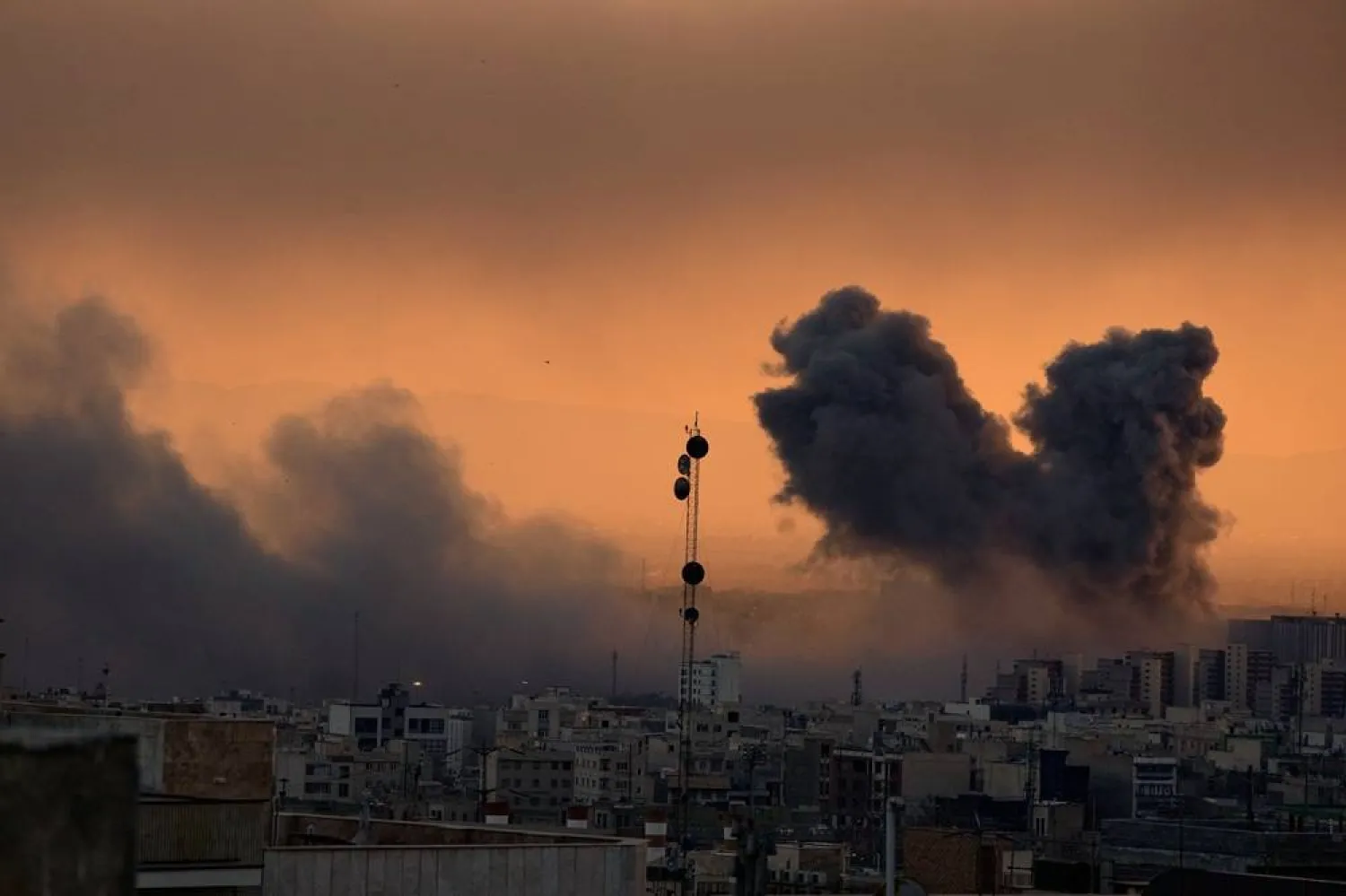
 A plume of smoke rises following a US-Israeli military strike in Tehran, Iran, Tuesday, March 3, 2026. (AP)
A plume of smoke rises following a US-Israeli military strike in Tehran, Iran, Tuesday, March 3, 2026. (AP)
TT

Israel Steps up Airstrikes in Tehran, as Iran Widens Its Response Across the Region

 A plume of smoke rises following a US-Israeli military strike in Tehran, Iran, Tuesday, March 3, 2026. (AP)
A plume of smoke rises following a US-Israeli military strike in Tehran, Iran, Tuesday, March 3, 2026. (AP)

Israel stepped up airstrikes against Iranian missile launchers and factories Tuesday, and Iran retaliated across the Gulf region, disrupting energy supplies and travel. As explosions rang out in Tehran and in Lebanon — where Israel said it struck Hezbollah militants — the American embassy in Saudi Arabia came under drone attack.

Four days into a war that President Donald Trump suggested would last several weeks but perhaps longer, hundreds of people have been killed, the vast majority in Iran, where information has been limited because of poor communications, round-the-clock airstrikes and tight restrictions on journalists.

The spiraling nature of the war raised questions about when and how it would end. Trump seemed to leave open the possibility for more extensive US military involvement, telling the New York Post on Monday that he was not ruling out the possibility of boots on the ground.

The administration has given various objectives. While the initial US-Israeli strikes killed Iranian Supreme Leader Ali Khamenei and Trump urged Iranians to overthrow their government, senior administration officials have since said regime change was not the goal.

Trump said Monday the military campaign’s four objectives were to destroy Iran’s missile capabilities, wipe out its navy, prevent it from obtaining a nuclear weapon and ensure that it cannot continue to support allied armed groups.

Israel and US target nuclear facilities and other targets in Iran

Across Iran’s capital, explosions rang out throughout the night into Tuesday, with aircraft heard overhead.

The Israeli military said it conducted a wave of airstrikes on sites that produce and store ballistic missiles, in Tehran and Isfahan.

Strikes caused two explosions at a broadcasting facility in Tehran, Iranian state TV said, adding that no one was injured.

The United Nations’ nuclear watchdog, the International Atomic Energy Agency, said Iran’s Natanz nuclear enrichment site had sustained “some recent damage,” though there was “no radiological consequence expected.”

The US hit Natanz during the 12-day war in June, when Israeli and American strikes greatly weakened Iran's nuclear program.

Israeli Prime Minister Benjamin Netanyahu maintained, however, that Iran was rebuilding “new sites, new places” underground for making atomic bombs. He offered no evidence to support his claim.

Iran has said it has not enriched uranium since June, though it has maintained its right to and says its nuclear program is peaceful.

Satellite photos analyzed by The Associated Press showed limited activity at two Iranian nuclear sites before the war. Analysts said Tehran was likely assessing damage from the 2025 strikes and possibly salvaging what remained.

Fears rise in Tehran as bombardment of capital intensifies

A north Tehran resident has described growing fears in the capital as it comes under heavy bombardment.

Communications into Iran remain unstable with the internet largely blocked. The resident messaged The Associated Press before dawn on Tuesday. He spoke on the condition of anonymity.

He said a major blast had shaken his building on Monday. “I was by the window and felt the shock wave. Pretty scary, then saw the smoke,” he said.

Most stores in the normally bustling area of Tajrish were closed, he added. Iran has declared an official mourning period following the killing of Khamenei.

The resident said bakeries were open and supermarkets were stocked, but ATMs were mostly “out of cash.” Iran’s economy was already spiraling when the currency crashed to record lows in December.

Attacks in the Gulf

An attack from two drones on the US Embassy in Riyadh caused a “limited fire,” according to Saudi Arabia’s Defense Ministry, and the embassy urged Americans to avoid the compound. It followed an attack on the US Embassy in Kuwait. US Embassies in Saudi Arabia, Kuwait and Lebanon said they were closed to the public.

The US State Department ordered the evacuation of non-emergency personnel and family in Kuwait, Bahrain, Iraq, Qatar, Jordan and the United Arab Emirates. In addition, the US has urged citizens to leave more than a dozen Middle Eastern countries, though with much of the airspace closed many remained stranded. Several other countries arranged evacuation flights for their citizens.

The US-Israeli strikes have killed at least 787 people, according to the Iranian Red Crescent Society. In Israel, where Iranian missiles struck several locations, 11 people were killed. The Iranian-supported Hezbollah party has also attacked Israel, whose retaliatory strikes killed 52 people in Lebanon.

The US military has confirmed six deaths of American service members. In addition, three people were killed in the United Arab Emirates, and one each in Kuwait and Bahrain.

The conflict is roiling business interests

Iran has hit many countries deemed safe havens in the Middle East in retaliation for the US-Israeli strikes. Recent targets included two Amazon data centers in the United Arab Emirates and one in Bahrain. The centers in the UAE were hit, while a drone struck near the one Bahrain, causing damage, the company said.

Iran has also struck energy facilities in Qatar and attacked several ships in the Strait of Hormuz, the narrow mouth of the Gulf through which a fifth of all oil traded passes, sending global oil and natural gas prices soaring.

“The Strait of Hormuz is closed,” declared Iranian Brig. Gen. Ebrahim Jabbari, an adviser to the paramilitary Revolutionary Guard, vowing that any ships that passed through it would be set on fire.

Qatari Foreign Ministry spokesman Majed Al Ansari vowed that Iranian attacks on the gas-rich country “will not go unanswered.”

As oil and natural gas prices climbed, stock prices fell sharply.

Israel sends troops into Lebanon

The conflict has spread to Lebanon, where Hezbollah fired missiles at Israel on Monday, prompting Israel to retaliate.

On Tuesday, the Israeli military hit Beirut with more airstrikes and said it had moved additional troops into southern Lebanon and taken new positions on several strategic points close to the border.

The UN peacekeeping force in Lebanon later said its peacekeepers saw Israeli troops going into and then out of Lebanon. But Israel’s army said its troops are still operating in Lebanon.



Pope Leo Marks First Easter as Pontiff with Call for Hope Amid Global Conflicts

 Pope Leo XIV presides over Easter Mass in St. Peter's Square at the Vatican, Sunday, April 5, 2026 (AP)
Pope Leo XIV presides over Easter Mass in St. Peter's Square at the Vatican, Sunday, April 5, 2026 (AP)
TT

Pope Leo Marks First Easter as Pontiff with Call for Hope Amid Global Conflicts

 Pope Leo XIV presides over Easter Mass in St. Peter's Square at the Vatican, Sunday, April 5, 2026 (AP)
Pope Leo XIV presides over Easter Mass in St. Peter's Square at the Vatican, Sunday, April 5, 2026 (AP)

Pope Leo celebrated his first Easter Mass as pontiff with a call Sunday to exercise hope against “the violence of war that kills and destroys,” saying “we need this song of hope today” as conflicts spread around the world.

With the US-Israeli war on Iran in its second month and Russia’s ongoing campaign in Ukraine, Leo has repeatedly called for a halt in hostilities. In his Easter homily, the pope singled out those who wage war, abuse the weak and prioritize profits.

Leo, the first US-born pope, addressed the faithful from an open-air altar in St. Peter’s Square flanked with white roses, while the steps leading down to the piazza where the faithful gathered were filled with spring perennials, symbolically resonating with the pope’s message of hope.

The pontiff implored the faithful to keep their hope in the face of death, which lurks “in injustices, in partisan selfishness, in the oppression of the poor, in the lack of attention given to the most vulnerable.

“We see it in violence, in the wounds of the world, in the cry of pain that rises from every corner because of the abuses that crush the weakest among us, because of the idolatry of profit that plunders the earth’s resources, because of the violence of war that kills and destroys,” he said.

He quoted his predecessor Pope Francis in warning against falling into indifference in the face of “persistent injustice, evil, indifference and cruelty,” because “it is also true that in the midst of darkness, something new always springs to life and sooner or later produces fruit.”

He will later deliver the traditional “Urbi et Orbi” message — Latin for “to the city and the world.”

Christians in the Holy Land were marking a subdued Easter Traditional ceremonies at the Church of the Holy Sepulchre, revered by Christians as the traditional site of Jesus’ crucifixion and resurrection, were scaled back under an agreement with Israeli police. Authorities have put limits on the sizes of public gatherings due to ongoing missile attacks.

The restrictions also dampened the recent Muslim holy month of Ramadan and Eid al-Fitr holiday, as well as the current weeklong Jewish festival of Passover. On Sunday, the Jewish priestly blessing at the Western Wall — normally attended by tens of thousands — was limited to just 50 people.

The restrictions have strained relations between Israeli authorities and Christian leaders. Police last week prevented two of the church’s top religious leaders, including Latin Patriarch Pierbattista Pizzaballa, from celebrating Palm Sunday at the Church of the Holy Sepulchre.

On Tuesday, the pope had expressed hope that the war could be finished before Easter.


France Condemns China’s Execution of a French Citizen Held on Death Row for 15 Years

 A child holds a Chinese national flag near the Hall of Prayer for Good Harvests in Beijing, China, Friday, April 3, 2026. (AP)
A child holds a Chinese national flag near the Hall of Prayer for Good Harvests in Beijing, China, Friday, April 3, 2026. (AP)
TT

France Condemns China’s Execution of a French Citizen Held on Death Row for 15 Years

 A child holds a Chinese national flag near the Hall of Prayer for Good Harvests in Beijing, China, Friday, April 3, 2026. (AP)
A child holds a Chinese national flag near the Hall of Prayer for Good Harvests in Beijing, China, Friday, April 3, 2026. (AP)

France said China has executed a French citizen convicted of drug trafficking after keeping him on death row for more than 15 years. 

Chan Thao Phoumy, 62, was executed in the southern Chinese city of Guangzhou, despite French authorities’ clemency appeals, the French Foreign Ministry said in a statement late Saturday. It didn’t say when the sentence was carried out. A Chinese court sentenced him to death in 2010. 

The ministry’s statement expressed “consternation” and added: “We particularly regret that Mr. Chan’s defense did not have access to the final court hearing, which constitutes a violation of his rights.” 

“We extend our condolences to his family, whose grief we share,” it said. 

In a short statement Sunday that didn't mention Chan by name, the Chinese Embassy in Paris said that China “treats defendants of all nationalities equally, handles all cases impartially and strictly in accordance with the law.” 

France abolished the death penalty by act of parliament in 1981, and has become a vigorous campaigner against its use and for its abolition everywhere. 

China's use of executions — carried out by firing squads or lethal injections — is shrouded in secrecy but has long been extensive. Amnesty International says China is the world's lead executioner, believed to sentence and put to death thousands of people annually. 


Iran Internet Blackout Is Longest Nationwide Shutdown on Record, Says NetBlocks

Iranians pose for pictures as they celebrate Iranian Nature's Day on the thirteenth day of Nowruz (Persian New Year), in a park in Tehran, Iran, 02 April 2026. (EPA)
TT

Iran Internet Blackout Is Longest Nationwide Shutdown on Record, Says NetBlocks

Iranians pose for pictures as they celebrate Iranian Nature's Day on the thirteenth day of Nowruz (Persian New Year), in a park in Tehran, Iran, 02 April 2026. (EPA)

Iran's internet blackout, first imposed well over a month ago, is now the longest nationwide shutdown on record, according to the monitor NetBlocks.

"Iran's internet blackout is now the longest nation-scale internet shutdown on record in any country, exceeding all other comparable incidents in severity having entered its 37th consecutive day after 864 hours," NetBlocks said in a tweet.

In another tweet, the monitor noted some countries had experienced intermittent or regional-level shutdowns over longer periods, while North Korea had never been connected to the global internet at all.