


US Sinks Iranian Warship as Iran Warns of Widespread Destruction in the Middle East

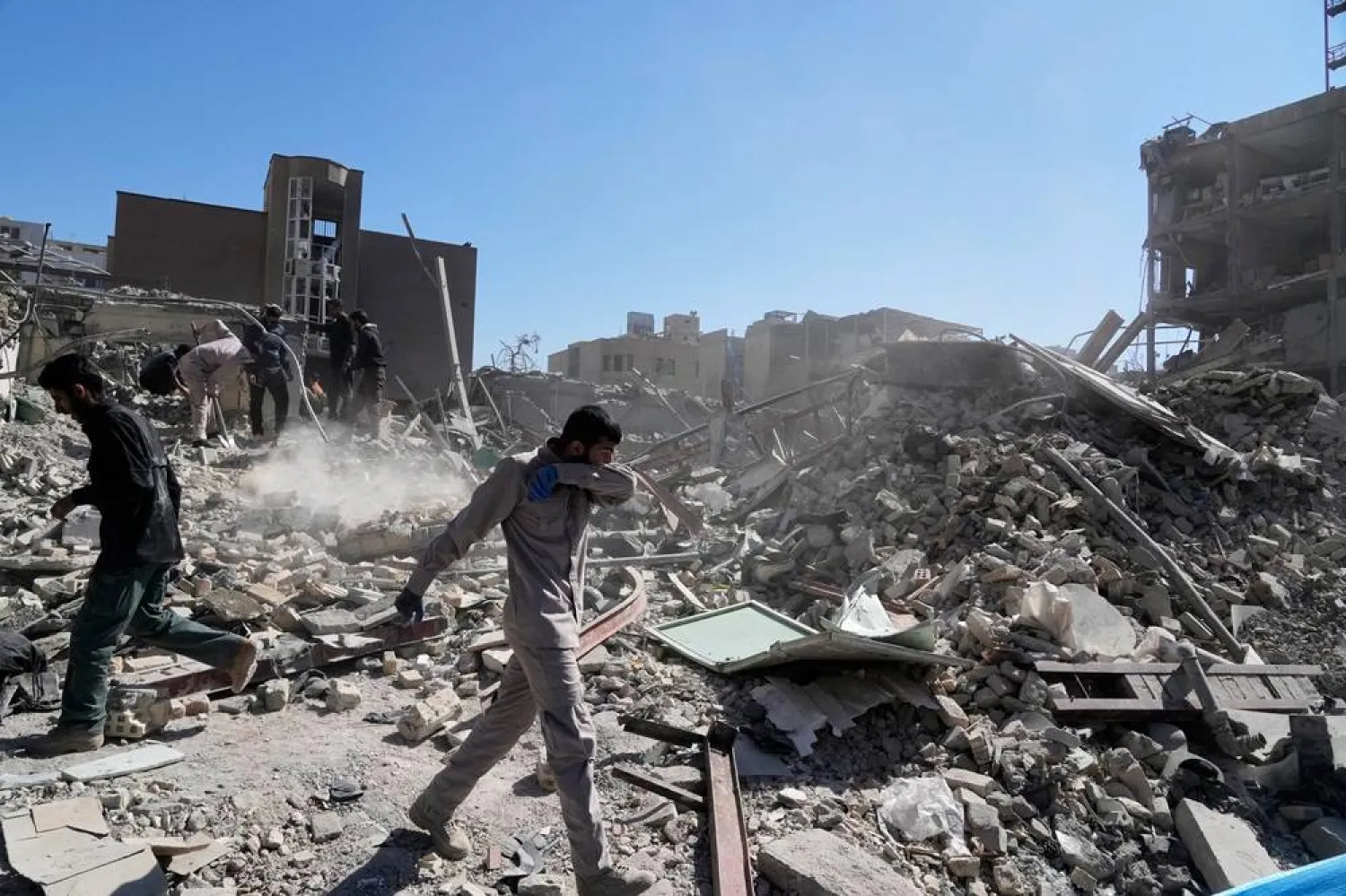
 A group of men inspect the ruins of a police station struck Monday amid the US–Israeli military campaign in Tehran, Iran, Tuesday, March 3, 2026. (AP)
A group of men inspect the ruins of a police station struck Monday amid the US–Israeli military campaign in Tehran, Iran, Tuesday, March 3, 2026. (AP)
TT

US Sinks Iranian Warship as Iran Warns of Widespread Destruction in the Middle East

 A group of men inspect the ruins of a police station struck Monday amid the US–Israeli military campaign in Tehran, Iran, Tuesday, March 3, 2026. (AP)
A group of men inspect the ruins of a police station struck Monday amid the US–Israeli military campaign in Tehran, Iran, Tuesday, March 3, 2026. (AP)

A US submarine sank an Iranian warship in the Indian Ocean, as Washington and Israel intensified their bombardment Wednesday of Iran's security forces and other symbols of power. Iran launched more missiles and drones as it warned of the destruction of military and economic infrastructure across the Middle East. 

The tempo of the strikes on Iran was so intense that state television announced the mourning ceremony for Iranian Supreme Leader Ali Khamenei, who was killed at the start of the conflict, would be postponed. Millions attended the funeral of his predecessor, Khomeini, in 1989. 

The US and Israel launched the war on Saturday, targeting Iran’s leadership, missile arsenal and nuclear program while suggesting that toppling the government is a goal. But the exact aims and timelines have repeatedly shifted, signaling an open-ended conflict. 

Israel was also trading fire with the Iranian-backed Hezbollah group in Lebanon, while Iran fired on Bahrain, Kuwait and Israel. As the conflict spiraled, Türkiye said NATO defenses intercepted a ballistic missile launched from Iran before it entered Türkiye’s airspace. 

The war has killed more than 1,000 people in Iran, more than 50 in Lebanon and around a dozen in Israel, according to officials in those countries. It has disrupted the supply of the world’s oil and gas, snarled international shipping, and stranded hundreds of thousands of travelers in the Middle East. 

Both sides are unrelenting

US Defense Secretary Pete Hegseth said a torpedo from a US submarine sank an Iranian warship in the Indian Ocean Tuesday night. 

Sri Lankan authorities said 32 people were rescued from the ship, which they said had 180 people on board and sank outside Sri Lanka’s territorial waters. The country's navy said it had recovered 87 bodies. 

Israel said it hit buildings associated with Iran's Basij, the all-volunteer force of the paramilitary Revolutionary Guard that conducted a bloody crackdown on protesters in January. Thousands of people were killed and tens of thousands detained as Iranian authorities suppressed those demonstrations. 

The Israeli military also said it hit buildings associated with Iran’s internal security command. Israel and the US have said they want to see Iranians overthrow the country's theocracy, and strikes against Iran's internal security forces may be aimed at hastening that. 

However, Iran's Foreign Minister Abbas Araghchi said over the weekend that its forces have decentralized leadership, with units acting largely on their own according to general orders, which could blunt the effect of attacks on top command and control hubs. 

Iranian state television showed the ruins of buildings in Tehran, with interviewees saying the attacks damaged their homes. Strikes have also been reported in the Shiite seminary city of Qom targeting a building associated with a clerical panel set to pick Iran’s next supreme leader. Iranian media said it was empty at the time. 

Shifting timelines for US operations  

During his Pentagon briefing, Hegseth didn't give a definitive timeline for US operations. 

“You can say four weeks, but it could be six, it could be eight, it could be three,” he said. “Ultimately, we set the pace and the tempo. The enemy is off balance, and we’re going to keep them off balance.” 

Adm. Brad Cooper, the top US military commander in the Middle East, said American forces have damaged Iran’s air defenses and taken out ballistic missiles, launchers and drones. Israeli military spokesman Brig. Gen. Effie Defrin said such damage has led to a decline in launches from Iran. 

Still, air raid sirens and explosions could be heard across central and northern Israel on Wednesday. Israel’s military said Iran launched missiles toward the country. Hezbollah also fired rockets, as Israel pounded targets in the suburbs of the Lebanese capital, Beirut. 

Iran has also struck around the region, and air sirens sounded Wednesday across Bahrain, home to the US Navy’s 5th Fleet. 

At least 1,045 people have been killed in Iran, the country's Foundation of Martyrs and Veterans Affairs said Wednesday. Eleven people have been killed in Israel and more than 50 in Lebanon. Six US troops have been killed. 

Israel says its offensive had been planned for mid-year 

Israeli Defense Minister Israel Katz said the offensive against Iran was originally planned for mid-2026, but “the need arose to bring everything forward to February.” 

He listed events inside Iran, US President Donald Trump's positions “and the whole possibility of creating a combined operation here,” as reasons. 

The protests in Iran put unprecedented pressure on its leadership. Trump threatened military action in response to the crackdown before shifting his attention to Iran's disputed nuclear program. 

Energy supplies in the crosshairs  

Iran’s paramilitary Revolutionary Guard issued its most-intense threat yet, saying the strikes against it would "cost of the complete destruction of the region’s military and economic infrastructure.” 

A container ship was attacked Wednesday while passing through the Strait of Hormuz, the narrow mouth of the Gulf through which about a fifth of the world’s oil is shipped. The ship was hit by an unknown projectile, the United Kingdom Maritime Trade Operations said. 

Tanker traffic through the strait has fallen by around 90% compared to prewar levels, shipping tracker MarineTraffic.com said Wednesday. 

Oil prices have soared as Iranian attacks have disrupted traffic through the strait, and global stock markets have been hammered over worries the spike in oil prices may grind down the world economy. 

Iran’s clerics are choosing a new supreme leader  

Iran’s leaders are scrambling to replace Khamenei, who ruled the country for 37 years. It’s only the second time since the 1979 revolution that a new supreme leader is being chosen. 

Potential candidates range from hard-liners committed to confrontation with the West to reformists who seek diplomatic engagement. Mojtaba Khamenei, Khamenei’s son, has long been considered among them — despite the fact he’s has never been elected or appointed to a government position. 

In a sign that Iran’s leadership will only seek to consolidate its power as it faces its biggest crisis in decades, the head of the judiciary warned that “those who cooperate with the enemy in any way will be considered an enemy.” 

Israel’s defense minister, meanwhile, threatened whoever Iran picks to be the country’s next supreme leader. 

“Every leader appointed by the Iranian terror regime to continue and lead the plan to destroy Israel, to threaten the United States and the free world and the countries of the region, and to suppress the Iranian people — will be a target for elimination,” Israel Katz wrote on X. 

It’s not clear how Washington will respond if a new leader in the mold of Khamenei is chosen. Trump said Tuesday that the “worst case would be do this, and then somebody takes over who’s as bad as the previous person.” 


Trump Says Strait of Hormuz Has Been Demined, Warns Iran Not to Plant More

Vessels in the Strait of Hormuz are visible near the beach of Bandar Abbas, Iran, August 25, 2026. Majid Asgaripour/WANA (West Asia News Agency) via REUTERS
TT

Trump Says Strait of Hormuz Has Been Demined, Warns Iran Not to Plant More

Vessels in the Strait of Hormuz are visible near the beach of Bandar Abbas, Iran, August 25, 2026. Majid Asgaripour/WANA (West Asia News Agency) via REUTERS

US President Donald Trump said on Tuesday that all mines had been detonated or removed from international waters of the Strait of Hormuz and that Iran has been told that any ship or boat placing new mines will be destroyed.

In a post ⁠on Truth Social, ⁠Trump said the United States, through its Space Force, was watching "every square inch" of the Strait, a key waterway in the global energy supply chain.

"There is ⁠a Zero Tolerance policy on mine placement in full force and effect," Trump said.

The US and Iran have not conducted air strikes on each other's militaries for weeks, but attacks on vessels in the Strait of Hormuz have continued as the two sides vie for ⁠control of ⁠the narrow maritime passage.

Oil transits through the strait were at 5 million barrels per day on Monday, provisional data from shiptracker Vortexa showed, down from more than 20 million per day before the war or about one of every five barrels consumed worldwide.


Ukraine’s Zelenskiy Sees Window for US Mediation Until Summer 2027

 Ukraine's President Volodymyr Zelenskiy attends a press conference following a meeting of the so-called Coalition of the Willing group, amid Russia's attack on Ukraine, in Kyiv, Ukraine August 24, 2026. (Reuters)
Ukraine's President Volodymyr Zelenskiy attends a press conference following a meeting of the so-called Coalition of the Willing group, amid Russia's attack on Ukraine, in Kyiv, Ukraine August 24, 2026. (Reuters)
TT

Ukraine’s Zelenskiy Sees Window for US Mediation Until Summer 2027

 Ukraine's President Volodymyr Zelenskiy attends a press conference following a meeting of the so-called Coalition of the Willing group, amid Russia's attack on Ukraine, in Kyiv, Ukraine August 24, 2026. (Reuters)
Ukraine's President Volodymyr Zelenskiy attends a press conference following a meeting of the so-called Coalition of the Willing group, amid Russia's attack on Ukraine, in Kyiv, Ukraine August 24, 2026. (Reuters)

Ukraine sees a window of opportunity for US mediation to end Russia's war in Ukraine until the end of next summer and has drafted one page of ideas with US and European officials to be presented to Moscow, President Volodymyr Zelenskiy said.

Zelenskiy said that a ceasefire and a previously discussed US proposal for a free economic zone in Ukraine's eastern Donbas area — to be administered by a third party — were among the ideas in the ‌document.

"It contains ‌one of the ideas for a ceasefire — that ‌is ⁠the main point. The ⁠second part concerns what the Americans proposed regarding a free economic zone," Zelenskiy told reporters in a weekend briefing.

Zelenskiy said that he saw a window to end the nearly four-and-a-half years of fighting that stretched from the G20 summit in the US in December this year until the end of summer 2027, given the looming campaign for the ⁠2028 presidential election in the US.

Zelenskiy said earlier this ‌month that Ukraine had handed proposals to ‌US negotiators for a plan to end the war, without providing more detail.

US-led ‌peace talks fell apart earlier this year as Ukraine refused Russian ‌demands to cede more territory and as Washington became increasingly preoccupied with the conflict with Iran.

US negotiators Steve Witkoff and Jared Kushner were last in Moscow in January and have not yet visited Kyiv.

Zelenskiy said the third ‌element in the draft proposal was the role that the European Union and NATO would play and ⁠what "Ukraine is ⁠prepared to do to achieve this". He did not elaborate further.

"These three ideas I've mentioned are not exclusively Ukrainian ideas," Zelenskiy said, adding they were developed jointly with the Americans and the Europeans, with some stemming from previous talks US negotiators had with Ukraine and Russia.

Russia was open to listening to new proposals on how to reach a settlement on the Ukraine conflict, but they should reflect the "realities on the ground", a senior Russian diplomat said in an interview published last week.

Moscow's key objective is capturing the remainder of Donbas, where it has been making a push to advance into Ukraine's so-called fortress belt of eastern cities.


UN, Red Cross Chiefs: World Must Rein in Autonomous Weapons

FILE PHOTO: United Nations Secretary-General Antonio Guterres leaves after a press conference at a UN compound in the Nicosia airport area, Cyprus, July 29, 2026. REUTERS/Yiannis Kourtoglou/File Photo
TT

UN, Red Cross Chiefs: World Must Rein in Autonomous Weapons

FILE PHOTO: United Nations Secretary-General Antonio Guterres leaves after a press conference at a UN compound in the Nicosia airport area, Cyprus, July 29, 2026. REUTERS/Yiannis Kourtoglou/File Photo

The United Nations and Red Cross warned Tuesday the world is "dangerously close" to a future where autonomous weapons -- so-called "killer robots" -- could target humans, and issued an urgent appeal for international regulations.

The warning follows a call in 2023 from UN Secretary General Antonio Guterres and Mirjana Spoljaric, president of the International Committee of the Red Cross, for countries to establish specific bans and restrictions on the rapidly developing technology by this year.

"Today, we renew this call with even greater urgency," they said in a joint statement, adding that while their "fundamental concerns remain unchanged... the risks have intensified.”

"We are now dangerously close to crossing a moral red line: the autonomous targeting of humans by machines," they warned.

Lethal autonomous weapon systems are generally understood as weapon systems that select targets and apply force without human intervention.

There has to date been no confirmed use of fully autonomous weapons.

But with global tensions soaring and conflicts raging in the Middle East and Ukraine, where drone warfare has become a major feature of the battlefield, fears abound that it could soon happen.

There is currently no specific treaty on autonomous and artificial intelligence-enabled weapons.

"Autonomous weapon systems are not part of a distant future: a race towards greater autonomy in weapons systems is already well under way," AFP quoted Guterres and Spoljaric as saying.

"Future generations will ask whether leaders acted when there was still a chance to set limits before these weapons proliferated beyond control."

They highlighted that scientists and engineers involved in developing such systems had, in many cases, raised the alarm themselves.

"When the architects of this technology are calling for limits, states cannot afford to remain passive," they said.

Discussions have been running for a decade around a possible future treaty regulating the use of autonomous weapons.

After three years of discussions, countries are due to decide in November whether to launch full-on treaty negotiations.

The UN and Red Cross chiefs called for "political courage,” saying: "A failure to act quickly and decisively will cost lives."

The need for clearly defined rules was "urgent,” they said, insisting that "innovation must serve humanity -- not endanger it.”
