


Hormuz Strait Puts Global Economy in ‘Intensive Care’

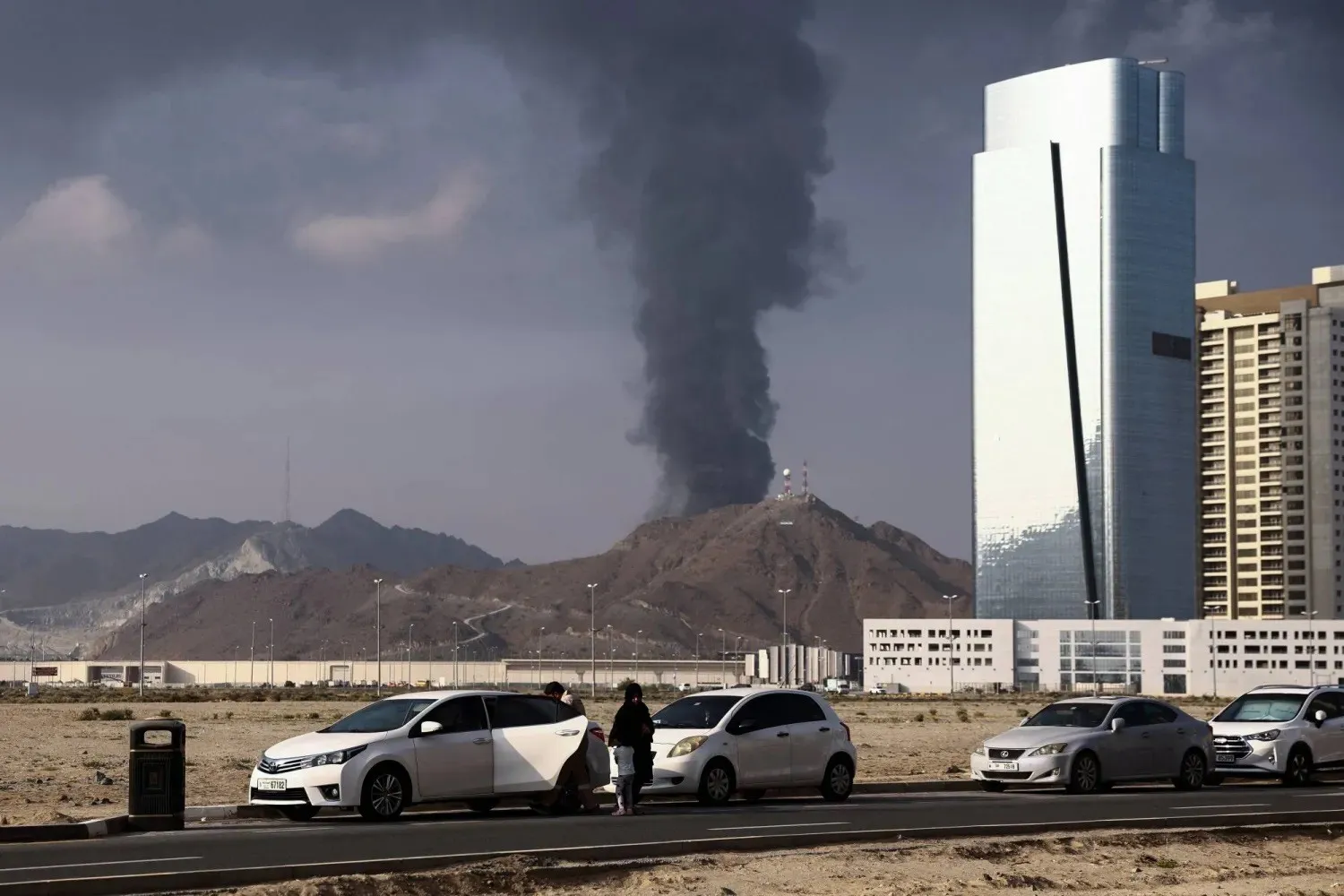
Smoke rises over the oil industry area in Fujairah after a fire caused by debris following the interception of a drone by air defenses. (Reuters)
TT

Hormuz Strait Puts Global Economy in ‘Intensive Care’

Smoke rises over the oil industry area in Fujairah after a fire caused by debris following the interception of a drone by air defenses. (Reuters)

The Strait of Hormuz is no longer merely an international waterway. In a decisive moment, it has turned into a tightly sealed bottleneck choking the global economy. As plumes of smoke rise from critical energy facilities following military confrontations between Iran on one side and Israel and the United States on the other, the world finds itself in the grip of a severe supply shock.

Attacks on tankers and energy infrastructure have disrupted oil and gas flows that power global industry, transforming once-secure shipping lanes into open conflict zones. Markets from Tokyo to London are already feeling the strain.

Brent crude prices reacted immediately, surging above $85 a barrel, with serious warnings that a prolonged maritime blockade could push prices toward the $100 mark.

Europe’s gas markets under pressure

In Europe, the crisis has escalated sharply. Gas prices recorded a staggering 70% cumulative jump within just two days.

The benchmark Dutch TTF (Title Transfer Facility) gas contract climbed 29.5%, reaching €57.50 per megawatt-hour, its highest level in more than a year. Analysts at ANZ warned the situation represents the “largest threat to global gas markets since Russia’s invasion of Ukraine in 2022.”

The spike places Europe - already struggling with low gas inventories - under intense pressure to compete with Asian buyers for limited spot cargoes. At the same time, US supplies are unlikely to fully replace the long-term gap left by disrupted Qatari shipments.

Saudi oil rerouted

In an effort to ease the pressure, Reuters reported that Saudi Aramco has launched a high-risk logistical maneuver to redirect crude exports away from the Strait of Hormuz.

According to sources, the company has informed some buyers of its Arab Light crude that their cargoes must be loaded from Yanbu Port on the Red Sea instead of Gulf terminals. The rerouting relies on Saudi Arabia’s massive East-West Pipeline (Petroline).

Gas shock from Qatar

Across the Gulf, military strikes targeting the Ras Laffan Industrial City complex in Qatar have caused a structural disruption to downstream production, not merely a pause in liquefied natural gas exports.

The complex is not just a gas extraction and liquefaction hub; it also serves as a supply center feeding major industrial plants with feedstock and energy required for smelting and chemical conversion.

The shutdown has broken logistical and operational links with facilities producing urea, polymers, methanol, and aluminum.

For Qatalum, the joint venture between QatarEnergy and Norsk Hydro, the disruption goes beyond an energy shortage. Aluminum smelting cells require an uninterrupted supply of electricity and natural gas.

With an annual production capacity of 648,000 tons, the company now faces a technical dilemma that extends beyond halted production to the risk of “frozen furnaces.”

Such a scenario would require enormous costs and extended time to restart operations if the energy disruption continues.

The industrial exposure has triggered supply panic across global markets. Aluminum prices on the London Metal Exchange jumped 3.8% to $3,250 per ton, reflecting a growing risk premium driven by fears of supply shortages.

At the same time, worsening logistical disruptions at major ports such as Fujairah Port in the UAE and Duqm Port in Oman have compounded the crisis.

Manufacturers are now facing not only raw-material shortages, but also shipping bottlenecks caused by tanker scarcity and the closure of the Strait of Hormuz.

Shipping industry in crisis

The maritime shipping sector has entered an unprecedented crisis. Rates for very large crude carriers (VLCCs) in the Middle East have soared to historic levels, exceeding $423,000 per day for shipments from the Gulf to China.

Iranian threats to open fire on any vessel attempting to transit the Strait of Hormuz have effectively halted many shipping operations. Daily charter rates for liquefied natural gas (LNG) carriers have also jumped by more than 40%.

Analysts at Wood Mackenzie expect spot rates to surpass $100,000 per day this week, driven by the scarcity of available vessels.

The logistical turmoil, combined with disruptions to fuel supplies at the Fujairah bunkering hub, has pushed global shipping companies such as Hyundai Glovis to activate emergency plans to secure alternative routes. The situation reflects growing logistical panic that could isolate global supply chains.

Global markets slide

The fallout has not been limited to commodity markets. Financial markets worldwide have also been shaken as investors retreat from risk.

The MSCI Asia Pacific Index (ex-Japan) fell 2.9%, extending losses for a second straight day. South Korea’s benchmark index plunged 7.2% after markets reopened following a holiday, the largest single-day drop since August 2024.

Japan’s Nikkei 225 dropped 3.1%, while S&P 500 electronic futures slipped 0.9%, according to Reuters.



Saudi East-West Pipeline Underpins Kingdom’s Energy Security Strategy

The King Fahd Industrial Port in Yanbu. (SPA)
TT

Saudi East-West Pipeline Underpins Kingdom’s Energy Security Strategy

The King Fahd Industrial Port in Yanbu. (SPA)

As regional military tensions escalate and attacks on shipping in the Strait of Hormuz recur, Saudi Arabia’s East-West oil pipeline has re-emerged as a critical safeguard in the global energy system.

With markets closely watching threats to the vital maritime corridor, the Kingdom’s sovereign infrastructure is acting as a strategic shield to keep oil flowing. The moment underscores that Saudi Arabia’s logistical resilience and delivery capacity are as vital as its production strength, reinforcing its reputation as the most reliable supplier in times of turmoil.

In a statement to Asharq Al-Awsat, Saudi Aramco said it had adjusted crude oil shipping operations to prioritize safety and service continuity, and to help ensure reliability, by temporarily redirecting allocated volumes to the Yanbu port as an option for customers unable to access the Arabian Gulf.

“We remain fully committed to supporting and serving our customers and continue to assess the situation in order to resume normal procedures,” the company said.

Reuters earlier cited sources as saying Aramco was seeking to reroute some crude exports to the Red Sea to avoid the Strait of Hormuz, after the risk of attacks brought shipping traffic to a near halt.

The company has also informed some buyers of its Arab Light crude that cargoes would need to be loaded at Yanbu.

Sovereign infrastructure

The pipeline, known as Petroline, is more than a transport project. It is sovereign infrastructure built to protect Saudi crude flows from potential maritime disruptions.

The East-West pipeline carries crude from fields in Saudi Arabia’s Eastern Province to the Red Sea coast, where it is exported through King Fahd Industrial Port in Yanbu. Stretching about 1,200 kilometers across the Kingdom, it runs through several pumping stations capable of moving millions of barrels per day efficiently.

The line began operating in the early 1980s during a period of heightened regional security concerns, when fears were growing over threats to shipping in the Strait of Hormuz, a route that carries about one-fifth of global seaborne oil trade.

The project had three clear aims: to provide an export outlet outside the Arabian Gulf, to strengthen Saudi energy security, and to reassure global markets about the continuity of supply.

Today, the pipeline has a capacity of about five million barrels per day, far above its initial capacity at launch. That scale gives Saudi Arabia significant logistical flexibility to redirect exports quickly in response to geopolitical or operational disruptions.

Operated by Saudi Aramco, the line is managed through advanced monitoring systems that efficiently regulate crude flows, alongside strict technical and security safeguards.

Why it matters now

Financial and economic adviser Dr. Hussein Al-Attas told Asharq Al-Awsat the pipeline linking the Eastern Region to Yanbu is among the most important strategic infrastructure projects in Saudi Arabia’s energy sector.

Its capacity of roughly five million barrels per day provides the kingdom with high logistical flexibility if disruptions occur in the Arabian Gulf or the Strait of Hormuz, he said.

Amid geopolitical tensions, having an export outlet far from maritime chokepoints reduces operational risks and strengthens the Kingdom’s ability to honor long-term supply contracts.

It is impossible to speak of zero disruptions in absolute terms, but the pipeline significantly reduces risks and makes the likelihood of widespread disruption to Saudi exports very low compared with many other producers, Al-Attas said.

He added that Petroline has evolved from a logistics project into a tool of economic national security.

What was once an oil transport project designed to improve export efficiency has become part of the Kingdom’s economic national security architecture, he said.

Aramco now treats it not only as an alternative route but as a strategic option that diversifies export outlets, reduces reliance on sensitive maritime passages, protects oil export revenues and strengthens reliability for customers in Asia and Europe.

Al-Attas stressed that delivery capability is as important as production capacity, noting that the pipeline’s strategic value lies in ensuring supply even under the most difficult conditions.

During wars or regional tensions, markets rapidly price in risk, he said. The presence of an effective alternative route gives Saudi Arabia a competitive edge by helping ease the risk premium on its crude compared with producers reliant on a single export route.

It also reinforces investor confidence in the stability of Aramco’s cash flows and strengthens the Kingdom’s image as a long-term reliable supplier—an important factor in futures markets.

The more Saudi Arabia proves it can maintain supplies even in the toughest circumstances, the more global markets will see it not only as the largest oil exporter but also as the most reliable and stable, Al-Attas said.

He stressed that the East-West pipeline is no longer just crude transport infrastructure. It is now a strategic pillar that protects revenues, supports financial stability and strengthens Saudi Arabia’s geopolitical weight in the global energy security equation.


Hungary Presses Russia Not to Hike Energy Prices amid Iran Turmoil

3D-printed oil barrels, an oil pump jack and a map showing the Strait of Hormuz and Iran appear in this illustration taken March 2, 2026. REUTERS/Dado Ruvic/Illustration/File Photo
TT

Hungary Presses Russia Not to Hike Energy Prices amid Iran Turmoil

3D-printed oil barrels, an oil pump jack and a map showing the Strait of Hormuz and Iran appear in this illustration taken March 2, 2026. REUTERS/Dado Ruvic/Illustration/File Photo

Hungary wants guarantees from Russia that it will not charge Budapest more for oil and gas, despite global prices jumping due to conflict in the Middle East, Hungary's foreign minister said Wednesday.

Hungarian Foreign Minister Peter Szijjarto was in Moscow to meet Russian President Vladimir Putin in the Kremlin later Wednesday to press the request, according to AFP.

Energy prices have surged since the United States and Israel attacked Iran on Saturday, including the benchmark price of Russian crude.

Hungary is the European Union's biggest importer of Russian fossil fuels, having maintained purchases and secured exemptions from sanctions despite pressure from Brussels amid the Russian offensive on Ukraine.

Budapest was already facing disruption from the closure of the Druzhba pipeline, which transports Russian oil to Hungary and which Ukraine says was damaged in a Russian strike.

Szijjarto said he would be seeking assurances that "the crude oil and natural gas necessary for Hungary's energy supply will continue to be available to us.

"I am also here to obtain guarantees that, despite the changed circumstances and the global energy crisis, Russia will continue to deliver the necessary quantities of oil and gas for Hungary at unchanged prices," he added.

Budapest relies on Russian oil and is currently in a standoff with Kyiv over a halt to supplies via the Soviet-era Druzhba pipeline, which runs through Ukraine.

Ukraine says Russia attacked the pipeline in January and that the threat of another strike was holding up repairs.

Hungary and Slovakia -- which also buys Russian crude -- accuse Kyiv of delaying the repairs in an attempt to put pressure on them and choke them of Russian energy.

Kremlin spokesman Dmitry Peskov said buyers of Russian oil were "facing blackmail" and accused Kyiv of "the deliberate blocking of deliveries through the Druzhba pipeline".


Gold Gains as Middle East Conflict Revives Safe-haven Bid

American gold bars stand on display during a preview of "Gold", a new exhibition dedicated to the highly prized mineral at the American Museum of Natural History in New York, November 15, 2006. The exhibit opens November 18 and runs through August 19 2007. REUTERS
TT

Gold Gains as Middle East Conflict Revives Safe-haven Bid

American gold bars stand on display during a preview of "Gold", a new exhibition dedicated to the highly prized mineral at the American Museum of Natural History in New York, November 15, 2006. The exhibit opens November 18 and runs through August 19 2007. REUTERS

Gold prices climbed 2% on Wednesday, rebounding from their lowest in more than a week reached in the previous session, as the dollar took a breather and mounting tensions in the Middle East drove investors toward safe havens.

Spot gold gained 2.2% to $5,198.58 per ounce by 1017 GMT, after falling more than 4% on Tuesday.

US gold futures for April delivery added 1.7% to $5,211.20, Reuters reported.

The US dollar fell 0.2%, making greenback-priced gold more affordable for buyers using other currencies.

"After the past few days of position unwinds and dollar strength, markets are back to a more typical macro risk-off stance, with silver higher too. A pause in the rise of the dollar and Treasury yields helps with their opportunity costs," said Jamie Dutta, market analyst at Nemo.money.

"Gold and silver's safe-haven characteristics can shine again." Gold's appeal as it draws support from the widening conflict in the Middle East is expected to remain intact even if some investors have favored the dollar as their preferred safe-haven, traders and analysts said on Tuesday.

Spot silver advanced 5.3% to $86.39 per ounce, after falling more than 8% in the last session. US forces continued round-the-clock assaults on Iran, and Israel mounted a "broad wave" of strikes targeting Iranian missile sites and air defense systems. Asian stocks tanked as investors dumped crowded bets on chipmakers on worries that the widening Middle East war would drive an oil shock, accelerating inflation and delaying interest rate cuts.

Markets see the US Federal Reserve holding rates at its two-day meeting later this month.

"If the military campaign prolongs or expands across the region, safe-haven demand could continue to support gold above the $5,000/oz level and potentially open the door for a retest of the recent highs," said Linh Tran, senior market analyst at XS.com. Spot platinum added 5.1% to $2,189.68 an ounce. The global platinum market is forecast to post a fourth consecutive year of deficit in 2026 at 240,000 troy ounces, the World Platinum Investment Council said. Palladium gained 3.6% to $1,705.71.