


Iran’s Choice of Mojtaba Khamenei Appears to Close Path to Swift End to War

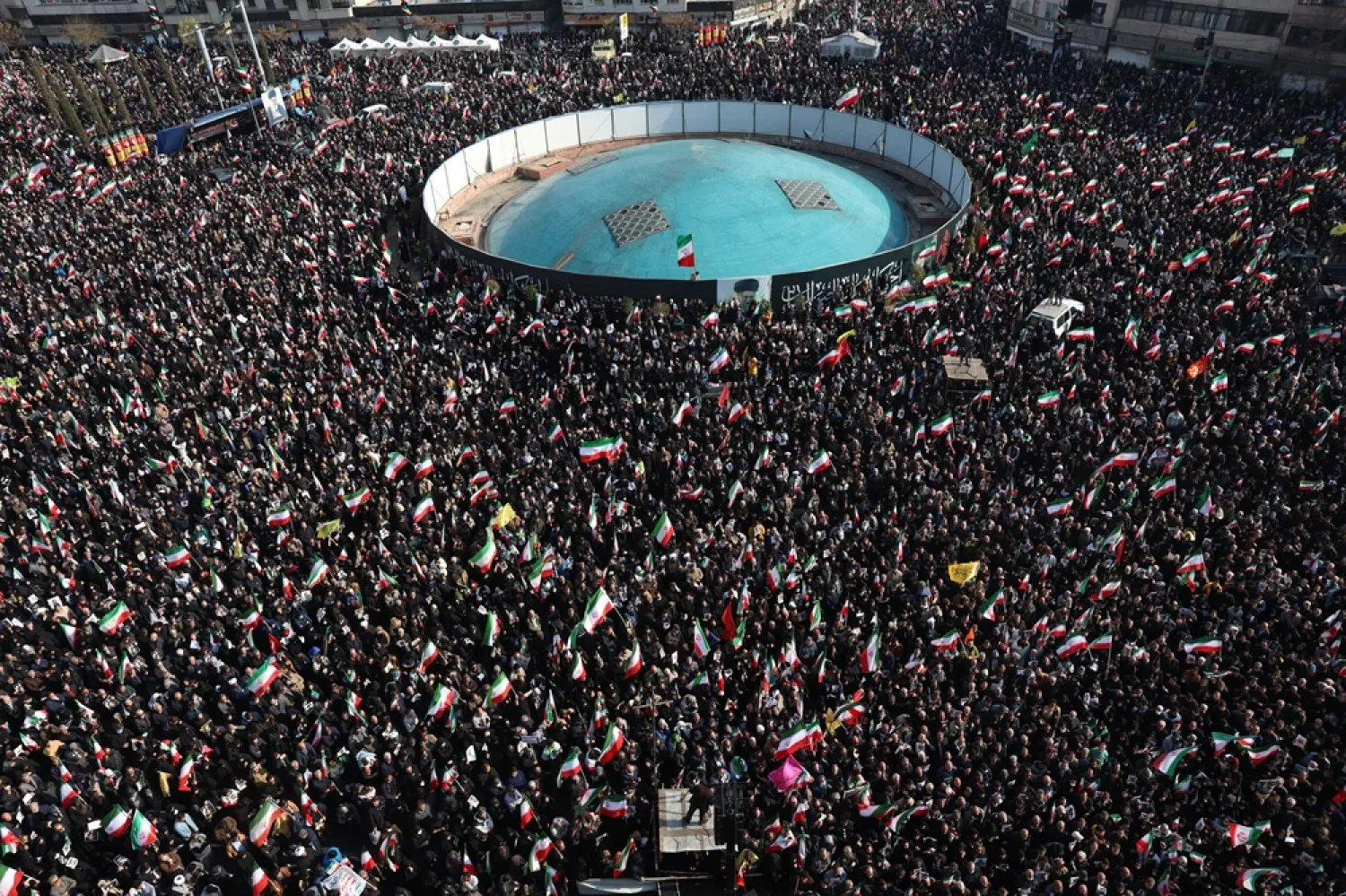
An Iranian man holds a portrait of Mojtaba Khamenei, son of the late Supreme Leader Ali Khamenei, during the 47th anniversary celebrations of the revolution in Tehran, Iran, 11 February 2026. (EPA)
TT

Iran’s Choice of Mojtaba Khamenei Appears to Close Path to Swift End to War

An Iranian man holds a portrait of Mojtaba Khamenei, son of the late Supreme Leader Ali Khamenei, during the 47th anniversary celebrations of the revolution in Tehran, Iran, 11 February 2026. (EPA)

Iran named Mojtaba Khamenei to succeed his slain father as supreme leader on Monday, signaling that hardliners remain firmly in charge and appearing to close off any path to a swift end to war in the Middle East. 

The prospect that the disruption to global energy supplies - already one of the most severe in history - could last longer than previously expected sent oil prices surging in record leaps and global stock markets went into a nosedive. 

Khamenei, 56, a cleric with a power base among the security forces and their vast business empire, has been declared unacceptable by US President Donald Trump, who has demanded Iran's unconditional surrender. 

IRAN'S POLITICAL SYSTEM RALLIES BEHIND MOJTABA 

Iran's political system rallied around the new supreme leader, with politicians and institutions issuing strongly worded pledges of loyalty. Public processions to take loyalty vows were announced for later on Monday. 

"We will obey the commander-in-chief until the last drop of our blood," a defense council statement said. 

Mojtaba's father, Supreme Leader Ali Khamenei, was killed in one of the first strikes against Iran more than a week ago. 

Mojtaba had been viewed as a frontrunner before Sunday's vote by the Assembly of Experts, a body of 88 ‌clerics tasked with choosing the ‌new supreme leader, who has the final say in all matters of state. 

Despite public vows of loyalty, ‌Iranian ⁠society remains deeply divided. ⁠Many Iranians publicly celebrated the elder Khamenei's death, weeks after his security forces killed thousands of anti-government protesters in the worst domestic unrest since the era of Iran's 1979 revolution. 

But there has been little sign of anti-government activity during the bombing campaign. Activists say it would be unsafe to take to the streets while the country is under attack. 

Israel says its war aim is to overthrow Iran's system of clerical rule. Washington was initially more circumspect, saying its aim was to destroy Iran's missile capabilities and nuclear program, although Trump ratcheted up his demands by also demanding the installation of a compliant Iranian government. 

Israel had said it would kill whoever succeeded the elder Khamenei unless Iran ended its hostile policies. Trump repeated his demand on Sunday that Washington have a say in the selection of the new supreme leader. 

"If ⁠he doesn't get approval from us, he's not going to last long," he told ABC News, adding ‌that ending the war would be a "mutual" decision with Israeli Prime Minister Benjamin Netanyahu. 

In an interview ‌with the Times of Israel after the new supreme leader was named, Trump declined to respond, saying only "We'll see what happens," according to the newspaper. 

OIL SURGES PAST $100 ‌A BARREL 

The war has effectively shut the Strait of Hormuz, where a fifth of global oil and seaborne liquefied gas is shipped near the ‌Iranian coast. With tankers unable to sail for over a week, producers have run out of storage and are being forced to halt pumping. 

Brent crude futures were up 12.5% at $104.30 per barrel at 1017 GMT, having earlier shot as high as 119.50, on track at one point for the biggest jump in a single day. 

The prospect of a prolonged energy crisis - reviving memories of the Middle East oil shock of the 1970s - sent share markets in Asia and Europe into a tailspin, which futures showed was ‌likely to reach Wall Street when it opens on Monday. 

The price of gasoline has huge political resonance in the United States, where Trump's Republicans hope to keep control of Congress in midterm elections in ⁠November. He won re-election in 2024 after ⁠pledging to end foreign wars and cut the cost of living. 

"Short-term oil prices, which will drop rapidly when the destruction of the Iran nuclear threat is over, is a very small price to pay for USA, and World, Safety and Peace," Trump posted on Truth Social on Sunday night. "ONLY FOOLS WOULD THINK DIFFERENTLY!" 

Tehran was choked in heavy black smoke from strikes that hit an oil refinery, an escalation in attacks to target Iran's domestic energy supplies which appeared to trigger attacks on Washington's Gulf Arab allies. 

Thick smoke rose from a huge refinery in Bahrain, where state oil company Bapco declared force majeure after it was struck overnight. 

The Israeli military said on Monday it had launched attacks in central Iran and struck the Lebanese capital Beirut, where Israel has extended its campaign after the Iran-backed Hezbollah fired across the border. 

The US military reported a seventh American had died from wounds sustained during Iran's initial counter-attack a week ago. 

Israel's military said on Sunday two of its soldiers were killed in southern Lebanon, the first fatalities among its troops since Israel-Hezbollah hostilities resumed. 

At least four people were killed in an Israeli strike on an apartment in the Ramada hotel building in central Beirut early on Sunday. Israel said it had targeted Iranian commanders operating in Beirut. 

The US-Israeli attacks have killed at least 1,332 Iranian civilians and wounded thousands, according to Iran's UN ambassador. Lebanon has reported scores of people killed there. 

In Israel, ambulance workers said one man was killed from shrapnel wounds at a construction site on Monday, raising to 11 the death toll in Iranian strikes. 


Kurdish Rebels Say Ready to Resist Iran, Await Uprising

A Kurdish fighter from the Iranian Kurdish armed faction Kurdistan Free Life Party (PJAK) stands with his rifle at a site near the Iraqi border with Iran in Iraq's autonomous Kurdistan region, on March 8, 2026. (AFP)
TT

Kurdish Rebels Say Ready to Resist Iran, Await Uprising

A Kurdish fighter from the Iranian Kurdish armed faction Kurdistan Free Life Party (PJAK) stands with his rifle at a site near the Iraqi border with Iran in Iraq's autonomous Kurdistan region, on March 8, 2026. (AFP)

From their hideouts in the Iraqi mountains near Iran, leftist Kurdish rebels say they are ready to fight the country, but hope for an uprising before they intervene, with or without US support.

After saying that he would be "all for" a Kurdish offensive on Iran, US President Donald Trump appeared to backtrack Saturday, saying he did not want such an attack.

Senior commander Roken Nerada of the Party of Free Life of Kurdistan (PJAK) told AFP: "If there is an attack on the Kurdish people... then with every means... we are ready to resist as we always have."

"I think we can achieve our rights without the help of the US or any other country," said Nerada, 39, who joined the rebels 17 years ago.

Like other Iranian Kurdish rebel groups, PJAK has bases in the mountains of Iraq's northern autonomous Kurdistan region, but it also maintains hideouts in majority-Kurdish areas inside Iran.

Iran has designated Kurdish rebels groups as terrorist organizations, and many have previously fought its security forces in Kurdish-majority areas along the border.

But in recent years, under political pressure mostly from their Iraqi hosts, they have largely refrained from armed activity -- raising questions about their current capacity to lead an armed offensive against Iran.

AFP journalists met 30 PJAK fighters in a bunker adorned with photos of fallen comrades, with a television inside showing war coverage with smoke rising from Tehran and Beirut.

Since the Middle East war began late last month with a wave of US-Israeli strikes on Iran, Tehran has repeatedly struck Kurdish militants' positions in Iraq, accusing them of serving Western or Israeli interests.

- Ground attack, not yet -

Just before the war, and after anti-government protests in Iran, PJAK joined a coalition of Kurdish rebel parties seeking to overthrow the Tehran regime and secure self-determination.

"We are ready to fight, especially after what they did 50 days ago," PJAK fighter Shwan said, referring to the crackdown on the protests in Iran that left thousands dead.

Amid reports that rebels might collaborate with the US, Tehran threatened to target "all facilities" in Iraq's Kurdistan if Kurdish militants cross the border.

But on Saturday, Trump said "we're not looking to the Kurds going in".

"We don't want to make the war any more complex than it already is," he added.

Amir Karimi, another commander in PJAK, told AFP last week that the "Americans are already in the area, and we have had a dialogue".

It was "a political exchange... to get to know each other," Karimi said, adding that "a ground attack is not on the table at this stage".

"From a strategic and tactical point of view, we believe it wouldn't be a good idea," he added, warning that Iranian forces have reinforced the borders.

"The most important thing is that the population itself becomes a driving force. There must be a popular uprising" in Iran, Karimi said.

"We are not waiting for Iran or the United States to give us the green light. But the population needs support from the outside," he added.

The Kurds will need guarantees to secure a democratic Iran, he said.

"Who can say that, tomorrow, they won't support another dictator and bring him to power," Karimi said, referring to the US.

Commander Nerada said: "What is important... is to change this current darkness into a democratic Iran."


Macron Arrives in Cyprus to Discuss Security Amid Middle East War

French President Emmanuel Macron is greeted by Cypriot President Nikos Christodoulides, as he arrives at the Paphos military airport, during a visit showing France's solidarity after recent drone attacks amid the US-Israeli conflict with Iran, and aimed at reinforcing European security in the Eastern Mediterranean, in Paphos, Cyprus, March 9, 2026. (Reuters)
TT

Macron Arrives in Cyprus to Discuss Security Amid Middle East War

French President Emmanuel Macron is greeted by Cypriot President Nikos Christodoulides, as he arrives at the Paphos military airport, during a visit showing France's solidarity after recent drone attacks amid the US-Israeli conflict with Iran, and aimed at reinforcing European security in the Eastern Mediterranean, in Paphos, Cyprus, March 9, 2026. (Reuters)

French President Emmanuel Macron arrived in Cyprus on Monday to discuss regional security, while Paris deployed warships to the Mediterranean and the US-Israeli war on Iran stretched into a second week.

Macron, who landed in Paphos earlier on Monday, met Cypriot President Nikos Christodoulides and Greek Prime Minister Kyriakos Mitsotakis for talks.

European Union member Cyprus was targeted last week by Iranian-made drones, leading Macron to order France's Charles de Gaulle aircraft carrier to the Mediterranean, as well as a frigate and air defense units to the island nation.

Macron was scheduled to visit the Charles de Gaulle on Monday afternoon. France's flagship is currently stationed off the coast of Crete, according to the Elysee.

The Elysee has said the visit aims to show "solidarity" and detail moves to "strengthen security around Cyprus and in the eastern Mediterranean".

Macron said he had spoken to his US and Iranian counterparts on Sunday ahead of the trip.

Macron also spoke on Monday morning to Israeli Prime Minister Benjamin Netanyahu about the situation in the Middle East and Lebanon, the Elysee said.

He had already spoken with Netanyahu last week for the first time since the summer of 2025.

During his visit to Cyprus, the French leader was also to discuss freedom of navigation and maritime security in the Red Sea and the Strait of Hormuz.

There have been numerous attacks targeting the key waterway in the Gulf since the US-Israeli war on Iran started on February 28.

A government spokesman for Cyprus, Konstantinos Letymbiotis, has said Macron's visit will allow the leaders of Cyprus, Greece and France to assess the "high level of coordination" between their nations.


Iran War’s Effects Already a Reality in Europe, Says EU Chief

 European Commission President Ursula von der Leyen speaks during a media conference at EU headquarters in Brussels, Belgium, Monday, March 2, 2026. (AP)
European Commission President Ursula von der Leyen speaks during a media conference at EU headquarters in Brussels, Belgium, Monday, March 2, 2026. (AP)
TT

Iran War’s Effects Already a Reality in Europe, Says EU Chief

 European Commission President Ursula von der Leyen speaks during a media conference at EU headquarters in Brussels, Belgium, Monday, March 2, 2026. (AP)
European Commission President Ursula von der Leyen speaks during a media conference at EU headquarters in Brussels, Belgium, Monday, March 2, 2026. (AP)

The ripples from war in the Middle East are already being felt in Europe, with rising energy prices and NATO allies targeted, EU chief Ursula von der Leyen said Monday.

Oil prices soared Monday peaking just short of $120 a barrel as the US-Israeli war against Iran continued into a second week, with Tehran launching fresh retaliatory strikes in the Gulf.

"We are now seeing a regional conflict with unintended consequences. And the spillover is already a reality today," the European Commission president told EU ambassadors, ahead of a midday call with Middle Eastern leaders.

"Our citizens are caught in the crossfire. Our partners are being attacked," she said, citing an Iranian-made drone hitting a British base on EU-member Cyprus, trade disruptions and the "displacement of people".

While Iran has not officially shut off the Strait of Hormuz -- through which a fifth of the world's crude supplies and a substantial amount of gas run -- shipping through the critical waterway has all but dried up.

European gas prices also jumped as much as 30 percent Monday, albeit remaining well below the peaks reached in the aftermath of Russia's 2022 invasion of Ukraine.

Von der Leyen stressed that "there should be no tears shed for the Iranian regime".

"The people of Iran deserve freedom, dignity, and the right to decide their own future -- even if we know this will be fraught with danger and instability during and after the war."

The "longer-term impact" of the war posed "existential questions" on the future of an international rules-based system and the 27-nation's bloc place in the world, she told the annual gathering of European Union diplomats in Brussels.

"The idea that we can simply retrench and withdraw from this chaotic world is simply a fallacy," she said.

Von der Leyen also addressed the Ukraine conflict and assured the gathering that Brussels will see through a vital 90-billion-euro ($104 billion) loan to Kyiv that is being blocked by Hungary.

"We will deliver on our commitments, because our credibility -- and more importantly, our security -- is at stake," she said.
