


Oil Falls as Trump Predicts Middle East De-escalation

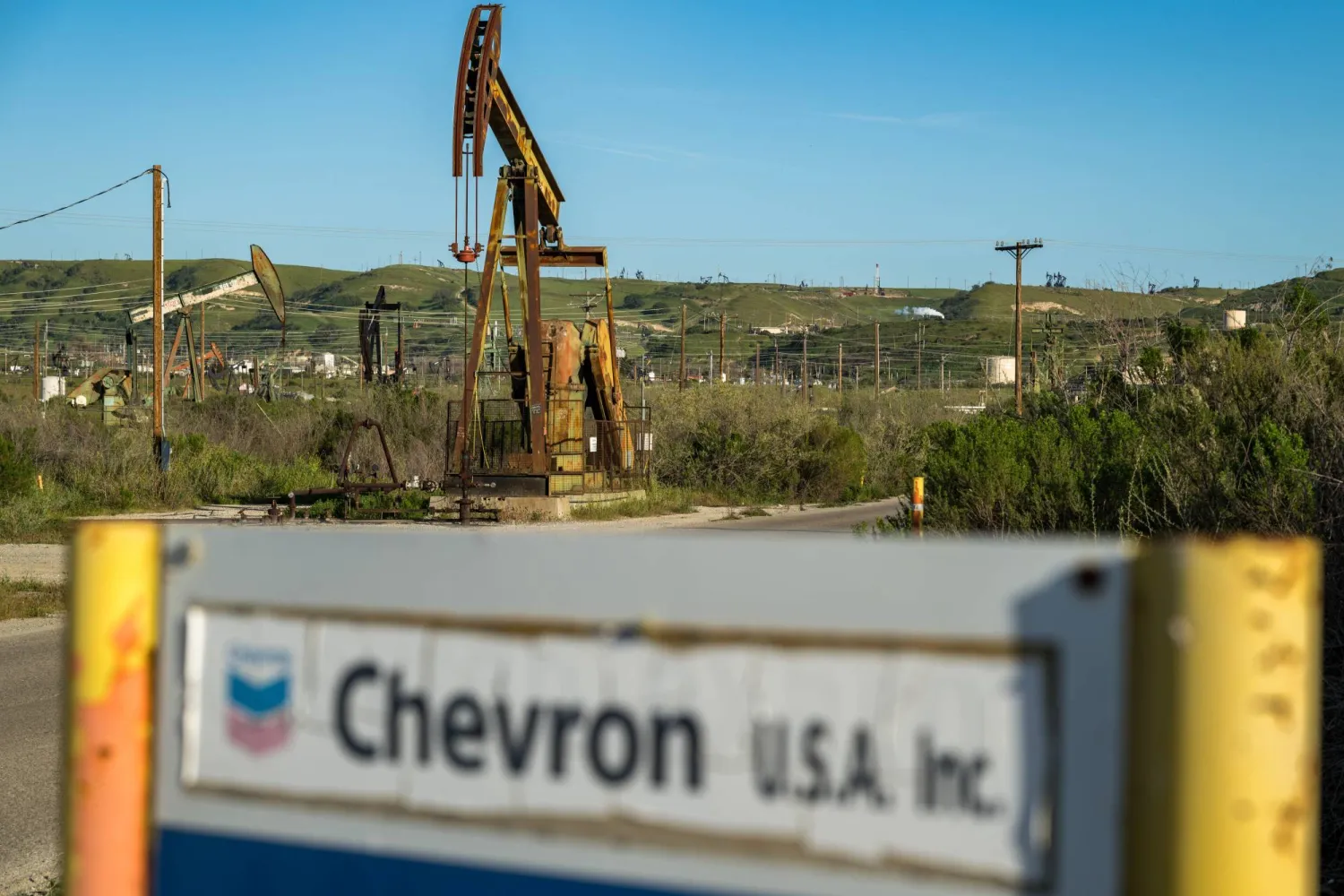
Wells at the San Ardo Oil Field in San Ardo, Calif., Monday, March 9, 2026. (AP Photo/Nic Coury)
TT

Oil Falls as Trump Predicts Middle East De-escalation

Wells at the San Ardo Oil Field in San Ardo, Calif., Monday, March 9, 2026. (AP Photo/Nic Coury)

Oil prices fell on Tuesday after hitting a more than three-year high in the previous session as US President Donald Trump predicted the war in the Middle East could end soon, easing concerns about prolonged disruptions to global oil supplies.

Brent futures fell $6.28, or 6.3%, to $92.68 a barrel at 0715 GMT, while US West Texas Intermediate (WTI) crude was down $6.19, or 6.5%, to $88.58 a barrel, reported Reuters.

Both contracts fell as much as 11% earlier before paring some losses. Oil surged past $100 a barrel on Monday to the highest since mid-2022, as ‌supply cuts ‌by Saudi Arabia and other producers during the expanding US-Israeli war ‌on ⁠Iran stoked fears ⁠of major disruptions to global supplies.

Prices later retreated after Russian President Vladimir Putin held a call with Trump and shared proposals aimed at a quick settlement to the war, according to a Kremlin aide, easing concerns about supply.

Trump said on Monday in a CBS News interview that he thought the war against Iran was "very complete" and Washington was "very far ahead" of his initial four- to five-week estimated time frame.

"Clearly Trump's comments about a short-lived war have calmed ⁠markets. While there was an overreaction to the upside yesterday, we ‌think there is an overreaction to the downside today," ‌said Suvro Sarkar, energy sector team lead at DBS Bank, adding that the market was ‌underappreciating risks at these levels for Brent.

"Murban and Dubai grades are still well above $100 ‌per barrel, so practically nothing much has changed in terms of ground realities," he added, referring to benchmark Middle Eastern oil grades.

In response to Trump, Iran's Revolutionary Guards Corps (IRGC) said they would "determine the end of the war," and Tehran would not allow "one liter of oil" to be exported ‌from the region if US and Israeli attacks continued, state media reported on Tuesday, citing the IRGC's spokesperson.

Prices, however, remain under ⁠pressure as Trump ⁠considers easing oil sanctions on Russia and releasing emergency crude stockpiles as part of a package of options aimed at curbing spiking global oil prices, according to multiple sources.

"Discussions around easing sanctions on Russian oil, comments from Donald Trump hinting that the conflict could eventually de-escalate, and the possibility of G7 countries tapping strategic oil reserves all pointed to the same message - that oil barrels will somehow continue to reach the market," Priyanka Sachdeva, a Phillip Nova analyst, said in a note on Tuesday.

"Once traders sensed that supply routes could still be maintained, the initial 'panic premium' that had pushed prices above the $100 mark yesterday started to fade, and oil prices quickly pulled back."

G7 nations had said on Monday they were prepared to implement "necessary measures" in response to surging global oil prices but stopped short of committing to the release of emergency reserves.



Trump Says He’ll Place 25% Tariff on Autos from EU, Accusing Bloc of Not Complying with Trade Deal

Cargo containers line a ship at the Port of Oakland on Wednesday, Aug. 6, 2025, in Oakland, Calif. (AP)
TT

Trump Says He’ll Place 25% Tariff on Autos from EU, Accusing Bloc of Not Complying with Trade Deal

Cargo containers line a ship at the Port of Oakland on Wednesday, Aug. 6, 2025, in Oakland, Calif. (AP)

President Donald Trump said Friday that he will increase the tariffs charged on cars and trucks from the European Union next week to 25%, a move that could jolt the world economy at a fragile moment.

Trump said in the post that the EU “is not complying with our fully agreed to Trade Deal,” though he did not flesh out his objections in the post.

Trump and European Commission President Ursula von der Leyen had agreed to the trade deal last July. It set a 15% tariff on most goods.

Both the US and the EU had previously confirmed their commitment to preserving the trade framework, known as the Turnberry Agreement, which was named after Trump’s golf course in Scotland.

But the status of the 2025 deal was first cast into doubt after the Supreme Court this year ruled that the Republican president lacked the legal authority to declare an economic emergency and charge tariffs on EU goods.

The initial agreement had been a tariff ceiling of 15% on goods from the EU, but the Supreme Court ruling reduced that to 10% as the Trump administration launched a new set of import taxes based on other laws.

The Trump administration is in the middle of investigations on trade imbalances and national security risks to impose a new tariff regime, which could ultimately put the agreement with the EU in risk of violation.

The EU had said it expected the bilateral deal would save European automakers about 500 million to 600 million euros ($585 million to $700 million) a month.

The value of EU-US trade in goods and services amounted to 1.7 trillion euros ($2 trillion) in 2024, or an average of 4.6 billion euros a day, according to EU statistics agency Eurostat.

“A deal is a deal,” the European Commission said in February after the Supreme Court ruling. “As the United States’ largest trading partner, the EU expects the US to honor its commitments set out in the Joint Statement — just as the EU stands by its commitments. EU products must continue to benefit from the most competitive treatment, with no increases in tariffs beyond the clear and all-inclusive ceiling previously agreed.”


Chevron's Upstream Strength Lifts First-quarter Earnings Past Estimate

3D-printed oil pump jacks and the Chevron logo appear in this illustration taken March 2, 2026. REUTERS/Dado Ruvic/Illustration
TT

Chevron's Upstream Strength Lifts First-quarter Earnings Past Estimate

3D-printed oil pump jacks and the Chevron logo appear in this illustration taken March 2, 2026. REUTERS/Dado Ruvic/Illustration

Chevron exceeded Wall Street estimates for its first-quarter earnings on Friday, as elevated oil prices linked to the US-Israeli war on Iran helped boost results from its upstream business.

The company reported adjusted earnings of $1.41 per share, well above the consensus estimate of 95 cents, according to data compiled by LSEG. Despite the strong beat, overall profit marked its lowest level in five years, partly due to unfavorable timing effects tied to financial derivatives.

Chevron's upstream segment, its largest business unit, generated $3.9 billion in earnings, up 4% year-on-year as higher oil prices led to increased revenue.

"Despite heightened geopolitical volatility and related supply disruptions, Chevron delivered solid first-quarter performance, underscoring the resilience of our portfolio and the value of disciplined execution," CEO Mike Wirth said in a statement.

The conflict with Iran, which began on February 28, significantly disrupted global energy markets. Shipping through the Strait of Hormuz was nearly halted, tightening supply and pushing oil prices up as much as 50% during the reported quarter.

Net income for the January-March period totaled $2.2 billion, down from $3.5 billion a year earlier. However, Chevron's exposure to the Middle East turmoil remains limited, accounting for less than 5% of its total production.

DOWNSTREAM RESULTS IN THE RED

In contrast, downstream operations swung to a loss of $817 million, from a profit of $325 million last year. This decline was largely due to accounting mismatches from derivative-related timing effects, which are expected to start reversing in the next quarter.

Larger rival Exxon also disclosed a similar hit from timing effects.

Chevron anticipates that paper positions worth about $1 billion will close and result in profit in the second quarter, Chief Financial Officer Eimear Bonner said in an interview.

Excluding timing effects that are typical in a volatile environment, she said Chevron's underlying business was strong.

"We can see cash flow growing, we can see earnings growing, and all our plans are on track."

The company said it could see additional timing effects if oil prices continue to rise and further "unwinds" when prices fall.

LIMITED MIDDLE EAST EXPOSURE

Chevron has lower production exposure to the Middle East compared with its peers. Production in the US remained robust, exceeding 2 million barrels per day for the third consecutive quarter, the company said.

First-quarter volumes declined slightly to 3.86 million barrels of oil equivalent per day compared with the previous three months due to downtime at the Tengiz field in Kazakhstan after a fire.

Free cash flow also swung to a negative $1.5 billion due to lower operating cash flow. On an adjusted basis excluding impacts to working capital, the metric was still down from the year-ago quarter.

Bonner reaffirmed the company's target of achieving at least 10% annual growth in adjusted free cash flow through 2030. During the quarter, Chevron paid $3.5 billion in dividends and repurchased $2.5 billion worth of shares. The buyback figure was lower than the previous quarter, though Bonner said the company continues to target full-year buybacks between $10 billion and $20 billion.

Chevron's results were strong, though some investors may be disappointed by the lack of buyback increases, said Biraj Borkhataria, an analyst with RBC Capital Markets, in a research note. He added that stronger cash generation this year could help lift repurchases in the second quarter.

The company said that capital expenditure in the first three months of 2026 was higher than last year, partly due to investments tied to its Hess acquisition, although this was offset by reduced spending in the Permian Basin.

Chevron shares were up less than 1% in pre-market trading.


Gold Heads for Weekly Loss as High Oil Prices Feed inflation worries

A jeweller holds gold bars in Cairo, Egypt, March 9, 2026. (Reuters)
TT

Gold Heads for Weekly Loss as High Oil Prices Feed inflation worries

A jeweller holds gold bars in Cairo, Egypt, March 9, 2026. (Reuters)

Gold prices fell more than 1% on Friday and were headed for a weekly loss of a similar magnitude, as elevated oil prices continued to fan inflation concerns that would discourage central banks from cutting interest rates.

Spot gold was down 1.1% at $4,573.33 per ounce at 1149 GMT, and on track for a weekly loss of 2.8%. US gold futures for June delivery fell 1% to $4,585.20.

"Gold remains negatively correlated to oil in the short term, as it impacts interest rate expectations," said UBS analyst Giovanni Staunovo.

Iran said on Thursday it would respond with "long and painful strikes" on US positions if Washington renewed attacks, reiterating its claim to the Strait of Hormuz, Reuters reported.

Brent crude prices have touched double the levels seen at the start of the year, raising concerns about a global economic slowdown and higher inflation as fuel prices surge.

US inflation accelerated in March as the war raised gasoline prices, reinforcing expectations that the Federal Reserve could keep interest rates on hold well into next year.

The European Central Bank and the Bank of England left interest rates unchanged on Thursday, following similar decisions this week by the Fed and the Bank of Japan.

Gold, traditionally seen as a hedge against geopolitical uncertainty and inflation, can come under pressure in a high interest rate environment as it loses its appeal to yield-bearing assets like US Treasuries.

However, Staunovo said UBS retained a constructive outlook over the next six to 12 months.

"Uncertainty surrounding upcoming (US) midterm elections, expectations of a weaker US dollar over time, and declining real interest rates (as the Fed cuts) will likely support investment demand alongside continued central bank demand," he said.

He added that these factors could drive prices towards $5,900/oz by late 2026.

Spot silver prices fell 0.3% to $73.53 per ounce, platinum was down 0.5% at $1,975.65, and palladium lost 0.1% to $1,522.18.