


Iran Launches New Attacks Targeting Israel as It Seeks to Ramp up Pressure on US

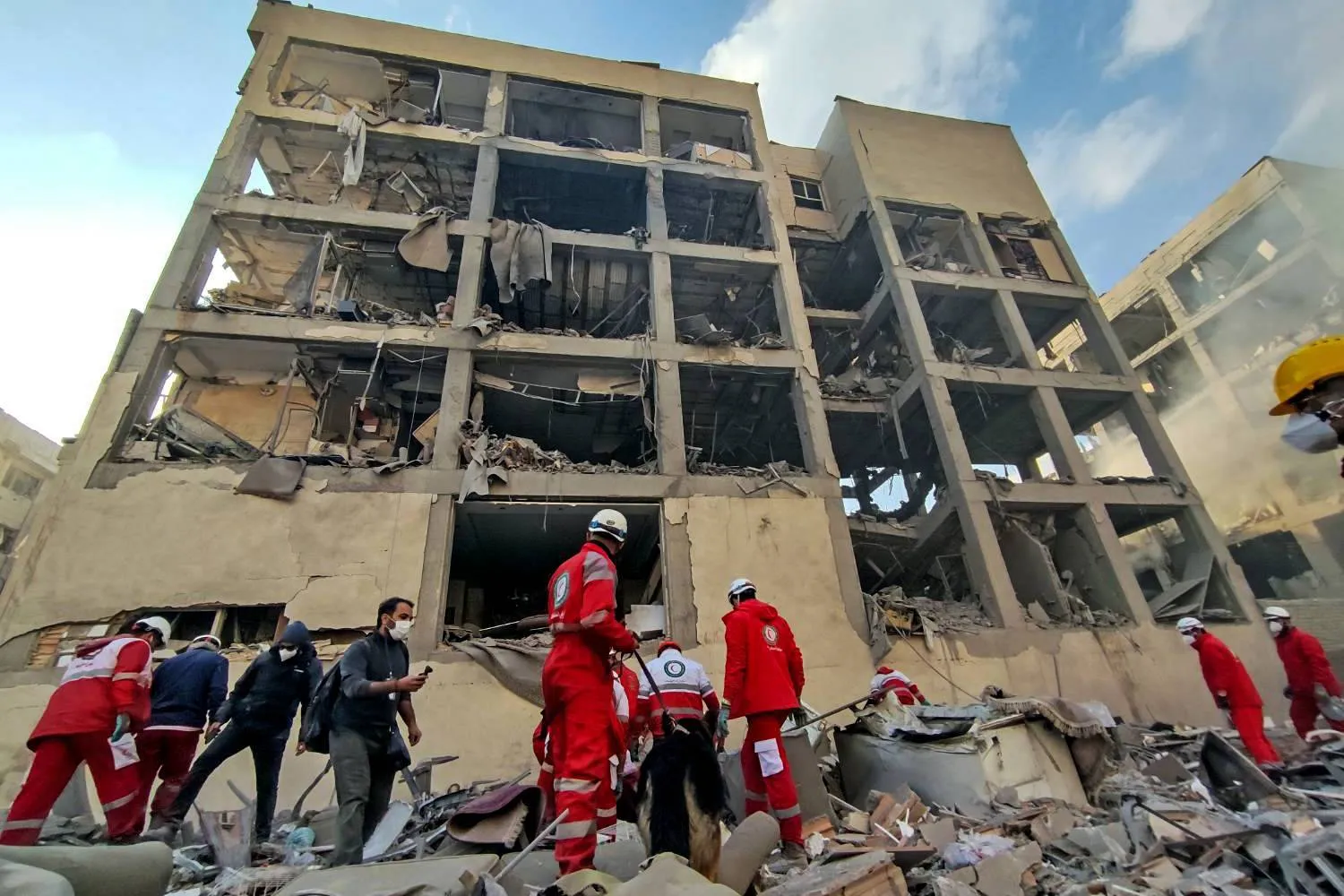
 10 March 2026, Iran, Tehran: Members of the Iranian Red Crescent Society (IRCS) rescue teams work at the site of a building damaged in a US-Israeli airstrike in Resalat Square. (dpa)
10 March 2026, Iran, Tehran: Members of the Iranian Red Crescent Society (IRCS) rescue teams work at the site of a building damaged in a US-Israeli airstrike in Resalat Square. (dpa)
TT

Iran Launches New Attacks Targeting Israel as It Seeks to Ramp up Pressure on US

 10 March 2026, Iran, Tehran: Members of the Iranian Red Crescent Society (IRCS) rescue teams work at the site of a building damaged in a US-Israeli airstrike in Resalat Square. (dpa)
10 March 2026, Iran, Tehran: Members of the Iranian Red Crescent Society (IRCS) rescue teams work at the site of a building damaged in a US-Israeli airstrike in Resalat Square. (dpa)

Iran launched new attacks on Tuesday at Israel and Gulf Arab countries as it kept up pressure on the Middle East in a war started by Israel and the United States that has sent oil prices surging and stunned global economies.

Sirens warned of incoming missiles in the futuristic business hub of Dubai, and in Bahrain, authorities said an Iranian attack hit a residential building in the capital, killing a 29-year-old woman and wounding eight others. Saudi Arabia said it destroyed two drones over the Eastern Region and Kuwait's National Guard said it shot down six drones.

Later in the morning, sirens also sounded in Jerusalem, and sounds of explosions could be heard in Tel Aviv as Israel's defense systems worked to intercept incoming fire, not long after the military said it detected an Iranian missile launch.

“We are definitely not looking for a ceasefire,” Iran's parliament speaker, Mohammad Bagher Qalibaf, wrote on X. “We believe that the aggressor should be punched in the mouth so that he learns a lesson so that he will never think of attacking our beloved Iran again.”

Another top Iranian security official, Ali Larijani, appeared to threaten US President Donald Trump himself, writing on X that “Iran doesn’t fear your empty threats. Even those bigger than you couldn’t eliminate Iran. Be careful not to get eliminated yourself.” Iran has been accused of plotting attempts to kill Trump in the past.

Witnesses reported hearing several explosions in Tehran in the afternoon as Israel commenced a new wave of airstrikes.

Attacks aimed at pressuring the US

Along with firing missiles and drones at Israel and at American bases in the region, Iran has also been targeting energy infrastructure and traffic through the Strait of Hormuz, a vital waterway for traded oil, sending oil prices soaring. The attacks appear aimed at generating enough global economic pain to pressure the US and Israel to end their strikes.

Brent crude, the international standard, spiked to nearly $120 on Monday before falling back but was still at around $90 a barrel on Tuesday, nearly 24% higher than when the war started on Feb. 28.

Trump, who has previously said that the war could last for a month or longer, sought to downplay growing fears that it could take even longer, saying it was “going to be a short-term excursion.”

Still, Israeli Prime Minister Benjamin Netanyahu vowed the strikes on Iran would continue.

“Our aim is to bring the Iranian people to cast off the yoke of tyranny, (but) ultimately it depends on them,” Netanyahu said during a meeting with Israel’s hospital and health system leaders. “There is no doubt that with the actions taken so far, we are breaking their bones.”

Oil is rerouted

Iran has effectively stopped tankers from using the Strait of Hormuz, which connects the Gulf and the Gulf of Oman — the gateway to the Indian Ocean — through which 20% of the world's oil is carried. Attacks on merchant ships near the strait have killed at least seven sailors, according to the International Maritime Organization.

A bulk carrier likely came under attack in the Gulf on Tuesday off the coast of the United Arab Emirates, with the captain reporting a splash and a loud bang nearby, according to a monitoring center run by the British military.

In a post on social media, Trump seemed not to acknowledge that, saying that “If Iran does anything that stops the flow of Oil within the Strait of Hormuz, they will be hit by the United States of America TWENTY TIMES HARDER than they have been hit thus far.”

Iran's paramilitary Revolutionary Guard doubled down, saying in a statement that it “will not allow the export of even a single liter of oil from the region to the hostile side and its partners until further notice.”

Meanwhile, Amin Nasser, the president and CEO of Saudi Arabia’s oil giant Aramco, said tankers were being rerouted to avoid the Strait of Hormuz, and that its East-West pipeline would reach its full capacity of 7 million barrels a day being brought to the Red Sea port of the Yanbu this week.

“The situation at the Strait of Hormuz is blocking sizable volumes of oil from the whole region,” he said, adding that tighter supplies would likely push the price per barrel globally even higher, translating to higher costs for gasoline and jet fuel.

“If this takes a long time, that will have serious impact on the global economy,” Nasser said.

Airstrike on Iran-linked militia in Iraq kills 5

As the conflict spread across the region, Israel launched multiple attacks on the Hezbollah group in Lebanon, which responded by firing missiles into Israel.

Iran-backed militias in Iraq have also launched attacks at US bases in the country since the beginning of the conflict.

Early Tuesday, one such militia — the 40th Brigade of the Popular Mobilization Forces in the city of Kirkuk — was hit with an airstrike that killed at least five militiamen and wounded four, according to officials who spoke on condition of anonymity because they were not authorized to talk to reporters.

It was not immediately clear who was behind the strikes.

Israel's military meanwhile reiterated a call for all residents of southern Lebanon to evacuate their homes, saying it planned to “operate forcefully” there against Hezbollah.

Since the war began, at least 1,230 people have been killed in Iran, at least 397 in Lebanon and 11 in Israel, according to officials.

A total of seven US service members have been killed.


Trump Confirms He Called Netanyahu Crazy in Phone Call

US President Donald Trump gives a thumbs up as he welcomes Israeli Prime Minister Benjamin Netanyahu at the White House in Washington, DC, US, September 29, 2025. (Reuters)
TT

Trump Confirms He Called Netanyahu Crazy in Phone Call

US President Donald Trump gives a thumbs up as he welcomes Israeli Prime Minister Benjamin Netanyahu at the White House in Washington, DC, US, September 29, 2025. (Reuters)

US President Donald Trump acknowledged having called Israeli Prime Minister Benjamin Netanyahu crazy in an expletive-filled phone exchange over fighting in Lebanon, while the US was trying to negotiate an end to hostilities with Iran.

In an interview broadcast Wednesday, Trump was asked whether he had called the longtime Israeli leader "effing crazy" and accused him of ingratitude, paraphrasing a report by Axios.

"I did," Trump told the "Pod Force One" podcast. "I wouldn't say angry. I was a little bit perturbed at his constantly fighting with Lebanon, you know."

Trump went on to say he and Netanyahu get along very well.

According to the Axios report, which cited an unidentified US official, Trump said to Netanyahu in a call on Monday: "You're ‌[expletive] crazy. You'd ‌be in prison if it weren't for me. I'm saving your ‌ass. ⁠Everybody hates you ⁠now. Everybody hates Israel because of this."

Trump said in the interview: "At some point I said, Bibi, we got to stop this. We got to stop it."

NETANYAHU CITES COMMON GOALS 

Netanyahu, asked about the Axios report, declined to offer details of the conversation but said his relationship with Trump had not changed. 

"We have common goals. Sometimes we have, as in the best of families, you have these tactical disagreements," he said in an interview on CNBC on Wednesday. 

"He's been the greatest friend that Israel has ever had in the White House, and he respects ⁠me; I respect him. We always find a way to work out our ‌differences." 

Iran has said it will not agree to a deal with the United States to end the war that Trump ⁠and Netanyahu launched in late February, unless a ceasefire also covers Lebanon, ‌which Israel invaded in March in pursuit of the ‌Iran-aligned Hezbollah group that fired across the border in support of Tehran.

Hostilities have continued despite a US-mediated agreement ‌announced on Monday that led Israel to step back from attacking the Hezbollah-controlled southern suburbs ‌of Beirut, and the group to halt cross-border strikes.

Israeli drone strikes killed at least six people in southern Lebanon and targeted a car just south of Beirut on Wednesday, Lebanese security sources said, while Israel said it intercepted a hostile aircraft likely fired by Hezbollah.

Trump bristled when asked if Netanyahu "tricked" him into attacking ‌Iran, saying his critics were "the enemy."

"I mean, I'm the one that started it," Trump said. "I started because we can't let them have ⁠a nuclear weapon."

"Now ⁠that pertains to Israel, because they probably would have been the first one to get hit. There would be no Israel. Tell you what, if there wasn't me, there would be no Israel right now."

Trump maintained that Israel would have been in a far worse position if he had not abandoned a 2015 accord reached by President Barack Obama and other world leaders with Iran, under which Tehran agreed to curb its nuclear program in return for the lifting of sanctions.

After Trump withdrew from that deal during his first White House term in 2018, Iran produced stockpiles of near-weapons-grade highly enriched uranium, which Trump now demands it relinquish. Trump's critics say Iran is now closer to making a nuclear weapon, and it will be hard for Trump to negotiate a better deal today.


Trump Touts Vance and Rubio for 2028 Republican Ticket

 Vice President JD Vance speaks with reporters upon arriving on Air Force Two at Joint Base Andrews, Md., Thursday, May 28, 2026. (AP)
Vice President JD Vance speaks with reporters upon arriving on Air Force Two at Joint Base Andrews, Md., Thursday, May 28, 2026. (AP)
TT

Trump Touts Vance and Rubio for 2028 Republican Ticket

 Vice President JD Vance speaks with reporters upon arriving on Air Force Two at Joint Base Andrews, Md., Thursday, May 28, 2026. (AP)
Vice President JD Vance speaks with reporters upon arriving on Air Force Two at Joint Base Andrews, Md., Thursday, May 28, 2026. (AP)

US President Donald Trump thinks the two Republicans most likely to jockey to succeed him would make an unbeatable ticket if they run together, he told an interviewer Wednesday.

Vice President JD Vance and Secretary of State Marco Rubio are both widely seen as strong contenders to run for the 2028 Republican presidential nomination -- and as rivals.

"I like them both. I like them together," Trump said on the New York Post podcast "Pod Force One," adding: "I don't know how you beat them if they're together."

The two men would have to agree to it but "they get along really well," Trump mused.

He did not venture to say who should be at the top of the ticket.

Neither man has officially declared his intention to run, and Rubio, 54, has publicly said that the vice president is a friend and insisted that he would not run in 2028 if Vance is a candidate.

Recent polls suggest that Vance and Rubio are nearly tied among Republican voters.

Last month, Rubio attracted buzz for confidently handling a White House press briefing, fielding questions on Iran, Cuba and China with a relaxed style and dashes of humor -- and little of the invective that Trump often unleashes in his briefing room appearances.


France Arrests Russian Captain of Moscow-Linked Tanker

A French Navy vessel sails by the Russian oil tanker "Tagor", suspected of flying a false Cameroonian flag and boarded by the French Navy on May 31, 2026, as it arrives in Douarnenez Bay, western France on June 2, 2026. (AFP)
TT

France Arrests Russian Captain of Moscow-Linked Tanker

A French Navy vessel sails by the Russian oil tanker "Tagor", suspected of flying a false Cameroonian flag and boarded by the French Navy on May 31, 2026, as it arrives in Douarnenez Bay, western France on June 2, 2026. (AFP)

French authorities have taken into custody the Russian captain of a seized oil tanker believed to be part of Moscow's "shadow fleet", a prosecutor said Wednesday.

The French navy detained the Tagor on Sunday in international waters with British help on suspicion the ship was flying a false flag and after its captain refused to comply with orders.

It is the fourth ship that France has seized since September on suspicion of belonging to the "shadow fleet", which Russia is accused of using to circumvent Western sanctions.

The tanker arrived in a harbor in Brittany on Tuesday.

The captain was arrested on Tuesday and faces up to one year in prison and a 150,000-euro ($174,000) fine, said the prosecutor in the northwestern city of Brest, Stephane Kellenberger.

The owner of the vessel, currently being identified, may be subject to the same penalties, he added.

The Russian embassy in France said it had demanded "consular access be granted to the captain immediately", in a post on Telegram. It rejected what it called "baseless accusations" and urging the captain to be released "as soon as possible".

The Kremlin has likened the seizure to "international piracy".

The Tagor is suspected of carrying Russian or Iranian oil despite international sanctions. It is linked to shipping magnate Mohammad Hossein Shamkhani, according to open-source database Opensanctions.org.

Shamkhani is the son of Ali Shamkhani, who was a security adviser to the former Iranian supreme leader Ali Khamenei. They were both killed on February 28, the first day of the US-Israeli attacks that started the Middle East war.

According to French authorities, the Tagor was on its way from Murmansk in northwestern Russia when it was boarded.

It was falsely flying a Cameroonian flag and was heading toward Limbe, a seaside city in the west of the African country, they added.

France previously detained two tankers in the Mediterranean, the Deyna in March and the Grinch in January, but they were freed after paying fines.

In another case, a French court in March issued a one-year jail sentence in absentia and a 150,000-euro ($177,000) fine against the Chinese captain of a tanker, the Boracay, for failing to comply with orders to stop in September last year off the coast of Brittany.

Several Western countries have imposed sanctions on hundreds of vessels believed to be part of Russia's "shadow fleet" over its 2022 invasion of Ukraine.

Nearly 600 ships suspected of belonging to the fleet are subject to European Union sanctions.
