
Strike Hits Beirut Apartment Block as Lebanon Grapples with 800,000 Displaced

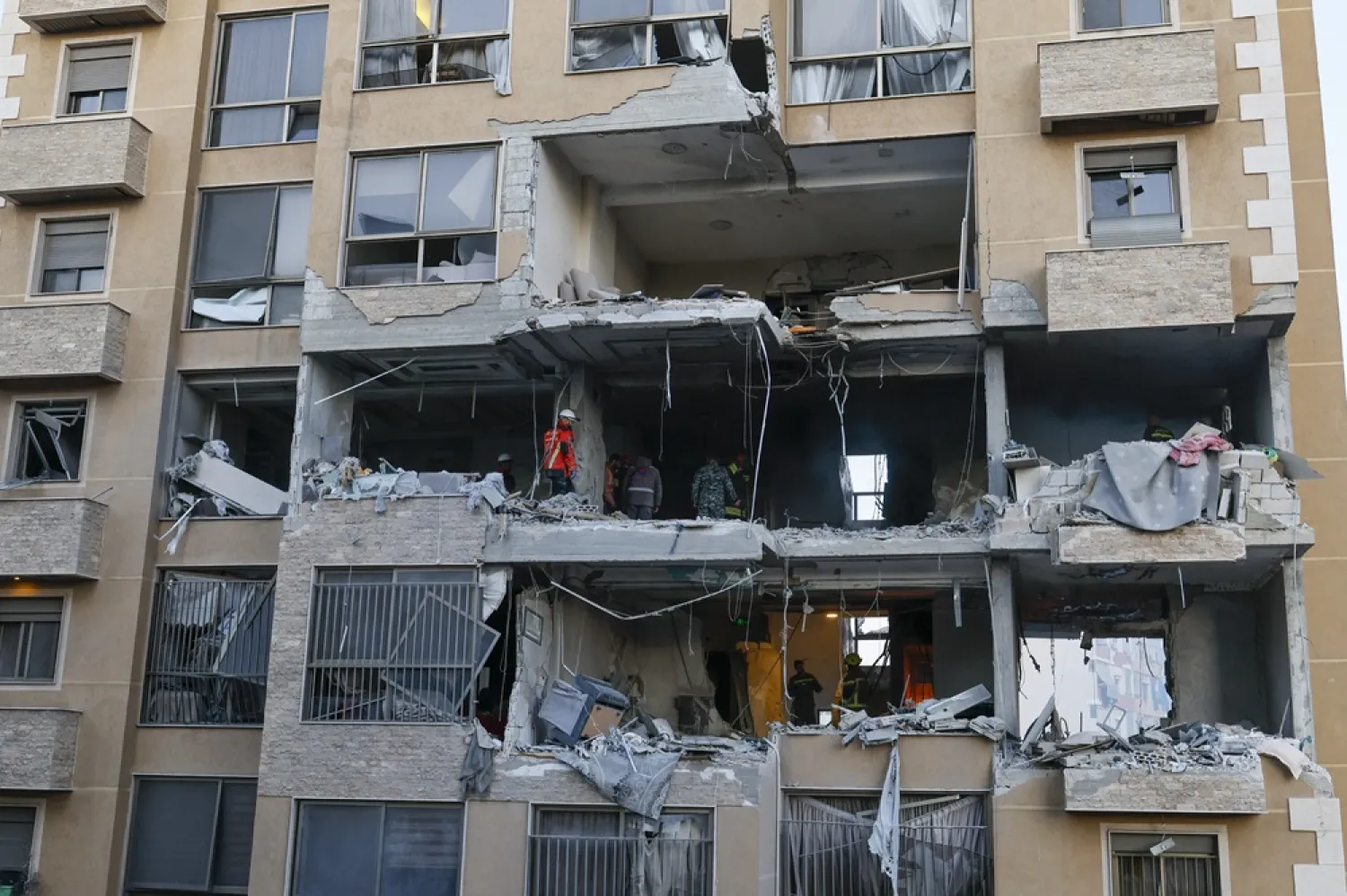
Emergency services inspect the damage after an Israeli strike targeted an apartment at a building in the Aisha Bakkar neighborhood, Beirut, Lebanon, 11 March 2026. (EPA)
TT

Strike Hits Beirut Apartment Block as Lebanon Grapples with 800,000 Displaced

Emergency services inspect the damage after an Israeli strike targeted an apartment at a building in the Aisha Bakkar neighborhood, Beirut, Lebanon, 11 March 2026. (EPA)

An Israeli strike hit an apartment block in central Beirut on Wednesday, Lebanese authorities said, further widening Israeli attacks in the capital beyond the Hezbollah-controlled southern suburbs where heavy bombardment continued. 

Israel launched an offensive against Iran-backed Hezbollah after it opened fire on March 2 to avenge the killing of Iran's supreme leader at the start of the US-Israeli war on Iran. Israeli strikes have killed more than 600 people in Lebanon and uprooted 800,000 more, Lebanese authorities say. 

The Israeli military ordered reinforcements to the area bordering Lebanon including its elite Golani Brigade. Reuters reported on Tuesday that Hezbollah fighters were braced for the possibility of a full-scale Israeli invasion of the south. 

'THIS IS A NIGHTMARE' 

Footage showed heavy damage to two floors of the apartment block in Beirut's Aisha Bakkar neighborhood, and smoke rising from the building. Four people were ‌wounded in the ‌strike, the Lebanese health ministry said. 

The Israeli military did not comment on the strike. 

"The sound ‌was ⁠indescribable, the fear ⁠is indescribable. Enough is enough, enough. This is a nightmare, when will it end?" said Bassima Ramadan, a woman living across the street who was woken up by the strike around 5:30 a.m. (0330 GMT).  

It would mark the second Israeli strike in the heart of Beirut in four days. On Sunday, an Israeli strike hit a hotel in a seafront neighborhood. Israel said that strike killed five senior members of Iran's Revolutionary Guards, which established Hezbollah in 1982. 

Israel kept up heavy strikes on the southern suburbs on Wednesday, sending towers of smoke billowing across the skyline. 

Israel has ordered residents of the suburbs to leave, along with residents of a swathe of southern Lebanon and ⁠parts of the east - all areas where Hezbollah has a grip on security and political ‌sway. 

MEDIC, PRIEST KILLED IN ISRAELI STRIKES 

Over 100,000 people are in organized shelters, ‌while others are staying with friends, family or are on the streets. 

After fleeing her village in the south, Mariam Rida, 73, said she spent $110 ‌for a night at a hotel, then three nights sleeping under a Beirut bridge and a few nights at ‌a school-turned-shelter. 

"I want to go back to my hometown. I'm afraid, I'm scared for myself. There are strikes here and there are strikes there, I’m confused about where to go," said Rida. 

Displaced people have struggled to reach shelters and once they do, they are living in "super rough conditions," said Maureen Philippon, the Norwegian Refugee Council's Lebanon director. 

Shelters lack showers and sufficient toilets, several families occupy the same rooms and there are fears of infectious diseases ‌spreading, she told Reuters. 

Lebanon's health ministry said on Wednesday that 634 people had been killed and more than 1,500 wounded in Israeli strikes since March 2. 

This week's toll includes Catholic ⁠priest Pierre al-Rahi and Red ⁠Cross medic Youssef Assaf. Both died after sustaining injuries in separate Israeli strikes on southern Lebanon earlier this week and were buried on Wednesday. 

Pope Leo offered his condolences for Rahi on Wednesday, saying he was a "true shepherd" who was killed while trying to help parishioners injured in a strike. 

The International Committee of the Red Cross mourned Assaf in a statement posted on social media, saying Assaf "lost his life while carrying out his humanitarian duty". 

ISRAEL PRESSES LEBANON AT UN 

The Israeli military says it has struck hundreds of Hezbollah targets since March 2, launching daily airstrikes in the south, Beirut's southern suburbs, and the Bekaa Valley. 

The Israeli military has sent more soldiers into south Lebanon and established new positions it said would help prevent Hezbollah attacks on northern Israel. 

Lebanon said last year it aims to establish a state monopoly on arms and its cabinet last week outlawed Hezbollah's military activities. 

But Israel's ambassador to the United Nations Danny Danon said on Wednesday that Beirut needed to take direct action. 

"If Hezbollah is being dismantled, what are the evidence? What are the operations against the launch sites? Where are the seizures of their weapons? Where is your military?" Danon said. 


Did Israel’s War on Lebanon Drive Syrian Refugees Back Home?

Syrian refugees in Lebanon return to their country through the Masnaa crossing after the fall of the Syrian regime in December 2024. (EPA)
TT

Did Israel’s War on Lebanon Drive Syrian Refugees Back Home?

Syrian refugees in Lebanon return to their country through the Masnaa crossing after the fall of the Syrian regime in December 2024. (EPA)

Israel’s war on Lebanon has accelerated the return of Syrian refugees, but officials and aid agencies say it has not by itself resolved, or fundamentally transformed, the displacement crisis.

Nearly one million Syrians remain in Lebanon despite Israel’s wars on Lebanon when Hezbollah opened a “support front” in solidarity with Hamas in 2023. Many refugees, meanwhile, still view remaining in Lebanon as preferable to returning to a country where homes and jobs may no longer exist.

Others have left. According to the UN refugee agency (UNHCR), more than 593,000 Syrian refugees have returned from Lebanon since January 2025, while Syrian authorities estimate around 260,000 crossed back between March 2 and April 20, 2026 as hostilities intensified.

Official figures show 95 Syrians were killed and 130 wounded in the latest round of fighting between March 2 and April 17.

For some, however, war has not changed the situation.

Faisal, a 41-year-old construction worker from Deir Ezzor living in Mount Lebanon for a decade, said returning to Syria remains too uncertain.

“Going back now means returning to the unknown,” he told Asharq Al-Awsat. “Here, despite the risks, I can still support my family.”

Lebanese Social Affairs Minister Haneen Sayed argued the rise in returns cannot be attributed mainly to war.

She told Asharq Al-Awsat that a government return plan adopted in June 2025 marked the real turning point, supported by administrative facilitations, financial incentives and coordination between Lebanese General Security and the UN refugee agency.

According to Sayed, 581,107 Syrians had returned before the latest conflict erupted in early March, while another 198,404 left during the war.

“That shows return was already under way before the fighting,” she stated, noting that many refugees could have moved to safer parts of Lebanon but instead chose Syria, suggesting the government’s strategy was gaining traction.

She said Syrian authorities had also contributed through policies intended to facilitate return and reintegration. Still, she stopped short of calling it a lasting solution.

“The displacement crisis is on its way to being resolved, but it has not reached a final settlement,” she underlined, noting Lebanon was preparing a review of the return plan later this year.

At the same time, she warned the war had created a new Lebanese internal displacement crisis, adding another humanitarian burden.

Lisa Abou Khaled, spokeswoman for the UNHCR in Lebanon, said decisions to return still depend less on war than on conditions inside Syria, including shelter, healthcare, education and livelihoods.

The current hostilities may have hastened returns for some, she told Asharq Al-Awsat, but often as a forced response rather than a voluntary shift.

“When refugees feel they have no alternative but to return, our role is to reduce risks and support them through the process,” she remarked.

UNHCR provides returnees with information, transport support and a $100 grant per person to help cover immediate needs.


Syria’s Sharaa, Lebanon’s Jumblatt Discuss Sweida Fallout, Reject ‘Alliance of Minorities’

Syrian President Ahmed al-Sharaa and Lebanese Druze leader Walid Jumblatt meet in Damascus on Saturday. (SANA)
TT

Syria’s Sharaa, Lebanon’s Jumblatt Discuss Sweida Fallout, Reject ‘Alliance of Minorities’

Syrian President Ahmed al-Sharaa and Lebanese Druze leader Walid Jumblatt meet in Damascus on Saturday. (SANA)

A meeting in Damascus on Saturday between Syrian President Ahmed al-Sharaa and Lebanese Druze leader Walid Jumblatt focused on containing the fallout from violence in Syria’s Sweida province, strengthening Lebanese-Syrian ties and rejecting what both sides described as an “alliance of minorities.”

Jumblatt, former head of Lebanon’s Progressive Socialist Party, met Sharaa at the People’s Palace in Damascus amid heightened regional tensions and strains along the Lebanese-Syrian border.

A statement from the PSP said the talks stressed improving Lebanese-Syrian relations in a way that serves the common interests of both countries, while rejecting the “alliance of minorities” theory and emphasizing the social and geographic ties linking the two neighbors.

The statement reaffirmed Syria’s unity and called for addressing the aftermath of the deadly unrest in Sweida, the predominantly Druze province in southern Syria.

A brief Syrian presidency statement said the two sides reviewed recent regional developments.

Accompanying Jumblatt to Damascus, Lebanese MP Hadi Abou Al-Hassan said the talks focused on deepening bilateral ties based on respecting the sovereignty and independence of each country, while recognizing longstanding historical and social links.

He told Asharq Al-Awsat Syria’s new leadership was seeking to redefine relations with Lebanon after what he called the end of Syrian tutelage following the fall of Bashar al-Assad.

Abou Al-Hassan said “some actors in Syria and Israel were trying to revive the idea of an ‘alliance of minorities’, but that Damascus no longer viewed the concept as relevant and was instead focused on its strategic Arab ties.”

Saturday's talks also touched on what he described as shared concerns over Israeli escalation against both countries, including fears of a proposed “yellow line” security belt stretching across southern Lebanon from Naqoura to Mount Hermon and potentially into southern Syria.

He noted that such concerns reflected worries over “a dangerous Israeli plan that required coordination and joint efforts to confront.”

Developments in Sweida took up much of the discussions, particularly given Jumblatt’s role in containing the repercussions and his rejection of calls to attach the province to Israel or seek Israeli protection for the region.

Abou Al-Hassan said the talks stressed addressing the fallout from the violence and building on a meeting in Amman involving Syria, Jordan and the United States.

Jumblatt also underscored “support for Syria’s unity and for a strong central state guaranteeing equal rights for all citizens, while preventing any forces from challenging state sovereignty,” he said.

The meeting comes as Lebanese-Syrian ties have improved through border coordination and anti-smuggling efforts, despite Syrian concerns over reported weapons-smuggling tunnels and reports of a security cell in Damascus allegedly linked to Hezbollah, an ally of the ousted regime.

Abou Al-Hassan said both countries needed to dispel mutual concerns and build trust.


Lebanon Says Israel Strikes Kill 14 in Deadliest Day Since Truce

Israeli soldiers operate on the Lebanese side of the border, as seen from the Upper Galilee in northern Israel, 26 April 2026, amid a ceasefire between Israel and Lebanon. (EPA)
TT

Lebanon Says Israel Strikes Kill 14 in Deadliest Day Since Truce

Israeli soldiers operate on the Lebanese side of the border, as seen from the Upper Galilee in northern Israel, 26 April 2026, amid a ceasefire between Israel and Lebanon. (EPA)

Lebanon's health ministry said Israeli strikes on the country's south on Sunday killed 14 people, the deadliest day since a ceasefire in the Israel-Hezbollah war came into force over a week ago.

It came as Israel and the Iran-backed group traded fresh accusations of breaching the fragile truce, with Prime Minister Benjamin Netanyahu saying the military was "vigorously" targeting Hezbollah and the group vowing to keep responding to "violations".

Israel's military has carried out repeated strikes in Lebanon since the April 17 ceasefire, which on Thursday was extended for three weeks, after six weeks of war in which Israel also invaded the country's south.

Israeli troops are operating inside an Israeli-announced "yellow line", which demarcates a ribbon of Lebanese territory around 10 kilometers (six miles) deep along the length of the border, where residents have been warned not to return.

Lebanon's health ministry said the dead on Sunday included two women and two children, adding that 37 other people were wounded.

Israeli strikes have killed at least 36 people since the truce began, according to an AFP tally of health ministry figures.

Israel's military said Sunday that one of its soldiers was killed "during combat" in southern Lebanon, and six were wounded, four of them severely.

- 'Freedom of action' -

Lebanon's state-run National News Agency (NNA) reported Israeli strikes in multiple locations in the south on Sunday, both in areas where Israel issued an evacuation warning and elsewhere.

AFP correspondents reported heavy traffic heading north as people fled following the warning and intensified raids.

"Hezbollah's violations are, in practice, dismantling the ceasefire," Netanyahu told his weekly cabinet meeting.

Tehran-backed Hezbollah drew Lebanon into the Middle East war on March 2 by firing rockets at Israel to avenge the death of Iran's supreme leader Ali Khamenei in US-Israeli strikes.

"We are acting vigorously in accordance with arrangements agreed with the United States and, incidentally, also with Lebanon," Netanyahu said.

Under the truce, which came after a landmark meeting between Israeli and Lebanese officials that angered Hezbollah, Israel reserves the right to respond to "planned, imminent or ongoing attacks".

"This means freedom of action not only to respond to attacks... but also to pre-empt immediate threats and even emerging threats," Netanyahu said.

Hezbollah said that Israel's "continued ceasefire violations... and above all its continued occupation of Lebanese territory and violations of its sovereignty will be met with a response".

It said its fighters targeted Israeli troops and positions in south Lebanon in response to ceasefire violations and attacks on Lebanese villages.

- More than 2,500 killed -

Israel's military issued evacuation orders for residents of seven towns and villages in the south on Sunday.

Shortly afterwards, the NNA said Israeli warplanes struck in Kfar Tibnit, causing casualties, while a raid on Zawtar al-Sharqiyah, another of the flagged villages, destroyed a mosque and another religious building.

The NNA also reported Israeli shelling in several border villages.

AFP correspondents saw clouds of grey smoke rise over Nabatieh al-Fawqa and several other locations after Israeli strikes.

Israel's military said it had struck "rocket-launching terrorist cells and weapons storage facilities" after earlier conducting "artillery and aerial strikes targeting terrorists and military infrastructure sites" used by Hezbollah north of the so-called "yellow line".

Shortly after Netanyahu's remarks, the military said it had intercepted three drones heading for Israeli territory.

Lebanon's health ministry says Israeli attacks have killed more than 2,500 people and wounded over 7,700 others since the war erupted.

The United Nations' UNIFIL peacekeeping force said it held a memorial in Beirut for an Indonesian peacekeeper who died on Friday after being wounded in a blast in south Lebanon last month.

A preliminary UN investigation found that an Israeli tank shell caused the explosion.