



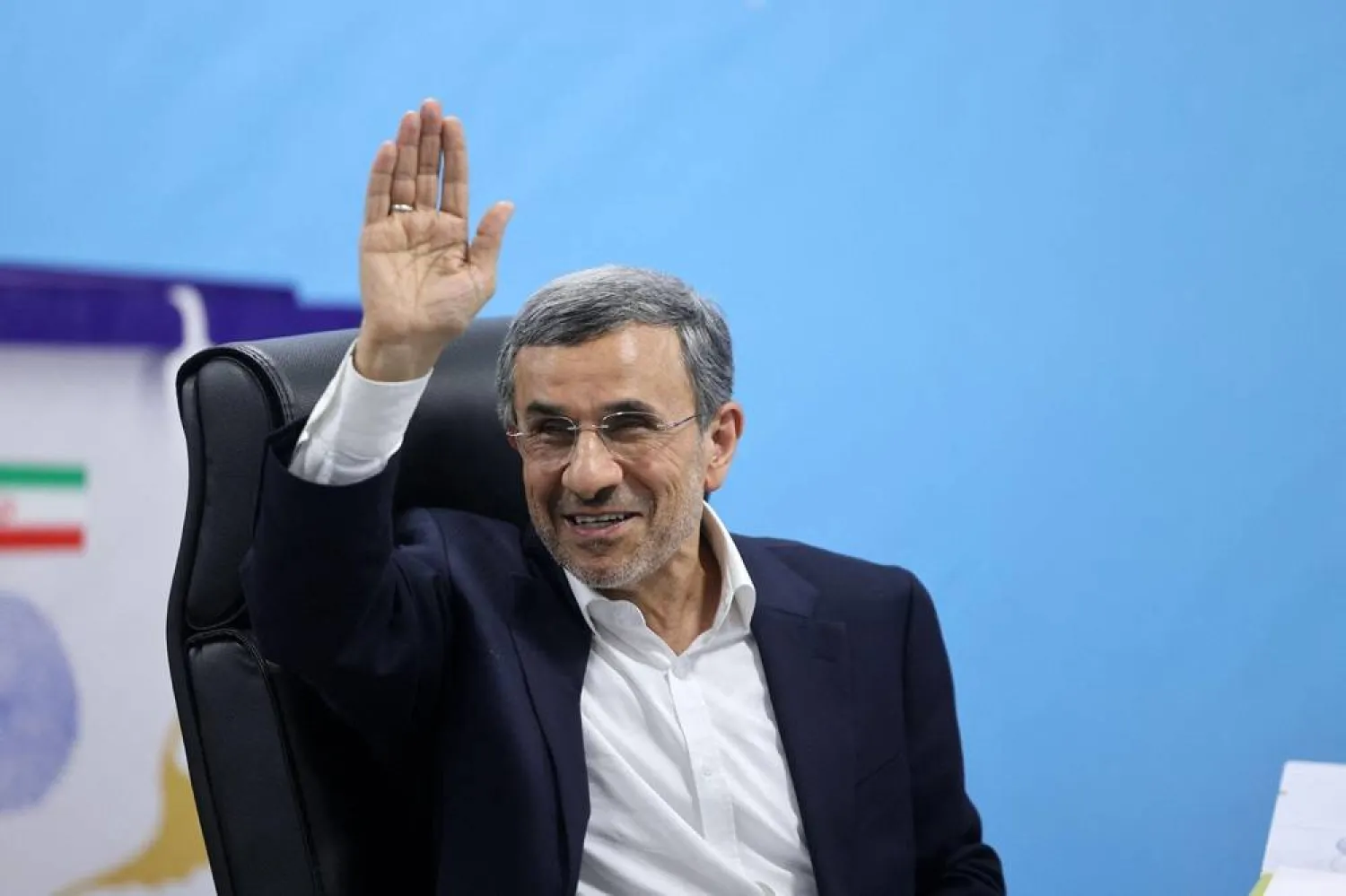

A report by The Atlantic said the strike that hit a region close to Iranian former President Mahmoud Ahmadinejad’s residence in the first days of the war on Iran has returned to the spotlight a still controversial political figure even though he left office for over a decade ago.
On the first day of the Iran war, the assassination of Supreme Leader Ali Khamenei overshadowed news of a strike near Ahmadinejad’s home, said the report.
“Many who remembered his term in office - marked by Holocaust denial, atom-bomb fetishism, and shoving revolutionary ideology down the throats of a country already weary of it - celebrated his reported assassination,” it added. He was president from 2005 to 2013.
“Among those who have followed Ahmadinejad’s post-presidential career, however, his targeting was more of an enigma. Since leaving office, Ahmadinejad has harshly criticized the Iranian government, and as a result, Iran’s Guardian Council has formally excluded him from running for president,” said the report.
For more than a decade, he has been known more as a regime opponent than as a supporter. “I don’t understand why Israel would want to kill him in the first place,” Meir Javedanfar, who co-wrote a biography of Ahmadinejad, told The Atlantic. “Perhaps to settle scores? It makes no sense.”
Contrary to early reports, Ahmadinejad is alive, his associates revealed, requesting anonymity. “The circumstances of his survival may prove significant as the war drags on. Whatever the intent, Ahmadinejad’s associates say the strike was in effect a jailbreak operation that freed the former president from regime control.”
“Long before the war, the government had posted a small number of bodyguards near Ahmadinejad, nominally to protect a prominent citizen but also to keep tabs on him. The regime has never been sure what to do with him,” said the report.
About a month ago, after the January protests, his freedom of movement was further reduced, his phones confiscated, and the contingent of bodyguards increased from single digits to about 50. The bodyguards were based a few hundred meters from Ahmadinejad’s residence itself, at the entrance to a cul-de-sac in Narmak, in northeast Tehran. They established a checkpoint to monitor the houses and high school on that street.
“A February 28 strike hit not the residence, but the security forces nearby. In the ensuing mayhem, Ahmadinejad and his family evidently escaped their home and went underground. The government believed he had died, and his death was announced by official channels, as well as the reformist daily Sharq.”
“When rumors arose that Ahmadinejad had escaped, regime elements immediately suspected that he had been spirited away to take part in a coup,” said The Atlantic. “Ahmadinejad’s only public statement since the attack has been a brief eulogy for the supreme leader, calculated to show that Ahmadinejad was alive and to dispel speculation that he had declared himself an enemy of the state. His location is unknown to the government.”
In 2018, former Defense Minister Hussein Dehghan likened Ahmadinejad to “the door of the mosque, which can’t be burned or thrown away” without torching the mosque itself.
“Arresting Ahmadinejad could unsettle the regime,” Javedanfar said. “He knows a hell of a lot about it.”
“Ahmadinejad’s fans say that he has popular support, and that any postwar government will want him around to lend that support. If the current regime survives, it will need all the legitimacy it can get. If it does not, the United States might need someone with intimate - if outdated - knowledge of the Iranian state to be involved with what comes next. Ahmadinejad could still be useful,” the report said.


