

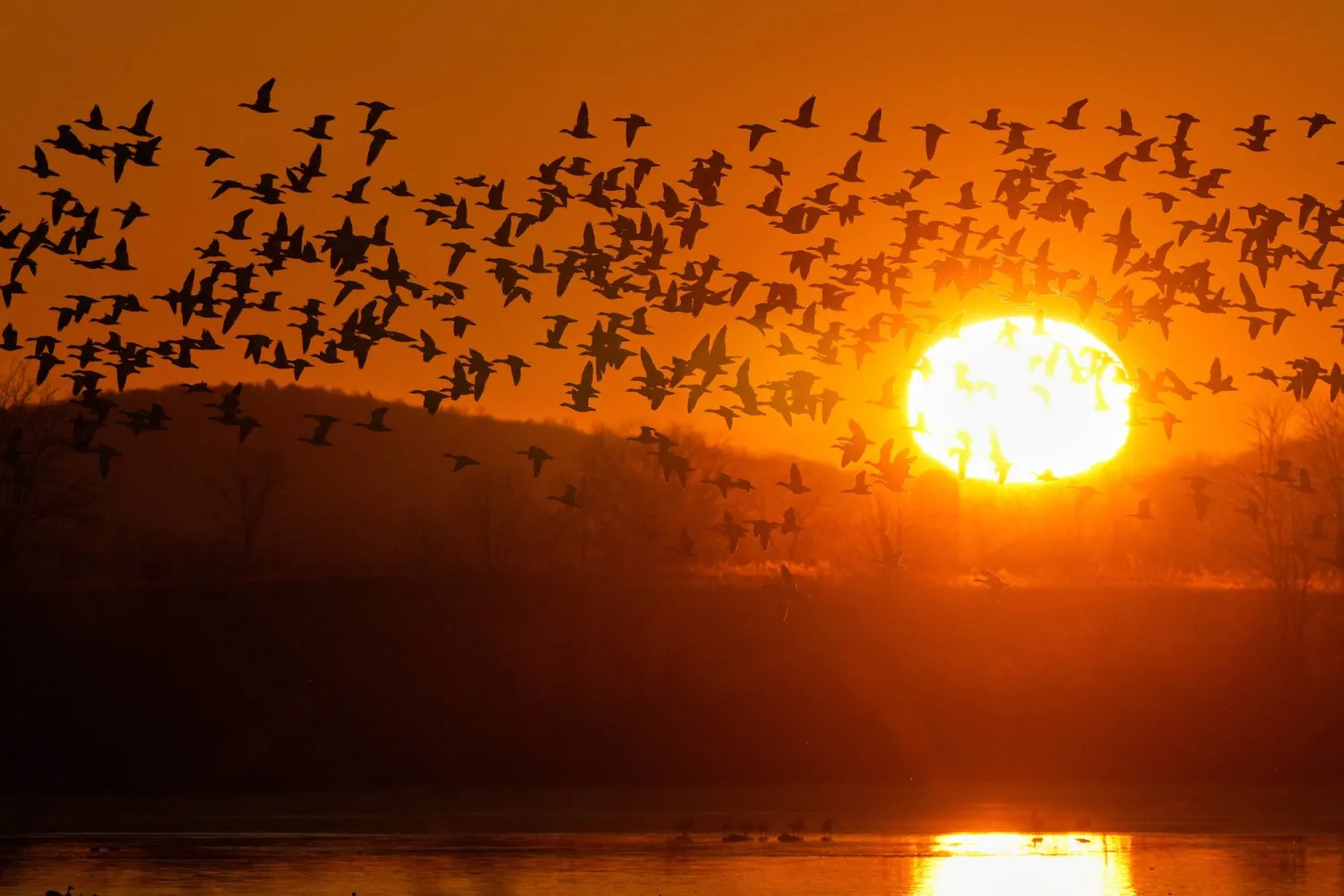

Snow Geese Take Off for the Arctic in Mesmerizing Sunrise Display

Snow geese take to the sky at sunrise after a stopover at the Middle Creek Wildlife Management Area, Monday, March 9, 2026, in Kleinfeltersville, Pa. (AP Photo/Robert F. Bukaty)
TT

Snow Geese Take Off for the Arctic in Mesmerizing Sunrise Display

Snow geese take to the sky at sunrise after a stopover at the Middle Creek Wildlife Management Area, Monday, March 9, 2026, in Kleinfeltersville, Pa. (AP Photo/Robert F. Bukaty)

A few dozen birdwatchers gathered in the predawn darkness to wait for the moment when thousands of migrating snow geese stopped honking and preening to suddenly take flight from a Pennsylvania reservoir.

The mesmerizing display, about an hour after sunrise, was over almost as soon as it began. The birds circled a few times and then headed out to neighboring farm fields, seeking unharvested grains and other sustenance on their epic annual spring flight northward into New York state and Quebec.

The Pennsylvania reservoir was built a half-century ago to attract waterfowl and over the years the gaggle has grown. Pennsylvania Game Commission environmental education specialist Payton Miller described it as a raucous bird tornado that lifts off the water.

“All it takes is for me to come out here on a really nice morning where there’s a huge morning flight and I’m kind of reminded how awesome it is to see such a large number of such a beautiful bird,” The Associated Press quoted Miller as saying. “I never get sick of it.”

Among those taking it all in was Adrian Binns, a safari guide from Paoli, Pennsylvania, who went to the Middle Creek Wildlife Management Area for “the whole enjoyment of seeing something you don't see every day.”

Snow geese have been arriving in growing numbers at the 6,300-acre (25 square kilometers) Middle Creek property since the late 1990s. At this time of year, they have just spent months along the Atlantic coast, from New Jersey south to the Carolinas, with many of them overwintering on the Delmarva Peninsula that forms the Chesapeake Bay.

They don’t stay long at Middle Creek — it’s just a way station on their journey to summer breeding grounds in the Canadian Arctic and western Greenland.

But for a few short weeks they are the main attraction at Middle Creek, which draws about 150,000 visitors annually — including about a thousand hunters.
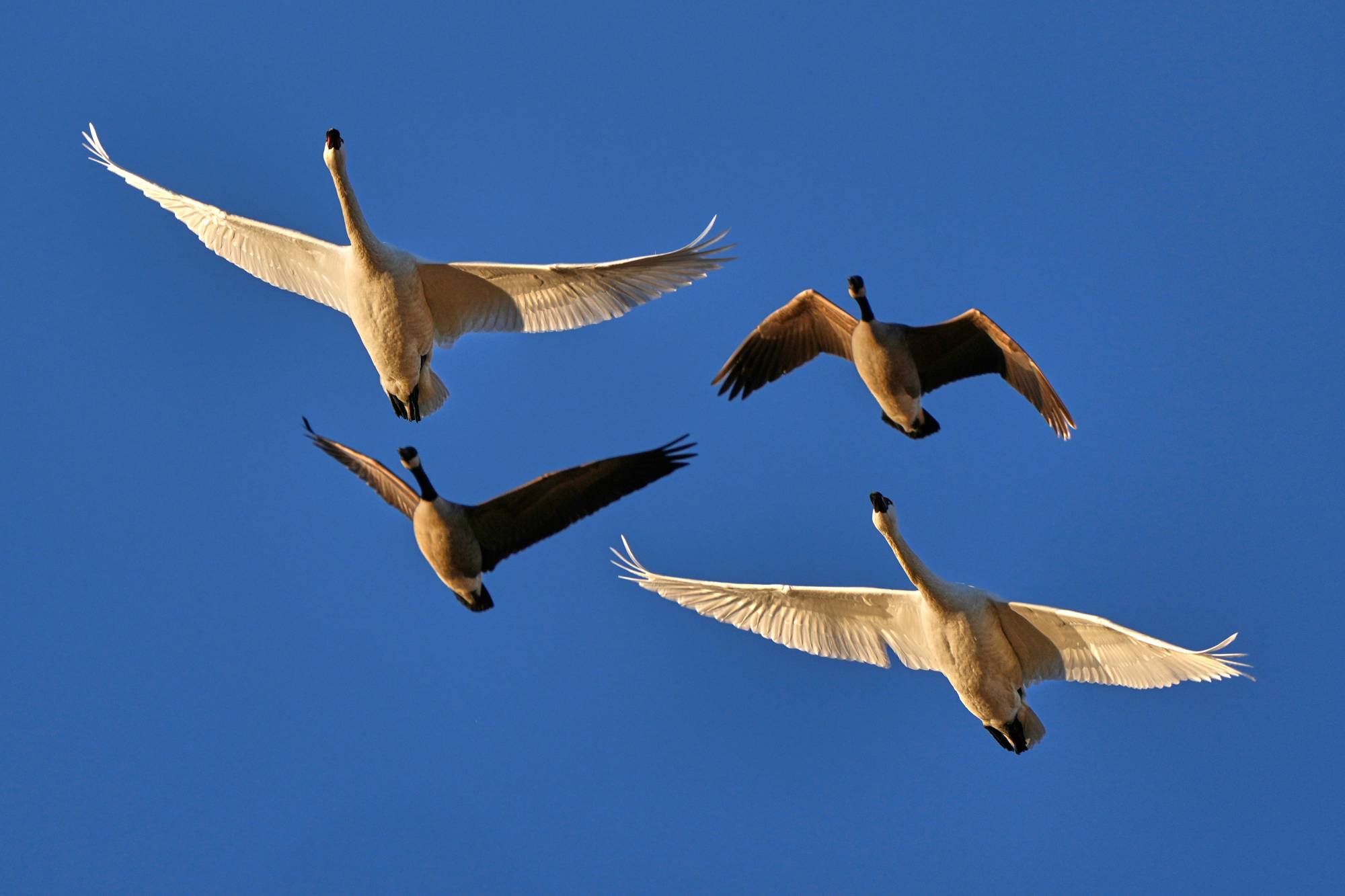
Pairs of tundra swans (larger birds) and Canada geese fly over the Middle Creek Wildlife Management Area, Monday, March 9, 2026, in Kleinfeltersville, Pa. (AP Photo/Robert F. Bukaty)

The Pennsylvania Game Commission, which owns Middle Creek, says about 100,000 snow geese were roosting there on the busiest day last year, on par with recent peak activity but below the single-day record of about 200,000 on Feb. 21, 2018.

Snow geese are doing well, but their large numbers have come with a cost.

According to a 2017 study published by Springer Nature, greater snow geese grew in population from about 3,000 in the early 20th century to some 700,000 by the 1990s. By some estimates, there are about a million of the birds now — along with maybe 10 million of lesser snow geese, which are smaller — that also breed in the Arctic.

The number of migrating tundra swans at Middle Creek, while far lower, has also increased over time, from a dozen or so in the mid-1970s to 5,000 or more in recent years. Middle Creek birders have also identified more than 280 bird species on the site, among them bald eagles, northern harriers, ospreys and owls.

As snow geese numbers have boomed in recent decades, wildlife officials in the US and Canada have navigated a balancing act involving hunting regulations, concerns about crop damage, shifts in snow geese migration and changes to overwintering patterns. Environmental damage from overgrazing in the Arctic has led experts to conclude the birds are overabundant.

David M. Bird, a McGill University wildlife biology professor, described the population as “probably one of the biggest conservation problems facing wildlife biologists in North America today.” Snow geese feed by pulling up plants by the roots, which damages habitats for themselves, various birds and other kinds of wildlife.

The Pennsylvania Game Commission reported recently that avian influenza viruses, present in the state since 2022, continue to circulate among the state’s wild birds. The game agency asked for the public’s help in reporting sick or dead wild birds and reported that about 2,000 wild bird carcasses — mostly snow geese — had to be removed from a quarry a few miles north of Bethlehem in December and January.

Bird said that for nature lovers, snow geese can be a delight but for farmers, they're a pest. For hunters, they're food but for animal rights advocates, they're a species that needs protection, he said.

“But if you are a paid professional wildlife manager at a municipal, state or federal level whose challenging job is to try to please all of the aforementioned parties, then you will undoubtedly experience many sleepless nights in the fall when the geese arrive,” Bird said.




Trump's Triumphal Arch Gets Official Name

White House Press Secretary Karoline Leavitt shows off an artist's rendering of President Donald Trump's planned Triumphal Arch. Brendan SMIALOWSKI / AFP
TT

Trump's Triumphal Arch Gets Official Name

White House Press Secretary Karoline Leavitt shows off an artist's rendering of President Donald Trump's planned Triumphal Arch. Brendan SMIALOWSKI / AFP

It's been dubbed the "Arc de Trump." But now President Donald Trump's latest building project has an official name -- the "United States Triumphal Arch."

White House Press Secretary Karoline Leavitt revealed the formal title on Wednesday, saying the giant structure was being built to mark the 250th anniversary of US independence, AFP reported.

"In honor of this historic occasion, President Trump and the Department of Interior will submit plans for the United States Triumphal Arch," Leavitt told reporters.

Showing off a picture that she initially held upside down, Leavitt said the "monumental" arch would stand 250 feet (76.2 meters) tall "in honor of 250 years."

Its colossal height, including a huge golden Lady Liberty statue on top, means it will dwarf perhaps its most famous predecessor, the Arc de Triomphe in Paris, which stands at 164 feet.

In fact it is set to be the largest structure of its kind in the world, pipping Mexico City's Monument to the Revolution and knocking Pyongyang's Arch of Triumph to third place.

Plans for the arch were first revealed in October when AFP journalists spotted a model on Trump's desk in the Oval Office, after which it was quickly dubbed the "Arc de Trump" by US media.

Trump revealed the first full renderings for the structure last Friday.

The arch is one of several architectural projects -- including the construction of a gigantic White House ballroom and renovations to the Kennedy Center for the Performing Arts -- that Trump has undertaken to leave a mark on Washington in his second term.

Critics say the gold-accented arch, which will tower over the 99-foot-tall Lincoln Memorial, is a monument to the 79-year-old Trump's vanity.

The arch will partly be funded by US taxpayers, getting $2 million in special funds from the US National Endowment for the Humanities, with up to $13 million in funds to match any donations, ABC News reported.

But Leavitt said it was aimed at celebrating US national pride.

"Long after everyone in this room is gone, our children and grandchildren will remain inspired by this national monument," she told reporters.


Much-hyped Alzheimer's Drugs Do Not Help Patients, Review Finds

New research has cast doubt on Alzheimer's drugs once hailed as a gamechanger. ALAIN JOCARD / AFP/File
TT

Much-hyped Alzheimer's Drugs Do Not Help Patients, Review Finds

New research has cast doubt on Alzheimer's drugs once hailed as a gamechanger. ALAIN JOCARD / AFP/File

Drugs once hailed as a breakthrough in the fight against Alzheimer's disease do not meaningfully help patients, a major review found Thursday, however some experts criticized the research.

The review by the Cochrane organization -- which is considered the gold standard for analyzing existing evidence -- looked at drugs that target a plaque called amyloids which builds up in the brains of Alzheimer's patients.

Researchers have long sought a way to eliminate this plaque, believing it could be the cause of the most common form of dementia which affects millions of elderly people every year, said AFP.

After decades of costly yet unsuccessful research, two anti-amyloid drugs called lecanemab and donanemab were initially hailed as gamechangers that finally offered a way to slow the progress of the debilitating disease.

Both drugs were approved by the United States and European Union over the last few years.

However concerns about their effectiveness, cost and side effects including an increased risk of brain swelling and bleeding have since prompted caution. State-run health services in the UK and France have refused to cover the drugs.

The new Cochrane review combined data from 17 clinical trials that included a total of more than 20,000 people with mild cognitive impairment or early dementia.

The trials, which took place over roughly 18 months, studied seven different anti-amyloid drugs.

Only one of the trials examined donanemab -- sold under the name Kisunla by US pharma giant Eli Lilly -- while one studied lecanemab, sold as Leqembi by Biogen and Eisai.

While early trials suggested these drugs made a statistically significant difference, this did not translate into "something clinically meaningful for patients," lead study author Francesco Nonino of Italy's IRCCS institute told a press conference.

Brain scans showed that the drugs successfully removed amyloids, the researchers emphasized.

This means "the idea that removing amyloids will benefit patients was refuted by our results," said study co-author Edo Richard of Radboud University Medical Center in the Netherlands.

- 'Not delivering on promise' -

Richard, who has previously expressed skepticism about anti-amyloid drugs, said he hopes efforts targeting other mechanisms that potentially cause Alzheimer's lead to more effective drugs in the future.

British biologist John Hardy, who first developed the amyloid hypothesis in the 1990s, criticized the review for lumping together data about lecanemab and donanemab along with drugs that are known to be ineffective, therefore dragging down the overall average.

"This is a silly paper which should not have been published," Hardy told AFP, disclosing that he has consulted for Eli Lilly, Biogen and Eisai.

In response to such questions, Richard said that while the drugs included in the study may work in different ways, they all have the same target: amyloid beta proteins.

Australian neuroscientist Bryce Vissel, who was not involved in the research, said it "does not prove amyloid has no role in Alzheimer's, and it does not rule out future amyloid-directed therapies that may yet help patients".

"But it does show that the current generation of anti-amyloid drugs is not delivering the promise that has surrounded it."


Indonesia Police Arrest Six for Komodo Dragon Smuggling

A komodo dragon is displayed by nature and conservation agency officials and police officers after being seized from suspects attempting to smuggle it into Thailand, during a press conference at the regional police headquarters in Surabaya on April 15, 2026. (Photo by JUNI KRISWANTO / AFP)
TT

Indonesia Police Arrest Six for Komodo Dragon Smuggling

A komodo dragon is displayed by nature and conservation agency officials and police officers after being seized from suspects attempting to smuggle it into Thailand, during a press conference at the regional police headquarters in Surabaya on April 15, 2026. (Photo by JUNI KRISWANTO / AFP)

Indonesian authorities said Wednesday they have arrested six people allegedly involved in smuggling endangered Komodo dragons native to the archipelago and destined for Thailand.

Two suspects were arrested in February in the port city of Surabaya on the east coast of Java island as they got off a ship with three live Komodo dragons -- the world's largest living lizard.

Further investigation led to four more arrests in the weeks that followed, AFP reported.

Police said the animals had been obtained from "suppliers or hunters" in Indonesia's East Nusa Tenggara province, where they are native to a handful of small islands.

The suspects are accused of buying the dragons for 5.5 million rupiah (about $320) apiece and selling them for six times the price, apparently to be shipped to clients in Thailand.

According to East Java police, the suspects have smuggled and traded at least 20 Komodo dragons since January last year, and pocketed some $33,000.

They face up to five years in prison and a fine.

The International Union for Conservation of Nature lists the Komodo dragon as endangered, with a global population of about 3,400, including juveniles.

The fearsome reptiles, which can grow to three meters (10 feet) in length and weigh up to 90 kilograms (200 pounds), are threatened by human activity and by climate change destroying their habitat.

Poachers collect them to be sold as pets or display animals.

Komodo dragons in the wild are found only in Indonesia's World Heritage-listed Komodo National Park and on neighboring Flores island.

Police said Wednesday they had also arrested two suspects for smuggling 140 kilograms of pangolin scales from the northwestern province of Riau to Surabaya.

Pangolins are among the world's most endangered species, and their scales are prized in countries like China and Vietnam, where they are used in traditional remedies even though they provide no scientifically proven medicinal benefit.