


Damascus, SDF Move to Close Political Detainee File

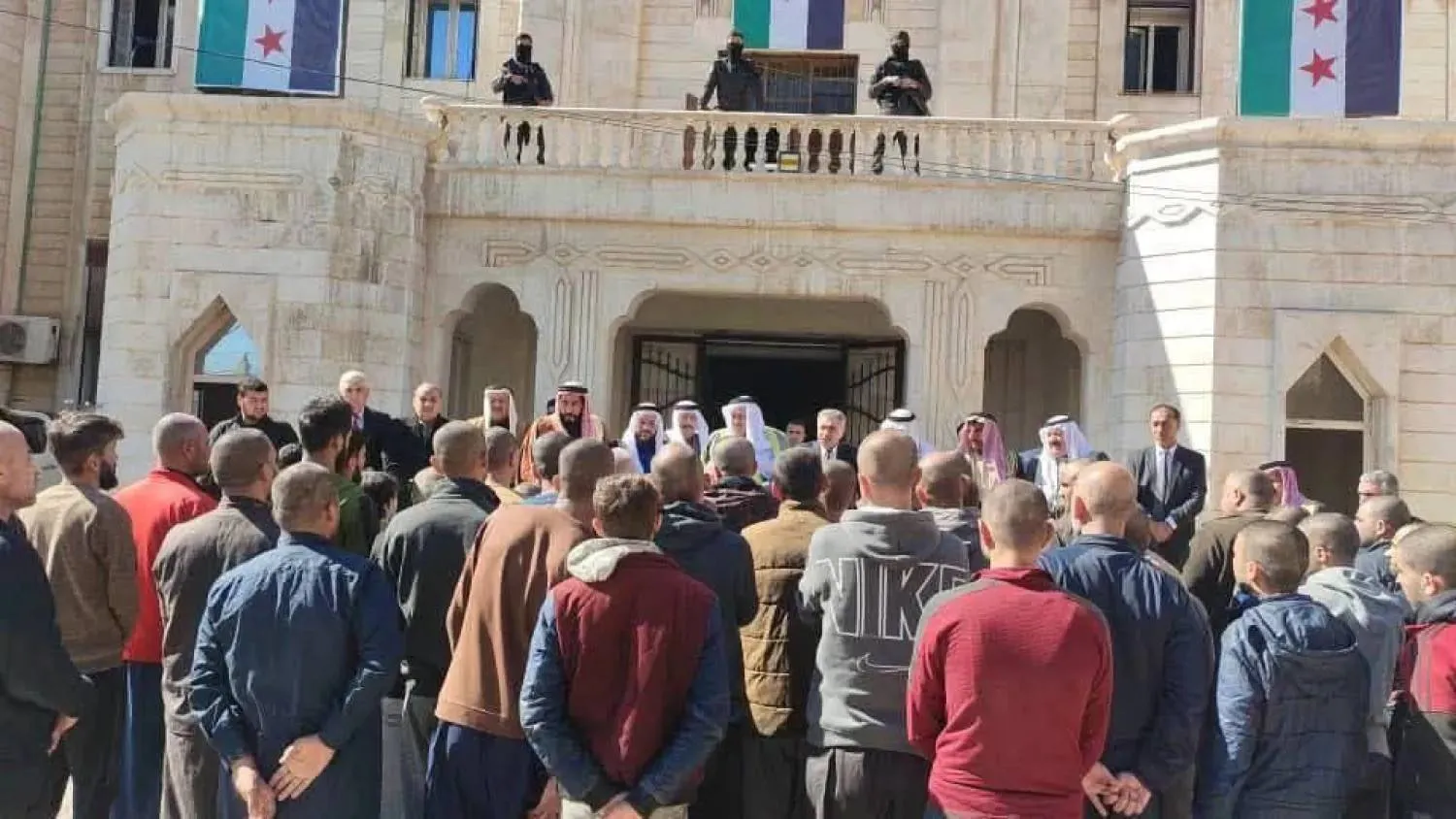
Former detainees released from Alaya Prison, controlled by the Syrian Democratic Forces (SDF) in Qamishli, in February (Al-Furat). 
TT

Damascus, SDF Move to Close Political Detainee File

Former detainees released from Alaya Prison, controlled by the Syrian Democratic Forces (SDF) in Qamishli, in February (Al-Furat). 

Syrian authorities are working with the Syrian Democratic Forces (SDF) to close the file of political detainees held by both sides, as part of ongoing coordination between Damascus and the Kurdish-led force.

Families in al-Hasakah province recently demanded the release of relatives from Alaya Prison in Qamishli, which remains under SDF control. Local sources said prison officials told families that no detainees remained at the facility and that some prisoners had been transferred to Iraq last month along with other Syrian inmates under a bilateral arrangement reportedly mediated by Washington.

At the same time, the Syrian government is preparing to resolve the broader detainee issue linked to the SDF. A presidential team operating in al-Hasakah is compiling lists of prisoners held by the SDF in preparation for their release. In return, Damascus is expected to free a new group of detainees held by the government in the coming days.

Video circulating online showed families gathering outside Alaya Prison seeking information about their relatives. The Hasakah Media Center said SDF personnel told them the prison held no detainees and that those previously held had been transferred to Iraq on terrorism-related charges.

Families told the outlet that some detainees had been arrested by the SDF for raising the Syrian flag, displaying images of Syrian President Ahmed al-Sharaa, or posting comments on social media.

Local reports, however, suggest some prisoners may still be held in Alaya. The SDF had previously transferred detainees there from al-Hasakah Central Prison, widely known as Ghuwayran Prison, before it was handed over to government authorities. Other detention sites include prisons in al-Aqtaan and al-Shaddadi.

Alaya Prison has been one of the SDF’s main detention facilities for individuals accused of criminal, security, or political offenses. According to available figures, it previously held about 1,000 detainees, most of whom have since been released.

A second round of prisoner releases involving SDF detainees is expected soon. Brigadier General Ziad al-Ayesh, the Syrian presidential envoy overseeing implementation of the January 29, 2026 agreement between Damascus and the SDF, said the process would include individuals previously detained during clashes with government forces in earlier “law-enforcement operations.”

In an interview with Syrian Al-Ikhbariah TV, al-Ayesh said the Syrian state intends to take over prisons formerly controlled by the SDF. Their administration would be transferred to the Interior Ministry and placed under judicial supervision by the Justice Ministry to ensure full state oversight.

He added that Damascus is also working with the SDF to release all political detainees, prisoners of conscience, and those detained in connection with events during the years of the Syrian uprising.

On March 10, the Syrian government and the SDF exchanged the release of 200 detainees. Al-Ayesh stated that Damascus aims to close the detainee file as part of a broader “national integration” process intended to promote reconciliation and strengthen the country’s unity.

Meanwhile, in remarks during a funeral for SDF fighters in Ayn al-Arab (Kobani), SDF commander Mazloum Abdi said that the group is working to return about 300 prisoners to the Syrian government in the coming days, as well as recover the bodies of fighters killed in recent clashes.

Further releases are expected before Nowruz on March 21, which Syria will celebrate this year for the first time as an official national holiday under Decree No. 17.



Iraq Hopes to Ship Oil to Türkiye by Pipeline as War Cuts off Exports

Technicians working at the Majnoon oil field in Basra, Iraq. (Reuters)
TT

Iraq Hopes to Ship Oil to Türkiye by Pipeline as War Cuts off Exports

Technicians working at the Majnoon oil field in Basra, Iraq. (Reuters)

Iraq is hoping to ship up to 250,000 barrels of oil per day to a port in Türkiye via a rehabilitated pipeline, its oil minister said, after the US-Israeli war on Iran cut off its main export route.

The amount would be just a fraction of the roughly 3.5 million barrels per day (bpd) that Iraq exported before the conflict, mostly through its southern Basra port and the Strait of Hormuz, where traffic has been severely disrupted by the war.

Authorities want to restore an old pipeline -- out of service for years -- that links the northern Kirkuk oil fields to the Turkish port of Ceyhan, where the oil could be shipped onwards to international buyers.

Oil Minister Hayan Abdel Ghani said late Sunday that the pipeline's rehabilitation is "complete, but there is a 100-kilometer section that needs to be inspected".

Teams will "conduct a hydrostatic test, which is the final phase of the pipeline's rehabilitation", hopefully "within a week", Ghani added, citing an export target of roughly 250,000 bpd.

The pipeline was damaged by the ISIS group in 2014.

Its use, however, requires "contact with the Turkish side and an agreement on logistical and technical issues", said oil expert Assem Jihad.

Initially, Baghdad wanted to send exports to the Ceyhan port via another pipeline that runs through Kurdistan.

But "so far, no agreement has been reached", Ghani said, as relations between the autonomous Iraqi Kurdistan and the federal government in Baghdad have deteriorated.

He acknowledged that "Iraqi oil exports were halted two or three days after the start of the war".

The country is also considering the possibility of transporting 200,000 bpd by tanker trucks, primarily via Jordan and Syria.

Iraq derives more than 90 percent of its revenue from oil.

Experts have warned that without this income, the state -- Iraq's largest employer -- will be unable to pay civil servants' salaries and risks a foreign currency shortage to finance imports or stabilise its exchange rate.


KSrelief Masam Project Clears 908 Mines Across Yemen in One Week

Saudi Arabia, through its humanitarian arm KSrelief, continues its efforts to clear mines in Yemen, enhancing civilian safety and supporting safe and dignified living conditions for Yemenis - SPA
TT

KSrelief Masam Project Clears 908 Mines Across Yemen in One Week

Saudi Arabia, through its humanitarian arm KSrelief, continues its efforts to clear mines in Yemen, enhancing civilian safety and supporting safe and dignified living conditions for Yemenis - SPA

The Project Masam for clearing landmines in Yemen, implemented by the King Salman Humanitarian Aid and Relief Center (KSrelief), removed 908 mines from various areas of Yemen during the second week of March 2026, including three anti-personnel mines, nine anti-tank mines, 890 unexploded ordnance, and six IEDs, SPA reported.

The team conducted clearance operations across several governorates, removing mines, explosive devices, and unexploded ordnance.

In Aden Governorate, it dismantled two anti-tank mines, 215 pieces of unexploded ordnance, and two IEDs.

It also removed one anti-tank mine and seven pieces of unexploded ordnance in Al-Khawkhah District of Al-Hudaydah Governorate; three anti-personnel mines, three anti-tank mines, 513 pieces of unexploded ordnance, and two IEDs in Al-Mukalla District of Hadhramaut Governorate; and one piece of unexploded ordnance in Midi District of Hajjah Governorate.

The number of mines removed in March rose to 2,171, bringing the total cleared since the launch of the Project Masam to 548,123.

Saudi Arabia, through its humanitarian arm KSrelief, continues its efforts to clear mines in Yemen, enhancing civilian safety and supporting safe and dignified living conditions for Yemenis.


Germany Warns Major Israeli Ground Campaign in Lebanon Would Worsen Humanitarian Situation

A displaced woman and a child sit in a tent in downtown Beirut, Lebanon, 15 March 2026.  EPA/WAEL HAMZEH
A displaced woman and a child sit in a tent in downtown Beirut, Lebanon, 15 March 2026. EPA/WAEL HAMZEH
TT

Germany Warns Major Israeli Ground Campaign in Lebanon Would Worsen Humanitarian Situation

A displaced woman and a child sit in a tent in downtown Beirut, Lebanon, 15 March 2026.  EPA/WAEL HAMZEH
A displaced woman and a child sit in a tent in downtown Beirut, Lebanon, 15 March 2026. EPA/WAEL HAMZEH

Germany is enormously concerned by the developments in Lebanon, said a government spokesperson in Berlin on Monday, and warned that ‌a major Israeli ‌ground offensive ‌would ⁠significantly worsen the ⁠already tense humanitarian situation in the region.

"A glance at this part ⁠of the war ‌zone ‌fills us ‌with concern because we ‌see preparations for a major Israeli ground offensive, which ‌would significantly worsen the already tense humanitarian ⁠situation ⁠in the region," said the spokesperson.

The spokesperson added that Germany welcomed efforts to restart talks between Israel and Lebanon.
