


Iran Rejects De-Escalation Offers; Israel Says It Kills Iranian Security Chief

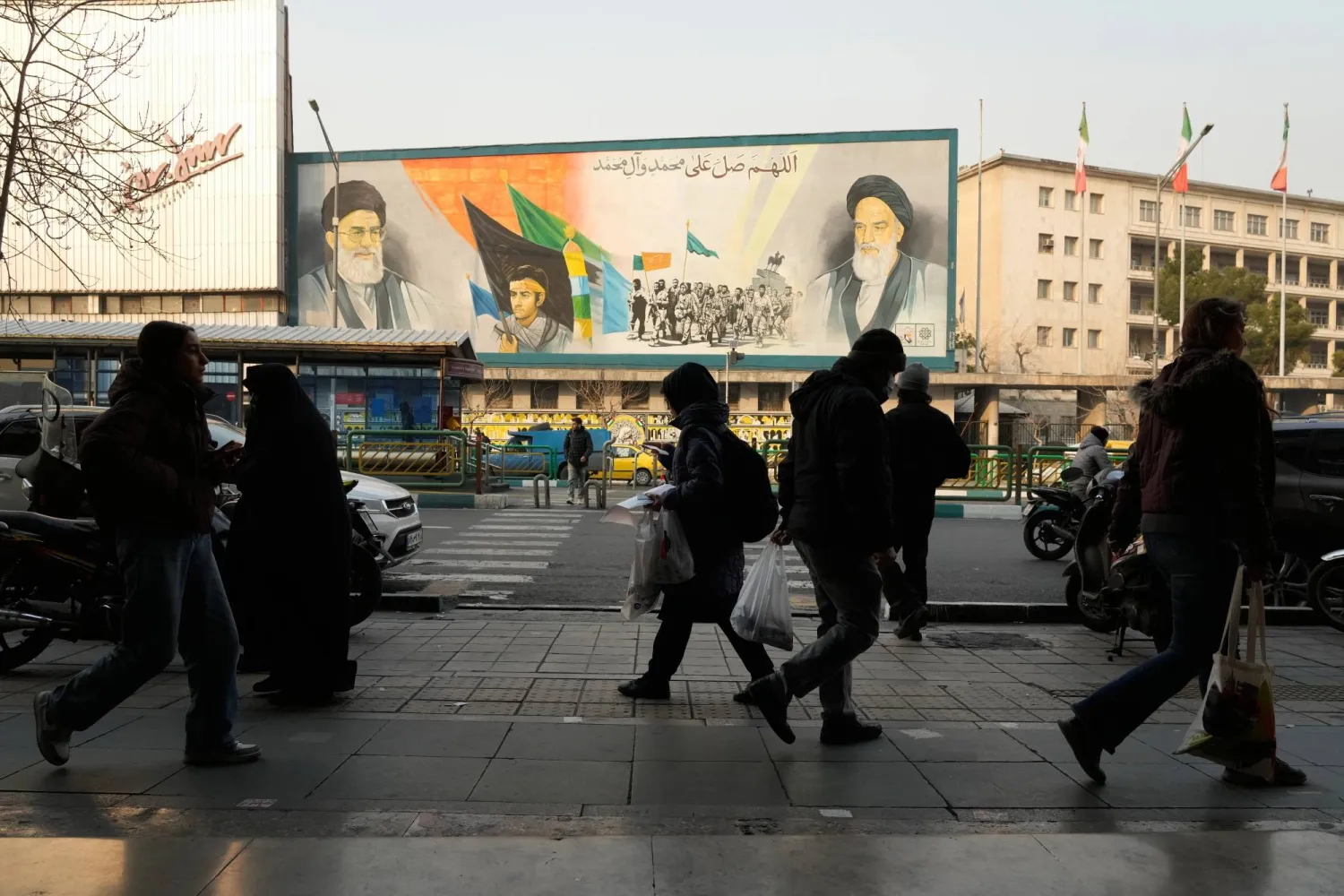
People walk in front of a mural depicting the late Iranian revolutionary founder Khomeini, right, members of the Basij paramilitary force and Supreme Leader Ali Khamenei along Enqelab-e-Eslami Street in Tehran, Iran, Sunday, Jan. 25, 2026. (AP Photo/Vahid Salemi)
TT

Iran Rejects De-Escalation Offers; Israel Says It Kills Iranian Security Chief

People walk in front of a mural depicting the late Iranian revolutionary founder Khomeini, right, members of the Basij paramilitary force and Supreme Leader Ali Khamenei along Enqelab-e-Eslami Street in Tehran, Iran, Sunday, Jan. 25, 2026. (AP Photo/Vahid Salemi)

Israel said on Tuesday it had killed Iran's security chief, the most senior figure targeted since the war's first day, while a senior Iranian official said the new supreme leader had rejected de-escalation offers conveyed by intermediary countries. 

Iran did not immediately comment on Israel's announcement it had killed Ali Larijani, widely viewed as one of Iran's most powerful figures and a confidant of slain Supreme Leader Ali Khamenei and his son and successor, Mojtaba. 

In a sign of Iran's continued defiance after more than two weeks of war, the senior Iranian official who asked not to be identified said the younger Khamenei had rejected proposals that were conveyed to Iran's Foreign Ministry for "reducing tensions or ceasefire with the United States". The official did not give further details. 

The official said Mojtaba Khamenei had held his first foreign policy session since being named supreme leader, and had declared that it was not "the right time for peace until the United States and Israel are brought to their knees, accept defeat, and pay compensation". 

He did not clarify whether the younger Khamenei, who has not yet been pictured since being named last week to replace his slain father, had attended the meeting in person or remotely. 

The US-Israeli war on Iran is ‌now in its ‌third week, with at least 2,000 people killed and no end in sight. 

The Strait of Hormuz remains largely closed ‌off and ⁠US allies have rebuffed ⁠US President Donald Trump's calls for them to help to reopen the vital waterway, through which about 20% of global oil and liquefied natural gas flows. 

Trump has called on allies to provide military assistance to ease the global economic impact by reopening the strait. Most NATO allies have informed the US they don't want to get involved in the conflict, Trump said on Tuesday, describing their position as "a very foolish mistake." 

"Because of the fact that we have had such Military Success, we no longer 'need,' or desire, the NATO Countries’ assistance — WE NEVER DID!" Trump wrote in a post on Truth Social, also singling out Japan, Australia and South Korea. 

European Union foreign policy chief Kaja Kallas said in an interview with Reuters on Tuesday that nobody was ready to risk the lives of their people in protecting the strait. 

"We have to find diplomatic ways to keep this open so that we don't have ⁠a food crisis, fertilizers crisis, energy crisis as well," Kallas said. 

Oil prices rose about 2% on Tuesday as Iran renewed ‌its strikes on oil facilities in the United Arab Emirates, and are up around 45% since the start of ‌the war, raising concerns of a renewed spike in global inflation. 

ISRAEL TARGETS IRAN'S SECURITY OFFICIALS 

The killing of Larijani, if confirmed, would make him the most senior figure killed by Israel ‌and the United States since the war's first day when they killed the supreme leader, other members of his family and other senior officials. 

Israel's Defense Minister Israel ‌Katz said Israeli forces had killed Larijani, as well as Gholamreza Soleimani who led the volunteer Basij militia, which plays a major role in domestic security. 

Prime Minister Benjamin Netanyahu said Israel was weakening Iran's leadership to give its people the opportunity to rise up and topple the government. 

"It won't happen in one go, it won't happen easily. But if we persist - we will provide them with the opportunity to take their destiny into their own hands," he added. 

Iranian state media published a handwritten note by Larijani commemorating Iranian sailors killed in a US attack. 

Larijani, secretary of ‌the Supreme National Security Council, had held a series of senior jobs and was close to the slain leader, although he had a reputation for pragmatic relations with other factions in the ruling system. 

AIR RAID SIRENS SOUND IN ISRAEL 

There ⁠was no let-up in attacks by both ⁠sides on Tuesday. 

In Israel, where Iranian missile attacks have killed 12 people, air raid sirens sounded throughout the day in the commercial hub Tel Aviv and surrounding cities as loud blasts of interceptions were heard as far away as Jerusalem. 

The barrage underscores Tehran's capacity to carry out long-range strikes despite more than two weeks of pounding by US and Israeli weapons. 

The Israeli military said it was targeting "Iranian regime infrastructure" with a new wave of strikes across Tehran, as well as Hezbollah sites in Beirut. 

Foreign Minister Gideon Saar said Israel "had, in effect already won the war", but gave no timeline for when the war might end. 

More than 900 people have died since Israel began attacks on Lebanon on March 2, the Lebanese Health Ministry said on Tuesday. More than 1,300 people have been killed and 7,000 injured in Iran, Iran's ambassador to the UN said on Monday. 

FUJAIRAH PORT DISRUPTED IN THIRD ATTACK 

Iran has responded by wide-ranging attacks on its Gulf neighbors. 

Gulf Arab states, including the UAE, have faced more than 2,000 missile and drone attacks on US diplomatic missions and military bases as well as oil infrastructure, ports, airports, ships and residential and commercial buildings. 

Oil loading at the UAE port of Fujairah was at least partly halted on Tuesday after a third attack in four days caused a fire at the export terminal. Fujairah lies on the far side of the Strait of Hormuz from the Gulf, making it one of the few ports from which the region's oil can be shipped without passing through the blockaded waterway. 

UAE authorities said debris from an intercepted ballistic missile also fell in Abu Dhabi's Bani Yas area, killing one Pakistani national, while a fire caused by a drone attack was being fought at Abu Dhabi's Shah gas field. 


Gunmen Attack Police Near Building Housing Israeli Consulate in Istanbul

A view of the building which houses the Israeli consulate in Istanbul after three gunmen engaged in a shootout with security personnel near the building in Istanbul, Türkiye, 07 April 2026. (EPA)
TT

Gunmen Attack Police Near Building Housing Israeli Consulate in Istanbul

A view of the building which houses the Israeli consulate in Istanbul after three gunmen engaged in a shootout with security personnel near the building in Istanbul, Türkiye, 07 April 2026. (EPA)

Three assailants opened fire at police outside a building housing the Israeli Consulate in Istanbul on Tuesday, sparking a gunfight that left one attacker dead, Turkish officials said. The two other assailants were wounded and captured.

Two police officers sustained slight injuries, Istanbul Gov. Davut Gul told reporters. The assailants were carrying long-barreled weapons.

The consulate is located in a high-rise building in Levent, one of the city’s main business districts. Officials said that there are no Israeli diplomats present in Israeli missions in Türkiye. Israel withdrew its diplomats amid security concerns and deteriorating relations with Türkiye during the war in Gaza.

Interior Minister Mustafa Cifti wrote on X that the attackers had traveled from the city of Izmit, about 100 kilometers (60 miles) east of Istanbul, in a rented car. One of the assailants was linked to a group he described as “exploiting religion,” without naming the organization.

The ISIS group has carried out deadly attacks in Türkiye in the past.

The two wounded assailants are brothers, identified as Onur C. and Enes C. The first has a criminal record related to drugs. Both are being interrogated, according to the Interior Ministry.

Video from the attack showed one assailant carrying what appeared to be an assault rifle, wearing a brown backpack and hiding behind a bus when exchanging fire with police. A police officer falls to the ground, apparently having been shot, and then rolls away to get behind a tree for cover.

One of the police officers was wounded in the leg and the other in the ear, the Interior Ministry said.

Turkish Justice Minister Akin Gurlek said that three prosecutors, including a deputy chief prosecutor, have been assigned to lead an investigation.

Police sealed off the building and blocked several roads, while forensic experts in white protective suits combed the area for evidence.

A witness described seeing officers take cover behind parked cars and communicate with each other during the shooting.

“In general, this is a noisy area, so initially we thought this might be something else. But the gunshots continued,” said Omer Dilki, 34. “We saw the police officers standing behind the cars, take shelter, and call out to each other.”

Ali Rıza Arpacı, who works nearby, described witnessing “serious clashes” happening right in front of him.

“We were almost inside the clashes,” he said, adding that the gunfight lasted for around 10 minutes.

Turkish President Recep Tayyip Erdogan denounced what he said was a “treacherous” attack.

“We will resolutely continue our fight against all forms of terrorism, and we will not allow the climate of security in Türkiye to be harmed by vile and timed provocations like today’s,” he said.

US Ambassador Tom Barrack condemned the assault, praising Turkish authorities for “their swift and decisive response.”

Israel’s Foreign Ministry similarly condemned the attack and commended Turkish security forces for their rapid action in thwarting it.


Russia and China Veto Watered-Down UN Resolution Aimed at Reopening the Strait of Hormuz

United States Ambassador to the United Nations Michael Waltz speaks during a United Nations Security Council meeting at United Nations Headquarters in New York, New York, USA, 07 April 2026. (EPA)
TT

Russia and China Veto Watered-Down UN Resolution Aimed at Reopening the Strait of Hormuz

United States Ambassador to the United Nations Michael Waltz speaks during a United Nations Security Council meeting at United Nations Headquarters in New York, New York, USA, 07 April 2026. (EPA)

Russia and China on Tuesday vetoed a UN Security Council resolution aimed at reopening the Strait of Hormuz that had been repeatedly watered down in hopes those two countries would abstain.

The vote — 11-2, with two abstentions from Pakistan and Colombia— took place just hours before an 8 p.m. Eastern deadline set by US President Donald Trump for Iran to open the strategic waterway or face attacks on its power plants and bridges.

One-fifth of the world’s oil typically passes through the strait, and Iran’s stranglehold during the war has sent energy prices soaring.

“Failing to adopt this resolution sends the wrong signal to the world, to the people of the world,” Abdullatif bin Rashid Al Zayani, Bahrain's foreign minister, said after the vote — “the signal that the threat to international waterways can pass without any decisive action by the international organization responsible for the maintenance of international peace and security.”

It’s doubtful the resolution introduced by Bahrain, even if it had been adopted, would have impacted the war, now in its sixth week, because it has been significantly weakened to try to get Moscow and Beijing to abstain rather than veto it.

The initial Gulf proposal would have authorized countries to use “all necessary means” to ensure transit through the Strait of Hormuz and deter attempts to close it.

The United States, which had supported the draft from its original form, assailed the countries that objected to the resolution.

“No one should tolerate that they are holding the global economy at gunpoint," Mike Waltz, the US ambassador to the UN, said of Iran, “but today, Russia and China did tolerate it.”

He said in his statement: “They sided with a regime that seeks to intimidate the Gulf into submission, even as it brutalizes its own people during a national internet blackout, for daring to imagine dignity or freedom.”

After Russia, China and France, all veto-wielding countries on the 15-member Security Council, expressed opposition to approving the use of force, the resolution was revised to eliminate all references to offensive action. It would have authorized only “all defensive means necessary.” A vote had been expected on Saturday.

But instead, the resolution was further weakened to eliminate any reference to Security Council authorization — which is an order for action — and limit its provisions to the Strait of Hormuz. Previous drafts had included adjacent waters.

The resolution vetoed Tuesday "strongly encourages states interested in the use of commercial maritime routes in the Strait of Hormuz to coordinate efforts, defensive in nature, commensurate with the circumstances, to contribute to ensuring the safety and security of navigation across the Strait of Hormuz.”

This should include escorting merchant and commercial vessels, and deterring attempts to close, obstruct or interfere with international navigation through the strait, it says.

The resolution also demanded that Iran immediately halt attacks on merchant and commercial vessels and stop impeding their freedom of navigation through the Strait of Hormuz and attacking civilian infrastructure.

In response to the US and Israeli attacks beginning on Feb. 28, Iran has targeted hotels, airports, residential buildings and other civilian infrastructure in more than 10 countries, including its own Gulf neighbors, some of the world’s major exporters of oil and natural gas.

Trump on Monday demanded again that Iran reopen the Strait of Hormuz after heaping praise on the US military for the daring rescue of two crewmen of a fighter jet shot down in Iran. The Republican president warned Iran that the "entire country can be taken out in one night, and that might be tomorrow night.”

He repeated the warning on Tuesday, saying a “whole civilization will die tonight” if Tehran does not meet his deadline to agree to a deal that includes reopening the Strait of Hormuz.

Russia’s UN Ambassador Vassily Nebenzia and China’s UN Ambassador Fu Cong have blamed the US and Israel for starting the war and sparking an expanding global crisis. They told the Security Council last week that the most urgent priority now is to end military operations immediately.

In response to Iran’s strikes against its Gulf neighbors, the Security Council adopted a Bahrain-sponsored resolution on March 11 condemning the “egregious attacks” and calling for Tehran to immediately halt its strikes.

That resolution, adopted by a vote of 13-0 with Russia and China abstaining, also condemned Iran’s actions in the Strait of Hormuz as a threat to international peace and security and called for an immediate end to all actions blocking shipping.


Deliberate Attacks on Civilian Targets ‘A War Crime’, Says UN

An Iranian flag lies amidst the rubble of a building of the Sharif University of Technology, which was damaged in a strike, amid the US-Israeli conflict with Iran, in Tehran, Iran, April 7, 2026. Majid Asgaripour/WANA (West Asia News Agency) via Reuters
TT

Deliberate Attacks on Civilian Targets ‘A War Crime’, Says UN

An Iranian flag lies amidst the rubble of a building of the Sharif University of Technology, which was damaged in a strike, amid the US-Israeli conflict with Iran, in Tehran, Iran, April 7, 2026. Majid Asgaripour/WANA (West Asia News Agency) via Reuters

The UN rights chief decried Tuesday the "incendiary rhetoric" in the Middle East war, warning that deliberate attacks on civilians and civilian infrastructure was "a war crime".

"Under international law, deliberately attacking civilians and civilian infrastructure is a war crime," UN high commissioner for human rights Volker Turk said in a statement, insisting that "anyone responsible for international crimes must be held to account by a competent court."

His comment came as US President Donald Trump ramped up his rhetoric against Iran, vowing to carry out the "complete demolition" of critical infrastructure, particularly bridges and power plants if Iran did not agree a deal by late Tuesday.

Hours before the deadline, the Israeli military said it had already completed a broad wave of strikes targeting "infrastructure sites" across Iran.

Writing on Truth Social, Trump stated that "a whole civilization will die tonight, never to be brought back again. I don't want that to happen, but it probably will", if the country does not heed his call for a deal.

Turk did not explicitly mention Trump nor the other countries involved in the conflict that began on February 28. But he said "I deplore the tirade of incendiary rhetoric being used in the Middle East war over the last couple of weeks by all parties."

In particular, he highlighted "the latest threats to annihilate a whole civilization and to target civilian infrastructure".

"This is sickening," he said, warning that "carrying through on such threats amounts to the most serious international crimes".

The UN rights chief stressed that "threats that spread fear and terror among civilians are unacceptable and must cease immediately."

He called on the international community to "take urgent steps to de-escalate the situation and to help protect the lives of all civilians."
