


Iran’s Larijani, the Man Whose Power Grew During Mideast War

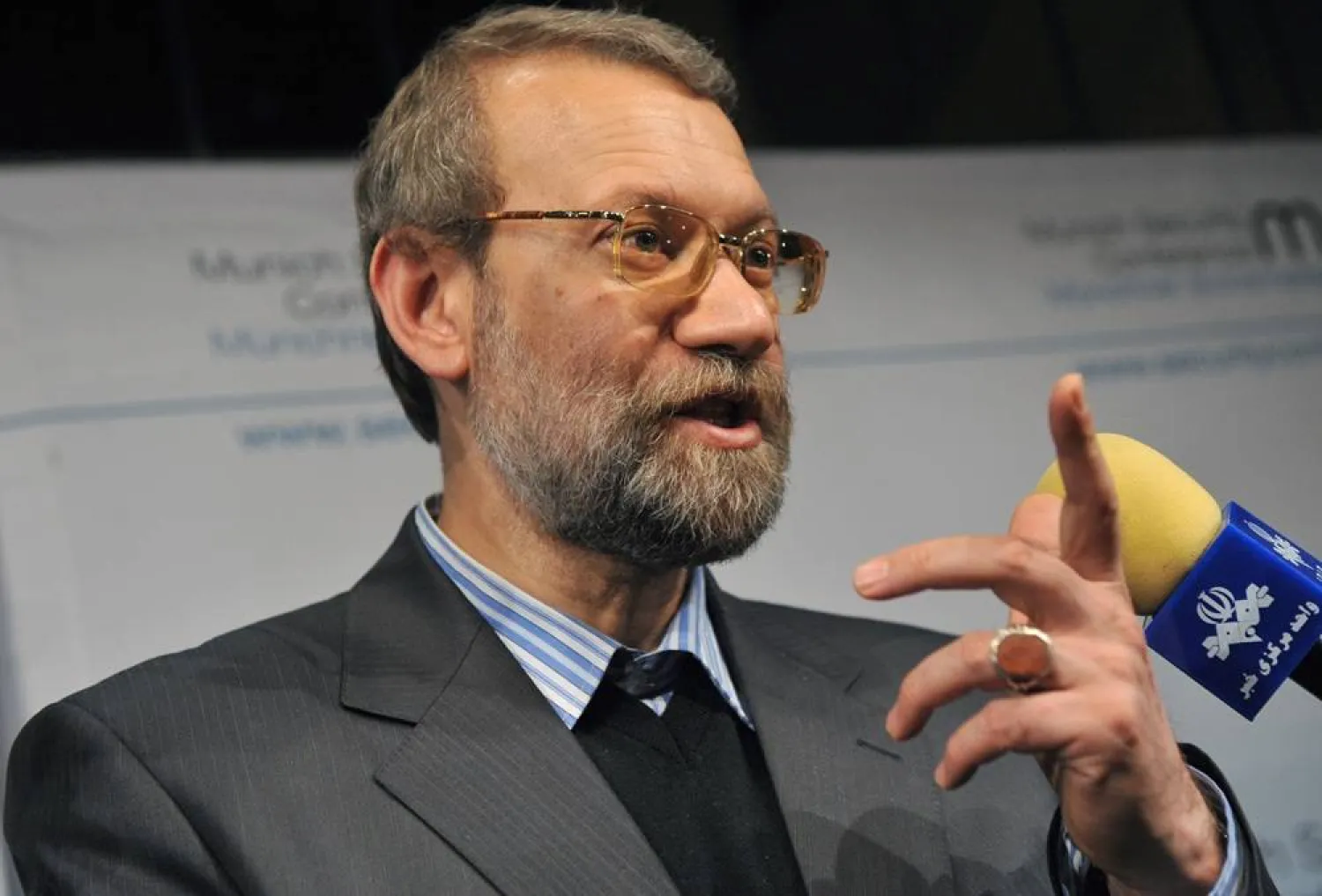
06 February 2009, Bavaria, Munich: Ali Larijani, then chairman of the Iranian parliament, speaks at the 45th Munich Security Conference in Munich. (dpa)
TT

Iran’s Larijani, the Man Whose Power Grew During Mideast War

06 February 2009, Bavaria, Munich: Ali Larijani, then chairman of the Iranian parliament, speaks at the 45th Munich Security Conference in Munich. (dpa)

When Israeli and US strikes killed Ali Khamenei at the start of the Middle East war, Iran's security chief Ali Larijani became even more powerful than he had been for decades.

Israel's Defense Minister Israel Katz said on Tuesday that Larijani had been killed, though Iran's authorities have not confirmed his death.

Larijani had since the start of the war played a far more visible role than the new supreme leader, Mojtaba Khamenei, who has not been seen in public since he was appointed to replace his slain father.

The security chief, on the other hand, was seen walking with crowds at a pro-government rally last week in Tehran, in a sign of defiance against Israel and the US.

His killing, if confirmed, would be a major blow against Iran, undermining a key figure seen as capable of navigating both ideology and diplomacy.

- Pragmatist -

Adept at balancing ideological loyalty with pragmatic statecraft, Larijani was central prior to the war to Iran's nuclear policy and strategic diplomacy.

Bespectacled and known for his measured tone, the 68-year-old was believed to enjoy the confidence of the late Khamenei, after a long career in the military, media and legislature.

In 2025, after Iran's last war with Israel and the US, he was appointed head of Iran's top security body, the Supreme National Security Council -- a position he had held nearly two decades earlier -- coordinating defense strategies and overseeing nuclear policy.

He later became increasingly visible in the diplomatic arena, travelling to Gulf states such as Oman and Qatar as Tehran cautiously engaged in nuclear negotiations that were ultimately scuppered by the war.

- 'Canny operator' -

"Larijani is a true insider, a canny operator, familiar with how the system operates," Ali Vaez, the International Crisis Group's project director for Iran, said before the Middle East war began.

Born in Najaf, Iraq in 1957 to a prominent Shiite cleric who was close to the Islamic Republic's founder Khomeini, Larijani's family has been influential within Iran's political system for decades.

Some of his relatives have been the targets of corruption allegations over the years, which they denied.

He earned a PhD in Western Philosophy from the University of Tehran.

A veteran of the Iranian Revolutionary Guard Corps during the Iran-Iraq war, Larijani later headed state broadcasting IRIB for a decade from 1994 before serving as parliamentary speaker from 2008 to 2020.

In 1996, he was appointed as Khamenei's representative to the Supreme National Security Council (SNSC). He later became secretary of the SNSC and chief nuclear negotiator, leading talks with Britain, France, Germany and Russia between 2005 and 2007.

He ran in the 2005 presidential elections, losing to populist candidate Mahmoud Ahmadinejad, with whom he later had disagreements over nuclear diplomacy.

Larijani was then disqualified from running for president in both 2021 and 2024.

Observers viewed his return as the head of the SNSC as signaling a turn reflecting his reputation as a conservative capable of combining ideological commitment with pragmatism.

Larijani supported the landmark 2015 nuclear deal with world powers which unraveled three years later after US President Donald Trump withdrew from the agreement.

In March 2025, Larijani warned that sustained external pressure could alter Iran's nuclear posture.

"We are not moving towards (nuclear) weapons, but if you do something wrong in the Iranian nuclear issue, you will force Iran to move towards that because it has to defend itself," he told state television.

Larijani repeatedly insisted negotiations with Washington should remain confined to the nuclear file and defended uranium enrichment as Iran's sovereign right.

- Violent repression -

Larijani was among officials sanctioned by the US in January over what Washington described as "violently repressing the Iranian people", following nationwide protests which erupted weeks earlier due to the rising cost of living.

According to rights groups, thousands of people were killed in the government's brutal crackdown of the protests.

Larijani acknowledged that economic pressures had "led to the protests", but blamed the violence which ensued on foreign involvement by the United States and Israel.


Who Is Leading Iran? Western Sources Map the Inner Circle of the New Supreme Leader

 A demonstrator holds a portrait of the Mojtaba Khamenei during the Quds day in London, England, Sunday, March 15, 2026. (AP)
A demonstrator holds a portrait of the Mojtaba Khamenei during the Quds day in London, England, Sunday, March 15, 2026. (AP)
TT

Who Is Leading Iran? Western Sources Map the Inner Circle of the New Supreme Leader

 A demonstrator holds a portrait of the Mojtaba Khamenei during the Quds day in London, England, Sunday, March 15, 2026. (AP)
A demonstrator holds a portrait of the Mojtaba Khamenei during the Quds day in London, England, Sunday, March 15, 2026. (AP)

Western diplomatic sources have outlined to Asharq Al-Awsat the tight inner circle surrounding Iran’s new Supreme Leader, Mojtaba Khamenei, shedding light on the key figures shaping decision-making at a critical moment for the country.

According to these sources, any serious discussion of a comprehensive ceasefire in the ongoing war with Israel and the US is unlikely to begin until this inner circle concludes that the country has reached a point of military exhaustion and that prolonging the conflict would only deepen its strategic predicament.

The sources also dismissed claims over Khamenei’s lack of experience over decision-making. Khamenei has long been involved in the decision-making process within the office of his late father, former Supreme Leader Ali Khamenei, they stressed. He has also maintained extensive ties with Iran’s military leadership, particularly within the Iranian Revolutionary Guard Corps (IRGC).

A key figure in this circle is Mohsen Rezaei, appointed by Mojtaba Khamenei as a senior military adviser. Often described as a “man of war”, Rezaei is also believed to have been among those who advised Khomeini to accept the ceasefire with Iraq at the end of the Iran-Iraq War, when Iranian forces were reportedly exhausted.

The sources identified several influential figures in the Supreme Leader’s inner circle. The most prominent among them is parliament Speaker Mohammad Bagher Ghalibaf, a former IRGC commander who is said to have played a leading role during last year’s 12-day conflict with Israel.

Other key figures include General Ahmad Vahidi, the commander of the IRGC, who previously served as minister under both presidents Ebrahim Raisi and Mahmoud Ahmadinejad, and was the first commander of the Quds Force, the foreign arm of the IRGC.

General Rahim Safavi, a senior adviser during the tenure of the slain Khamenei, General Ali Abdollahi, head of operations at the armed forces’ general staff, General Majid Mousavi, commander of the IRGC’s missile unit, and Rear Admiral Alireza Tangsiri, head of its naval forces, are also part of the new supreme leader’s inner circle.

Despite the heavy blows, the Iranian regime has so far succeeded in preventing any fragmentation within its military and leaderships, the sources noted.

Developments indicate that Iran’s military leadership had preprepared a strategy aimed at making any war against it extremely costly for both the region and the global economy.

This strategy, they said, rests on two main pillars: first, “drawing Gulf states into the theater of war through missile and drone attacks under the pretext of targeting US presence”; and second, “causing widespread or total disruption to maritime traffic through the Strait of Hormuz.”

The sources added that Tehran is betting on what it perceives as US President Donald Trump’s limited patience for prolonged conflict, especially amid rising oil prices, which Iran hopes could approach $200 per barrel, the proximity of US midterm elections, and the lack of broad public support for war.

On the other side, US and Israeli forces have escalated strikes in an effort to demonstrate the scale of destruction inflicted on Iran’s military arsenal and defense industries.

The objective of regime change appears to have receded in favor of a strategy of attrition, one that could compel Iran to scale back what the sources described as its “self-destructive behavior.”

The sources suggested that the new supreme leader may initially find it difficult to adopt a flexible or conciliatory stance in his first test of leadership. However, a growing sense that continued attrition could trigger internal unrest — or even raise questions about the regime’s survival — may ultimately lead senior military figures to conclude that preserving the system justifies accepting painful compromises.

They also warned that missile and drone attacks targeting Gulf Cooperation Council (GCC) countries could prove counterproductive, particularly as they have largely struck civilian targets.

The sources stressed that the Gulf states’ significant regional and international standing could form the basis for mounting global pressure on Iran to agree to a ceasefire. When that moment comes, Tehran may find that the war has set it back by years.


Why Iranian Drones Are Hard to Stop

Protesters hold a mockup of Iranian-made drone Shahed-136, during a rally marking al-Quds Day (Jerusalem Day), amid the US-Israeli conflict with Iran, outside the U.S. Embassy in Jakarta, Indonesia, March 13, 2026. (EPA)
TT

Why Iranian Drones Are Hard to Stop

Protesters hold a mockup of Iranian-made drone Shahed-136, during a rally marking al-Quds Day (Jerusalem Day), amid the US-Israeli conflict with Iran, outside the U.S. Embassy in Jakarta, Indonesia, March 13, 2026. (EPA)

Cheap and deadly, Iranian-designed Shahed drones have inflicted major damage in the Middle East war, and have anti-jamming and other capabilities that make them difficult to stop.

- Offline navigation -

Designed to explode on impact, Shahed drones connect to GPS to register their location shortly before or after takeoff, then typically turn off their receivers, said Thomas Withington, a researcher at Britain's Royal United Services Institute (RUSI).

The drones then travel long distances towards their target using gyroscopes that measure their speed, direction and position -- known as an "inertial navigation system".

"GPS is going to get jammed by whatever is protecting the target," Withington told AFP.

"If you look at a map of GPS jamming at the moment in the Middle East, you see that there's a lot of jamming... By not using the GPS, you avoid that."

The drones can then return to GPS just before impact for a more precise strike, or remain offline.

"It's not always necessarily very accurate, but it's as accurate as it needs to be," said Withington.

- Anti-jamming mechanisms -

Russia has been making Shahed-style drones to use in its war in Ukraine.

The US-based Institute for Science and International Security found in 2023 that those drones used "state-of-art antenna interference suppression" to remove enemy jamming signals while preserving the desired GPS signal.

Anti-jamming mechanisms were found in the wreckage of an Iranian-made drone that struck Cyprus in the opening days of the Middle East war, a European industry source told AFP.

"They have put (the Shahed) together using off-the-shelf parts, but it has... many of the capabilities that US military GPS equipment has," Todd Humphreys, a professor of aerospace engineering at the University of Texas at Austin, told AFP.

Defending against them now requires sophisticated electronic warfare equipment.

"The Shaheds have been upgraded," said Ukrainian air force spokesman Yuriy Ignat.

- Stealth materials -

The Shahed is built from "lightweight radar-absorbing materials", such as plastic and fiberglass, a 2023 RUSI paper said.

Their small size and low altitude allow them to slip through aerial defense systems.

- Other positioning systems? -

Some experts think Iran is using multiple positioning systems, making it easier for its drones to dodge jamming.

Serhii Beskrestnov, a technology adviser to the Ukrainian defense ministry, said Iran is using the BeiDou system, a Chinese rival to the US-developed GPS.

And the Russia-made version of Shaheds uses both BeiDou and the Russian equivalent, GLONASS, he said.

Others suspect Iran may be using LORAN, a radio navigation system developed during World War II.

LORAN, which does not require satellites, largely fell out of use when GPS emerged.

But Iran said in 2016 it was reviving the technology, which requires a network of large ground-based transmitters, though experts have not confirmed it is active today.

- Counter-strategies -

Militaries have mainly defended against Shaheds by shooting them down with cannon fire, missiles and interceptor drones, with the United States and Israel also developing lasers.

But jamming can work, as Ukraine has shown, as can "spoofing", which involves hacking into the drone's navigation system to change its destination.

Ukraine used electronic warfare to neutralize 4,652 attack drones from mid-May to mid-July 2025 -- not far off the number it shot down in the same period, 6,041, according to AFP analysis of Ukrainian military data.

Its experts insist that electronic and conventional defenses are often used in tandem against the drones.


How Poland Went from Post-Communist Wreck to One of the World's 20 Biggest Economies

FILE - Newer skyscrapers flank the communist-era Palace of Culture and Science, foreground, in n, Poland, May 25, 2018. (AP Photo/Alik Keplicz, File)
TT

How Poland Went from Post-Communist Wreck to One of the World's 20 Biggest Economies

FILE - Newer skyscrapers flank the communist-era Palace of Culture and Science, foreground, in n, Poland, May 25, 2018. (AP Photo/Alik Keplicz, File)

A generation ago, Poland rationed sugar and flour while its citizens were paid one-tenth what West Germans earned. Today its economy has edged past Switzerland to become the world’s 20th largest with over $1 trillion in annual output.

It’s a historic leap from the post-Communist ruins of 1989-90 to today's European growth champion that economists say has lessons on how to bring prosperity to ordinary people — and that the Trump administration says should be recognized by Poland's presence at a summit of the Group of 20 leading economies later this year.

The transformation is reflected in people like Joanna Kowalska, an engineer from Poznan, a town of half a million people midway between Berlin and Warsaw. She returned home after five years in the US.

“I get asked often if I’m missing something by coming back to Poland, and, to be honest, I feel it’s the other way around,” Kowalska said. “We are ahead of the United States in so many areas.”

Kowalska works at the Poznan Supercomputing and Networking Center, which is developing the first artificial intelligence factory in Poland and integrating it with a quantum computer, one of 10 on the continent financed by a European Union program.

Kowalska worked for Microsoft in the US after graduating from the Poznan University of Technology in a job she saw as a “dream come true.”

But she missed having a “sense of mission," she said.

“Especially when it comes to artificial intelligence, the technology started developing so rapidly in Poland,” Kowalska added. “So it was very tempting to come back.”

Multiple factors in breaking out of poverty

The guest invitation to the G20 summit is mostly symbolic; no guest country has been promoted to full member since the original G20 met at the finance minister level in 1999, and that would take a consensus decision of all the members. Moreover, the original countries were chosen not just by GDP rank, but by their “systemic significance” in the global economy.

But the gesture reflects a statistical truth: In 35 years — a little less than one person's working lifetime — Poland’s per capita gross domestic product rose to $55,340 in 2025, or 85% of the EU average. That's up from $6,730 in 1990, or 38% of the EU average and now roughly equal to Japan’s $52,039, according to International Monetary Fund figures measured in today's dollars and adjusted for Poland’s lower cost of living.

Poland’s economy has grown an average 3.8% a year since joining the EU in 2004, easily beating the European average of 1.8%.

It wasn't simply one factor that helped Poland break out of the poverty trap, says Marcin Piątkowski of Warsaw’s Kozminski University and author of a book on the country’s economic rise.

One of the most important factors was rapidly building a strong institutional framework for business, he said. That included independent courts, an anti-monopoly agency to ensure fair competition, and strong regulation to keep troubled banks from choking off credit.

As a result, the economy wasn’t hijacked by corrupt practices and oligarchs, as happened elsewhere in the post-Communist world.

Poland also benefited from billions of euros in EU aid, both before and after it joined the bloc in 2004 and gained access to its huge single market.

Above all, there was the broad consensus, from across the country's political spectrum, that Poland’s long-term goal was joining the EU.

“Poles knew where they were going,” Piątkowski said. “Poland downloaded the institutions and the rules of the game, and even some cultural norms that the West spent 500 years developing.”

As oppressive as it was, communism contributed by breaking down old social barriers and opening higher education to factory and farmworkers who had no chance before. A post-Communist boom in higher education means half of young people now have degrees.

“Young Poles are, for instance, better educated than young Germans,” Piatkowski said, but earn half what Germans do. That’s “an unbeatable combination” for attracting investors, he said.

An electric bus ride to success Solaris, a company founded in 1996 in Poznan by Krzysztof Olszewski, is one of the leading manufacturers of electric buses in Europe with a market share of around 15%. Its story shows one hallmark of Poland’s success: entrepreneurship, or the willingness to take risks and build something new.

Educated as an engineer under the Communist government, Olszewski opened a car repair shop where he used spare parts from West Germany to fix Polish cars. While most enterprises were nationalized, authorities gave permission to small-scale private workshops like his to operate, according to Katarzyna Szarzec, an economist at the Poznan University of Economics and Business. “These were enclaves of private entrepreneurship," she said.

In 1996, Olszewski opened a subsidiary of the German bus company Neoplan and started producing for the Polish market.

“Poland’s entry to the EU in 2004 gave us credibility and access to a vast, open European market with the free movement of goods, services and people,” said Mateusz Figaszewski, responsible for institutional relations.

Then came a risky decision to start producing electric buses in 2011, a time when few in Europe were experimenting with the technology. Figaszewski said larger companies in the West had more to lose if switching to electric vehicles didn't work out. "It became an opportunity to achieve technological leadership ahead of the market," he said.

An aging population is still a challenge

Challenges still remain for Poland. Due to a low birth rate and an aging society, fewer workers will be able to support retirees. Average wages are lower than the EU average. While small and medium enterprises flourish, few have become global brands.

Poznan Mayor Jacek Jaśkowiak sees domestic innovation as a third wave in Poland’s postsocialist economic development. In the first wave, foreign countries opened factories in Poland in the early 1990s, taking advantage of a skilled local population.

Around the turn of the millennium, he said, Western companies brought more advanced branches, including finance, IT and engineering.

“Now it’s the time to start such sophisticated activities here,” Jaśkowiak says, adding that one of his main priorities is investing in universities.

“There is still much to do when it comes to innovation and technological progress,” added Szarzec, the Poznan economist. “But we keep climbing up on that ladder of added value. We're no longer just a supplier of spare parts.”

Szarzec's students say more needs to be done to reduce urban-rural inequalities, make housing affordable and support young people starting families. They say Poles need to acknowledge that immigrants, such as the millions of Ukrainians who fled the Russian invasion in 2022, contribute to economic development in an aging population.

"Poland has such a dynamic economy, with so many opportunities for development, that of course I am staying," said Kazimierz Falak, 27, one of Szarzec's graduate students. “Poland is promising.”