
Palestinians Were Bystanders to the Iran War. Now They’re Victims Too

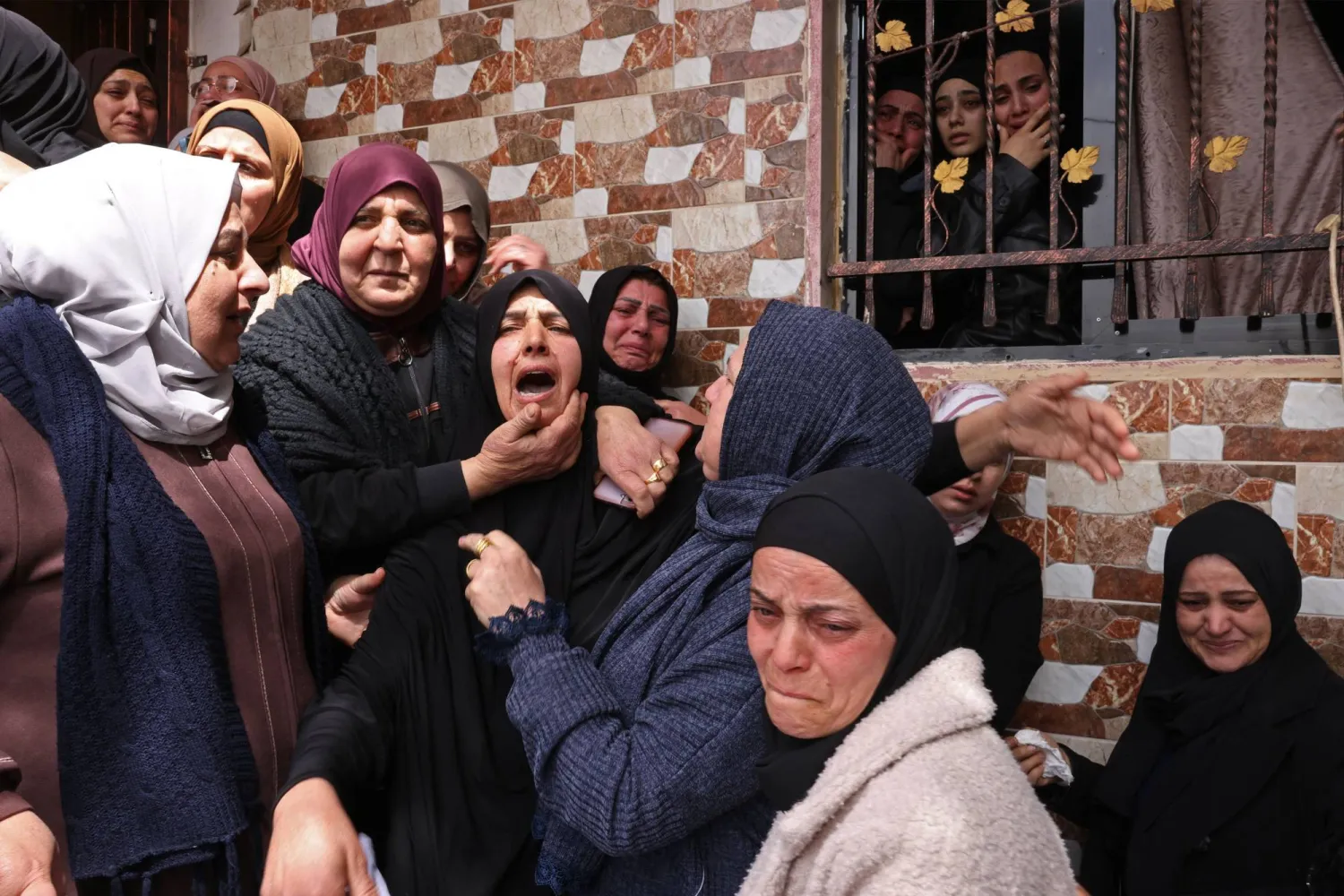
Family members mourn the death of one of the three Palestinian women killed in Iranian missile attacks, in Beit Awa town near the occupied West Bank city of Hebron on March 19, 2026. (AFP)
TT

Palestinians Were Bystanders to the Iran War. Now They’re Victims Too

Family members mourn the death of one of the three Palestinian women killed in Iranian missile attacks, in Beit Awa town near the occupied West Bank city of Hebron on March 19, 2026. (AFP)

For nearly three weeks, Palestinians in the occupied West Bank have mostly been bystanders as Israel and Iran have exchanged airstrikes. But on Wednesday, four women became victims of the war.

In the town of Beit Awa, women and their daughters were inside a small beauty salon when an Iranian missile struck only steps away, sending shrapnel tearing through walls and shelves stacked with boxes of acrylic nails and bottles of turquoise and scarlet polish.

More than a dozen were injured and four were killed, including a single mother who was six months pregnant and her daughter, the Palestinian Red Crescent and eyewitnesses said.

The morning after the strike, hundreds of coffee cups and acrylic nails lay scattered across a floor red with dried blood. The salon — a business run out of a metal container in a family’s yard — was pocked with holes, with parts laying in debris piles beside a small crater where the strike hit.

Ambulances delayed in critical ‘golden hour’

Salon owner Hadeel Masalmeh lost friends and her business partner, Sahera Atileh. She said she heard sirens from the Israeli settlement of Negohot about 2 miles (3 kilometers) away. “We didn’t pay much attention and didn’t expect any shrapnel or anything like that to fall on us,” she said.

Much of life in Israel has been centered around those sirens and alerts since the war started, sending Israeli's running to shelters, often several times a day. But Palestinians, who have not been targeted by Iranian strikes, have gone about their business as usual throughout much of the last three weeks, barely pausing when distant sirens blare or the rare phone with Israeli service sounds a warning alert.

The drive to Beit Awa should have taken less than 10 minutes but stretched to 25, leaving the victims without medical care for crucial minutes, Abedullraziq Almasalmeh said. He heard rockets whoosh overhead and then fall, his house shaking as he reached to dial for ambulances after 10 p.m.

The Palestinian Red Crescent attributed delays to Israeli gates outside Beit Awa that forced ambulances to take a longer route.

Wednesday's victims were the first Palestinian fatalities in the West Bank since the start of the Iran war. But the Red Crescent had warned that the hundreds of new Israeli gates and roadblocks slicing up the territory were increasingly preventing them from reaching Palestinians in need of emergency care.

Qusai Jabr, the manager of the group’s disaster risk management department, told The Associated Press that in the first week of the war that included women in labor, elderly men having strokes and victims of a growing number of Israeli settler attacks.

“This forced closure caused significant delays, compelling ambulances to take long, rugged alternative routes, which critically impacted the ‘golden hour’ essential for life-saving interventions,” Palestinian Red Crescent said in a statement.

Israeli authorities have not imposed the kind of full lockdown seen during last year’s 12-day war with Iran. But for emergency crews like Palestinian Red Crescent, movement hasn't gotten easier and ambulances have found many gates often closed. Jabr said there were about 800 gates during last year’s war and now there are roughly 1,100, both manned and unmanned.

Palestinians lack shelters

The beauty salon strike underscored how Palestinians who live close enough to see Israel from their homes lack the shelters and medical assistance that have effectively minimized Israeli deaths and injuries throughout nearly three weeks of Iranian airstrikes.

Israel operates a system of sirens and phone alerts directing residents to fortified shelters that can protect them from incoming missiles or their remnants, which fall after being intercepted by Israel’s air defense systems.

Not all of Israel enjoys equal access to shelters, especially Arab-majority towns, but its building codes have required them in homes since the first Gulf War and public shelters are nearby for those who don't have them.

Palestinians in the occupied West Bank — both in crowded cities and rural areas — lack such protections. The West Bank isn't an Iranian target but had previously been hit by shrapnel pieces and debris.

Israel operates a system of sirens and phone alerts directing residents to fortified shelters that can protect them from incoming missiles or their remnants, which fall after being intercepted by Israel’s air defense systems.

The nature of the strike Wednesday was unclear. Israel’s military called it a direct hit, rather than debris or shrapnel that fell after being intercepted by Israel’s air defense system and said it was a submunition from a cluster bomb. Those missiles can explode midair and disperse smaller bomblets across wide areas, trading precision for coverage.

Iraq’s Nujaba Movement Warns against ‘US Plot’ to Integrate PMF in New Security Ministry

Slain Iranian Supreme Leader Ali Khamanei (R) and Nujaba Movement leader Akram al-Kaabi in Tehran in December 2018. (Supreme leader’s website)
TT

Iraq’s Nujaba Movement Warns against ‘US Plot’ to Integrate PMF in New Security Ministry

Slain Iranian Supreme Leader Ali Khamanei (R) and Nujaba Movement leader Akram al-Kaabi in Tehran in December 2018. (Supreme leader’s website)

The Iran-aligned Nujaba Movement in Iraq warned on Saturday against an “American plot” to merge the pro-Iran Popular Mobilization Forces (PMF) in state institutions, presenting new Prime Minister Ali al-Zaidi with his first test in imposing state monopoly over arms.

It made its warning in wake of a visit to Iraq earlier this week by former US Central Command Commander David Petraeus, who also previously led US forces stationed in Iraq.

The new Iraqi government appears to be a taking a tougher stance against the Iran-aligned armed factions in the country in wake of attacks launched from Iraq against Saudi Arabia and the United Arab Emirates.

Riyadh and Abu Dhabi have said the attacks were launched from Iraqi territory. Zaidi has slammed the attacks as “criminal acts”.

Spokesperson for the Commander-in-Chief of the Iraqi Armed Forces Sabah al-Numan said the committee probing the attacks will cooperate with Riyadh and Abu Dhabi to uncover the perpetrators.

“The official statements are not up for debate: the security of our brothers is a read line and there can be no replacing the rule of law,” he said in statements carried by the official state news agency INA.

Any party found responsible for the attacks will face judicial and military measures, he vowed, adding that the attacks were a “threat to Iraq’s national security and flagrant violation of its sovereignty”.

On the state monopoly over arms, al-Numan said the decision “is not a mere political slogan, but a security strategy that must be implemented.”

“The success of the government will be measured by how much it establishes itself as the sole party that holds power over weapons,” he stressed.

Prominent armed factions, such as the Kataib Hezbollah and Kataib Sayyid al-Shuhada, have not made any statements over the recent developments.

The Nujaba Movement, however, has openly defied the state’s decision to impose monopoly over weapons.

The party, which is seen as the most hardline, has also rejected attempts to restructure the PMF.

Deputy head of the movement’s executive council Hussein al-Saeedi said: “The resistance’s weapons are not open to compromise.”

“Stripping the factions of their weapons will leave society exposed to the ongoing threats,” he declared from Basra.

He also slammed as an “American plot” the alleged plan to merge the PMF with the federal police and other forces as part of a new “federal security ministry”.

He said such efforts are “futile” and “impossible to execute”, warning that insisting on forging ahead with the plan will have “political and popular implications.”


10,000 Kurds Apply for Syrian Citizenship

Syrian Kurds demonstrate to mark Kurdish Language Day, demanding constitutional recognition of the Kurdish language by the Syrian government, in Qamishli, Syria, May 14, 2026. (Reuters)
TT

10,000 Kurds Apply for Syrian Citizenship

Syrian Kurds demonstrate to mark Kurdish Language Day, demanding constitutional recognition of the Kurdish language by the Syrian government, in Qamishli, Syria, May 14, 2026. (Reuters)

Damascus announced on Saturday that it has received over 10,000 applications for Syrian citizenship from Kurds in wake of a recent decree that preserves their rights in the country.

The Interior Ministry said it received applications for citizenship from 2,892 families and 10,516 individuals.

The majority of the applications were filed in the northeastern Hasakeh region, followed by Aleppo, Raqqa, then Deir Ezzor.

Authorities began receiving applications for citizenship from the Kurds on April 6. A May 7 deadline for receiving applications was extended to allow people more time to complete their official procedures ahead of applying.

Receiving the application is the first step towards citizenship. It will be followed by interviews with applicants to verify their documents and eligibility. The final step culminates in receiving citizenship and a document that allows them to enjoy all of their civilian rights.

The process covers all Kurds who do not have an identification document in Syria, as well as expatriates.


Lebanon Civil Defense Says Israeli Strike Destroys its Nabatieh Facility

Smoke rises from the site of an Israeli strike that targeted the southern Lebanese village of Kfar Tibnit on May 21, 2026. (Photo by Abbas FAKIH / AFP)
TT

Lebanon Civil Defense Says Israeli Strike Destroys its Nabatieh Facility

Smoke rises from the site of an Israeli strike that targeted the southern Lebanese village of Kfar Tibnit on May 21, 2026. (Photo by Abbas FAKIH / AFP)

Lebanon's civil defense agency said early on Sunday its regional facility in the southern city of Nabatieh had been destroyed by an Israeli strike.

The Directorate General of Civil Defense said the building had collapsed and a large number of vehicles and equipment had been damaged by a "direct hit in a hostile Israeli strike".

It added there were no reports of casualties among its personnel, who had been moved to another location before the incident, said AFP.

The civil defense agency condemned "this attack on a center dedicated to humanitarian and relief work", stressing that it was facing "growing risks and challenges" in carrying out its operations.

Israeli strikes in Lebanon have continued despite a truce that came into effect on April 17, with Israel saying it is targeting Iran-backed Hezbollah.

Lebanon's health ministry has recorded the deaths of 123 rescuers and health workers in Israeli strikes since the country was drawn into the wider regional war on March 2 when Hezbollah launched rockets at Israel in retaliation for the death of Iran's supreme leader in US-Israeli strikes.