


From Gaza to Lebanon, Doctor Races Against Time to Treat War-Wounded Children

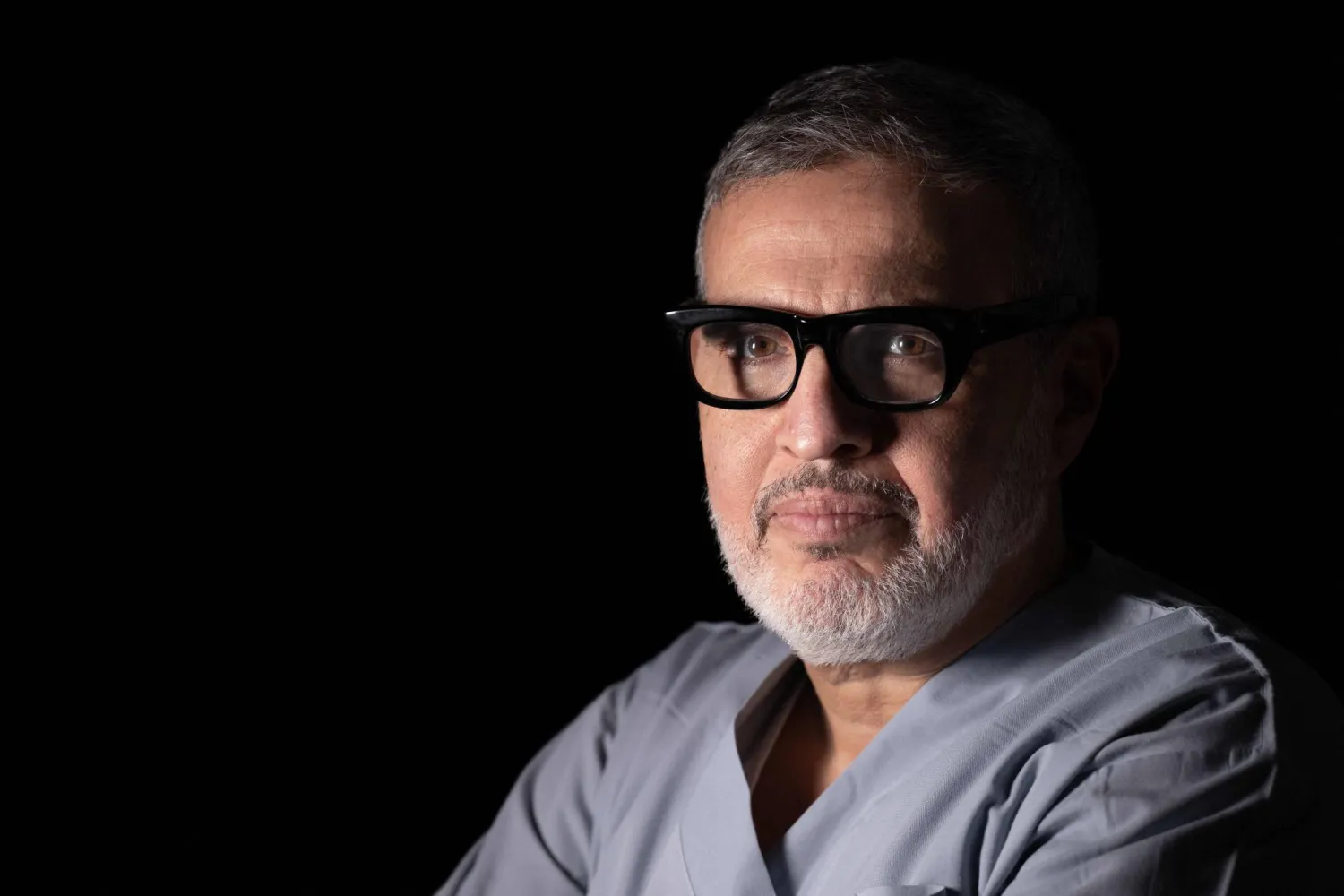
British-Palestinian plastic and reconstructive surgeon Ghassan Abou-Sittah poses during a photo session in the Lebanese capital Beirut on March 19, 2026. (AFP)
TT

From Gaza to Lebanon, Doctor Races Against Time to Treat War-Wounded Children

British-Palestinian plastic and reconstructive surgeon Ghassan Abou-Sittah poses during a photo session in the Lebanese capital Beirut on March 19, 2026. (AFP)

During almost three weeks of war in Lebanon, British-Palestinian doctor Ghassan Abu-Sittah has had no respite, telling AFP he has been working "against the clock" to save children wounded in Israeli bombardment.

At the American University of Beirut Medical Center, one of the capital's main hospitals, his pediatric intensive care unit has been receiving critical cases from across the country and desperate parents praying for their children's survival.

This week, Israeli strikes hit densely populated central Beirut areas not far from the hospital, with three badly wounded children pulled from the rubble.

Among them was an 11-year-old girl who had "metal shrapnel in her abdomen, and partial amputation of the foot", said Abu-Sittah, a plastic surgeon specializing in conflict injuries.

"She's now in a stable condition," added the doctor, who lives near the hospital and rushes there for emergencies.

Israeli strikes have pummeled Lebanon since Hezbollah fired rockets into Israel on March 2 to avenge the killing of Iran's supreme leader Ali Khamenei in Israeli-US attacks.

Lebanese authorities say that 118 children have been killed and 370 others wounded.

Abu-Sittah said he had seen "partial limb amputations, brain injuries, shrapnel in the face, shrapnel in the eye, penetrating abdominal shrapnel, a lot of fractures, a lot of broken bones, a lot of soft tissue damage... and all of this in one child."

Such wounds mean "lots of surgeries", he added, dark rings under his eyes.

- War an 'endemic disease' -

He recalled three sisters who were brought to the hospital around a fortnight ago.

"Their injuries are so bad, I have to take them to the operating room every 48 hours... to get rid of more of the dead tissue and clean the wounds so that at some stage, they're ready for the reconstructive surgery," he said.

Born in Kuwait to a Palestinian refugee father from Gaza and a Lebanese mother, Abu-Sittah has dedicated his life to treating wounded civilians in the region.

War is the "endemic disease" of the Middle East, said Abu-Sittah.

But "you never get used to" children suffering, he said.

"A child should never become faceless, they never become numbers."

His first experience of conflict was as a medical student in 1991 after the withdrawal of Iraqi troops from Kuwait during the first Gulf War, and treating the wounded would soon become his mission.

He graduated in the United Kingdom and over the decades has worked repeatedly in Gaza and Lebanon, as well as in Iraq and Yemen.

After Palestinian group Hamas's October 7, 2023 attack on Israel sparked war in Gaza, Abu-Sittah spent more than a month in the Palestinian territory.

Lebanon this time is "a kind of small version of Gaza", Abu-Sittah said.

While the death toll in Lebanon is far lower, health facilities and workers in the country have paid a heavy price, with the health ministry saying 40 health workers have been killed and 119 wounded.

- Ongoing care -

Abu-Sittah said four hospitals in Beirut's southern suburbs had been forced to evacuate, "one of which has a big intensive care unit for children", amid persistent Israeli bombardment of the area.

He said some badly wounded children have died because they were not transferred in time from parts of the country where health facilities are less equipped than those in Beirut.

"The Israelis are targeting the ambulances, and so moving kids from one hospital in Nabatieh or in the Bekaa is very dangerous," he said, referring to a city in south Lebanon and to east Lebanon's Bekaa valley area.

"It can only happen during the day, and it takes a long time," he added.

The Israeli military has accused Hezbollah of using ambulances "for military purposes", an accusation Lebanon's health ministry has described as "a justification" for crimes "against humanity".

In 2024, the doctor created the Ghassan Abu-Sittah Children's Fund, which aims to provide medical care in Gaza and Lebanon and ongoing support to wounded children after they leave hospital.

Abu-Sittah said his youngest patient in Lebanon now was a four-year-old boy whose parents and three siblings were killed, and who will need major long-term physical and psychological support after suffering a head wound and an amputated foot.

"Who's going to look after them when they go home?" Abu-Sittah said.

Many wounded children "come from poor backgrounds who don't have the means to manage all of this", he added.

"It's not just the body that's destroyed, it's the family unit that's destroyed."


WHO: Strike on Sudan Hospital killed at Least 64 People

Women Muslim worshippers gather for the early morning prayers for Eid al-Fitr, marking the end of the holy month of Ramadan, at a stadium in Sudan's eastern Red Sea port city of Port Sudan on March 20, 2026. (Photo by Ibrahim ISHAQ / AFP)
TT

WHO: Strike on Sudan Hospital killed at Least 64 People

Women Muslim worshippers gather for the early morning prayers for Eid al-Fitr, marking the end of the holy month of Ramadan, at a stadium in Sudan's eastern Red Sea port city of Port Sudan on March 20, 2026. (Photo by Ibrahim ISHAQ / AFP)

At least 64 people were killed, including at least 13 children, in a strike on a hospital in Sudan's western Darfur region last week, the World Health Organization said Saturday.

The strike on the Al Daein Teaching Hospital in East Darfur on Friday also injured at least 89 people and rendered the hospital non-functional, Tedros Ghebreyesus, the head of the WHO, said on X.

Sudan slid into chaos in April 2023 when a power struggle between the military and the rival Rapid Support Forces exploded into war throughout the country.

The RSF has blamed the military for the strike on the hospital.

The army has denied the attack, but two military officials said the strike was targeting a nearby police station, The Associated Press reported. They spoke on the condition of anonymity as they were not allowed to discuss the matter openly.

The devastating war has killed more than 40,000 people, according to UN figures, but aid groups say that is an undercount and the true number could be many times higher.

The WHO has said that over 2,000 people have been killed in attacks on medical facilities since the start of the war.

“Enough blood has been spilled. Enough suffering has been inflicted. The time has come to de-escalate the conflict in Sudan,” said Ghebreyesus.


Damaged Russian Tanker to Be Towed to Libya

A series of explosions rocked the Arctic Metagaz on March 3. Miguela XUEREB / Newsbook Malta/AFP
TT

Damaged Russian Tanker to Be Towed to Libya

A series of explosions rocked the Arctic Metagaz on March 3. Miguela XUEREB / Newsbook Malta/AFP

A damaged Russian gas tanker that was abandoned in the Mediterranean will be towed to a Libyan port, according to a state-owned oil company in the north African country.

The Arctic Metagaz was ferrying about 700 tons of fuel and a consignment of liquified natural gas (LNG) from Russia to Egypt when it was hit by a series of explosions on March 3. Russia accused Ukraine of trying to blow it up.

The 30 crew members were rescued, leaving the LNG-laden carrier to drift between Malta and Libya for nearly three weeks.

Libya's National Oil Corporation (NOC) announced on Saturday that it would collaborate with Italian group Eni to fetch the wrecked vessel.

"Managing this environmental threat is fully achievable," NOC said in a statement. "It will be towed safely to one of the Libyan ports following coordination with the relevant authorities."

The company said it had already taken action to "reduce the risk of pollution".

AFP footage taken from a plane earlier this month showed the carrier listing to one side, parts of it blackened and seriously damaged by fire, with two holes on either side in the middle of the hull.

According to Italy's Civil Protection Department, the carrier is located in international waters, but within the Libyan search and rescue zone.

It said that towing the wreck would be a "complex operation" due to the "large breach along its side".

The WWF environmental group warned that any spill could cause long-lasting pollution in the area, among the most biodiverse in the Mediterranean basin.

The ship faced US and European Union sanctions as a suspected part of Russia's "shadow fleet" of vessels carrying Russian oil and gas in contravention of international sanctions.


War Deepens Lebanon’s Economic Collapse

A displaced young girl who fled with her family Israeli airstrikes in southern Lebanon, eats an apple at a playground school that turned into a shelter in Beirut, Saturday, March 21, 2026. (AP Photo/Hussein Malla)
TT

War Deepens Lebanon’s Economic Collapse

A displaced young girl who fled with her family Israeli airstrikes in southern Lebanon, eats an apple at a playground school that turned into a shelter in Beirut, Saturday, March 21, 2026. (AP Photo/Hussein Malla)

Lebanon’s economy barely catches its breath before another crisis hits, tightening the squeeze and deepening its fragility.

The current war has wiped out efforts to revive it, as the country still reels from the 2019 financial collapse, the coronavirus pandemic, the Beirut port blast, and the 2023-2024 war.

After successive governments failed to resolve its structural crisis, the latest military escalation has further weakened the economy and stalled reform efforts, despite the current government's attempts to lay out recovery plans and legislation.

Since the first week of the war, some businesses have halved employees’ working hours to cut wages, while others have shut down entirely, aside from those destroyed in Beirut’s southern suburbs and the south.

The impact has been immediate, with many workers still earning less than half their pre-2019 salaries.

Losses of $100 million a day

Nicolas Chammas, secretary-general of the Lebanese Economic Organizations and head of the Beirut Traders Association, described the war’s impact as “huge,” compounded by years of strain since 2019.

“In 2025, economic growth reached 5%, but that followed a 7% contraction in 2024,” Chammas told Asharq Al-Awsat. “We had already started this year on a negative footing, and the current war has worsened conditions.”

According to the World Bank, the 2024 war cost $14 billion, or about $225 million a day.

“Using that as a benchmark, the current war is costing roughly $100 million a day,” he said, citing damage to infrastructure, reduced economic activity, and the cost of sheltering and assisting displaced people.

Chammas said tourism and travel were among the hardest-hit sectors, with travel down by more than 80%.

“Hotel occupancy is now below 10%, and declines are also severe in car rentals, furnished apartments, and resorts,” he said. “The industrial and commercial sectors are also affected, with the latter down around 50%.”

If the war continues, he warned, growth could flip into a contraction of up to 10%.

Structural contraction

Economist Jassem Ajaka said the war has shifted the downturn from “monetary” to “structural.”

“Under full dollarization, the shock no longer shows in a currency collapse, but in paralyzed economic activity and higher operating costs,” he told Asharq Al-Awsat.

He put total losses from the previous and current wars at about $15 billion, direct and indirect, based on World Bank estimates and updated research for 2026.

With Brent crude above $115, production and dollarized service costs have risen by more than 40%, eroding companies' profit margins, he said.

The agricultural sector has been the hardest hit geopolitically, with losses of about $2.5 billion due to destroyed land and disrupted supply chains. Tourism revenues have fallen 74% compared with the 2024 season, depriving the economy of a key source of foreign currency.

Ajaka said recent Banque du Liban data showed external assets holding at about $12.07 billion, supported by liquid foreign securities.

But he warned that a prolonged war and high oil prices would gradually drain those assets to cover fuel and essential imports, threatening this “artificial stability” in the second half of the year if reserves fall below safe levels.

Latest figures

Ajaka said 30% of small and medium-sized businesses had shut down permanently by the first quarter of 2026, unable to cover dollarized operating costs amid weak demand.

Those still operating have shifted to “emergency cash flow management,” with some paying half salaries or flat dollar wages worth no more than 40% of previous levels.

Unemployment has surged to between 46% and 48%, driven not only by business closures but also by the inability of productive sectors to absorb labor costs amid rising global energy and input prices.
