
Five Options Under Consideration to Reopen the Strait of Hormuz

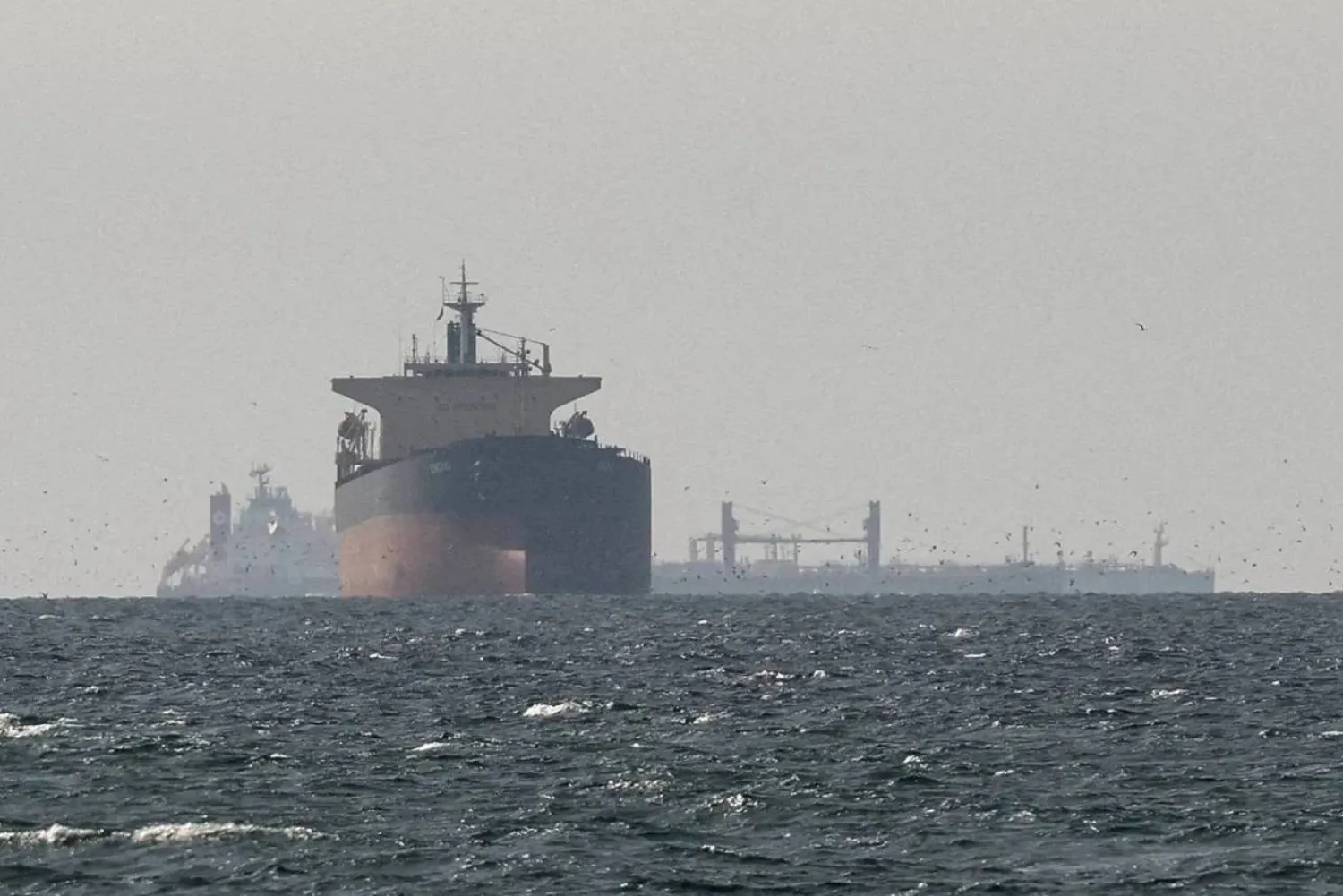
Tankers sail in the Gulf, near the Strait of Hormuz, as seen from northern Ras al-Khaimah, near the border with Oman’s Musandam governance, March 11, 2026. REUTERS/Stringer/File Photo
TT

Five Options Under Consideration to Reopen the Strait of Hormuz

Tankers sail in the Gulf, near the Strait of Hormuz, as seen from northern Ras al-Khaimah, near the border with Oman’s Musandam governance, March 11, 2026. REUTERS/Stringer/File Photo

Luke Broadwater, Helene Cooper, Eric Schmitt*

Washington: As the United States presses ahead with its military campaign against Iran, the Strait of Hormuz has emerged as the war’s most pivotal battlefield.

In response to US and Israeli airstrikes, Iran has largely blockaded the strait, snarling oil shipments and rapidly causing the price of gasoline to rise.

With the war approaching the three-week mark, President Donald Trump is facing a battery of military and diplomatic choices that are testing his abilities as a leader.

The United States has been flowing military resources into the region to deal with the problem, and carrying out waves of attacks against Iranian forces and installations in the hopes of reopening the strait — a goal vital to ending the war and addressing the economic and political pressures on the White House.

The president has also pushed for allies to send warships to protect oil tankers in the strait. But he has built up little good will with those countries, after repeatedly subjecting them to punishing tariffs, insults and threats.

On Friday, Trump said he would leave reopening the strait to the countries that use it, claiming the United States did not. “If asked, we will help these Countries in their Hormuz efforts, but it shouldn’t be necessary once Iran’s threat is eradicated,” he wrote on social media.

It was one in a string of mixed messages the Trump administration has sent about the war.
Here are the options under consideration to attempt to reopen the Strait of Hormuz, all of which are complex and carry substantial risks. None of them would guarantee a quick end to the conflict.

Eliminate threats to shipping from land-based attacks

Before the Navy escorts commercial vessels through the strait, US commanders want to destroy as many of Iran’s missiles and drones as possible.

What it would take: In recent days, American warplanes have ramped up strikes against missiles and their launchers along Iran’s southern flank that could target slow-moving oil tankers and giant cargo ships.

Earlier this week, the military’s Central Command said that Air Force F-15E fighter-bombers had dropped several 5,000-pound bombs to penetrate layers of rock and concrete to destroy underground bunkers storing cruise missiles and support equipment.

Gen. Dan Caine, the chairman of the Joint Chiefs of Staff, said that Iran’s ability to launch missiles had declined by 90% since the start of the war. But he acknowledged that Iranian forces still had some firepower left.

General Caine added that some regional allies, which he did not identify, were using Apache helicopter gunships to “handle one-way attack drones,” one of the most potent weapons Iran has used to threaten shipping, as well as neighboring Arab countries and their energy sites across the Arabian Gulf.

Sweep the strait for mines

US officials appear to disagree about whether Iran has already started mining the strait. Intelligence officials say yes, while Pentagon officials say they have not seen clear evidence.
What it would take: Clearing the narrow waterway of Iranian mines would be a weekslong operation, according to one former naval officer who was stationed on a minesweeper in the Arabian Gulf. And it could put US sailors directly in harm’s way.

Iran is believed to maintain a variety of naval mines. They include small limpet mines containing just a few pounds of explosives that divers place directly on a ship’s hull and typically detonate after a set amount of time. Iran also has larger moored mines that float just under the water’s surface, releasing 100 pounds or more of explosive force when they come in contact with an unsuspecting ship.

More advanced “bottom” mines sit on the seafloor. They use a combination of sensors — magnetic, acoustic, pressure and seismic — to determine when a ship is nearby, and explode with hundreds of pounds of force.

“All it takes is for one of those things to get through to shut down traffic,” said Rear Adm. John F. Kirby, a retired naval officer. “The fear alone can be paralyzing to the shipping industry, as we have already seen.”

The Navy had four minesweepers in the Gulf, each with 100 sailors aboard, based in Bahrain. But those ships are gone now, one official said, replaced with three littoral combat ships that can sweep for mines but are also used for other purposes. And two of the ships, the USS Tulsa and the USS Santa Barbara, were spotted far from the Middle East this week, between Malaysia and Singapore, according to the military website The War Zone.

Go after Iran’s navy and fast boat fleet

The Pentagon has targeted the Iranian navy since the opening hours of the war, destroying or damaging more than 120 vessels, including several submarines. The goal was to blunt Iran’s ability to shut down the strait and threaten neighboring countries.

But Iran’s Revolutionary Guards Corps also has hundreds of speed boats. A fighter armed with a rocket-propelled grenade aboard one of these boats could slip through US defenses and land a deadly blow to a tanker or warship.

What it would take: Low-flying Air Force A-10 Warthog planes are “hunting and killing fast-attack watercraft” in the contested sea lanes, General Caine said. The A-10 was developed to provide close air support for US ground troops, but has been repurposed to strike ships at sea, he said.

US warplanes are also striking speedboats hiding in coastal redoubts, but Iran has positioned some of them in civilian ports, increasing the risks to civilians from any American attacks.

The US military is also attacking storage areas for naval drones before the drones can be launched.

Invade Kharg Island

Adm. Brad Cooper, the head of the military’s Central Command, said the US attack against Iranian military sites on Kharg Island, the country’s oil export hub, had destroyed more than 90 targets, including bunkers for naval mines and missiles.

That has softened the island’s defenses if Trump follows through on his threat to seize the island and put a stranglehold on Iran’s oil economy, a possibility the Pentagon has gamed out in war-planning scenarios for years.

But Iranian troops are still on the island, and US commanders say that such a mission would be risky.

What it would take: Some 2,200 Marines on three warships — armed with drones, attack helicopters and warplanes — have cut short a patrol in the Indo-Pacific region, and are expected to arrive in the Arabian Gulf region later next week. The Marines are trained to conduct amphibious landings.

The US military is dispatching 2,500 additional Marines to the Middle East next month, officials said Friday. They are expected to replace or augment those en route to the region now.

Another option involves Special Operations forces and paratroopers from elite units, like the Army’s 82nd Airborne Division, taking the island. Once in control, the Americans would likely be subject to attack from any remaining land- or sea-based Iranian forces.

On Thursday, the president said he had no plans to commit ground forces to the war, before qualifying: “If I were, I certainly wouldn’t tell you.” He added that he would “do whatever’s necessary to keep the price” of oil down.

Use naval escorts to escort oil tankers

Trump said on Friday that escorting oil tankers through the Strait of Hormuz was “a simple military maneuver.” Naval experts say it is anything but.

In fact, of all of Trump’s options for opening up the strait, naval escorts are perhaps the trickiest.

What it would take: Naval escorts are cumbersome operations that require not just Navy destroyers and littoral combat ships, but also attack aircraft.

The Navy has deployed around 12 destroyers and littoral combat ships to the region and could certainly send more, although that could take weeks, Navy officials said. A Navy destroyer, which is equipped with the Aegis Combat System that uses computers and radar to track and target, can protect oil tankers by firing cruise and ballistic missiles at land targets in Iran, while Standard antimissile systems can intercept incoming threats.

But one Navy official said that would require a high ratio of Navy destroyers to commercial ships, and would likely be a huge strain on naval assets. The Pentagon has already requested an additional $200 billion in funding for the war.

Mark Montgomery, a retired rear admiral, estimated that about a dozen Navy destroyers, with armed helicopters and other aircraft overhead, would be needed to escort five or six tankers or cargo ships at a time through the strait — a transit he said could take roughly 10 to 12 hours.

During the so-called tanker war between Iran and Iraq in the 1980s, the United States escorted reflagged Kuwaiti tankers through the Arabian Gulf and the Strait of Hormuz, part of Operation Earnest Will.

The USS Samuel B Roberts was nearly destroyed by a mine, and the USS Stark was heavily damaged by Iraqi missiles. In the end, 37 American sailors were killed.

*The New York Times


Baby Born in Tent on a Beirut Roadside Struggles to Survive, Her Family Displaced by War

Haifa Kenjo, who fled Israeli airstrikes on the southern suburbs of Beirut, holds her 15-day-old daughter Shiman inside the tent she uses as a shelter and where she gave birth to her in Beirut, Sunday, April 12, 2026. (AP Photo/Emilio Morenatti)
TT

Baby Born in Tent on a Beirut Roadside Struggles to Survive, Her Family Displaced by War

Haifa Kenjo, who fled Israeli airstrikes on the southern suburbs of Beirut, holds her 15-day-old daughter Shiman inside the tent she uses as a shelter and where she gave birth to her in Beirut, Sunday, April 12, 2026. (AP Photo/Emilio Morenatti)

All that newborn Shiman knows of the world is a flimsy tent along Beirut’s waterfront — the stench of mildewed blankets, stings of swarming insects and screams of Israeli warplanes striking the Lebanese capital.

As of Monday, she was 16 days old after being born here in the mud, said her mother, Haifa Kenjo.

Kenjo, 34, was nine months pregnant when Israeli attacks on Beirut’s southern suburbs of Dahiyeh sent her, her husband and their 2-year-old son, Khalid, running for their lives in sandals and pajamas. They had no time to bring anything as explosions shook the house, they said — not clothes, not cash.

They took refuge in a donated tent near downtown Beirut and secured the tarp with rocks as the wind threatened to rip it from the ground.

Of the more than 1 million people uprooted in Lebanon by this latest war between Israel and the Iran-backed Hezbollah, 13,500 are pregnant and more than 1,500 are expected to deliver in the next month, the United Nations’ sexual and reproductive health agency said this week, warning that many struggle to access adequate maternal care.

When life had been normal, Kenjo pictured giving birth at Beirut's main public hospital, where she delivered Khalid. She is originally from Syria, and although she has spent almost half her life in the Lebanese capital and married a Lebanese man, she must pay to access the country’s public hospitals, where Lebanese mothers can give birth for free.

When her water broke and she went into labor on March 28, she called an ambulance and her husband scraped together the $40 admission fee. But the $500 they needed to deliver Shiman at the hospital was buried in the ruins of their home, razed the week before in an Israeli airstrike.

They returned to the tent, called a midwife and prayed.

Umm Ali, the midwife, said she did her best, but the tent was filthy. The rain seeped inside. They washed tiny Shiman with bottled water.

Kenjo had no milk in her breasts to give her child. Infant formula costs more than her husband makes in a day installing water tanks.

She knows her baby is hungry. Volunteers passing out food in the displacement camp gave her just enough formula for the next few days.

Shiman doesn’t cry like a normal infant. She coughs. Her skin is cold and clammy, pockmarked with insect bites.

“She is so precious,” Kenjo said, stroking her baby girl. “But for her we have nothing. We have less than zero.”


Iran, Lebanon Bore Brunt of Missiles and Drones Launched During War

 People stand next to a Synagogue, which was damaged in a strike, amid the US-Israeli conflict with Iran, in Tehran, Iran, April 7, 2026. Majid Asgaripour/WANA (West Asia News Agency) via Reuters
People stand next to a Synagogue, which was damaged in a strike, amid the US-Israeli conflict with Iran, in Tehran, Iran, April 7, 2026. Majid Asgaripour/WANA (West Asia News Agency) via Reuters
TT

Iran, Lebanon Bore Brunt of Missiles and Drones Launched During War

 People stand next to a Synagogue, which was damaged in a strike, amid the US-Israeli conflict with Iran, in Tehran, Iran, April 7, 2026. Majid Asgaripour/WANA (West Asia News Agency) via Reuters
People stand next to a Synagogue, which was damaged in a strike, amid the US-Israeli conflict with Iran, in Tehran, Iran, April 7, 2026. Majid Asgaripour/WANA (West Asia News Agency) via Reuters

Some three-quarters of the airstrikes during the Middle East war targeted sites in Iran or Lebanon, according to an AFP analysis of data from ACLED, a non-profit that tracks political violence worldwide.

At least 7,700 strikes or series of strikes by missiles, drones, rockets or bombs, were recorded by the US-based conflict research group between the start of the war on February 28 up to April 8, when a fragile ceasefire concluded between Tehran and Washington came into effect.

ACLED collected and vetted its data from sources that it considers reliable, such as news reports, social networks, institutions, and other NGOs.

This count, which includes attacks that were intercepted, cannot be considered an exhaustive list from the conflict.

- Iran -

Approximately four out of 10 recorded attacks targeted Iran, mostly attributed to the Israeli military, According to AFP's analysis, in only a third of the cases could the target be identified as military or linked to the Iranian Revolutionary Guard Corps (IRGC), the regime's ideological army.

A third of the attacks had no identified target. April 6 and 7 -- the two days preceding the ceasefire -- saw the highest number of strikes.

- Lebanon -

Lebanon, where Israel has been conducting a campaign triggered by the Iran-backed movement Hezbollah on March 2 launching an offensive, accounted for a third of the attacks, according to ACLED data as of April 3.

The vast majority were carried out by Israeli forces, while nearly 10 percent were Hezbollah attacks against Israeli positions in the south of Lebanon.

Israel asserts the two-week ceasefire agreed between the United States and Iran does not apply to Lebanon and it has continued to bombard the country.

- Israel -

One in seven attacks targeted Israel, most of which were intercepted. The attacks were in almost equal proportions from Iran and Hezbollah.

- Other countries -

The main countries targeted by Iran were Gulf states, primarily the United Arab Emirates, Kuwait, Saudi Arabia, and Bahrain. In Iraq, 40 percent of the attacks were against Kurdish groups and 20 percent against US interests.

Qatar and Oman were targeted to a lesser extent.

In Syria, ACLED recorded approximately one hundred incidents, but these were mainly the result of Iranian missiles and drones being intercepted by Israel. Several dozen similar incidents were recorded in the West Bank and Jordan.

In Türkiye, four missile launches were intercepted by NATO to protect its Incirlik airbase, where US troops are stationed.

- Most common targets -

Israel targeted 15 bridges or their approaches in Lebanon and around 20 in Iran.

Attacks against energy infrastructure in Iran were most intense during the second and third weeks of the conflict, as well as during the week of the ceasefire announcement.

Iran's key petrochemical complex at Assalouyeh, already targeted in mid-March, was struck again on April 6 by Israel. Numerous Iranian fuel depots were also hit.

ACLED reported four strikes near Iran's only nuclear power plant, in Bushehr.

Military bases housing US personnel were targeted around 50 times in total, primarily during the first two weeks of the conflict.


US-Iran: More Than Four Decades of Enmity

A person holds a placard representing a US flag, with an image of Iran's new Supreme Leader Mojtaba Khamenei on a billboard in the background, on the day of a ceremony marking 40 days since Ali Khamenei was killed in Israeli and US strikes, in Tehran, Iran, April 9, 2026. Majid Asgaripour/WANA (West Asia News Agency) via Reuters
TT

US-Iran: More Than Four Decades of Enmity

A person holds a placard representing a US flag, with an image of Iran's new Supreme Leader Mojtaba Khamenei on a billboard in the background, on the day of a ceremony marking 40 days since Ali Khamenei was killed in Israeli and US strikes, in Tehran, Iran, April 9, 2026. Majid Asgaripour/WANA (West Asia News Agency) via Reuters

The United States and Iran have been sworn enemies since the 1979 revolution and the hostage crisis at the US embassy in Tehran.

On Saturday, the arch-foes are set to hold talks in Islamabad to end more than a month of war in the Middle East, as a fragile ceasefire holds despite deep mutual mistrust.

- 1979: Hostage crisis -

On November 4, 1979, student activists demanding the extradition of Iran's deposed monarch -- Mohammad Reza Pahlavi, who was undergoing medical treatment in the US -- take staff hostage at the US embassy in Tehran.

The move comes seven months after the establishment of the Islamic Republic of Iran.

Some 52 hostages are held for 444 days.

In April 1980, Washington breaks off diplomatic relations with Iran and imposes restrictions on commerce and travel. Nine months later, the last hostages are released.

- 2002: 'Axis of evil' -

On April 30, 1995, US president Bill Clinton announces a complete ban on trade and investment with Iran, accusing it of supporting terrorism.

The US cites Iran's backing of regional armed groups including Hezbollah, Hamas and Palestinian Islamic Jihad.

Foreign companies that invest in Iran's oil and gas sector are targeted.

On January 29, 2002, US president George W. Bush says Iran, Iraq and North Korea belong to a terror-supporting "axis of evil".

In April 2019, the US designates Iran's Revolutionary Guard Corps, the ideological arm of its military, a "terrorist organization".

- 2018: US walks out of nuclear deal -

In the early 2000s, revelations of undeclared nuclear sites in Iran spark fears Tehran is trying to make nuclear weapons, claims it denies.

A 2011 report by the UN nuclear watchdog IAEA, collating "broadly credible" intelligence, says that Iran "carried out activities relevant to the development of a nuclear explosive device" until at least 2003.

In 2005, Iranian president Mahmoud Ahmadinejad ends a freeze on uranium enrichment. Tehran insists its nuclear program is solely for civilian purposes.

A decade later, an accord with six world powers -- China, France, Germany, Russia, the United Kingdom and the United States -- on Iran's nuclear program is reached in Vienna.

It gives Tehran relief from crippling economic sanctions in exchange for guarantees that it will not make an atomic bomb. The deal is endorsed by the United Nations.

US President Donald Trump pulls out of the pact in 2018, reinstating sanctions on Iran and companies with ties to it.

A year later Iran starts to backtrack on some of its commitments under the deal.

Diplomatic efforts fail to bear fruit. UN sanctions are reimposed on September 28, 2025. The accord lapses in October.

- 2020: Top general killed -

On January 3, 2020, the US kills top Iranian general Qasem Soleimani in Baghdad.

Trump says Soleimani had been planning an "imminent" attack on US diplomats and forces in Iraq.

Iran retaliates with missile strikes on bases in Iraq hosting American forces.

- 2025: Nuclear sites bombed -

During the 12-day war between Israel and Iran, the US strikes three major Iranian nuclear sites on June 21, 2025.

Trump says the sites have been "obliterated", but the true extent of the damage is not known.

- February 2026: Khamenei killed -

Trump threatens to strike Iran in response to its deadly crackdown on a massive protest movement that began in late December 2025, though the focus of his threats soon shifts to Tehran's nuclear program.

He sends a US "armada" to the region. The two countries resume indirect talks under Omani mediation in early February 2026.

On February 28, the US and Israel launch coordinated strikes killing supreme leader Ali Khamenei and hitting Iran's military and nuclear infrastructure.

Tehran vows to avenge Khamenei's death, launching waves of missiles at its Gulf neighbors hosting US forces and effectively closing the vital Strait of Hormuz, through which one-fifth of the world's crude flows.

- April 2026: high-level talks amid shaky truce -

The US and Iran reach a fragile two-week ceasefire at the start of April, with thousands killed and displaced, and the global economy severely disrupted after over a month of war.

Top delegations from the two countries are to meet on Saturday in Islamabad, Pakistan, which brokered the truce.

The teams led by US Vice President JD Vance and Iranian parliamentary speaker Mohammad Bagher Ghalibaf express mutual distrust, and remain at odds on key demands.

The ceasefire is set to expire April 22 unless the talks reach an agreement.