

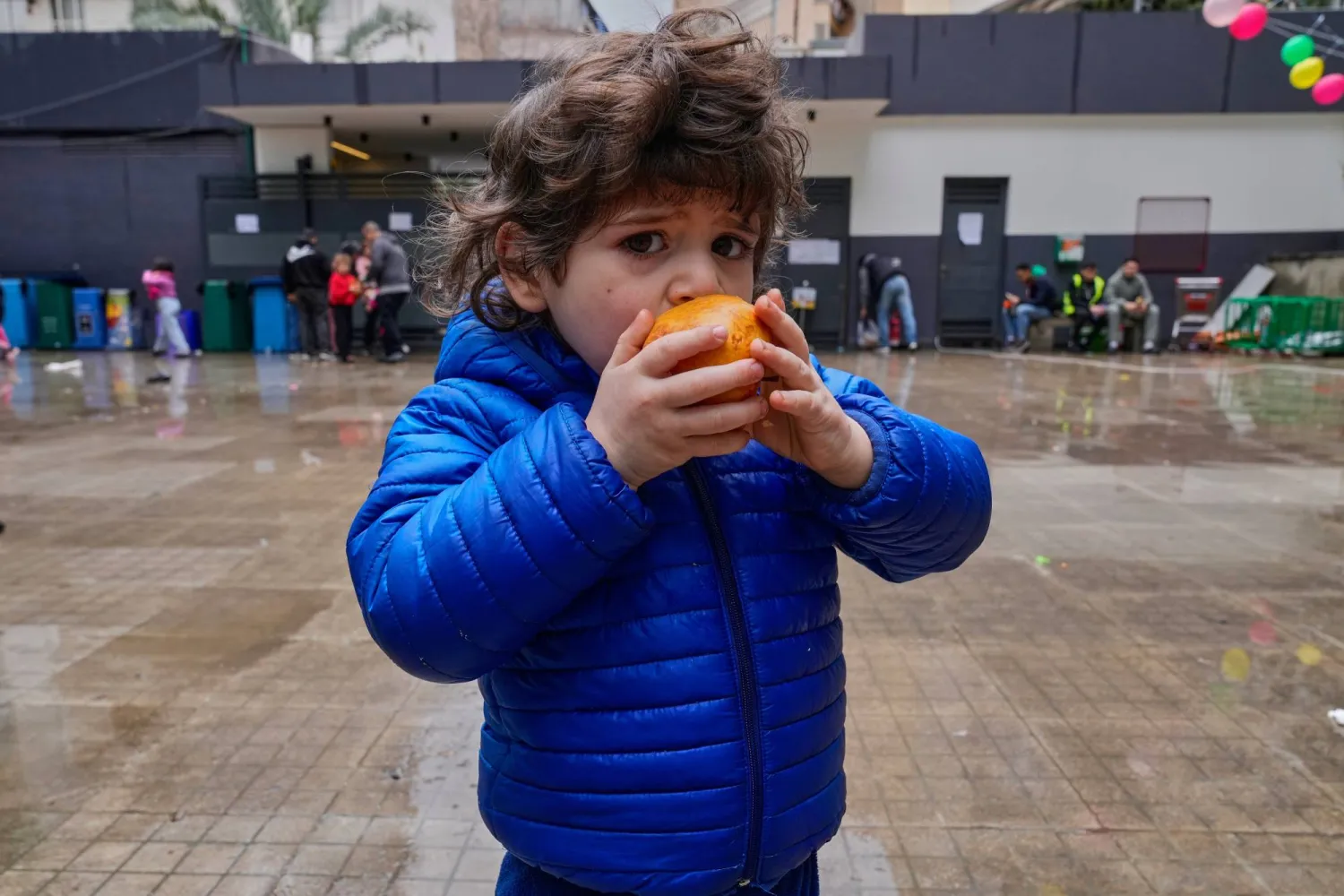

War Deepens Lebanon’s Economic Collapse

A displaced young girl who fled with her family Israeli airstrikes in southern Lebanon, eats an apple at a playground school that turned into a shelter in Beirut, Saturday, March 21, 2026. (AP Photo/Hussein Malla)
TT

War Deepens Lebanon’s Economic Collapse

A displaced young girl who fled with her family Israeli airstrikes in southern Lebanon, eats an apple at a playground school that turned into a shelter in Beirut, Saturday, March 21, 2026. (AP Photo/Hussein Malla)

Lebanon’s economy barely catches its breath before another crisis hits, tightening the squeeze and deepening its fragility.

The current war has wiped out efforts to revive it, as the country still reels from the 2019 financial collapse, the coronavirus pandemic, the Beirut port blast, and the 2023-2024 war.

After successive governments failed to resolve its structural crisis, the latest military escalation has further weakened the economy and stalled reform efforts, despite the current government's attempts to lay out recovery plans and legislation.

Since the first week of the war, some businesses have halved employees’ working hours to cut wages, while others have shut down entirely, aside from those destroyed in Beirut’s southern suburbs and the south.

The impact has been immediate, with many workers still earning less than half their pre-2019 salaries.

Losses of $100 million a day

Nicolas Chammas, secretary-general of the Lebanese Economic Organizations and head of the Beirut Traders Association, described the war’s impact as “huge,” compounded by years of strain since 2019.

“In 2025, economic growth reached 5%, but that followed a 7% contraction in 2024,” Chammas told Asharq Al-Awsat. “We had already started this year on a negative footing, and the current war has worsened conditions.”

According to the World Bank, the 2024 war cost $14 billion, or about $225 million a day.

“Using that as a benchmark, the current war is costing roughly $100 million a day,” he said, citing damage to infrastructure, reduced economic activity, and the cost of sheltering and assisting displaced people.

Chammas said tourism and travel were among the hardest-hit sectors, with travel down by more than 80%.

“Hotel occupancy is now below 10%, and declines are also severe in car rentals, furnished apartments, and resorts,” he said. “The industrial and commercial sectors are also affected, with the latter down around 50%.”

If the war continues, he warned, growth could flip into a contraction of up to 10%.

Structural contraction

Economist Jassem Ajaka said the war has shifted the downturn from “monetary” to “structural.”

“Under full dollarization, the shock no longer shows in a currency collapse, but in paralyzed economic activity and higher operating costs,” he told Asharq Al-Awsat.

He put total losses from the previous and current wars at about $15 billion, direct and indirect, based on World Bank estimates and updated research for 2026.

With Brent crude above $115, production and dollarized service costs have risen by more than 40%, eroding companies' profit margins, he said.

The agricultural sector has been the hardest hit geopolitically, with losses of about $2.5 billion due to destroyed land and disrupted supply chains. Tourism revenues have fallen 74% compared with the 2024 season, depriving the economy of a key source of foreign currency.

Ajaka said recent Banque du Liban data showed external assets holding at about $12.07 billion, supported by liquid foreign securities.

But he warned that a prolonged war and high oil prices would gradually drain those assets to cover fuel and essential imports, threatening this “artificial stability” in the second half of the year if reserves fall below safe levels.

Latest figures

Ajaka said 30% of small and medium-sized businesses had shut down permanently by the first quarter of 2026, unable to cover dollarized operating costs amid weak demand.

Those still operating have shifted to “emergency cash flow management,” with some paying half salaries or flat dollar wages worth no more than 40% of previous levels.

Unemployment has surged to between 46% and 48%, driven not only by business closures but also by the inability of productive sectors to absorb labor costs amid rising global energy and input prices.



Army Chief: Israel to 'Advance Targeted Ground Operations' in Lebanon

People inspect a crater following an Israeli airstrike that hit the Qasmiyeh Bridge near the coastal city of Tyre, Lebanon, Sunday, March 22, 2026. (AP Photo/Mohammad Zaatari)
TT

Army Chief: Israel to 'Advance Targeted Ground Operations' in Lebanon

People inspect a crater following an Israeli airstrike that hit the Qasmiyeh Bridge near the coastal city of Tyre, Lebanon, Sunday, March 22, 2026. (AP Photo/Mohammad Zaatari)

Israel's military will expand its ground operations in Lebanon against Hezbollah, its army chief said Sunday, warning that the offensive against the group was still in its early stages.

"The operation against the Hezbollah terrorist organization has only begun... This is a prolonged operation," Lieutenant General Eyal Zamir said in a statement.

"We are now preparing to advance the targeted ground operations and strikes according to an organized plan," he added.

Zamir's comments came as Israel struck more targets in south Lebanon on Sunday, including a key bridge, triggering a warning from the Lebanese president that it could be launching a full ground invasion.

Destroying bridges further isolates residents from the rest of Lebanon.

The destruction of bridges and homes marks a significant escalation in Israel's military campaign in Lebanon, which was pulled into the regional war on March 2 when Hezbollah fired into Israeli territory.

Sunday's strike damaged a crossing on Lebanon's coastal highway that runs through farmland and is one of the main routes linking southern and central Lebanon.

An Israeli military spokesperson had ‌announced the army would ‌strike the Qasmiyeh bridge earlier on Sunday.

Smoke and flames rise after an Israeli strike targeting the Qasmiyeh Bridge near Tyre, in southern Lebanon, 22 March 2026. EPA/STRINGER

Israel has sent troops into Lebanon and carried out extensive airstrikes, while Hezbollah has launched rocket barrages.

"In recent weeks, we have achieved significant accomplishments: we have struck more than 2,000 targets, dozens of weapons storage facilities, and struck and eliminated hundreds of terrorists," Zamir said.

"We will not stop until the threat is pushed away from the border and long term security is ensured for the residents of northern Israel," he added.

Lebanese authorities say Israel's strikes have killed more than 1,000 people and displaced more than 1 million.


Israel Probing if Own Forces Killed Civilian on Lebanon Border

Smoke rises after an Israeli strike, following an escalation between Hezbollah and Israel amid the US-Israeli conflict with Iran, as seen from Marjayoun, Lebanon, March 22, 2026. REUTERS/Karamallah Daher
TT

Israel Probing if Own Forces Killed Civilian on Lebanon Border

Smoke rises after an Israeli strike, following an escalation between Hezbollah and Israel amid the US-Israeli conflict with Iran, as seen from Marjayoun, Lebanon, March 22, 2026. REUTERS/Karamallah Daher

Israel's military said it was investigating whether its own fire killed an Israeli civilian near the Lebanese border on Sunday, after Hezbollah claimed an attack in the same area.

Israeli emergency workers said earlier Sunday that a man was killed in a "direct hit" on his car by a rocket from Lebanon, making him the first fatality in the country's north since the latest round of fighting with Hezbollah broke out.

The Iran-backed militant group said after the incident that its fighters had attacked Israeli soldiers in the same area.

But the Israeli army later announced it was "conducting a comprehensive investigation" into the death, AFP reported.

"The possibility that the incident involved fire originating from IDF soldiers is being examined," the military said in a statement.

Lebanon was pulled into the Middle East war when Hezbollah began firing rockets into Israel on March 2 to avenge the killing of Iran's supreme leader Ali Khamenei in Israeli-US attacks.

Israel has sent troops into Lebanon and carried out extensive airstrikes in the country, while Hezbollah continues to fire rocket barrages across the border.


Israeli Airstrikes Kill Four in Gaza

UN vehicles escort ambulances and a bus carrying Palestinian patients in Khan Younis as they travel to the Rafah crossing to leave the Gaza Strip for medical treatment abroad, Thursday, Mar, 19, 2026.(AP Photo/Abdel Kareem Hana)
TT

Israeli Airstrikes Kill Four in Gaza

UN vehicles escort ambulances and a bus carrying Palestinian patients in Khan Younis as they travel to the Rafah crossing to leave the Gaza Strip for medical treatment abroad, Thursday, Mar, 19, 2026.(AP Photo/Abdel Kareem Hana)

An Israeli airstrike on a police vehicle on Sunday killed three people in the middle of the Nuseirat camp in the central Gaza Strip, health officials said, hours after another person was killed in a strike on northern Gaza.

According to Reuters, medics and police sources said the three men killed in Nuseirat were members of the Hamas-led police force.

Ten people were also wounded in the attack, medics said.

Earlier on Sunday ⁠a separate airstrike ⁠killed one person - identified as a leader of one of Fatah's armed groups - and injured an unknown number of others in the Sheikh Radwan neighborhood in northern Gaza.

The Israeli military said it was checking on ⁠the two incidents.

While Israeli attacks in Gaza declined in the days after the US and Israel launched attacks on Iran on February 28, according to residents, medics and analysts, they have since begun to rise again. Israeli fire has killed dozens of Palestinians since the outbreak of the Iran war, Gaza health officials say.

In Gaza there have been regular outbreaks of ⁠violence ⁠since a ceasefire went into effect in October following two years of devastating war triggered by Hamas-led attacks in Israel in October 2023.

The territory's health ministry says that at least 680 people have been killed by Israeli fire since the October ceasefire. Israel said four soldiers were killed by militants in Gaza in the same period.

Israel and Hamas have traded blame for truce violations.