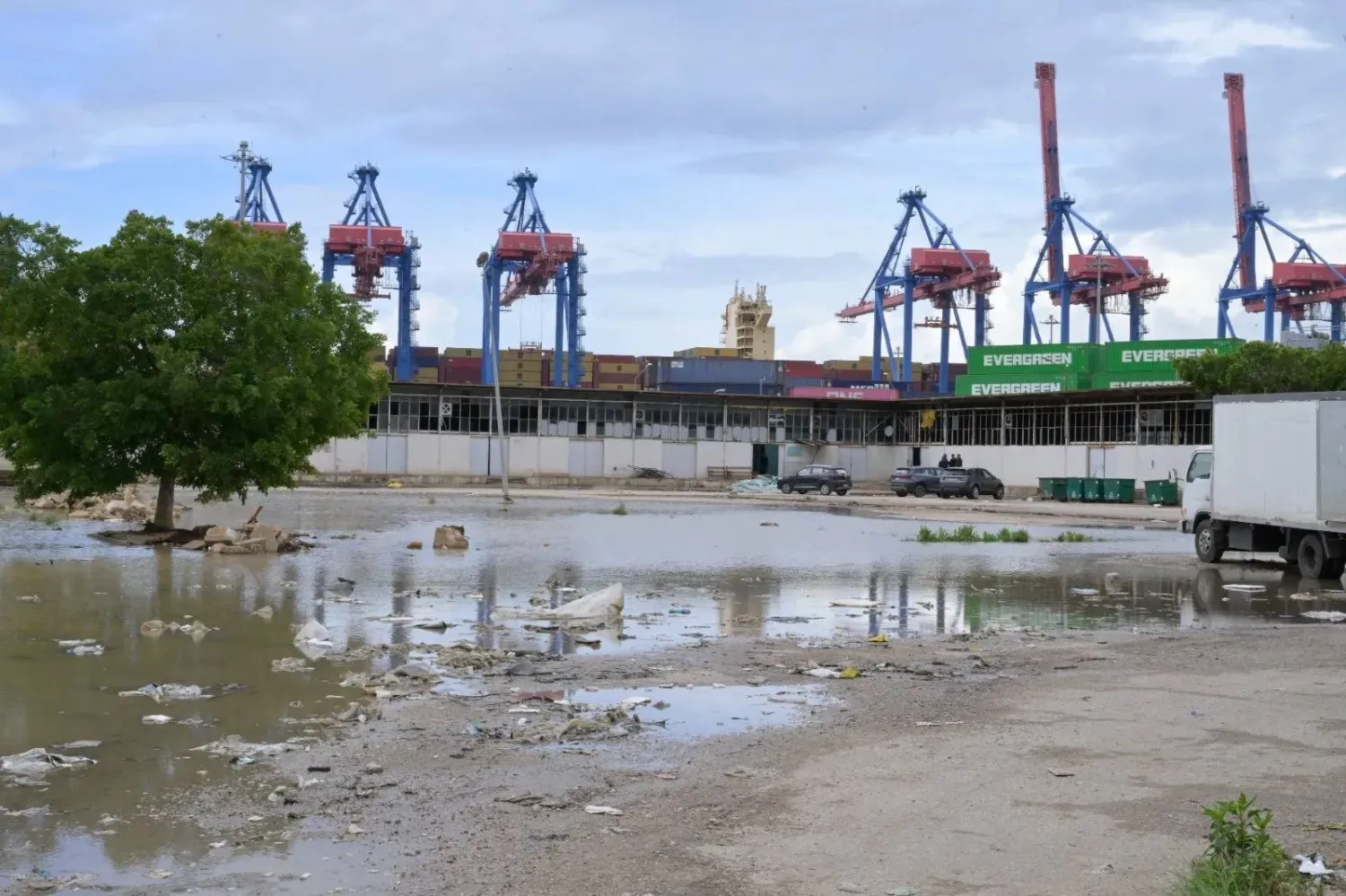
Opposition to Beirut Displacement Center Rises over Security, Sectarian Concerns

The site of a displacement shelter under construction in the Karantina area near Beirut port (Asharq Al-Awsat)
TT

Opposition to Beirut Displacement Center Rises over Security, Sectarian Concerns

The site of a displacement shelter under construction in the Karantina area near Beirut port (Asharq Al-Awsat)

Security and sectarian concerns are fueling opposition in Lebanon to plans for a displacement center in central Beirut, as ongoing conflict between Israel and Hezbollah drives new waves of displaced people.

Prime Minister Nawaf Salam has called for tighter security measures, amid growing political and public debate over establishing shelters for those displaced, most recently in the Karantina area near Beirut port.

At a security meeting at the Grand Serail, Salam stressed “the need to intensify security measures across Lebanon, particularly in Beirut, to safeguard citizens and their property,” citing developments in the south and the resulting displacement and security challenges.

A government decision to set up the displacement center in Karantina has triggered controversy, with several lawmakers urging it be scrapped on security and political grounds.

Although about 70 percent of the facility had been completed shortly after work began, informed sources said construction has been temporarily halted pending further review, without ruling out cancelling the project altogether. Funding is provided by international organizations and civil society groups.

Sources said the dispute reflects both political and sectarian sensitivities, while acknowledging that some concerns are legitimate. They added that security forces and the Lebanese Red Cross would oversee the center, with detailed registries of residents to ensure control.

The facility is intended to house around 800 people, particularly families unwilling to relocate to northern Lebanon or Mount Lebanon, preferring to remain in Beirut near their homes.

The suspension followed criticism from several political figures. MP Nicolas Sehnaoui of the Free Patriotic Movement described the project as “wrong in every sense,” calling for alternative solutions.

Lebanese Forces MP Razi Hage warned against turning the Karantina-port area into “a security and social hotspot under the pretext of a displacement center,” adding that temporary measures often become permanent.

For his part, Independent MP Waddah Sadek warned Beirut risked fragmenting into “security zones” and areas lacking oversight, while MP Fouad Makhzoumi urged the government to reconsider plans for large shelters in Karantina and Martyrs’ Square.

“While we fully recognize the humanitarian dimension, we respectfully urge reconsideration,” he said, warning of security and organizational repercussions.

The debate comes after Israeli strikes targeted areas previously considered relatively safe. Israel said it had targeted members of Hezbollah and Iran’s Revolutionary Guards in Aramoun in Mount Lebanon and areas near central Beirut.

The strikes have heightened concerns among residents in host communities, complicating efforts to respond to the growing displacement crisis.


Hamas Delegation Visits Cairo to Discuss Israeli Violations in Gaza

In the Al-Aqsa Martyrs' Hospital in Deir al-Balah in the center of the Gaza Strip, mourners gather around the bodies of two Palestinians killed in an Israeli strike (AFP) 
TT

Hamas Delegation Visits Cairo to Discuss Israeli Violations in Gaza

In the Al-Aqsa Martyrs' Hospital in Deir al-Balah in the center of the Gaza Strip, mourners gather around the bodies of two Palestinians killed in an Israeli strike (AFP) 

A Hamas delegation, led by Khalil al-Hayya, held talks on Sunday with Egyptian mediators in Cairo to address Israeli violations of the Gaza ceasefire, two officials from the Palestinian group said.

The ceasefire took effect last October. But both Israel and Hamas have accused each other of breaching the US-backed truce, which has largely halted the two-year war.

The delegation met with Egyptian intelligence officials handling the Palestine file on Saturday evening, with further meetings held Sunday that addressed Israeli violations and the implementation of the first phase of the agreement, a Hamas official told AFP.

According to the official, Hamas emphasized the need for Israel to cease all violations of the truce, dismantle its military positions in Gaza established west the Yellow Line, fully reopen border crossings, increase the flow of travelers, allow greater volumes of humanitarian aid into the territory and enable the 15-member Palestinian national committee to assume administrative responsibilities in Gaza.

The Movement also emphasized the need to complete Israeli withdrawals and ensure the daily entry of 600 aid trucks as stipulated in the agreement, urging mediators to exert real pressure to guarantee compliance.

Another source told AFP that the delegation is consulting with Palestinian faction leaders present in Cairo and is expected to meet UN envoy Nikolay Mladenov to discuss the same issues.

In January, Washington announced that the ceasefire had moved into its second phase under a peace plan brokered by President Donald Trump.

This phase stipulates the disarmament of Hamas and a gradual withdrawal of Israeli forces from Gaza and also calls for the establishment of a peacekeeping force, called the International Stabilization Force, to which several countries have committed troops.

Hamas says it is not opposed to handing over part of its arsenal, but only as part of a Palestinian political process.

Meanwhile, violence persists in Gaza.

The Strip’s civil defense agency reported on Saturday that Israeli air strikes killed seven people in the Bureij refugee camp in Central Gaza.

At least 749 Palestinians have been killed since the truce began, according to Gaza’s health ministry. The Israeli army has reported five soldiers killed in Gaza since the start of the truce.


Lebanon PM Says Working to Get Israeli Troop Withdrawal

FILED - 16 February 2026, Lebanon, Beirut: Lebanese Prime Minister Nawaf Salam is pictured during a meeting at the Prime Minister's office. Photo: Markus Lenhardt/dpa
TT

Lebanon PM Says Working to Get Israeli Troop Withdrawal

FILED - 16 February 2026, Lebanon, Beirut: Lebanese Prime Minister Nawaf Salam is pictured during a meeting at the Prime Minister's office. Photo: Markus Lenhardt/dpa

Lebanese Prime Minister Nawaf Salam said Sunday he was working to stop the Israel-Hezbollah war, even as Israeli premier Benjamin Netanyahu told troops in south Lebanon that the fight there was far from over.

The Lebanese Red Cross said in a statement that one of its paramedics had been killed in the south, said AFP.

They said its teams had been "directly targeted by an Israeli drone" while on a humanitarian mission, even though "the ambulances and their crews bore the protective Red Cross emblem".

Secretary general of the International Federation of Red Cross and Red Crescent Societies, Jagan Chapagain, said he was "appalled and saddened" at the killing of a second Lebanese Red Cross volunteer in weeks.

The United Nations peacekeeping force UNIFIL said an Israeli tank rammed its vehicles on two occasions, "in one case causing significant damage".

Israel says the fragile temporary ceasefire in the wider Middle East war does not apply to its battle with Iran-backed Hezbollah in Lebanon.

It has kept up its attacks on the country as the militants fight back.

"We will continue to work to stop this war, to ensure the Israeli withdrawal from all our lands," Salam said in a televised address.

"We are continuing our efforts... to negotiate to stop the war," he added, ahead of planned talks on Tuesday in Washington between Lebanese, Israeli and US officials.

Lebanon was pulled into the Middle East conflict when Hezbollah fired rockets at Israel after US-Israeli strikes killed Iran's supreme leader.

Israel has responded with massive strikes and a ground invasion.

- 'Accountability' -

Netanyahu said Sunday that Israeli forces had eliminated the threat of an invasion by Hezbollah militants during a visit to troops in southern Lebanon.

But he added: "There is still more to do, and we are doing it.

"The war continues, including within the security zone in Lebanon," Netanyahu said in a video released by his office.

Israeli officials have repeatedly said that Israel wants to establish a "security zone" in south Lebanon to help prevent Hezbollah attacks.

Lebanon's state-run National News Agency (NNA) reported Israeli attacks on dozens of locations in the south on Sunday, with additional strikes on the adjacent West Bekaa area.

The health ministry raised the war's overall toll to more than 2,050 dead, including 165 children and more than 80 health workers.

The Lebanese Red Cross condemned attacks on its personnel as "clear and blatant violations of all provisions of international law".

Before Sunday's deadly mission, which also wounded another paramedic, "the necessary contacts were made with UNIFIL for protection and safe passage", it said.

Israel's military has repeatedly accused Hezbollah of using ambulances for military ends.

Lebanon's health ministry also said an Israeli strike on Qana killed five people, including three women, and wounded 25 others.

An AFP photographer in the southern town saw significant destruction as an excavator worked to clear debris and first responders carried a body out from under the rubble.

- 'Moral obligation' -

In south Lebanon's Bazuriyeh, Hassan Berro, a rescue worker from the Risala Scout association -- which is affiliated with the Hezbollah-allied Amal movement -- said: "Our emergency center was hit and completely destroyed, along with all its contents, including beds and medical equipment."

The AFP photographer saw windows shattered and debris covering several hospital beds in the building, where walls and ceilings were also damaged.

Also Sunday, the Israeli army accused Hezbollah of using a hospital compound in south Lebanon's Bint Jbeil "for military purposes".

Hezbollah said it had launched attacks on Israeli targets across the border and inside Lebanon, including against troops in Bint Jbeil, where the NNA reported heavy fighting.

Pope Leo XIV, who visited Lebanon late last year, expressed his closeness to the Lebanese people on Sunday.

He said there was a "moral obligation to protect the civilian population from the atrocious effects of war"


Negotiations between Lebanon, Israel Deepen Hezbollah’s Crisis with the State

A destroyed building is pictured at the site of an Israeli strike that targeted the southern Lebanese village of Al-Bazouriyah, on April 12, 2026. (AFP)
TT

Negotiations between Lebanon, Israel Deepen Hezbollah’s Crisis with the State

A destroyed building is pictured at the site of an Israeli strike that targeted the southern Lebanese village of Al-Bazouriyah, on April 12, 2026. (AFP)

Lebanon will hold direct negotiations with Israel at the US State Department on Tuesday amid concerns that they will be a failure with each party clinging to their conditions. The success of the negotiations will also have implications in Lebanon because Hezbollah opposes any agreement that would restrict its movement and demand its disarmament or impose new realities on the ground.

Lebanon is prioritizing a comprehensive ceasefire, Israeli withdrawal from areas it is occupying in the South and the deployment of the Lebanese army. If successful, this will be followed by political talks. Israel is demanding that negotiations be held under fire, starting with Hezbollah’s disarmament, which is an early sign that the talks will fail since the Iran-backed party refuses to lay down its weapons.

Lebanon and Israel are agreeing to hold negotiations for the first time since 1982, meaning since the May 17 agreement. However, this does not mean that Tuesday’s talks will lead to tangible results given that Hezbollah can obstruct them immediately.

Former Minister Rashid Derbas said that Hezbollah may resort to field escalation by launching dozens of rockets and drones at Israel to abort any agreement, forcing Israel to retaliate on a larger scale in Lebanon.

In remarks to Asharq Al-Awsat, he stressed that the Lebanese government, for the first time, is seizing the initiative and trying to take decisions that can be executed.

He called for allowing the government to seize the opportunity, rather than obstruct its efforts. Ironically, Hezbollah is conditioning the handover of its weapons to the rise of the state, while at the same time it is thwarting any attempt by the state to consolidate its authority.

Derbas urged various political powers to “rally around the government to allow it to hold negotiations with Israel and reach decisive results.”

Hezbollah is very wary of the negotiations and is refusing anything that it views as “strategic concessions,” especially over its military wing and disarmament. The party is tying its war with Israel to the US-Iran war.

Regardless, the party’s position should not erase the optimism over the Lebanese state’s decision to turn towards a political process with Israel no matter how complicated it is.

Former MP Fares Soaid told Asharq Al-Awsat that the path of negotiations is tied to two main principles: the first, accepting the idea of negotiations themselves to reach a political solution; and the second, is the mechanism for these negotiations.

For the first time since 1983, the Lebanese state has taken an “advanced position” in that negotiations with Israel are widely accepted among the people and the Arab world, he noted.

The crux lies in the mechanism because Israel wants negotiations to be held under fire, while Lebanon wants to hold them after it withdraws from occupied areas and after a ceasefire is established, he remarked.

Internal hurdles

The issue at hand is not the wide gap between Lebanese and Israeli demands, but inside Lebanon itself where the state effectively does not control the decision of war and peace, but Hezbollah does, which has usurped it given that it is an effective political and military force in the country.

The party is insisting on indirect negotiations that can achieve a permanent ceasefire, Israeli withdrawal, return of the displaced to their homes, release of detainees, demarcation of the border, reconstruction in areas damaged in the war and then the launch of talks over a defense strategy based on the “army, people, resistance” equation – meaning Hezbollah will retain its weapons.

Derbas warned that Hezbollah’s conditions “are impossible to achieve because the balance of power is clearly tipped in Israel’s favor. Israel has free rein over Lebanon’s airspace and territories, meaning it has greater power in any negotiations.”

On whether Hezbollah may resort to street action or try to impose a new political reality by force, Derbas said protests cannot topple an agreement.

“The party can stage rallies and threaten to occupy the Grand Serail and state institutions, but going down that path has its own internal and external risks,” he warned.

He also noted: “Israel, which opposes Hezbollah’s presence in caves and trenches, will in no way accept seeing it at the Grand Serail.”

Hezbollah has accused President Joseph Aoun and Prime Minister Nawaf Salam of succumbing to Israel’s conditions and of seeking a peace treaty with Israel while it is killing the Lebanese people with abandon.

Soaid said negotiations will not necessarily lead to a peace agreement. Rather, they can lead to phased arrangements, such as a security agreement or a return to the truce, or even establishing a framework over ties with Israel.

“The state is demanded to draw the limits of national interest that balances the interest of the majority of the Lebanese people, and Hezbollah’s interest on the other side of the divide,” he explained.

“Efforts to persuade Hezbollah to fully become part of state-building have failed so far because the party sees its weapons and ties with Iran as guarantees for its existence, while the majority of the Lebanese people view the state as a guarantee for them,” he added.