


India’s Historic Haveli Homes Caught Between Revival and Ruin

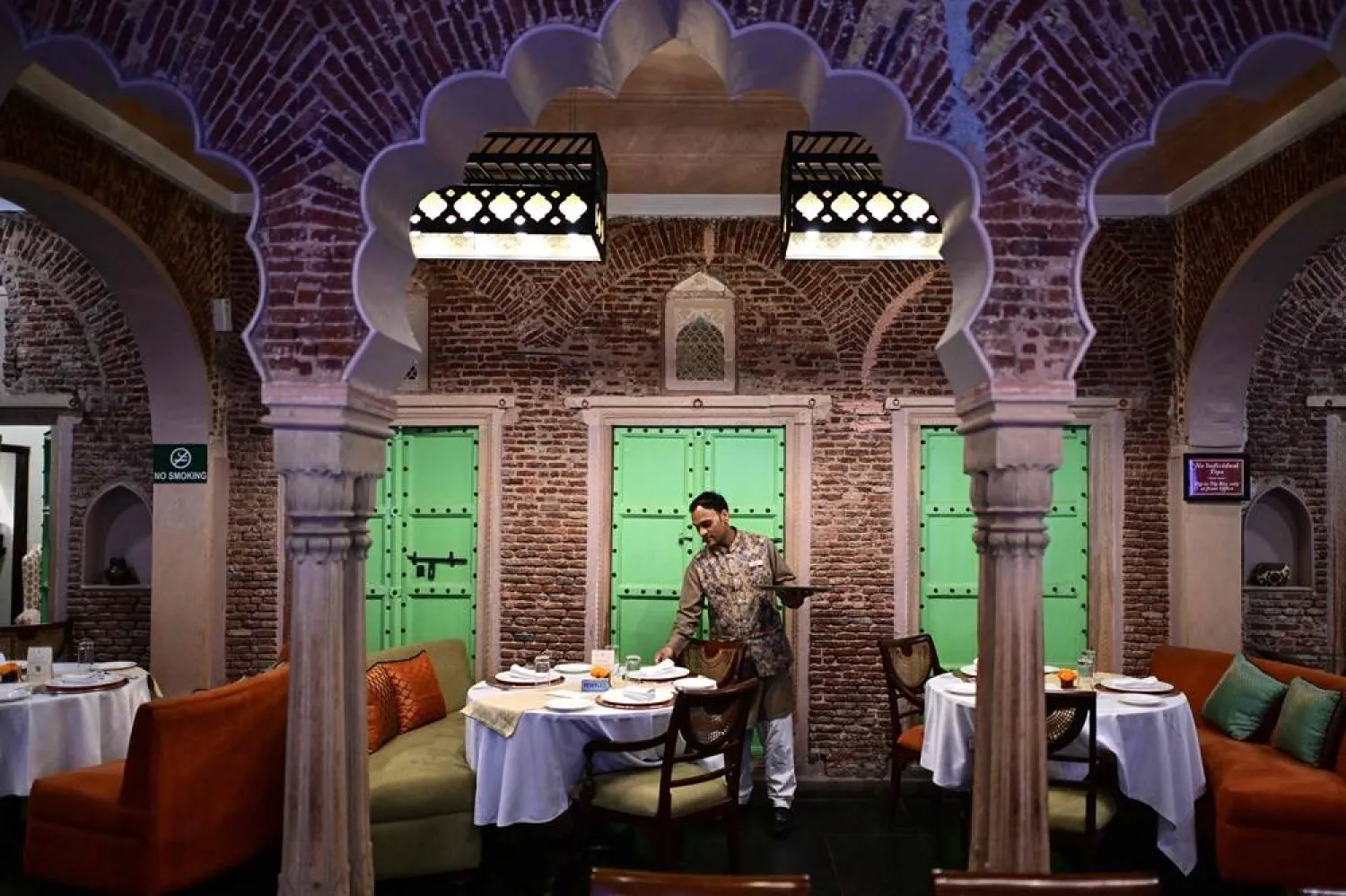
 This photograph taken on February 2, 2026 shows a hospitality staff arranging tableware at the Dharampura Haveli, an 18th-century haveli-turned-heritage hotel in the old quarters of Delhi. (AFP)
This photograph taken on February 2, 2026 shows a hospitality staff arranging tableware at the Dharampura Haveli, an 18th-century haveli-turned-heritage hotel in the old quarters of Delhi. (AFP)
TT

India’s Historic Haveli Homes Caught Between Revival and Ruin

 This photograph taken on February 2, 2026 shows a hospitality staff arranging tableware at the Dharampura Haveli, an 18th-century haveli-turned-heritage hotel in the old quarters of Delhi. (AFP)
This photograph taken on February 2, 2026 shows a hospitality staff arranging tableware at the Dharampura Haveli, an 18th-century haveli-turned-heritage hotel in the old quarters of Delhi. (AFP)

Once the grand residences of Mughal-era nobility, the Indian capital's haveli homes now stand at a fragile crossroads -- a handful lovingly restored but many more sliding quietly into ruin.

Across Old Delhi -- the 17th century walled city founded as the Mughal capital Shahjahanabad -- cracked facades, shuttered gateways and sagging balconies tell the story of a heritage under siege from neglect, inheritance battles and relentless urban pressure.

Only a few restored pockets provide a glimpse of what once was -- airy courtyards, carved sandstone pillars and homes built around a deeply social way of life.

Inside one restored mansion that now houses a cultural center, sunlight filters through stained glass onto carved sandstone arches, the air infused with freshly polished wood and rosewater.

Musicians tune their instruments in a frescoed courtyard, where nobles may once have entertained guests, offering a rare peek into Old Delhi's rich architectural past.

But outside in the narrow lanes of Old Delhi's Chandni Chowk district, the contrast is stark.

Many havelis are abandoned or on the verge of collapsing, their carved facades fading beneath peeling paint.

The contrast reflects two futures -- one of careful restoration and the other of gradual decay.

- 'Who will pay?' -

The Kathika Cultural Centre's founder Atul Khanna said his initiative hoped to create an immersive cultural space inside a restored structure.

But he admitted that conservation in Old Delhi remains a huge challenge.

Many havelis are split among multiple heirs, with no single stakeholder willing or able to invest in costly upkeep.

"When there are multiple ownerships, that becomes a challenge," he said.

"If the haveli is decaying, who is going to spend the money?"

Khanna also blamed bureaucratic hurdles for discouraging restoration.

"There should be some kind of a single window for anyone who is working with heritage," he said, arguing that easing red tape would be more effective than offering subsidies for restoration.

Another prominent restoration is the 18th century Haveli Dharampura, now converted into a heritage hotel.

"Restoration in Old Delhi is still isolated unless there is sustained support and awareness," said Vidyun Goel, whose family owns the property.

Residents say family disputes and the push to convert properties into shops or apartments have led to rapid decline.

In nearby Roshanpura, only a scattering of old homes still stand. Among them, the century-old Mathur ki Haveli is a rare example of a lived-in heritage home.

- Showpiece projects -

"We are in love with this house," said Ashok Mathur, a fourth-generation resident who continues to live in the ancestral property despite mounting challenges.

Wooden ceilings are deteriorating, floors are wearing thin and doors require constant repair, he said, walking through rooms that bear only traces of intricate craftsmanship.

Still, he said he has never considered leaving -- although he can only imagine the social world that once defined haveli life.

"There is no community left," Mathur, 56, said. "We are living in a cocoon."

Conservationist K. T. Ravindran said that while Old Delhi is economically vibrant, its havelis suffer from unclear titles and multiple claimants.

"Often buildings that look intact from outside conceal deeper damage," he said, noting that the condition was worse in the inner lanes hidden from public view.

Ravindran said revival was still possible, but only through neighborhood-level regeneration rather than isolated showpiece projects.

Oral historian Sohail Hashmi said each haveli once formed part of "a larger social ecosystem of neighborhoods, crafts and traditions", with architecture and community deeply intertwined.

As Khanna put it, the loss goes beyond architecture.

"When you lose a haveli, you are not only losing the structure," he said.

"Every element in it is a piece of art."


Saudi Arabia: King Abdulaziz Library to Launch 26th Free Reading Festival

The King Abdulaziz Public Library. SPA
TT

Saudi Arabia: King Abdulaziz Library to Launch 26th Free Reading Festival

The King Abdulaziz Public Library. SPA

The King Abdulaziz Public Library, in cooperation with the Riyadh Education Department, will launch its 26th annual Free Reading Festival for public school students on Sunday.

Running from May 10 to 14 in Riyadh, the festival will bring together more than 100 schools, over 1,550 students, and a number of educators and teachers.

It aims to foster a love of reading and learning, expand students’ literary, scientific, and cultural horizons, and encourage teachers to promote independent reading. It will also provide a platform to showcase student talents and strengthen Arabic language skills.

Through initiatives like this festival, the King Abdulaziz Public Library promotes reading through diverse programs and a wide range of books that foster pride in the Kingdom’s heritage.


Qassim's Monday Market Retains Heritage Role as Economic and Cultural Hub

The Monday market in the governorate of Uyun Al-Jiwa. (SPA)
TT

Qassim's Monday Market Retains Heritage Role as Economic and Cultural Hub

The Monday market in the governorate of Uyun Al-Jiwa. (SPA)

The Monday market in the governorate of Uyun Al-Jiwa, north of Qassim Region, stands as one of the oldest traditional weekly markets, enduring through changing times while maintaining its role as a vibrant economic and cultural hub.

The market draws a growing number of visitors from across Qassim and beyond, supported by the governorate’s strategic location.

During a field tour, the Saudi Press Agency observed lively activity throughout the market, with stalls displaying a diverse range of products. These include agricultural goods such as almonds and dried figs; animal products like ghee and milk, for which the region is renowned; as well as handicrafts and natural items such as henna and sidr.

Visitors noted that the market has retained its authentic character, continuing to serve as a vital source of income for small vendors and families working in the cottage industry, reinforcing its role as a key platform for preserving traditional culture while supporting the local rural economy.


Heritage Commission Revives Al-Nasb Heritage District as Abha Cultural Tourism Destination

The district’s significance lies in its unique architectural composition - SPA
TT

Heritage Commission Revives Al-Nasb Heritage District as Abha Cultural Tourism Destination

The district’s significance lies in its unique architectural composition - SPA

Al-Nasb Heritage District in Abha is one of the most prominent living examples of traditional architecture in Aseer Region, preserving its long history and architectural details that embody people’s connection to their local environment and document the social and cultural patterns that have shaped the identity of the place across generations.

The district’s significance lies in its unique architectural composition, where mud and stone buildings stand side by side in visual harmony. They were built using local materials such as stone, clay, and juniper trunks, while the narrow alleyways and closely set buildings give the district a cohesive social character that reflects the spirit of past communities in the region and the close relationship between people and place.

The Heritage Commission has revived the district through an integrated restoration and rehabilitation project aimed at preserving its original elements and enhancing its sustainability, as part of national efforts to protect urban heritage and highlight it as a cultural and tourism asset, SPA reported.

The site is also distinguished by its natural setting, as the district overlooks the banks of Abha Valley and surrounding farms, giving it a distinctive visual and aesthetic dimension. Its narrow passageways and closely set buildings illustrate a traditional urban pattern that strengthens ties among residents and captures the nature of social life in that era.

The district is now a growing destination for culture and tourism in Abha, attracting visitors and heritage enthusiasts who come to explore the details of authentic architecture and learn about the traditional ways of life that have shaped Aseer Region’s identity across generations. The project helps raise awareness of the importance of preserving archaeological sites as a key pillar in forming national memory.

The project is part of the Kingdom’s efforts to protect and effectively manage cultural heritage, in line with the targets of Saudi Vision 2030, which gives special attention to the cultural sector. It seeks to turn heritage sites into vibrant spaces that support cultural tourism and sustainable development while reconnecting society with its historical roots.
