


Iraq Summons US, Iran Representatives After Deadly Strikes

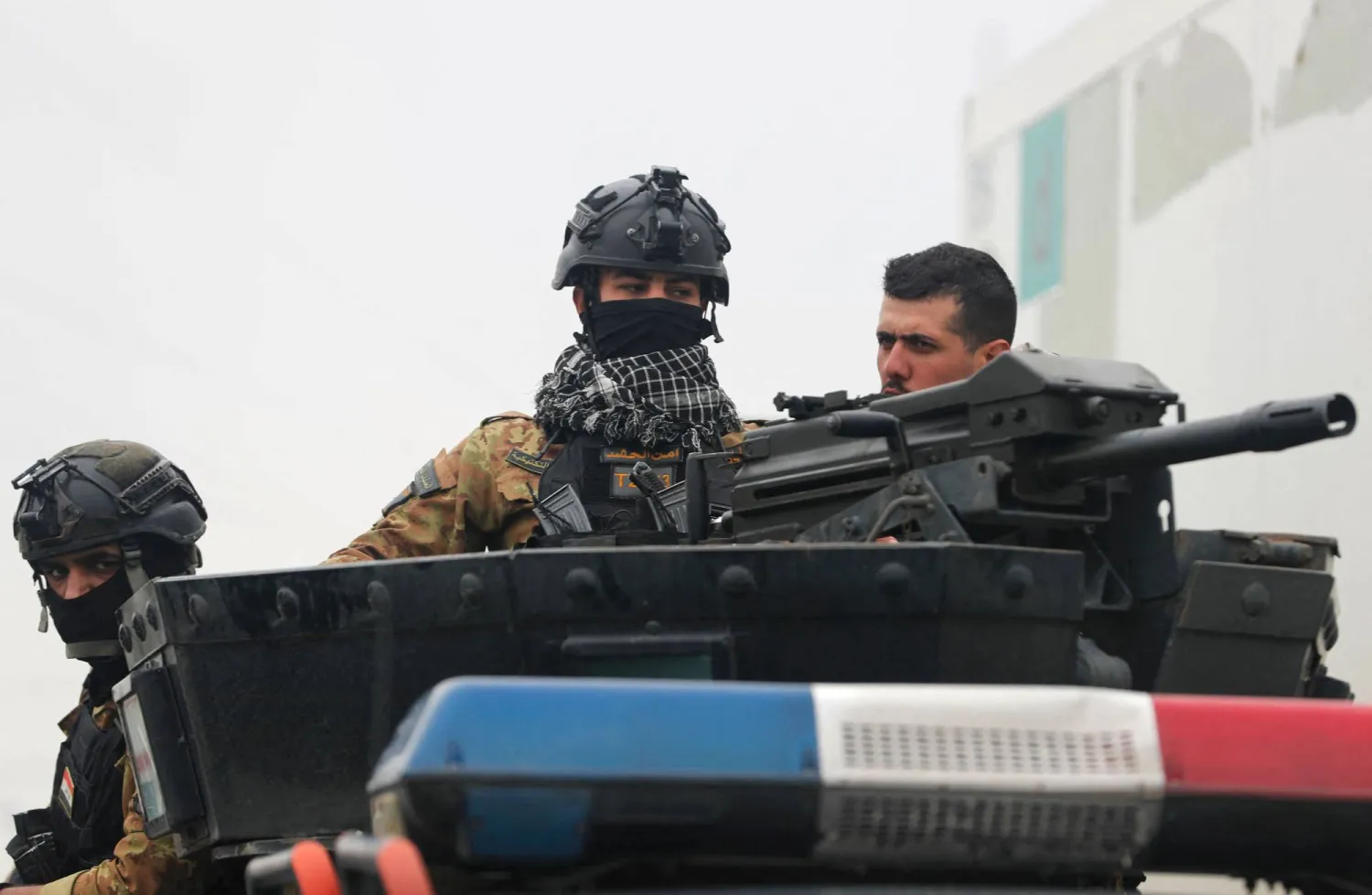
Members of Iraq’s PMF guard the streets during the funeral for members of the PMF in Baghdad on March 24, 2026. (AFP)
TT

Iraq Summons US, Iran Representatives After Deadly Strikes

Members of Iraq’s PMF guard the streets during the funeral for members of the PMF in Baghdad on March 24, 2026. (AFP)

Iraq said late on Tuesday it would summon the US charge d'affaires and the Iranian ambassador after deadly strikes blamed on their countries, as Iraqi authorities granted targeted former paramilitary groups the "right to respond".

Iraq has been pulled into the war sparked by US and Israeli strikes on Iran on February 28, and which has since engulfed much of the region.

The former paramilitary Popular Mobilization Forces (PMF), part of Iraq's regular armed forces but which also includes brigades belonging to Iran-backed groups, blamed the United States for the deadliest strike so far on Iraqi territory, which killed a commander and 14 other fighters.

In the autonomous Kurdistan region, a ballistic missile attack killed six of the regional force's fighters, known as the peshmerga.

The region accused Iran of conducting the first such deadly attack on Kurdish security forces since the war began.

Neither the United States nor Iran commented on the accusations, but in a statement released late on Tuesday, Iraq said its foreign ministry would summon both representatives to "deliver formal notes of protest regarding the attacks".

It also emphasized the necessity of maintaining balanced relations both internationally and regionally to prevent Iraq being "drawn into areas of conflict".

Iraq has long been a proxy battleground for the United States and Iran, and has struggled to balance diplomatic ties with both countries.

Since the war began, pro-Iran armed groups have claimed responsibility for attacks on US interests in Iraq and across the region, while strikes have also targeted these groups, including state-linked positions.

In the statement from the prime minister's office, however, Iraq granted former paramilitaries within the official armed forces the right to "respond to military attacks" by drones and aircraft that targeted their headquarters.

- 'Decisions of war' -

Late on Tuesday, the Coordination Framework, Iraq's ruling coalition of Shiite parties with varying degrees of links to Iran, backed the government decision.

However, it also condemned "attacks against state institutions and diplomatic missions", and called for the perpetrators to be punished.

The coalition said the government retained "the exclusive right of the state over decisions of war".

The PMF said those killed in the strike targeting its fighters included a top provincial commander.

It described the strike as a "treacherous American attack that targeted the operation headquarters", and later urged authorities to "confront these repeated American violations".

The overnight strike targeted a base in the western Anbar province bordering Syria, long the scene of operations against the ISIS group.

Since the start of the Middle East war, Baghdad has repeatedly denounced attacks on the PMF, formed in 2014 to fight ISIS.

After the extremists were defeated in 2017 in Iraq, the coalition gained influence within the security forces. Its armed factions also developed political roles, including representation in parliament, as well as economic interests.

Last week, the Pentagon acknowledged that combat helicopters had carried out strikes against pro-Iran armed groups in Iraq during the current conflict.

On Tuesday night, the sound of fighter jets was repeatedly heard in the skies above the Iraqi capital.

- Iraqi Kurdistan -

Earlier, the PMF said a "Zionist-American strike" had targeted their Mosul office in northern Iraq, with a security official saying it was a second home for coalition leader Falih al-Fayadh, although he was not present during the attack.

The Kurdish defense ministry in the north separately said a strike targeting peshmerga forces killed six fighters and wounded 30 others, blaming the attack on Iran.

"Six Iranian ballistic missiles targeted them," said the Iraqi Kurdish authorities, branding the attack "hostile, treacherous".


Barrack: Israeli Strike on Syria’s Abu al-Duhur Base Sought to Bait Türkiye

Abu al-Duhur airbase following strikes, Syria, August 18, 2026. REUTERS/Stringer
TT

Barrack: Israeli Strike on Syria’s Abu al-Duhur Base Sought to Bait Türkiye

Abu al-Duhur airbase following strikes, Syria, August 18, 2026. REUTERS/Stringer

The Israeli strike on the Abu al-Duhur military base in northern Syria near the Turkish border last Tuesday, may have been intended to provoke Ankara and is considered a “very dangerous game,” US Special Envoy to Syria and Ambassador to Türkiye Tom Barrack said on Saturday.

Eight Israeli airstrikes hit the airbase early Tuesday, targeting the runway and storage facilities, Syria’s state-run Al-Ikhbariya had reported.

In response, Ankara accused the Netanyahu government of using “cheap politics” for electoral gain and seeking to portray Türkiye as a new threat.

According to Barrack, the incident escalated from another Israeli strike in Syria into a moment that could have triggered a far more dangerous regional confrontation.

The ambassador invoked the downing of a Russian jet in late 2014 that escalated regional tensions.

In a YouTube interview with podcast host Mario Nawfal and in comments to PBS NewsHour, Barrack said the incident in which Israeli jets, without advance warning, struck the airbase in Syria - around 80 kilometers east of the Turkish border - intended to “bait” or provoke Ankara.

He described a situation in which fighter jets operate near a border without coordination or warning as a “very dangerous game.”

Last Tuesday, Israeli Prime Minister Benjamin Netanyahu’s office described the airstrikes as a warning to Türkiye against expanding its military presence in Syria or helping rebuild the Syrian armed forces.

In return, Syrian Foreign Minister Asaad al-Shaibani told Axios that Damascus had previously informed Israel there were no plans to establish a Turkish military base at Abu al-Duhur, which was being rehabilitated for use by the Syrian Air Force.

For its part, the Turkish presidency rejected the Israeli allegations as “baseless,” accusing Netanyahu of promoting them ahead of Israel’s October elections and calling on the international community to curb Israeli actions threatening regional peace and stability.

Barrack said Israel might have received intelligence indicating Turkish military personnel or military assets could be stationed at the Syrian base.

According to Barrack, Israel raised the concern with the United States about six days before the strike.

“We have some intelligence that there might be Turkish movement into this site, which we would be very concerned about,” Barrack said about the message delivered to Washington.
Barrack then confirmed reports that Mossad chief Roman Gofman had spoken with al-Shaibani several days before the strike to convey Israel’s concerns. He described the talks as a two-hour, in-depth conversation.

Despite those contacts, Israeli forces struck the base’s runways without Türkiye receiving advance warning of the operation.

Scenarios of Israeli Strikes on Abu Al-Duhur Base

According to Barrack, one possibility that led to the strikes on Abu al-Duhur is that “the Israelis were baiting the Turks.”

He directly linked this possibility to Israeli politics, saying that the strike may have been a “very aggressive but maybe a well-received pre-election concept.”

He added that another possible reason for the attack on Abu Duhur was a miscommunication between the Israeli military and the country’s intelligence agency.

Barrack said it was likely that Israel had intelligence suggesting Türkiye may be bolstering its presence in the area and “a commander somewhere in the field made a decision ‘We’re not going to let that happen’... What they didn’t do is tell us or Türkiye.”

Barrack said the Turkish leadership exercised “maximum restraint and patience” when they saw Israeli aircraft, and that they did not allow tensions to escalate into direct conflict.

He told PBS NewsHour that Türkiye had explicitly stated it has no aggressive intentions or posture toward Israel and does not want to participate in any military operation or direct conflict. “What the Turks want is a sovereign and independent Syria, and that is what we, Israel, and all the countries of the region want,” he said.

While the American diplomat acknowledged “Israel's legitimate security concerns,” he stressed that diplomacy and maintaining open channels of communication “are a priority under the current circumstances.”

Cheap Politics

For its part, Ankara said the Netanyahu government is seeking to portray Türkiye as a new threat as part of “cheap politics” aimed at gaining an electoral advantage.

Türkiye's Communications Directorate on Friday warned that Israel's increasingly aggressive threat rhetoric poses serious risks to regional and global stability.

It said the “cheap politics” pursued by Netanyahu and his associates, which it said was also designed to secure an advantage in elections, has no resonance in Israeli society, the region, the international community or Türkiye.

The directorate strongly rejected remarks by the Israeli Prime Minister's Office concerning President Recep Tayyip Erdogan.

The office on Friday called Erdogan an “antisemitic dictator.”

The directorate described the comments as an “impertinent rant” devoid of historical facts and political seriousness and another sign of the desperation of an administration seeking to evade accountability for war crimes and crimes against humanity.


Blast Targets Security Forces’ Bus Near Damascus, Causing Injuries

Injuries were reported among the passengers. (SANA)
TT

Blast Targets Security Forces’ Bus Near Damascus, Causing Injuries

Injuries were reported among the passengers. (SANA)

An explosive device targeted a bus carrying security forces near the Syrian capital Damascus on Saturday, resulting in injuries among the passengers, state media reported.

"An explosive device targeted a bus carrying Internal Security Forces personnel on the Maarounah-al-Tal road in Damascus countryside, leaving several personnel injured," state news agency SANA reported.

"Authorities are investigating the attack and working to identify those responsible," the news agency added, without immediately providing further details.

It published pictures showing a badly damaged bus at the side of a road, with its windows and one of its doors blown out, with glass scattered on the front seat.

Syria's authorities have faced significant security challenges since overthrowing longtime ruler Bashar al-Assad in late 2024, with Damascus and its suburbs the site of multiple attacks.

Earlier in August, a bus blast wounded 14 people in Jaramana, a town near Damascus.

In July, two blasts went off near a hotel where visiting French President Emmanuel Macron had been staying, though he was not in the facility at the time.

That blast killed one person and wounded 36 others, with authorities later saying they had arrested those responsible, adding that they were part of the ISIS group.


Israel Says It Has Serious Concerns with Hamas Disarmament Deal

Mourners carry flag-draped body bags containing the remains of Palestinians killed in Israeli strikes during the war with Hamas and recently recovered from the rubble, during a mass funeral in Gaza City on August 20, 2026. (AFP)
TT

Israel Says It Has Serious Concerns with Hamas Disarmament Deal

Mourners carry flag-draped body bags containing the remains of Palestinians killed in Israeli strikes during the war with Hamas and recently recovered from the rubble, during a mass funeral in Gaza City on August 20, 2026. (AFP)

Israel has shared “serious security concerns” with the White House regarding the proposed disarmament deal with Hamas, an Israeli official said as Israeli strikes overnight and into Sunday evening killed at least 17 people, including children, in Gaza.

The remarks by Doron Spielman, spokesperson for Israeli Prime Minister Benjamin Netanyahu's office, were some of the first public comments since US President Donald Trump announced the agreement.

Spielman told The Associated Press that Israel's intelligence assessment is that Hamas remains committed to rebuilding its military rather than genuinely demilitarizing. He said the Israeli military would not withdraw from Gaza — where it controls more than 60% of the territory — before Hamas disarms.

“Our assessment is that if we redeploy before Hamas is truly disarmed, it will quickly expand its presence throughout Gaza, rebuild its terrorist infrastructure, once again threaten Israeli communities, and seek to carry out another Oct. 7-style attack,” he said, referring to the Hamas attack on Israel in 2023 that triggered the war in the Gaza Strip.

“Disarming means physically giving up the weapons. Nothing less,” Spielman said.

His comments come days after Hamas said that it would begin disarming as part of the US-brokered ceasefire signed nine months ago to end the nearly three-year-long conflict. It marks a potential breakthrough in ending the conflict, but many hurdles, conditions and long timelines remain.

Hamas says it's agreed to disarm but the process has obstacles

Trump’s 20-point ceasefire plan calls on the militant group to surrender its weapons and destroy its vast network of tunnels. It also envisions Israeli forces withdrawing from Gaza, the arrival of a new technocratic Palestinian government, deployment of an international security force and the rebuilding of the battered Palestinian enclave.

Hamas disarming has been a sticking point and has deadlocked negotiations for months. In announcing the deal on social media on Thursday, Trump said it would be carried out in “carefully structured phases.”

A copy of the agreement obtained and verified by the AP said that all weapons held by the Hamas-run police will be transferred to the US-backed Palestinian technocratic committee, known as the National Committee for the Administration of Gaza, upon its arrival in the enclave. It’s not clear when that would happen since it is contingent on other steps.

A process to decommission and store heavy weapons and to dismantle military production sites and tunnels will begin after the arrival of the Palestinian committee and the deployment of international forces. The process will be linked to a phased Israeli withdrawal, according to the agreement.

The areas Israel controls in Gaza have been mostly destroyed and depopulated. Most of the territory’s 2 million Palestinians are in the other part, where hundreds of thousands live in squalid tent camps and destroyed neighborhoods.

Israel appears unlikely to pull back significant forces or make other concessions ahead of its October elections. Prime Minister Benjamin Netanyahu faces a tough reelection battle, with his far-right coalition partners urging him to keep up the pressure on Hamas and leave forces in Gaza, and opponents accusing him of failing to prevent the Oct. 7, 2023, attack.

Hamas-led fighters attacked Israeli communities then, killing around 1,200 people, mostly civilians, and taking 251 others hostage. Israel responded with a punishing military offensive that has killed more than 73,000 people, according to the Gaza Health Ministry.

The ministry, part of the Hamas-run government, maintains detailed records viewed as generally reliable by UN agencies and international organizations. It does not distinguish between civilians and fighters but says women and children make up around half of all fatalities.

Israel warns that Hamas is rearming

While Spielman said Israel greatly appreciates Trump’s commitment to its security and to finding a durable resolution, the government's position on disarmament is based on detailed intelligence saying that Hamas continues to rearm, recruit fighters, and rebuild its military capabilities.

The White House did not provide additional comments on Sunday, when asked specifically about Israel’s assessment that Hamas remains committed to rebuilding its military.

US officials, who briefed reporters on the disarmament agreement last week, said that Israel had been consulted at every step of the negotiations and was not being asked to do anything more than what it had committed to as part of the ceasefire and hostage release agreement signed last October.

It's unclear what exactly Israel conveyed to the White House. Two people with knowledge of the deal told the AP that Israel had communicated its issues with it to former British Prime Minister Tony Blair, who's part of the Trump-led Board of Peace. One of them said that among the points Israel wanted was freedom to conduct military operations in Gaza. They spoke anonymously because they were not authorized to speak to the media.

According to another person familiar with the deal, the Israelis raised two other issues: that Qatar and Türkiye not be involved in verifying the stages of the agreement, and that Hamas’ weapons be destroyed after confiscation. The person spoke on condition of anonymity because they were not authorized to speak to the media.

Israel continues to strike Gaza

Since the ceasefire was signed last October, Israel has continued striking Gaza, saying it’s targeting Hamas and its infrastructure.

Local Gaza hospitals said at least 17 were killed in the latest Israeli strikes, including children. A strike on a residential apartment in southern Gaza killed three family members, including their 4-year-old child, according to Nasser hospital, where the bodies arrived.

The Israeli military said the strikes had targeted militant operatives.