


Tehran Rejects Trump's Talk of Negotiation, as Israel and Iran Launch Airstrikes

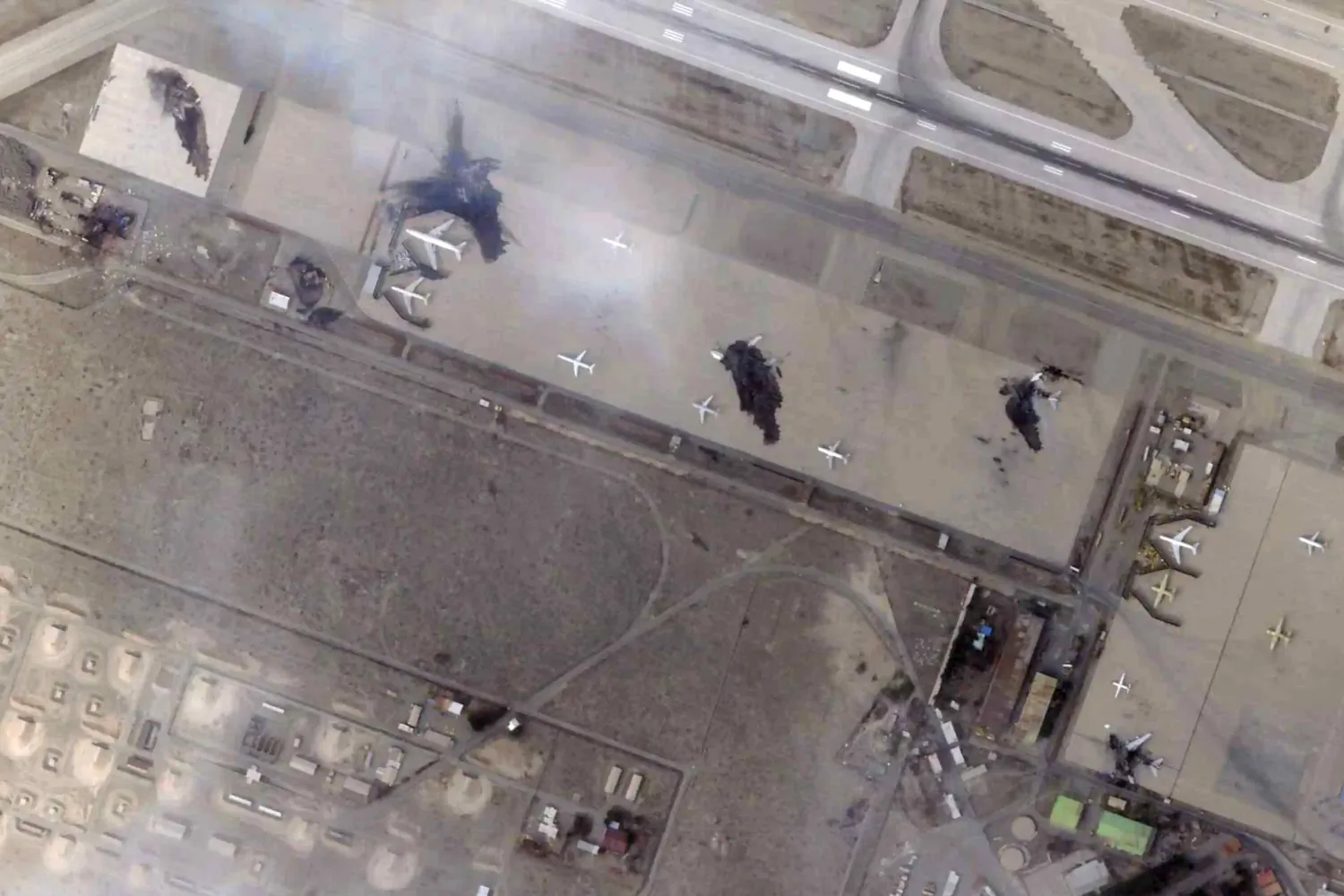
This satellite image from Planet Labs PBC shows damage after airstrikes targeting Mehrabad International Airport in Tehran, Iran, March 7, 2026. (Planet Labs PBC via AP)
TT

Tehran Rejects Trump's Talk of Negotiation, as Israel and Iran Launch Airstrikes

This satellite image from Planet Labs PBC shows damage after airstrikes targeting Mehrabad International Airport in Tehran, Iran, March 7, 2026. (Planet Labs PBC via AP)

Israel and Iran exchanged airstrikes on Wednesday, as Iran's military rejected President Donald Trump's claim Washington was in negotiations to end to the war, saying the US is negotiating with itself.

The rejection of negotiations by the unified command of the Iranian Armed Forces, which is dominated by the Revolutionary Guards, comes amid reports the US has sent a 15-point plan for discussion to Tehran.

"Has the level of your inner struggle reached the stage of you (Trump) negotiating with yourself?" the top spokesperson for Iran's joint military command, Ebrahim Zolfaqari, said on Iranian state TV.

"People like us can never get along with people like you."

"As we have always said... no one like us will make a deal with you. Not now. Not ever."

Iran's leadership has previously said it cannot negotiate with the US as it has attacked the country twice during high level negotiations in the past two years.

Four weeks into the war that has killed thousands, created the worst energy shock in history and sparked global inflation fears, there was no letup in airstrikes from Iran and Israel on Wednesday.

The Israeli Defense Forces said in a Telegram post it had launched a wave of strikes targeting infrastructure across Tehran. The semi-official Iranian SNN News Agency said the strikes hit a residential ⁠area in the ⁠city, with rescuers searching the rubble.

Iran's Revolutionary Guards said it had launched a new wave of attacks against locations in Israel including Tel Aviv and Kiryat Shmona, as well as U.S. bases in Kuwait, Jordan and Bahrain, Iranian state media reported.

Trump told reporters at the White House on Tuesday the US was in "negotiations" with "the right people" in Iran to end the war, adding the Iranians wanted to reach a deal very badly.

Stocks rose and oil prices fell on Wednesday on reports the US is seeking a month-long ceasefire and had sent a 15-point plan to Iran for discussion, raising hopes for a ⁠resumption of oil exports out of the Arabian Gulf.

The New York Times reported on Tuesday that Washington sent Iran a 15-point plan to end the war in the Middle East. Israel's Channel 12, quoting three sources, said the US was seeking a month-long ceasefire to discuss the 15-point plan.

A source familiar with the matter confirmed that the US had sent a plan to Iran but provided no further details.

The Israeli media outlet said the plan would include the dismantling of Iran's nuclear program, ceasing support for proxy groups, such as Lebanon's Hezbollah, and the reopening of the Strait of Hormuz.

The US and Israel launched strikes on Iran on February 28 after saying they had failed to make enough headway in talks aimed at ending Iran's nuclear program, although mediator Oman said significant progress had been made.

The US struck Iran's nuclear facilities in June 2025.

Since the start of "Operation Epic Fury" by the US in February, Iran has attacked countries that host US bases, struck Gulf energy infrastructure and effectively closed the Strait of Hormuz, conduit for a fifth of the world's oil and liquefied natural gas.



NATO: Ukraine Still Receiving Arms Despite Mideast War

NATO Secretary General Mark Rutte via Reuters/File
TT

NATO: Ukraine Still Receiving Arms Despite Mideast War

NATO Secretary General Mark Rutte via Reuters/File

Ukraine is still getting essential defense equipment despite the war in the Middle East, which is depleting stockpiles in Europe and the United States, NATO Secretary General Mark Rutte said Thursday.

"The good news is that essential equipment into Ukraine continues to flow," he told reporters. That included American-made Patriot missile interceptors, which Ukraine desperately needs, he added, AFP reported.

The PURL program, launched last year, allows Ukraine to receive US equipment financed by European countries.

Some 75 percent of the missiles used by Patriot batteries in Ukraine have been supplied through the program, and 90 percent of the munitions used by other air-defense systems, Rutte added.

Rutte called on European countries to increase their own production capacity.

"They need to produce more extra production lines, extra shifts, opening new factories. The money is there," he said.


Germany FM Says 'Encouraging' if US Speaking Directly to Iran

German Foreign Minister Johann Wadephul. (Reuters: File Photo)
TT

Germany FM Says 'Encouraging' if US Speaking Directly to Iran

German Foreign Minister Johann Wadephul. (Reuters: File Photo)

Germany's foreign minister Thursday said it was encouraging if the United States was talking directly to Iran to end the war in the Middle East, but Washington should make its intentions clear.

"I hear that there are signs that the US is speaking directly to Iran. I think that this is encouraging and this is welcome," Johann Wadephul told reporters before heading into the meeting of G7 foreign ministers outside Paris, AFP reported.

With US Secretary of State Marco Rubio set to join the discussions from Friday, he added: "For the German government it is of great importance to know precisely what our American partners are intending."


US Envoy Witkoff Says Iran is Seeking an Off-ramp

US Special Envoy Steve Witkoff speaks during a cabinet meeting at the White House in Washington, DC, US, March 26, 2026. REUTERS/Evelyn Hockstein
TT

US Envoy Witkoff Says Iran is Seeking an Off-ramp

US Special Envoy Steve Witkoff speaks during a cabinet meeting at the White House in Washington, DC, US, March 26, 2026. REUTERS/Evelyn Hockstein

The United States has sent Iran a "15-point action list" as a basis for negotiations to end the current conflict, US Special Envoy Steve Witkoff said on Thursday, adding that there are signs that Tehran was interested in making a deal.


Witkoff, speaking during a cabinet meeting at the White House, said that the nascent talks could be successful if the Iranians realize there were no good alternatives - a realization Tehran might be coming to, he argued, Reuters reported.


"We will see where things lead, and if we can convince Iran that this is the inflection point with no good alternatives for them other than more death and destruction," Witkoff told reporters.


"We have strong signs that this is a possibility."


Witkoff said Pakistan had been acting as a mediator, confirming statements from Pakistani officials.