


Iran and the US Harden their Positions as Tehran Keeps Its Grip on the Strait of Hormuz

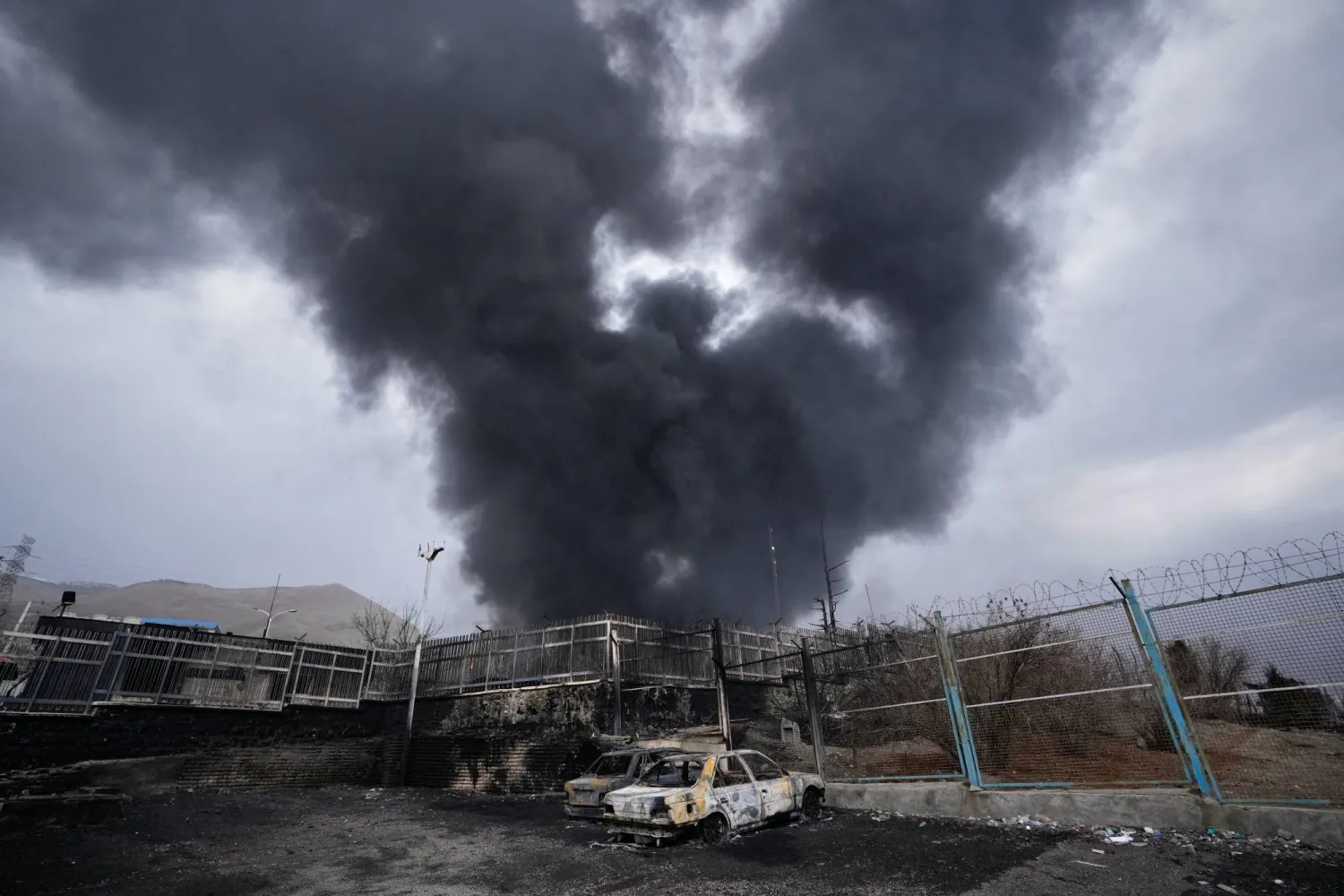
FILE - A thick plume of smoke rises from an oil storage facility hit by a US-Israeli strike in Tehran, Iran, March 8, 2026. (AP Photo/Vahid Salemi, File)
TT

Iran and the US Harden their Positions as Tehran Keeps Its Grip on the Strait of Hormuz

FILE - A thick plume of smoke rises from an oil storage facility hit by a US-Israeli strike in Tehran, Iran, March 8, 2026. (AP Photo/Vahid Salemi, File)

Iran and the United States hardened their positions as diplomacy aimed at reaching a ceasefire in the war in the Middle East appeared to be faltering on Thursday. Tehran moved to formalize its control over the crucial Strait of Hormuz while Washington prepared for the arrival of US combat forces in the region that could be used on the ground in the Iranian Republic.

Iran is instituting a “de facto ‘toll booth’ regime,” industry experts say, with some ships paying in Chinese yuan to pass through the strait, where 20% of all traded oil and natural gas is transported in peacetime.

Meanwhile, a strike group anchored by the amphibious assault ship USS Tripoli drew closer to the Mideast with some 2,500 Marines. Also, at least 1,000 paratroopers from the 82nd Airborne have been ordered to the region, The Associated Press said.

The troop movements don’t guarantee US President Donald Trump will try to use force to compel Iran to open the strait and halt its attacks on Gulf Arab states.

Trump previously deployed a large force in the Caribbean before the American military captured former Venezuelan leader Nicolás Maduro in January. In the current situation, the US is seen as focused on possibly seizing Iran’s oil terminal at Kharg Island or other sites near the strait.

US Navy Adm. Brad Cooper, who commands the American military in the region, said his forces have hit more than 10,000 targets since Israel and the US started the war Feb. 28, destroying 92% of Iran's largest ships and more than two-thirds of the country's missile, drone and naval production facilities.

“We’re not done yet,” said Cooper, who heads the US Central Command, in a video message. “We are on a path to completely eliminate Iran’s wider military apparatus.”

Iran seen as operating Strait of Hormuz as ‘de facto toll booth’

With its stranglehold on traffic through the Strait of Hormuz, which leads from the Arabian Gulf toward the open ocean, Iran has been blocking ships it perceives as linked to the US and Israeli war effort, but letting through a trickle of others.

The Fars and Tasnim news agencies, both close to Iran’s paramilitary Revolutionary Guard, quoted lawmaker Mohammadreza Rezaei Kouchi as saying that parliament was working to formalize the process of charging fees to let ships pass.

“We provide its security, and it is natural that ships and oil tankers should pay such fees,” he was quoted as saying.

Lloyd’s List Intelligence called it a “de facto ‘toll booth’ regime.”

The shipping intelligence firm said vessels have to provide manifests, crew details and their destination to Iran’s Guard for sanctions screening, cargo alignment checks that currently prioritizes oil over all other commodities, and for what is described as ‘geopolitical vetting.’”

“While not all ships are paying a direct toll, at least two vessels have and the payment is settled in yuan,” Lloyd’s List said, referring to China’s currency.

Iran's grip on the strait and relentless attacks on Gulf regional energy infrastructure has sent oil prices skyrocketing and concerns of a global energy crisis surging. Brent crude, the international standard, traded at US$104 early Thursday, up more than 40% from the day the war started.

“To make it crystal clear, this war is a catastrophe for world's economies,” German Defense Minister Boris Pistorius told reporters during a visit to Australia.

US maintains negotiations are ongoing but Iran says there are no talks

Using Pakistan as an intermediary, Washington has delivered to Iran a 15-point ceasefire proposal, which includes the reopening of the Strait of Hormuz.

Trump, speaking at a fundraiser Wednesday night in Washington, insisted that Iran still wants to cut a deal.

“They are negotiating, by the way, and they want to make a deal so badly, but they’re afraid to say it because they figure they’ll be killed by their own people,” Trump said.

Iran’s Foreign Minister Abbas Araghchi said in an interview on state TV, however, that his government has not engaged in talks to end the war, “and we do not plan on any negotiations.”

Araghchi said the US had tried to send messages to Iran through other nations, “but that is not a conversation nor a negotiation.”

Press TV, the English-language broadcaster on Iranian state television, said Iran has its own five-point proposal, which includes “sovereignty over the Strait of Hormuz.”

A wave of Israeli airstrikes hits as Iran fires on Gulf neighbors

Israel said it carried out a wave of attacks early on Thursday targeting Iranian infrastructure, and air defenses were heard in Tehran, while heavy strikes were also reported around Isfahan, a city some 330 kilometers (205 miles) south of the Iranian capital.

Ifahan is home to a major Iranian air base and other military sites, as well as one of the nuclear sites bombed by the US during the 12-day war between Israel and Iran in June.

Sirens sounded very early on Thursday morning in parts of Tel Aviv and cities in central Israel. Rescue workers said two people were injured in a blast in Kfar Qasim.

Saudi Arabia's Defense Ministry said it intercepted multiple drones over its oil-rich Eastern Province, the United Arab Emirates' air defenses also worked to intercept incoming fire, and Bahrain reported extinguishing a blaze in a neighborhood that is home to the Bahrain International Airport.

Since the war began, more than 1,500 people have been killed in Iran, its Health Ministry says. Twenty people have been killed in Israel; two Israeli soldiers have also been killed in Lebanon. At least 13 US military members have been killed. More than a dozen civilians in the occupied West Bank and Gulf Arab states have also died.

Nearly 1,100 people have died in Lebanon, authorities said. In Iraq, where Iranian-supported militant groups have entered the conflict, 80 members of the security forces have been killed.



China Voices Concern Over US Seizure of Iranian Cargo Ship, Urges Further Talks

13 April 2026, China, Beijing: Guo Jiakun, spokesman for the Chinese Foreign Ministry, speaks to journalists. (dpa)
TT

China Voices Concern Over US Seizure of Iranian Cargo Ship, Urges Further Talks

13 April 2026, China, Beijing: Guo Jiakun, spokesman for the Chinese Foreign Ministry, speaks to journalists. (dpa)

China has expressed concern over the "forced interception" by the US of an Iranian-flagged cargo ship, a Chinese foreign ministry spokesperson said on Monday, urging relevant parties to abide by the ceasefire agreement in a responsible ‌manner.

"The situation ‌in the Strait of ‌Hormuz ⁠is sensitive and complicated," ⁠said spokesman Guo Jiakun during a regular press briefing. Parties involved should avoid further escalation and "create the necessary conditions for normal transit through the strait ⁠to resume," he added.

The ‌US said ‌earlier it fired on and seized ‌an Iranian cargo ship that tried ‌to run its blockade of Iranian ports.

Iran's military said the ship had been travelling from China ‌and vowed retaliation against what it called "armed piracy by the US ⁠military."

Beijing ⁠on Monday also urged relevant parties to "continue to maintain the momentum of the ceasefire and negotiations".

"Now that a window for peace has opened, favorable conditions should be created to bring the war to an end as soon as possible," Guo said.


Russia Arrests German Woman in Alleged Bomb Plot

People visit the observation deck at Vorobyovy gory (Sparrow Hills) with the main building of the Ministry of Foreign Affairs of Russia in the background during a spring day in Moscow, Russia, 17 April 2026. (EPA)
TT

Russia Arrests German Woman in Alleged Bomb Plot

People visit the observation deck at Vorobyovy gory (Sparrow Hills) with the main building of the Ministry of Foreign Affairs of Russia in the background during a spring day in Moscow, Russia, 17 April 2026. (EPA)

Russia said Monday it had arrested a German woman found with a homemade bomb in her backpack in what it alleged was a Ukrainian-hatched plot to blow up a security services facility in the south.

Russia has arrested dozens of people throughout the four-year war, mostly its own citizens, on allegations of working for Ukraine to carry out sabotage attacks.

There has been a string of high-profile arrests of Western citizens since Moscow ordered its troops into Ukraine -- typically on espionage charges that are widely seen as baseless, with those detained later swapped in exchange for Russians jailed abroad.

Detentions of Western citizens for carrying out or preparing actual attacks are much rarer.

The FSB security agency said the woman, born in 1969, had been dragged into the alleged plot by a citizen from a Central Asian country, who was working on orders from Ukraine.

She was detained and found with an improvised explosive device in her bag in the Caucasus city of Pyatigorsk, the FSB said.

The FSB said it had "prevented a terrorist attack planned by the Kyiv regime against a law enforcement facility in the Stavropol region, involving a German citizen born in 1969," the agency said in a statement.

The FSB said the device -- which contained an explosive charge equivalent to 1.5 kilograms (three pounds) of TNT -- was supposed to be detonated remotely, killing the German woman.

The blast was prevented by electronic jamming, the FSB added.

- 'Radical ideology' -

A man from an unidentified Central Asian state, born in 1997 and "a supporter of radical ideology", was found and arrested near the targeted site, it added.

The pair face life in prison on terrorist charges.

There was no immediate reaction to the allegations in Kyiv or Berlin.

Video footage of the purported arrest published on state media showed armed Russian security agents approach the woman, who was lying face down dressed in all black in a car park.

Another video showed masked plainclothes agents pulling a man into a station, followed by a controlled explosion of the backpack.

Russia has previously accused Ukraine of working with fundamentalists to carry out terror attacks inside Russia, without providing evidence.

Officials initially alleged that the perpetrators of a 2024 massacre at a concert hall on the outskirts of Moscow that killed 150 people were ISIS members in coordination with Ukraine.

ISIS claimed responsibility for that attack, making no reference of any Ukrainian involvement, for which no evidence was presented by Moscow and which Kyiv denies.


Iran Foreign Ministry Says US Not Serious About Pursuing Diplomacy

An Iranian woman walks next to a wall painting of Iran’s national flag on a street in Tehran, Iran, 20 April 2026. (EPA)
TT

Iran Foreign Ministry Says US Not Serious About Pursuing Diplomacy

An Iranian woman walks next to a wall painting of Iran’s national flag on a street in Tehran, Iran, 20 April 2026. (EPA)

Iran's foreign ministry said Monday that the United States was not serious about pursuing diplomacy, citing what it called "violations" of their two-week ceasefire.

"While claiming diplomacy and readiness for negotiations, the US is carrying out behaviors that do not in any way indicate seriousness in pursuing a diplomatic process," said ministry spokesman Esmaeil Baqaei in a weekly press briefing.

He said a US attack on an Iranian cargo ship early Monday, the US naval blockade on Iranian ports, and delays in implementing a ceasefire in Lebanon were all "clear violations of the ceasefire".

Iran has been at war with Israel and the United States since February 28 when strikes killed supreme leader Ali Khamenei, triggering a conflict that has engulfed the region.

Tehran and Washington have since held a round of negotiations which failed to culminate in a deal to end the war. It took place against the backdrop of a fragile two-week ceasefire which began on April 8.

US President Donald Trump said Sunday he had ordered US negotiators to travel to Pakistan on Monday to hold another round of talks, but Iran has yet to confirm its attendance.

"As of now, while I am at your service, we have no plans for the next round of negotiation, and no decision has been made in this regard," said Baqaei.

Key sticking points include Iran's stockpile of highly enriched uranium and the status of the strategic Strait of Hormuz, which has been largely closed since the outbreak of the war.

"Regarding the issue of transferring enriched uranium, neither during this period of negotiations nor before has transferring it to the United States been discussed," Baqaei said.

"It was never raised as an option for us," he added.