


War between Hezbollah and Israel Deepens Fractures in Lebanon

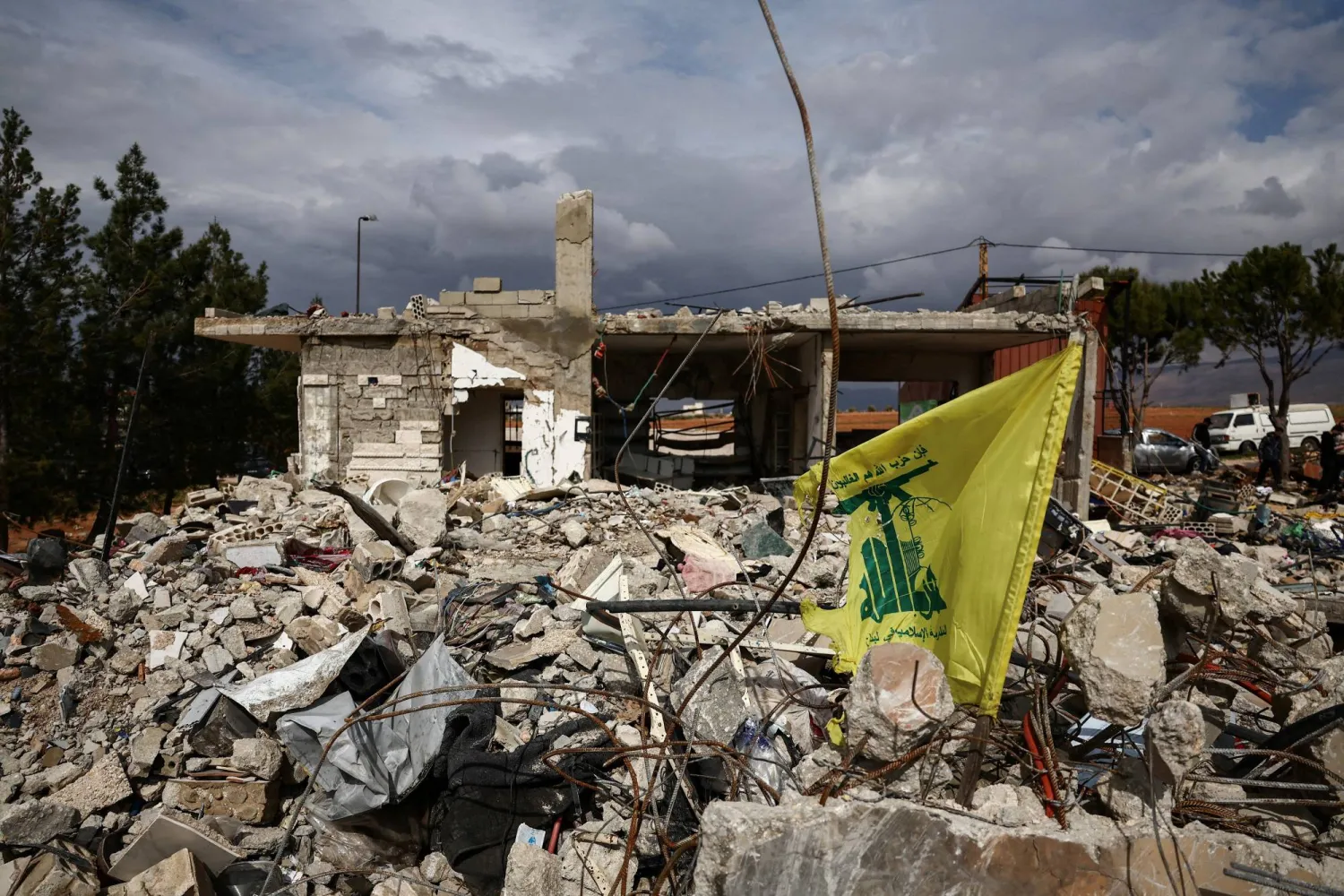
A Hezbollah flag is placed in front of a house destroyed by an Israeli strike, following an escalation between Hezbollah and Israel, amid the US-Israeli conflict with Iran, during a media tour in Chaat, Lebanon, March 23, 2026. REUTERS/Yara Nardi/File Photo
TT

War between Hezbollah and Israel Deepens Fractures in Lebanon

A Hezbollah flag is placed in front of a house destroyed by an Israeli strike, following an escalation between Hezbollah and Israel, amid the US-Israeli conflict with Iran, during a media tour in Chaat, Lebanon, March 23, 2026. REUTERS/Yara Nardi/File Photo

War between Israel and Hezbollah is pushing Lebanon's fragile state and society towards breaking point, straining sectarian and political faultlines as Shi'ite Muslims are displaced and enmity deepens between the Iran-backed group and its opponents.

Of all Lebanon's many crises since a 1975-90 civil war, the renewed conflict ignited by the Iran war could be its most destabilizing, Lebanese analysts and figures from across the political spectrum say.

Israel has threatened Gaza-like destruction and an occupation of the south and there are acrid splits in Lebanon over Hezbollah's weapons, which the group has refused to give up despite a year-long effort by the state to disarm it peacefully, Reuters said.

Israeli bombardment and orders for people to leave have driven Hezbollah's Shi'ite constituents into Christian, Druze and other areas, where many blame the group for starting a war in support of Tehran only 15 months after the last one.

Local authorities are vetting displaced people seeking rented accommodation, fearing the presence of anyone who might be a target for Israel.

Tensions between Hezbollah and the government are worsening. The administration led by Prime Minister Nawaf Salam and President Joseph Aoun has banned Hezbollah's military wing, called for talks with Israel and demanded Iran's ambassador leave.

Hezbollah official Mahmoud Qmati has compared the government to the Vichy France leaders sentenced to death for collaborating with Nazi Germany in World War Two.

"We are capable of turning the country upside down," he told a Lebanese media outlet although he later said his remarks were taken out of context.

Druze lawmaker Wael Abu Faour says internal tensions ‌are increasing because of political ‌divisions over the war and displacement and "the defiant rhetoric from more than one side".

"This exacerbates fears for internal stability," he said.

'TICKING BOMB'

More ‌than 1,000 ⁠people have ⁠been killed in Lebanon and over a million - more than a fifth of the population - have been displaced, most of them Shi'ite Muslims, since Hezbollah fired at Israel on March 2 and Israel hit back.

A foreign official said the displacement was straining communal ties and would be "a ticking bomb" if the displaced cannot go home.

Israel's military has ordered people to leave much of the south as well as Beirut's Hezbollah-controlled southern suburbs and the group's heartlands in eastern Lebanon.

Israel's defense minister has said his country intends to create a "security zone" up to the Litani River, which meets the sea about 30 km (19 miles) north of the border with Israel. He has said hundreds of thousands of Shi'ites will not return south of the Litani until security is ensured for northern Israel.

Nadim Gemayel, a Christian lawmaker opposed to Hezbollah, expressed concern that Israel was deliberately pushing Shi'ites into other parts of Lebanon to create conflict with other communities.

Hezbollah has long been at odds with many other Lebanese factions and has an arsenal more potent than the army's.

During a brief civil war ⁠in 2008, when a Western-backed government tried to outlaw Hezbollah's communications network, Hezbollah fighters took over Beirut. The government backed down.

Gemayel said tension "already ‌exists, but the ignition hasn't happened yet, and I hope that it will never happen".

"If the Israelis stay long, very long ‌in the south, this will be catastrophic for everyone ... Lebanon cannot assimilate such a displacement of people," he said, urging the Lebanese government to "disarm Hezbollah and terminate this war".

In response to a request for comment on ‌the accusation Israel was seeking to stir sectarian tensions, an Israeli official did not directly address the question but said the only conflict in Lebanon was the one started by Hezbollah and ‌urged the country to eject the group.

The Israeli military said it was operating solely against Hezbollah, and that any allegations it was operating against a specific population were "false and misleading”.

However, an Israeli military official told Reuters that evacuation notices had been issued only to Shi'ite villages in Lebanon's south, and that Christian villages were still populated and not targeted by Israeli forces.

'SECTARIAN LOGIC'

Hezbollah lawmaker Hassan Fadlallah said some Lebanese were dealing with the issue of displacement "with sectarian logic".

"We will overcome this phase because the displaced will return to their land and their homes as soon as the aggression ceases," he said.

Underlining tensions, residents of a predominantly Christian area north of Beirut brawled with ‌displaced people and demanded they leave on Tuesday when fragments of an Iranian ballistic missile intercepted over Lebanon fell onto the area.

Moves to establish a shelter for displaced in Beirut's Karantina district, in a predominantly Christian area near the port, prompted objections by Christian politicians. Salam ⁠later decreed the site would instead be used to ⁠store aid.

In the predominantly Christian neighborhood of Dekwaneh east of Beirut, about 2,000 displaced Shi'ites are sheltering in a vocational college.

Zeinab al-Meqdad, 50, said her family had encountered no problems in the neighborhood since fleeing her home in the southern suburbs on March 2.

Antoine Abu Aboud, a local official, said another 1,000 displaced were in hotels and rented accommodation in Dekwaneh.

"There is a war, and the situation is bigger than us. Today, we Lebanese must be patient with one another," he said.

He said the local council had tightened vetting of people seeking to rent, sending IDs to security forces for checks, saying residents feared anyone who could "represent a danger to their building or lives".

COEXISTENCE BETWEEN STATE AND HEZBOLLAH ARMS ENDING?

Divisions in Lebanese society are mirrored in the state, which has also been shaken by the fallout of the war.

Hezbollah held decisive sway over the state until being pummeled by Israel in 2024. After that conflict, the government sought to disarm it, but the many rockets fired by Hezbollah since March 2, and its rapid deployment of fighters back to the south, have shaken confidence in the state at home and abroad.

Hezbollah believes the government will ultimately retreat from decisions including the banning of its military wing.

"All the measures taken by the government will be reversed when Israel fails to achieve its objectives," Fadlallah said. "When we finish confronting this aggression, we, as Lebanese, will address our internal problems."

Israeli officials have indicated Israel's offensive will continue beyond the Iran war, and much hinges on what happens in the broader conflict.

A 15-point US proposal for ending the war includes Iran cutting off funding for allies such as Hezbollah, according to Israeli cabinet sources. Iran has indicated that Lebanon must be included in any ceasefire.

Christian lawmaker Alain Aoun said Lebanon was in a transitional phase, with the final terms to be determined by the war.

"The coexistence between the state and Hezbollah arms which we witnessed for decades is nearing its end in one way or another, with all the potential repercussions for society and the political system," he said.



Israeli Strikes Kill Three Palestinians, Including a Child, in Gaza, Medics Say

 Palestinians inspect the site of an Israeli strike that targeted a police post, in Gaza City, May 5, 2026. (Reuters)
Palestinians inspect the site of an Israeli strike that targeted a police post, in Gaza City, May 5, 2026. (Reuters)
TT

Israeli Strikes Kill Three Palestinians, Including a Child, in Gaza, Medics Say

 Palestinians inspect the site of an Israeli strike that targeted a police post, in Gaza City, May 5, 2026. (Reuters)
Palestinians inspect the site of an Israeli strike that targeted a police post, in Gaza City, May 5, 2026. (Reuters)

Israeli strikes killed at least three Palestinians, including a child, and wounded several others in the Gaza Strip on Tuesday, health officials said.

Medics said a Palestinian was killed and two others were wounded by an Israeli airstrike near the Sheikh Radwan neighborhood in Gaza City, while another was killed and several others were wounded by Israeli tank shelling near the central area of the enclave.

Later on Tuesday, an Israeli strike targeted a police station in northern Gaza, killing a 15-year-old child, medics said. The Hamas-run interior ministry said ‌some policemen ‌were also wounded in the attack.

Reuters has previously reported ‌that ⁠Israel has intensified its ⁠attacks on Gaza's Hamas-run police force, which the group has used to reinforce its hold in the areas it controls in the strip.

There was no immediate Israeli comment on any of the incidents.

Violence in Gaza has persisted despite an October 2025 ceasefire, with Israel conducting almost daily attacks on Palestinians. Israel and Hamas have blamed each ⁠other for ceasefire violations.

At Al Shifa Hospital, the largest ‌medical facility still partially functional in the ‌enclave, relatives and friends arrived to bid farewell to one of those ‌killed on Tuesday, Mohammed Al-Ghandour. Two girls were crying and being ‌comforted by a woman outside the hospital's morgue.

"The Zionist enemy doesn't know anything called truce and does not commit to international treaties or laws or humanitarian laws," said the victim's uncle, Abu Omar Al-Naffar.

At least 830 Palestinians ‌have been killed since the ceasefire deal took effect, according to local medics, while Israel says fighters have ⁠killed four ⁠of its soldiers over the same period.

Israel says its strikes are aimed at thwarting attempts by Hamas and other Palestinian fighters to stage attacks against its forces.

More than 72,500 Palestinians have been killed since the Gaza war started in October 2023, most of them civilians, according to Gaza health authorities.

Since the truce last October, Israel still occupies more than half of Gaza, where it has ordered residents out and demolished almost all remaining structures. Nearly the entire population of more than 2 million Palestinians now lives in a narrow strip along the coast, mainly in tents and damaged buildings, under the de facto control of Hamas.


Israel Court Extends Gaza Flotilla Activists’ Detention Until Sunday

 Brazil's activist Thiago Avila is escorted into court in the Israeli coastal city of Ashkelon on May 5, 2026. (AFP)
Brazil's activist Thiago Avila is escorted into court in the Israeli coastal city of Ashkelon on May 5, 2026. (AFP)
TT

Israel Court Extends Gaza Flotilla Activists’ Detention Until Sunday

 Brazil's activist Thiago Avila is escorted into court in the Israeli coastal city of Ashkelon on May 5, 2026. (AFP)
Brazil's activist Thiago Avila is escorted into court in the Israeli coastal city of Ashkelon on May 5, 2026. (AFP)

An Israeli court has extended the detention of two foreign activists from a Gaza-bound flotilla until Sunday, a rights group representing them said, as authorities continue to question the pair.

Spanish national Saif Abu Keshek and Brazilian national Thiago Avila appeared before a court in the city of Ashkelon for their second hearing on Tuesday, after they were brought to Israel for questioning last week.

The two, held in a prison in the southern Israeli city, were among dozens of activists aboard a Gaza-bound flotilla intercepted by Israeli forces off the coast of Greece early on Thursday.

At their first hearing on Sunday, the court extended their detention by two days. A second hearing was held on Tuesday, where both appeared with their legs shackled.

"The court approved their detention until Sunday morning" at Tuesday's hearing, Miriam Azem, international advocacy coordinator at the Israeli rights group Adalah told AFP.

An AFP journalist saw the two activists brought to the courtroom.

Adalah said the two activists were on hunger strike, with Tuesday their sixth day of protest.

On Monday, the rights group alleged the pair had been subjected to physical and psychological abuse in detention.

- Abuse claims -

Both Abu Keshek and Avila are being held in isolation, with "high-intensity lighting" on at all times in their cells, Adalah said, adding that Avila was being held in "extremely cold temperatures".

"They are kept blindfolded at all times whenever they are moved outside their cells, including during medical examinations," it said.

Israeli authorities have rejected the abuse claims.

At Sunday's hearing, Adalah said the state attorney had presented a list of offences the pair were accused of, including "assisting the enemy during wartime" and "membership in and providing services to a terrorist organization".

But Adalah's lawyers challenged the state's jurisdiction, arguing there had been an "unlawful abduction" of the two activists in international waters.

Israel's foreign ministry said both individuals were affiliated with the Popular Conference for Palestinians Abroad (PCPA), a group accused by Washington of "clandestinely acting on behalf of" Palestinian group Hamas.

The ministry said Abu Keshek was a leading PCPA member, and that Avila was also linked to the group and "suspected of illegal activity".

The flotilla's vessels had set sail from France, Spain and Italy with the aim of breaking Israel's blockade of Gaza and bringing humanitarian supplies to the devastated Palestinian territory.

But they were intercepted by Israeli forces off the coast of Greece.

The Global Sumud Flotilla's first voyage last year was also intercepted by Israeli forces off the coasts of Egypt and Gaza.

Israel controls all entry points into Gaza, which has been under an Israeli blockade since 2007.

Throughout the Gaza war that started in October 2023, there have been shortages of critical supplies in the territory, with Israel at times cutting off aid entirely.


With Wood Scarce, Gaza Carpenters Make Simple Beds from Pallets

 Palestinian carpenter Mohammed Wafi builds furniture from recycled wooden pallets in his workshop amid shortages of materials in Khan Younis, in the southern Gaza Strip, May 2, 2026. (Reuters)
Palestinian carpenter Mohammed Wafi builds furniture from recycled wooden pallets in his workshop amid shortages of materials in Khan Younis, in the southern Gaza Strip, May 2, 2026. (Reuters)
TT

With Wood Scarce, Gaza Carpenters Make Simple Beds from Pallets

 Palestinian carpenter Mohammed Wafi builds furniture from recycled wooden pallets in his workshop amid shortages of materials in Khan Younis, in the southern Gaza Strip, May 2, 2026. (Reuters)
Palestinian carpenter Mohammed Wafi builds furniture from recycled wooden pallets in his workshop amid shortages of materials in Khan Younis, in the southern Gaza Strip, May 2, 2026. (Reuters)

As Israeli restrictions continue to curb the entry of goods into Gaza, local carpenters are turning to scrap wood and shipping pallets to make much-needed basic beds and tables in a strip battered by two years of war between Hamas and Israel.

In a workshop in southern Gaza, carpenters dismantle used pallets to make beds, cupboards, and shelves for families displaced by fighting, after regular construction materials became scarce or prohibitively expensive.

Mohammed Wafi, 34, a carpenter in Khan Younis, said pallets became one of the few available sources of wood when limited ‌aid trucks began entering ‌Gaza.

Demand for his handiwork has grown as people living ‌in ⁠tents seek basic furniture ⁠to get by, Wafi said. Even recycled furniture has become more costly as prices for basic components soar.

"Today people say, 'I just need something to get by, something to get my clothes off the floor'... especially those (living) in tents," said Wafi, who has worked in carpentry for 16 years.

"Due to the rats and cockroaches, they need a tent or a bed to be lifted off the ground," he said.

Rats and parasites are spreading ⁠through Gaza's tent camps, biting people as they sleep, gnawing through ‌possessions, and spreading disease.

COGAT, the Israeli military agency ‌that coordinates aid into Gaza, didn't respond to a request for comment. Wood is a construction material ‌that Israel bans from entry to Gaza because it is considered a dual-use ‌item - items for civilian but also potential military use.

"We used to get a kilo of nails for 5 shekels ($1.70). Today, a kilo of nails costs around 100 or 130 shekels," Wafi said. Hinges and other fittings have also multiplied in price.

Still, furniture made from pallets remains far ‌cheaper than conventional bedroom sets, consisting of a bed, closet and dresser, he said. A pallet set sells for 4,000 to ⁠5,000 shekels compared ⁠to 18,000 for a traditional set.

Shortages of electricity and wood have slowed production, he added, leaving carpenters unable to guarantee delivery times.

The ceasefire in Gaza has been repeatedly violated, with over 830 Palestinians and four Israeli soldiers reported killed since it began in October, according to Palestinian and Israeli tallies.

Israel cites security concerns for curbs on Gaza, and COGAT has previously said it invests considerable efforts to ensure aid reaches Gaza and has denied restricting supplies.

In tent encampments near Khan Younis, Mohammed Tayseer, who has lived in a tent for two years, said he slept on the ground until recently.

"The ground is sandy and dirty, and as you can see, you find the clothes full of sand. There are rats and mice," he said.

"One's back hurts and is stiff from sleeping on the floor... now (we) have a bed," he said.