


Meet the Artemis Crew in NASA's First Astronaut Mission to the Moon in More than a Half-century

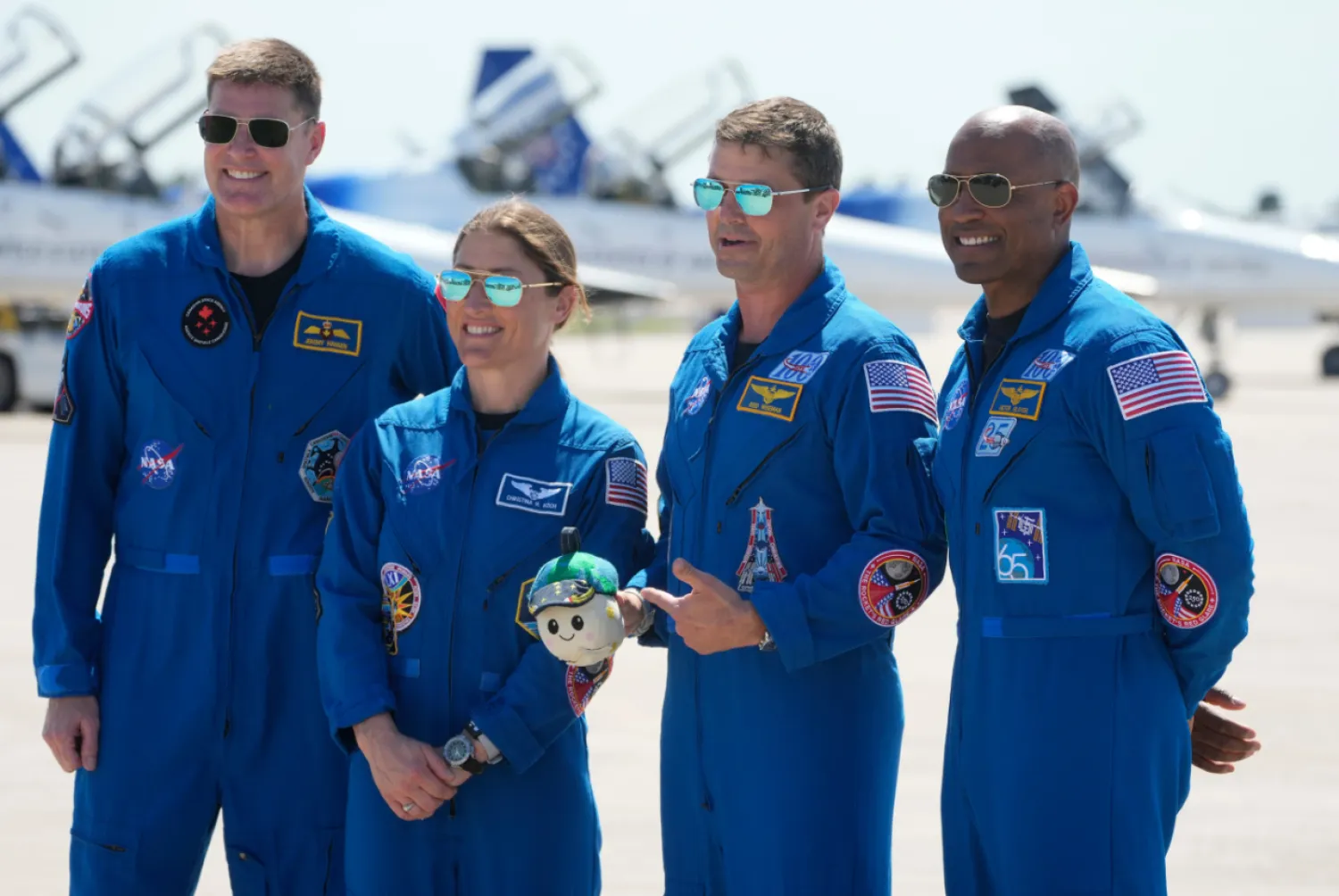
Artemis 2 crew members, from left, Mission Spc. Jeremy Hansen, of Canada, Mission Spc. Christina Koch, Commander Reid Wiseman, and Pilot Victor Glover pose for a photo after the crew’s arrival at the Kennedy Space Center Friday, March 27, 2026, in Cape Canaveral, Fla. (AP Photo/Chris O’Meara)
TT

Meet the Artemis Crew in NASA's First Astronaut Mission to the Moon in More than a Half-century

Artemis 2 crew members, from left, Mission Spc. Jeremy Hansen, of Canada, Mission Spc. Christina Koch, Commander Reid Wiseman, and Pilot Victor Glover pose for a photo after the crew’s arrival at the Kennedy Space Center Friday, March 27, 2026, in Cape Canaveral, Fla. (AP Photo/Chris O’Meara)

The four astronauts making NASA’s next lunar leap bear little resemblance to the Apollo era.

The Americans who blazed the trail to the moon more than half a century ago were white men chosen for their military test pilot experience. This first Artemis crew includes a woman, a person of color and a Canadian, products of a more diversified astronaut corps.

None of them were alive during NASA’s storied Apollo program that sent 24 astronauts to the moon including 12 moonwalkers. They won’t land on the moon this time or even orbit it, but the out-and-back journey will take them thousands of miles deeper into space than even the Apollo astronauts ventured, promising unprecedented views of the lunar far side, The AP news reported.

Here’s a look at the Artemis astronauts whose mission aims to pave the path for future moon landings:

Commander Reid Wiseman Leading the nearly 10-day mission is a widower who considers solo parenting — not rocketing to the moon — his biggest and most rewarding challenge.

Wiseman, 50, a retired Navy captain from Baltimore, was serving as NASA’s chief astronaut when asked three years ago to lead humanity’s first lunar trip since 1972. His wife Carroll’s death from cancer in 2020 gave him pause.

He’d spent more than five months at the International Space Station in 2014, and his two teenage daughters, especially the older one, had “zero interest” in him launching again.

“We talked about it and I said, ‘Look, of all the people on planet Earth right now, there are four people that are in a position to go fly around the moon,” he said. “I cannot say no to that opportunity.”

The next day, homemade moon cupcakes awaited him, along with his daughters' support. The toughest part isn’t leaving them — “it's the stress that I’m putting on them,” he said.

Open with his daughters about everything, he recently told them where he keeps his will.

Pilot Victor Glover As one of NASA’s few Black astronauts, Glover sees his presence on the mission as “a force for good.”

The 49-year-old Navy captain and former combat pilot from Pomona, California, makes it a habit to listen to Gil Scott-Heron’s “Whitey on the Moon” and Marvin Gaye’s “Make Me Wanna Holler” from the white-dominated Apollo era.

“I listen to those for perspective,” he said. “It captures what we did well, what we did poorly.”

The ability for him now to offer hope to others is “an amazing blessing and a privilege.” Despite having one spaceflight behind him — an early SpaceX crew run to the International Space Station — he finds himself in new personal territory. His four daughters are in their late teens and early 20s, “and I spend as an much time and thought preparing them as NASA does preparing me.”

He’s hyper-focused on running “our best race so that we can hand the baton off to the next leg” — a 2027 practice docking mission in orbit around Earth between an Orion crew capsule and one or two lunar landers. The all-important moon landing would follow in 2028 with yet another set of astronauts.

Mission specialist Christina Koch The last time Koch blasted into space, she was gone almost a year, so she’s not sweating a quick trip to the moon and back.

The 47-year-old electrical engineer from Jacksonville, North Carolina, holds the record for the longest single spaceflight by a woman — 328 days. She took part in the first all-female spacewalk during her lengthy stay at the space station in 2019.

More than any one individual, “it’s about celebrating the fact that we’ve arrived to this place in history” where women can fly to the moon, she said.

Before she got called up by NASA, Koch spent a year at a South Pole research station. Between that and her space stint, she feels she's “inoculated” most of her family and friends.

“So far, I haven't gotten too many nerves from folks. Maybe my dog, but I've reassured her that it's only 10 days. It's not going to be as long as last time.”

Her and her husband's rescue pooch is named Sadie Lou.

Canadian Space Agency's Jeremy Hansen The Canadian fighter pilot and physicist is making his space debut, stressful enough, but also serving as his country's first emissary to the moon.

“Maybe I'm naive, but I don't feel a lot of personal pressure.”

Hansen, 50, grew up on a farm near London, Ontario, before moving to Ingersoll and pursuing a flying career. The Canadian Space Agency selected him as an astronaut in 2009, and he was named to the Artemis crew in 2023.

He realizes only now how much effort it took to send men to the moon during Apollo.

“When I walk out and I look at the moon now, it looks and feels a little bit farther than it used to be,” he said. “I just understand in the details how much harder it is than I thought it was watching videos of it.”

Dangers still loom — something he’s shared with his college-aged son and twin daughters. “The most likely outcome is that we will come back safe. There’s a chance we won’t, and you will be able to move through life even if that happens,” he assured them.



Humpback Whale ‘Timmy’ Struggles to Escape Shallow Waters off Germany

A humpback whale lies on a sandbank in the shallow waters at Wismar Bay in the Baltic Sea, after having moved overnight, near Wismar, Germany, March 29, 2026. (Reuters)
TT

Humpback Whale ‘Timmy’ Struggles to Escape Shallow Waters off Germany

A humpback whale lies on a sandbank in the shallow waters at Wismar Bay in the Baltic Sea, after having moved overnight, near Wismar, Germany, March 29, 2026. (Reuters)

A young humpback ‌whale named Timmy by rescuers was struggling to find its way out of shallow bays off the Baltic coast of Germany on Sunday morning, after a week-long ordeal that has put its survival in doubt.

The plight of Timmy, who is thought to measure 12 to 15 meters in length, shows the difficulty of freeing such creatures given their size, with rescuers using dredging equipment and boats ‌to guide ‌the whale back onto a ‌long ⁠route to the ⁠Atlantic.

After days of efforts to free the animal, rescuers are now hoping the whale will manage to make it out on its own.

"The whale is quite weak. We're still hopeful that it will pull through," Daniela von Schaper, a marine ⁠expert at Greenpeace, told Reuters.

The whale, whose ‌gender has not ‌been established, was named after Timmendorfer Strand, the white sandy ‌beach on Germany’s resort-filled Baltic coastline where it ‌was first spotted on a nearby sandbank on Monday.

Repeated rescue attempts have failed since, with Greenpeace and its partners documenting an animal in severe stress with skin irritation ‌and fishing gear entangled in its mouth.

There were brief glimmers of hope ⁠over ⁠the weekend, when the whale managed to free itself twice before running into difficulty again.

Humpback whales are not native to the Baltic Sea. While uncommon, large whales are spotted in the region every couple of years, according to von Schaper.

Conservationists say disrupted migration routes and human influence play a role in whale strandings around the world, though animals can also lose their way while searching for food.

"Some of them find their way out again, others unfortunately do not," von Schaper said.


Swiss Back Tougher Social Media Rules for Minors, Survey Finds

Instagram, TikTok, Snapchat, YouTube, Facebook, Twitch and Reddit applications are displayed on a mobile phone ahead of new law banning social media for users under 16 in Australia, in this picture illustration taken on December 9, 2025. (Reuters)
TT

Swiss Back Tougher Social Media Rules for Minors, Survey Finds

Instagram, TikTok, Snapchat, YouTube, Facebook, Twitch and Reddit applications are displayed on a mobile phone ahead of new law banning social media for users under 16 in Australia, in this picture illustration taken on December 9, 2025. (Reuters)

The ‌vast majority of Swiss want stronger protection for children and teenagers on social media, according to a survey published on Sunday, as governments and courts worldwide intensify scrutiny of Big Tech over its impact on young users.

On Wednesday, a Los Angeles jury found Meta and Alphabet's Google negligent for designing social ‌media platforms that ‌are harmful to young ‌people, ⁠in a verdict ⁠that will serve as a bellwether for numerous similar cases.

The Swiss study by polling firm GfS Bern for the Mercator Foundation found 94% of respondents felt minors should be ⁠better protected from the damaging effects ‌of social media, ‌while 78% believed large technology firms have ‌too much influence over public opinion.

Swiss Interior ‌Minister Elisabeth Baume-Schneider has said she is open to a potential ban on social media for youngsters. Her government is drafting ‌legislation to regulate major online platforms, aiming to make them more ⁠transparent.

The ⁠poll's publication in newspaper SonntagsZeitung follows a decision by neighboring Austria on Friday to pursue a ban on social media use for children under 14.

The GfS Bern survey polled about 1,000 Swiss residents aged 16 and above between December 1 and 12. It had a margin of error of plus or minus 3.2 percentage points, the paper said.


The Sea Beneath Arctic and Antarctic Ice Holds Many Secrets. These Scientists Dive Deep to Find Out

Ruari Buijs, a marine biology and oceanography student, right, and Caroline Chen, a scientific diver and research assistant, prepare to dive during a Polar Scientific Diving class in Kilpisjärvi, March 15, 2026. (AP Photo/Kostya Manenkov)
TT

The Sea Beneath Arctic and Antarctic Ice Holds Many Secrets. These Scientists Dive Deep to Find Out

Ruari Buijs, a marine biology and oceanography student, right, and Caroline Chen, a scientific diver and research assistant, prepare to dive during a Polar Scientific Diving class in Kilpisjärvi, March 15, 2026. (AP Photo/Kostya Manenkov)

As bubbles rippled across the frigid Finnish lake, diver Daan Jacobs emerged from a hole carved out of the thick, crackling ice.

The journey had taken him 8 meters (26 feet) beneath the surface, where sunlight filtered through the Arctic ice and fish swam around a rock formation. It's a remote place few will ever see, especially in winter, when snow blankets the ice and temperatures on land approach minus 40 degrees in both Celsius and Fahrenheit.

But Jacobs, a biodiversity adviser in the Netherlands, is one of a growing number of fortunate underwater explorers, The Associated Press said.

He was part of the Polar Scientific Diving class in the far north of Finland earlier this month, a program designed by the Finnish Scientific Diving Academy to train the next generation of scientists and researchers to dive beneath the Arctic and Antarctic ice to study the flora and fauna below.

“The view is beautiful,” Jacobs said, gulping for air following his 45-minute dive.

The Arctic is warming four times faster than the rest of the planet. From impacting worldwide weather patterns to making the polar bear population smaller, weaker and hungrier, because they rely on the sea ice to hunt from, higher temperatures at the North Pole spell disaster for the entire globe.

In Antarctica, meanwhile, global warming is leading to melting of ice sheets, prompting sea level rise and disrupting ocean ecosystems.

Human divers still needed

So scientists need to study what's underneath the remaining Arctic — and Antarctic — ice, and determine how climate change is affecting the plants and animals that have traditionally survived along the seafloor with little to no sunlight. But carrying out such research requires specialized scuba diving skills plus the proper scientific background — qualifications that experts say only a few hundred people in the world currently have.

The Finnish Scientific Diving Academy’s class aims to not only train more divers, but also to convince the world that the polar ice crisis requires additional research.

“Because it is melting so fast, we need to have more people deployed there — more science to be done — to understand better what happens,” said Erik Wurz, a marine biologist and one of the class's scientific diving instructors. “We have to do more and we need to be fast to save this unique ecosystem in the Arctic, but also the Antarctic.”

And in a world that’s increasingly outsourcing work to artificial intelligence and robots, British Antarctic Survey marine biologist Simon Morley said that human hands are still necessary for this. Dragging nets across the seafloor would destroy the habitat, and a remotely operated submersible or robot can usually only pick up one specimen at a time.

“A diver can go down and pick up 12 urchins, put them in a bag and not affect the rest of the system,” said Morley, who isn't part of the course.

Challenging conditions

During each 10-day session, the academy's instructors drill a dozen experienced divers on a frozen lake at the University of Helsinki's Kilpisjärvi Biological Station. The program began in 2024 and the demand has allowed them to add a second session per year.

The participants range from marine and freshwater biologists and other scientists to highly skilled recreational divers and documentary filmmakers.

Ruari Buijs, a marine biology and oceanography student at the University of Plymouth in England, ultimately wants to work in Antarctica and research marine megafauna. He enrolled in this month's polar diving class in an effort to be more employable upon graduation.

“I thought this would be a very good stepping stone toward that goal,” he said.

Meanwhile, Caroline Chen, a scientific diver and research assistant in Germany, said it’s her dream to dive in the polar regions. She believes that her experience in this course will help her design future experiments in such challenging conditions.

The students must learn more than just diving under ice that's nearly a meter (around three feet) thick and into water temperatures that hover just above freezing. For starters, there's the frigid air temperatures and whipping winds over Lake Kilpisjärvi.

That challenges the topside support team, which must operate equipment to keep the diver safe while fending off their own risk of frostbite. They also have to learn how to become safety divers in case of an emergency, like if the primary diver can't find the hole in the ice to surface after 45 minutes below.

But once they're underwater, the divers say it's an incredible experience. During this month's session, the group dived beneath ice roughly 80 centimeters (around 2½ feet) thick. Chen spotted some fish along the sea floor and then took a moment to look to the surface as sunlight streamed through the ice, seemingly mimicking another Arctic phenomenon.

“It looks insane from the bottom up,” Chen said. “It changes all the time, like the Northern Lights.”

Buijs said that the cold doesn't affect the covered parts of a diver's body. But the area around their mouth remains exposed underwater.

“I think the worst thing is like your lips feel very numb afterward and they like stick out a lot,” he said, laughing. “You kind of get Botox lips a little bit.”