


Iran Hangs 18-Year-Old Over Protests in Latest Wartime Execution, Say Activists

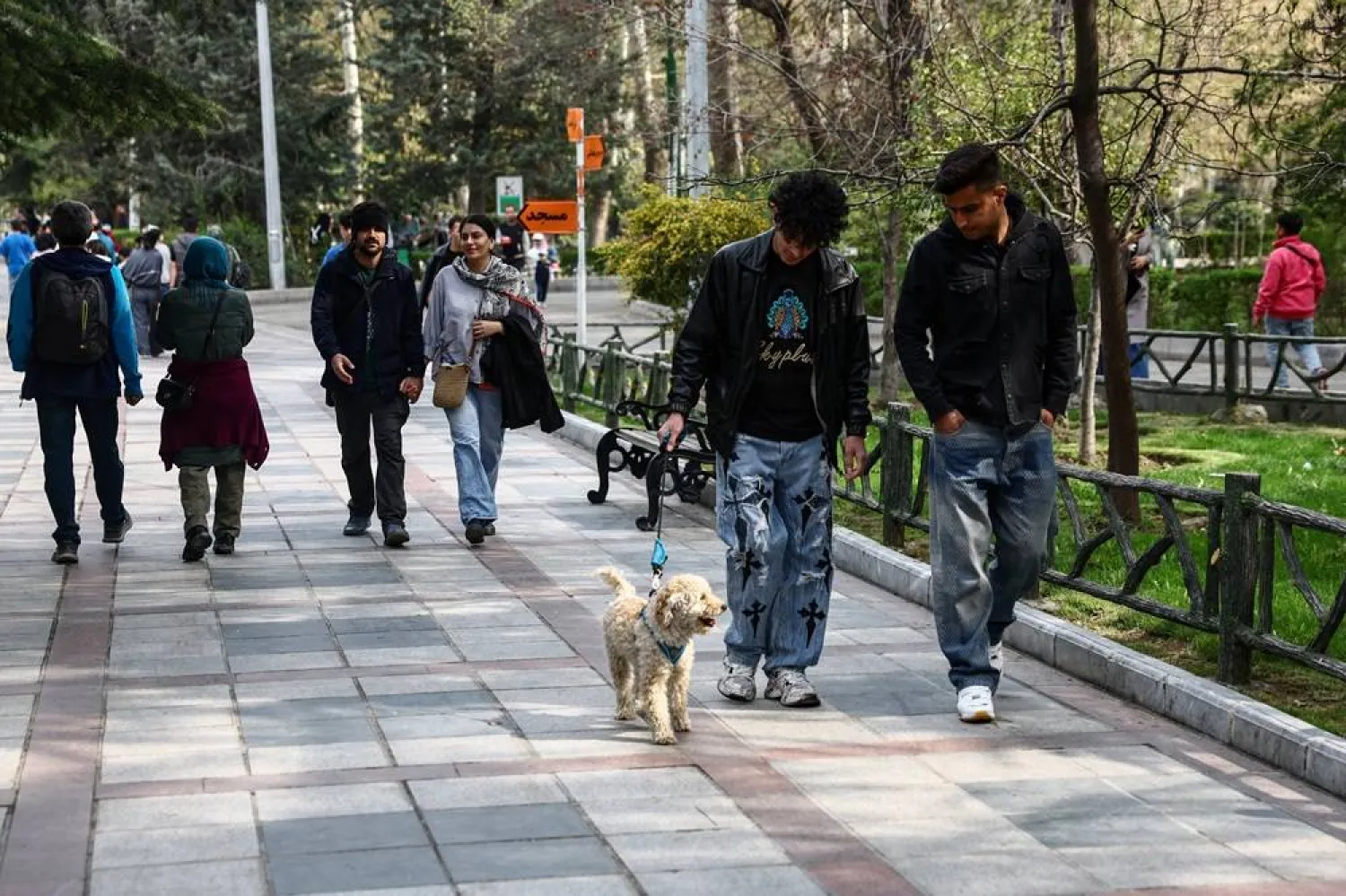
Iranians walk at a park on Nature Day, amid the US-Israeli conflict with Iran, in Tehran, Iran, April 2, 2026. Majid Asgaripour/WANA (West Asia News Agency) via Reuters
TT

Iran Hangs 18-Year-Old Over Protests in Latest Wartime Execution, Say Activists

Iranians walk at a park on Nature Day, amid the US-Israeli conflict with Iran, in Tehran, Iran, April 2, 2026. Majid Asgaripour/WANA (West Asia News Agency) via Reuters

Iranian authorities Thursday executed a teenager convicted over January protests after a fast-track trial rights groups labelled as "grossly unfair", as the country ramps up executions during the war with the US and Israel.

Amir Hossein Hatami, 18, was sentenced to death in February along with six others by a Tehran revolutionary court and was hanged at dawn in the notorious Ghezel Hesar prison outside the capital, according to Norway-based NGO Iran Human Rights.

The Iranian judiciary's Mizan Online website said he acted "against national security" on behalf of Israel and the United States by breaking into "a military center and destroying it in order to seize the weapons stored there" during the protests.

But Amnesty International said it was "outraged by the arbitrary execution of the teenage protester", adding the trial was "grossly unfair" and that he had been sentenced to death less than a month after his arrest.

Hatami is the fourth man to be executed over protests that broke out in Iran in late December against the rising cost of living before evolving into nationwide anti-government demonstrations. The protests peaked on January 8 and 9 and were met with a crackdown that activists say left thousands dead.

On March 19, authorities executed three men convicted of killing police in the protests, including 19-year-old Saleh Mohammadi, a wrestler who took part in international competitions.

This week, authorities have hanged four men convicted on charges of rebellion for membership in the banned People's Mujahedin of Iran (MEK) after their sentences were upheld by the supreme court.

Hatami "was subjected to torture and sentenced based on forced confessions in a grossly unfair trial before the revolutionary Court," said IHR director Mahmood Amiry-Moghaddam.

"In the past two weeks alone, three protesters and four political prisoners have been executed, and hundreds more remain at imminent risk," he added. IHR said that just 84 days had elapsed between his arrest and execution.

- 'Tool of repression' -

The seven were accused of setting fire to a base belonging to the Basij militia -- a volunteer force of the Revolutionary Guards -- in Tehran during the protests.

But defense lawyers accused plainclothes forces of trapping protesters inside a building, locking the doors, and themselves starting the fire.

Amnesty International said that the execution showed the judiciary is "a tool of repression sending individuals to the gallows to spread fear and exacting revenge on those demanding fundamental political change".

IHR said the seven men had been convicted in the fast track-trial -- just a month after their arrest -- by the court presided over by the notorious judge Abolqasem Salavati.

Salavati was sanctioned in 2019 by the United States, which said he is known as the "Judge of Death" for his frequent death sentences.

The executions came amid Iran's war with Israel and the United States which erupted on February 28 with strikes that killed the Islamic republic's supreme leader, Ali Khamenei.

"Hundreds more now face imminent executions in the coming days and weeks," warned Amiry-Moghaddam.



UN Security Council Delays Vote on Authorizing Force to Protect Hormuz

With oil and gas shipments severely restricted due to the US-Israeli war against Iran, the UN Security Council is meeting to consider authorizing the use of 'defensive' force as a way to open the vital Strait of Hormuz. FADEL SENNA / AFP/File
TT

UN Security Council Delays Vote on Authorizing Force to Protect Hormuz

With oil and gas shipments severely restricted due to the US-Israeli war against Iran, the UN Security Council is meeting to consider authorizing the use of 'defensive' force as a way to open the vital Strait of Hormuz. FADEL SENNA / AFP/File

The UN Security Council has postponed a vote scheduled for Friday on authorizing the use of "defensive" force to protect shipping in the Strait of Hormuz from Iranian attacks, according to the official program.

The 15-member body was set to vote Friday morning on a draft resolution brought by Bahrain, but by Thursday night the schedule shifted.

The reason given was that the United Nations observes Good Friday as a public holiday, according to diplomatic sources -- despite this fact being known when the vote was first announced.

No new date has been given for voting on the draft.

Iran has placed a stranglehold on the key shipping lane -- threatening fuel supplies and roiling the global economy -- in retaliation for US-Israeli strikes that triggered the month-old Middle East war.

"We cannot accept economic terrorism affecting our region and the world, the whole world is being affected by the developments," Bahrain's United Nations ambassador Jamal Alrowaiei said this week.

He said the text, which has gone through several amendments and is supported by the United States, "comes at a critical juncture."

President Donald Trump on Wednesday called for countries struggling with fuel shortages to "go get your own oil" in the Strait of Hormuz, adding that US forces would not help them.

A sixth and final draft, seen by AFP, greenlights member states -- either unilaterally or as "voluntary multinational naval partnerships" -- to use "all defensive means necessary and commensurate with the circumstances."

It applies to the strait and adjacent waters to "secure transit passage and to deter attempts to close, obstruct or otherwise interfere with international navigation through the Strait of Hormuz."

The measure would last for a period of at least six months.

The draft resolution has been molded in a bid to rally several countries that have appeared skeptical, including Russia, China and France.

Revised wording no longer explicitly invokes Chapter 7 of the UN Charter, which allows the Security Council to authorize armed force to restore peace.

The latest version, which was scheduled to be voted on at 11:00 am (1500 GMT) Friday before the postponement, also emphasizes the defensive nature of any intervention -- a stipulation that seems to have alleviated French concerns.

'Tall odds'

Jerome Bonnafont, France's UN ambassador, said Thursday that "it is up to the Council to quickly devise the necessary defensive response" after members voted in March to condemn Iran's blocking of the Strait of Hormuz.

President Emmanuel Macron earlier said a military operation to free the waterway is "unrealistic."

It is not certain that Russia and China -- who both wield veto powers -- will back the draft resolution.

"Authorizing member states to use force would amount to legitimizing the unlawful and indiscriminate use of force, which would inevitably lead to further escalation of the situation and lead to serious consequences," said Chinese ambassador Fu Cong.

Russia, a long-time ally of Tehran, has denounced what it calls one-sided measures.

Considering the possible Russian and Chinese vetos, the text "faces tall odds to make it through the Security Council," Daniel Forti, an analyst at International Crisis Group, told AFP.

"It is hard to see them supporting a resolution that treats stability in the strait exclusively as a security issue, instead of one that also grapples with the need for a durable political end to the hostilities," he said.

Normally, around a fifth of the world's oil and liquefied natural gas passes through the Strait of Hormuz.

Its near-total closure is impacting global supplies of important commodities including oil, liquefied natural gas and fertilizer and leading to sharp rises in energy prices.

Security Council mandates authorizing member states to use force are relatively rare.


Man Arrested After Setting off Pyrotechnics on German Train, Injuring 12

A police officer stands on a platform at Siegburg station where a Deutsche Bahn ICE train is parked, in Siegburg, Germany, early Friday, April 3, 2026, after a man was arrested on Thursday after threatening an attack on a high-speed train. (Roberto Pfeil/dpa via AP)
TT

Man Arrested After Setting off Pyrotechnics on German Train, Injuring 12

A police officer stands on a platform at Siegburg station where a Deutsche Bahn ICE train is parked, in Siegburg, Germany, early Friday, April 3, 2026, after a man was arrested on Thursday after threatening an attack on a high-speed train. (Roberto Pfeil/dpa via AP)

A man armed with knives was arrested after setting off pyrotechnics on a high-speed train in Germany, injuring 12 people, police said Friday.

The incident occurred late Thursday on an Intercity Express train, the German equivalent of France's TGV, bound for Frankfurt in western Germany, with around 180 passengers evacuated.

The suspect was locked in a bathroom by passengers after setting off the pyrotechnics, police said in a statement, adding that the man was carrying two knives.

Police said they were investigating the suspect's motives, but German media reported he allegedly threatened to carry out an attack and said he wanted to kill people.

Public radio station Deutschlandfunk reported, citing witness statements, that the man threw pyrotechnic devices filled with plastic pellets.

At least 12 passengers were slightly injured, including one who was taken to hospital but was released after treatment, police said.

Police said they searched the train for dangerous objects, but did not find anything.


North Korea to Hold Burial Ceremony for Troops Killed in Ukraine War

North Korean leader Kim Jong Un visits the Memorial Museum of Combat Feats, in Pyongyang, North Korea, in this picture released by North Korea's official Korean Central News Agency on April 3, 2026. (KCNA via Reuters)
TT

North Korea to Hold Burial Ceremony for Troops Killed in Ukraine War

North Korean leader Kim Jong Un visits the Memorial Museum of Combat Feats, in Pyongyang, North Korea, in this picture released by North Korea's official Korean Central News Agency on April 3, 2026. (KCNA via Reuters)

North Korea will hold a ceremony this month to bury the remains of its soldiers killed while fighting overseas alongside Russia against Ukraine, state media said Friday.

Pyongyang has sent thousands of troops -- as well as missiles and munitions -- to support Russia's war in Ukraine. Seoul estimates about 2,000 North Koreans have been killed.

In return, analysts say North Korea is receiving financial aid, military technology, food and energy from Russia, helping Pyongyang circumvent heavy international sanctions over its banned nuclear programs.

The isolated country is building a museum honoring the fallen troops, with state media saying Friday the project is 97 percent complete.

A ceremony of "burying the remains of the martyrs there would be solemnly held in mid-April and the museum be inaugurated", KCNA said.

It will be held "on the occasion of the first anniversary of the concluded operations for liberating Kursk", it added.

North Korean leader Kim Jong Un visited the site and inspected final stages of the project, including the arrangement of exhibits, sculptures and symbolic memorials and "highly appreciated" the progress, KCNA said.

Kim described the museum as a monument to the era, praising the "great heroism" of the late soldiers and calling the facility "a seat for education in patriotism".

North Korea confirmed it had deployed troops to support Russia's war in Ukraine in April last year and admitted that its soldiers had been killed in combat.

Kim has since held various ceremonies to honor the fallen troops.

At one such event last year, images released by KCNA showed an emotional Kim embracing a returned solider who appeared overwhelmed, burying his face in the leader's chest.

The leader was also seen kneeling before a portrait of a fallen soldier to pay his respects and placing medals and flowers beside images of the dead.

In early July, state media again showed a visibly emotional Kim honoring flag-draped coffins, apparently of the deceased soldiers returning home.