


Aid Groups Warn Iran War Is Hindering Food and Medicine from Reaching Millions

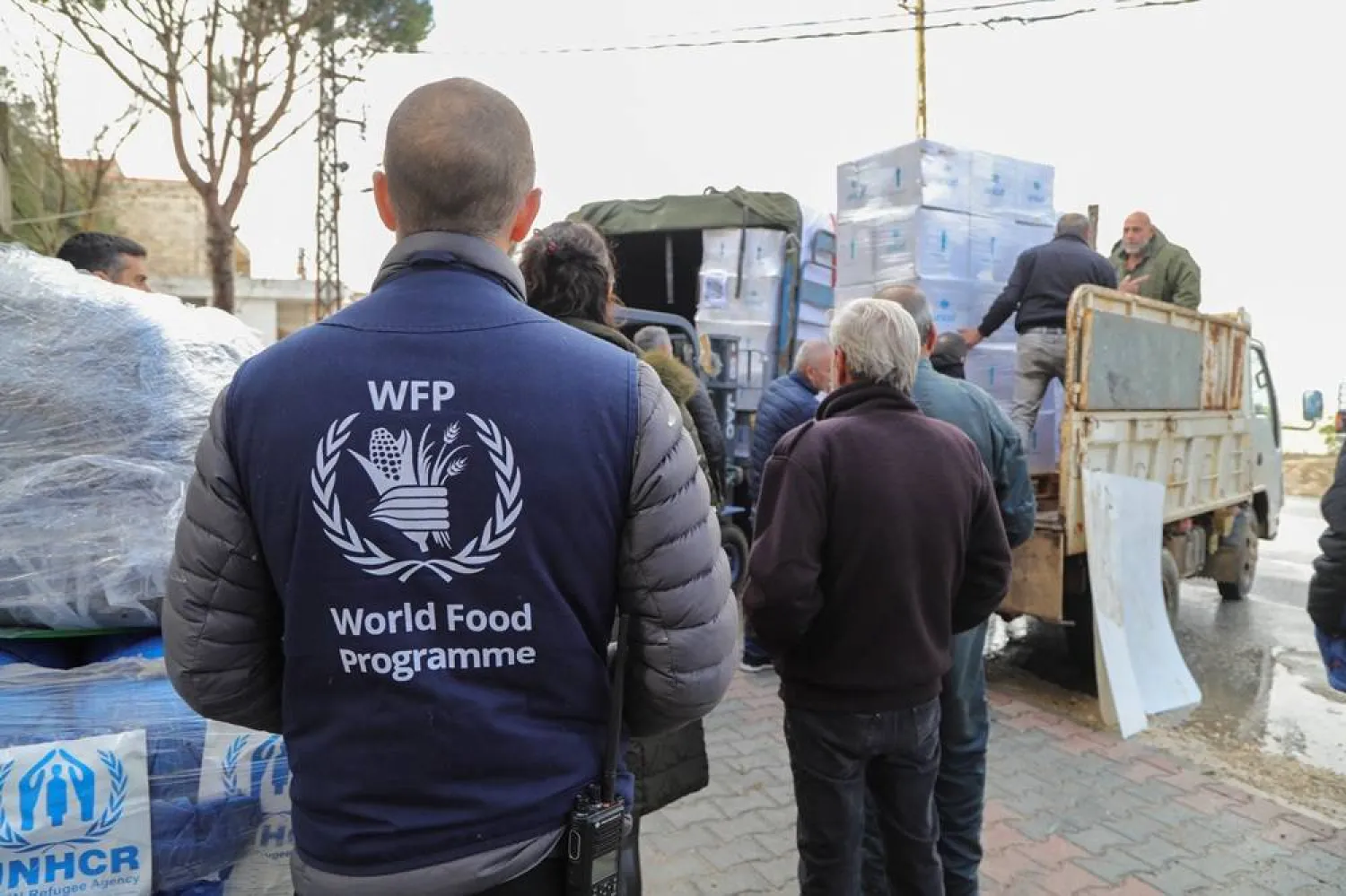
 Aid distributed by the World Food Program, the UNHCR, UNICEF and UNFPA arrives in Qlayaa, amid escalating hostilities between Israel and Hezbollah, as the US-Israel conflict with Iran continues, in southern Lebanon, March 27, 2026. (Reuters)
Aid distributed by the World Food Program, the UNHCR, UNICEF and UNFPA arrives in Qlayaa, amid escalating hostilities between Israel and Hezbollah, as the US-Israel conflict with Iran continues, in southern Lebanon, March 27, 2026. (Reuters)
TT

Aid Groups Warn Iran War Is Hindering Food and Medicine from Reaching Millions

 Aid distributed by the World Food Program, the UNHCR, UNICEF and UNFPA arrives in Qlayaa, amid escalating hostilities between Israel and Hezbollah, as the US-Israel conflict with Iran continues, in southern Lebanon, March 27, 2026. (Reuters)
Aid distributed by the World Food Program, the UNHCR, UNICEF and UNFPA arrives in Qlayaa, amid escalating hostilities between Israel and Hezbollah, as the US-Israel conflict with Iran continues, in southern Lebanon, March 27, 2026. (Reuters)

Aid groups are warning that the war in the Middle East has upended their ability to get food and medicine to millions of people around the world in need, and that the suffering will deepen if the violence continues.

Not only has the conflict cut off vital shipping routes, creating a global energy crisis, it’s also disrupting supply chains for aid groups, forcing them to use costlier, more time-consuming routes.

Key pathways such as the Strait of Hormuz have been effectively shuttered and routes from strategic hubs such as Dubai, Doha and Abu Dhabi have also been impacted. Transport costs have spiked with higher fuel and insurance rates, meaning less supplies can be delivered with the same amount of money.

The World Food Program says it has tens of thousands of metric tons of food heavily delayed in transit. The International Rescue Committee has $130,000 worth of pharmaceuticals intended for war-torn Sudan stranded in Dubai and nearly 670 boxes of therapeutic food meant for severely malnourished children in Somalia stuck in India. The UN Population Fund says it's delayed sending equipment to 16 countries.

Steep US cuts to foreign aid already had hobbled many aid groups, who say the war is exacerbating the problem.

The United Nations says this is the most significant supply chain disruption since COVID, with up to a 20% cost increase on shipments and delays as goods are rerouted. And the war is creating new emergencies, such as in Iran, and also in Lebanon where at least one million people have been displaced.

“The war on Iran and disruption to the Strait of Hormuz risk pushing humanitarian operations beyond their limits," said Madiha Raza, associate director for public affairs and communications for Africa for the International Rescue Committee.

Even when the fighting stops, the shock to global supply chains could continue to delay lifesaving aid for months, she said.

Longer and more costly routes

The war has forced organizations to find new ways to transport goods, with some bypassing the Strait of Hormuz and the Suez Canal and rerouting vessels around Africa, adding weeks to the delivery.

Others are using a hybrid of methods, including land, sea and air, increasing costs.

Jean-Cedric Meeus, chief of global transport and logistics for UNICEF, said his agency is using a mix of land and air routes to send vaccines to Nigeria and Iran in order to get them there in time for the vaccination campaigns, but the costs have soared.

Before the war, UNICEF sent vaccines to Iran by plane directly from vendors around the world. Now it’s flying the vaccines to Türkiye and driving them into Iran, which has increased costs by 20% and has added 10 days to the delivery time, he said.

Save the Children International, which would normally send supplies by ocean freight from Dubai to Port Sudan, will now have to truck the goods from Dubai through Saudi Arabia and then by barge across the Red Sea, it said. The route adds 10 days and increases costs by about 25%, at a time when over 19 million Sudanese face acute food insecurity. The delay puts more than 90 primary health care facilities across Sudan at risk of running out of essential medicines, it said.

The spike in prices also means organizations have to choose what to prioritize.

“In the end, you sacrifice either the number of children that you serve ... or you sacrifice the number of items that you can afford to buy,” said Janti Soeripto, president of Save the Children for the United States. The group said it has stockpiles in countries where it works but some of those could run out within weeks.

Rising costs are also impacting people's ability to seek help within their countries.

Doctors Without Borders said rising fuel prices across Somalia — where some 6.5 million people are experiencing acute food insecurity — have driven up transport and food costs, making it harder for people to get care. In Nigeria, the IRC says fuel prices have surged by 50% and clinics are struggling to power equipment, such as generators and mobile health teams have scaled back operations.

Hunger crisis could deepen

One of the biggest concerns is the impact the war will have on global hunger.

WFP warns that if the conflict continues through June, 45 million more people will be acutely hungry, adding to nearly 320 million people facing hunger around the world.

Some 30% of the world's fertilizer comes through the Strait of Hormuz and with planting season ahead in areas like East Africa and South Asia, small farmers in poor countries will be hard hit. Sudan imports more than half its fertilizer from the Gulf and Kenya approximately 40% from there, aid groups say.

The UN secretary-general has established a task force to facilitate fertilizer trade — modeled on the Black Sea Grain Initiative. But aid groups say that won't be enough. If there's no ceasefire, governments need to provide more funding for organizations to respond to the rising costs, they say.

Humanitarian experts say there's been a slower international response to fund aid during this war compared to previous conflicts like Ukraine, which could reflect growing pressure to invest in security over aid at a time when the world is in turmoil.

“They’re making hard choices between defense security and humanitarian aid,” said Sam Vigersky, an international affairs fellow at the Council on Foreign Relations who has written about the war’s impact on aid.

He said when the US goes to war, it normally has provisions for aid, but hasn't been “activating” those provisions. “It’s not a capacity issue, it’s a policy decision,” he said.

Tommy Pigott, principal deputy spokesperson for the US State Department, said that the US has been the “most generous country in the world" when it comes to humanitarian aid.

The department said it's releasing an additional $50 million in emergency assistance to Lebanon, including to the World Food Program and working closely with the United Nations and others to address the humanitarian needs.



Israel Says Haifa Residential Building Suffers Direct Hit in Iran Attack

 Israeli security forces and rescue teams work amid the rubble of a residential building struck by an Iranian missile in Haifa, Israel, Sunday, April 5, 2026. (AP)
Israeli security forces and rescue teams work amid the rubble of a residential building struck by an Iranian missile in Haifa, Israel, Sunday, April 5, 2026. (AP)
TT

Israel Says Haifa Residential Building Suffers Direct Hit in Iran Attack

 Israeli security forces and rescue teams work amid the rubble of a residential building struck by an Iranian missile in Haifa, Israel, Sunday, April 5, 2026. (AP)
Israeli security forces and rescue teams work amid the rubble of a residential building struck by an Iranian missile in Haifa, Israel, Sunday, April 5, 2026. (AP)

The Israeli military and medics said on Sunday that a missile fired from Iran hit a residential building in the northern city of Haifa, injuring four people.

The building was hit by a "direct impact of a missile", the military told AFP. When asked if it was a missile fired from Iran, it said: "Yes."

The strike occurred minutes after the military warned it had detected a new round of missiles fired from Iran.

In a separate statement, Israel's emergency service, Magen David Adom, said four people were wounded when a seven-storey building sustained a direct hit.

Images and footage published by MDA show smoke rising from the remains of a flattened building in a densely populated area, and stretchers laid on the road by rescuers for casualties.

The injured included an 82-year-old man, MDA said, adding that he was in a "serious condition".

He was "wounded by a heavy object and the blast", the MDA said, adding that the other three suffered shrapnel and blast injuries.

MDA paramedic Shevach Rothenshtrych quoted residents saying that there were casualties trapped under the rubble on the lower floors, and the 82-year-old was rescued after first responders "managed to move large pieces of concrete with our hands".

His colleague Tal Shustak said that when emergency calls were received, "we were dispatched in large forces to the scene and saw extensive destruction, including glass, smoke and concrete scattered across the ground".


China Ready to Cooperate With Russia to Ease Middle East Tension, Foreign Minister Says

 Russian Foreign Minister Sergei Lavrov speaks during a joint news conference with Egyptian Foreign Minister Badr Abdelatty following their meeting in Moscow, Russia April 3, 2026. (Pavel Bednyakov/Pool via Reuters)
Russian Foreign Minister Sergei Lavrov speaks during a joint news conference with Egyptian Foreign Minister Badr Abdelatty following their meeting in Moscow, Russia April 3, 2026. (Pavel Bednyakov/Pool via Reuters)
TT

China Ready to Cooperate With Russia to Ease Middle East Tension, Foreign Minister Says

 Russian Foreign Minister Sergei Lavrov speaks during a joint news conference with Egyptian Foreign Minister Badr Abdelatty following their meeting in Moscow, Russia April 3, 2026. (Pavel Bednyakov/Pool via Reuters)
Russian Foreign Minister Sergei Lavrov speaks during a joint news conference with Egyptian Foreign Minister Badr Abdelatty following their meeting in Moscow, Russia April 3, 2026. (Pavel Bednyakov/Pool via Reuters)

China is willing to continue to cooperate with Russia at the UN Security Council and make efforts to cool down the Middle East situation, Foreign Minister Wang Yi told his Russian counterpart Sergei Lavrov in a phone call on Sunday. 

Wang said the fundamental way to resolve navigation issues in the Strait of Hormuz is to achieve a ‌ceasefire as soon ‌as possible, adding that China has ‌always ⁠advocated political settlement of ⁠hotspot issues through dialogue and negotiation. 

The foreign ministers' call came ahead of a UN Security Council vote next week on a Bahraini resolution to protect commercial shipping in and around the Strait of Hormuz. 

As permanent ⁠UNSC members, China and Russia ‌should "adopt an objective and balanced ‌approach and seek to win greater understanding and ‌support from the international community," Wang told Lavrov, ‌according to a statement from his ministry. 

A Russian Foreign Ministry statement said the ministers discussed ways to achieve a rapid ceasefire and "launch a political-diplomatic dialogue." 

"Satisfaction ‌was expressed at the coincidence in Russia's and China's approaches on most ⁠issues ⁠on the global agenda, including the situation around Iran, related to the unprovoked aggression of the US and Israel against that country," it said. 

China has repeatedly called for a ceasefire in the Gulf region and Middle East, urging an end to the fighting that has run for more than a month and largely closed the Strait of Hormuz, a critical shipping artery for oil and gas. 


Migrants Missing after Mediterranean Capsize: NGOs

Hellenic coast guard performs SAR operation, following migrant's boat collision with coast guard off the Aegean island of Chios, near Mersinidi, Greece, February 4, 2026. REUTERS
TT

Migrants Missing after Mediterranean Capsize: NGOs

Hellenic coast guard performs SAR operation, following migrant's boat collision with coast guard off the Aegean island of Chios, near Mersinidi, Greece, February 4, 2026. REUTERS

Dozens of people are missing after a migrant boat capsized in the central Mediterranean, the NGOs Mediterranea Saving Humans and Sea-Watch said Sunday on social media.

Two people died and 32 were rescued from the boat, which had left Libya on Saturday afternoon with around 105 people on board, according to Mediterranea Saving Humans, AFP reported.

"Tragic Easter shipwreck. 32 survivors, two bodies recovered and more than 70 people missing," the NGO wrote on X, adding that the boat capsized in a search-and-rescue zone handled by Libyan authorities.

Sea-Watch said two commercial ships saved the survivors and took them to the Italian island of Lampedusa.

An aerial video it posted showed two men clinging to the hull of the capsized vessel, and the approach of one of the commercial ships.

Mediterranea Saving Humans said the accident was "the consequence of policies by European governments that refuse to open safe and legal pathways" for migrants.

Lampedusa is a key entry point for migrants crossing the Mediterranean from North Africa to Europe.

Since the start of 2026, at least 683 migrants have lost their lives or gone missing on attempts to cross the sea, according to the UN's migration agency IOM.

According to the Italian government, 6,175 migrants arrived on Italian territory over the same period.