


Attempted Abduction of Qassam Fighters Ends in Deadly Clashes in Central Gaza

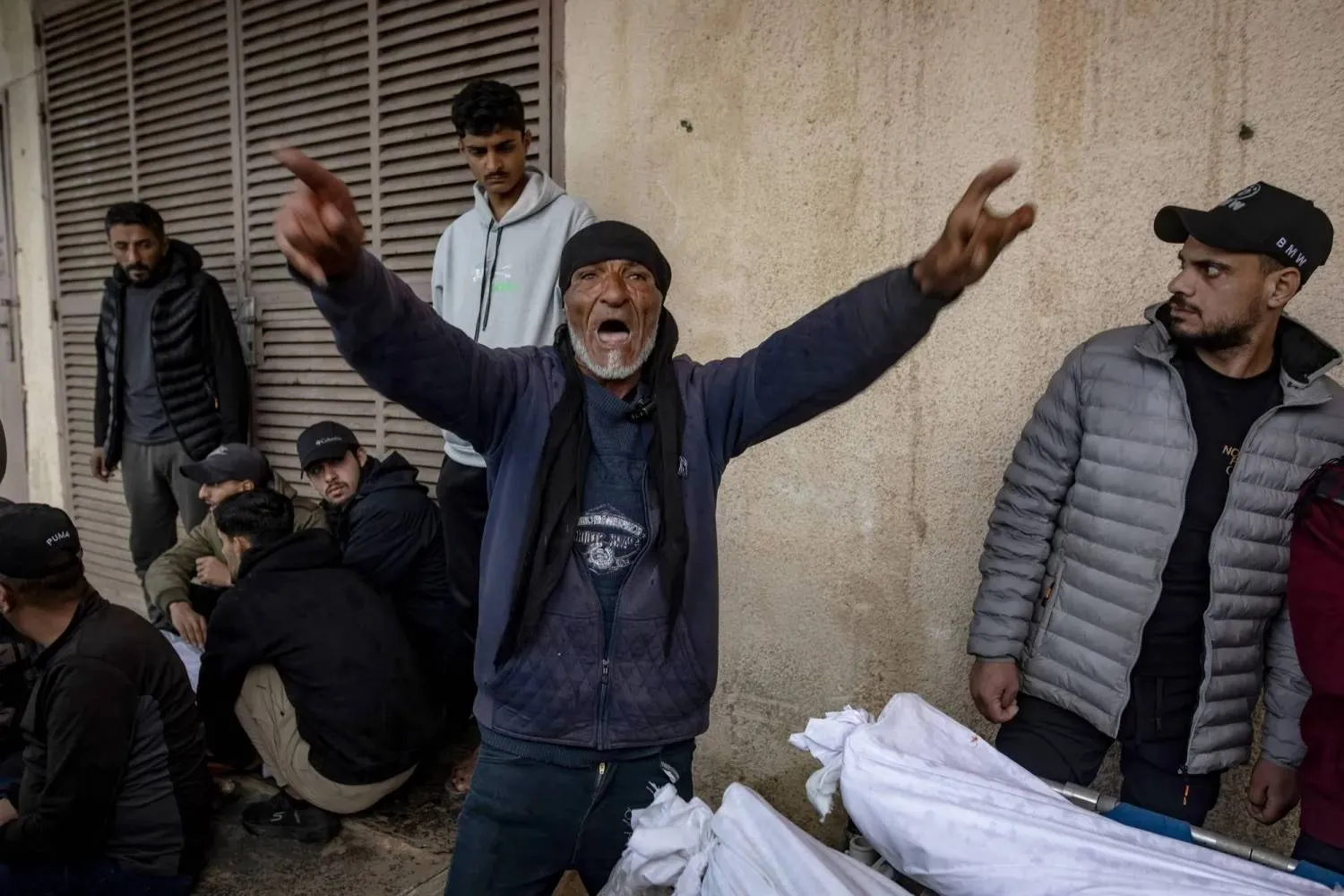
Palestinians stand by the bodies of victims of an Israeli airstrike in central Gaza on Tuesday. (EPA)
TT

Attempted Abduction of Qassam Fighters Ends in Deadly Clashes in Central Gaza

Palestinians stand by the bodies of victims of an Israeli airstrike in central Gaza on Tuesday. (EPA)

An attempt by members of an armed group aligned with Israel to abduct operatives from the Izz ad-Din al-Qassam Brigades, the military wing of Hamas, in central Gaza left at least 10 Palestinians dead and about 15 wounded, according to field sources.

A source from an armed faction in Gaza said fighters from a group led by Shawqi Abu Nasira tried to lure Qassam operatives into an ambush on Monday evening near a school sheltering displaced people east of the Maghazi refugee camp.

The situation escalated into clashes, the source said, followed by Israeli intervention using drones and military vehicles positioned along what is known locally as the “yellow line,” separating Hamas-controlled areas from Israel. The intervention provided cover for the attackers, the source added.

At least 10 Palestinians were killed, including two who later died of their wounds, and around 15 others were injured, some critically. Multiple sources said the attackers failed to abduct any Qassam members.

Another field source from a faction close to Hamas said a member of the armed group who recently surrendered to Hamas security is suspected of acting as a double agent and orchestrating the ambush. The suspect allegedly lured Qassam operatives to the area under the pretext that rival fighters were planning an attack.

The source added that the “alertness” of Qassam fighters prevented the abduction attempt and led to clashes, with additional fighters already deployed nearby in anticipation of such an attack.

Three Hamas field sources in central Gaza declined to confirm that account but agreed that an abduction attempt had taken place.

One of the sources said the attackers took advantage of the dense civilian presence in the area, a few hundred meters west of the “yellow line.” Although the operation failed, families reported that two civilians were abducted, the source added.

Hamas-affiliated sources estimated the number of attackers at around 30, saying Israeli support and heavy firepower prevented significant casualties among them. There was no independent confirmation of deaths among the attackers.

Abu Nasira, a former Palestinian security officer and freed prisoner, leads a group that operates in northeastern Khan Younis and parts of central Gaza. Despite its relatively recent emergence, the group has expanded its activities and has been linked to several assassination attempts targeting Qassam members and Hamas security personnel.

Separately, the World Health Organization said it had suspended medical evacuations from Gaza to Egypt via the Rafah crossing for a second day after an Israeli strike killed a contracted driver despite his having a permit to pass near Bani Suheila in eastern Khan Younis.

WHO Director-General Tedros Adhanom Ghebreyesus said two staff members were present but unharmed, adding that the incident was under investigation and calling for the protection of civilians and humanitarian workers.



Nawaf Salam Asks Pakistani Counterpart to Ensure Lebanon Included in Ceasefire Deal

FILED - 16 February 2026, Lebanon, Beirut: Lebanese Prime Minister Nawaf Salam is pictured during a meeting at the Prime Minister's office. Photo: Markus Lenhardt/dpa
TT

Nawaf Salam Asks Pakistani Counterpart to Ensure Lebanon Included in Ceasefire Deal

FILED - 16 February 2026, Lebanon, Beirut: Lebanese Prime Minister Nawaf Salam is pictured during a meeting at the Prime Minister's office. Photo: Markus Lenhardt/dpa

Lebanese Prime Minister Nawaf Salam on Thursday asked his Pakistani counterpart, Shehbaz Sharif, to affirm that the ceasefire should include Lebanon, according to the German news agency (dpa).

In a phone call with Sharif, Salam “requested confirmation that the ceasefire must cover Lebanon, to prevent a repeat of the Israeli attacks witnessed yesterday,” a statement said.

Salam also praised the “efforts undertaken by the Pakistani prime minister that led to the ceasefire.”

For his part, Pakistan’s prime minister condemned the “recent Israeli attacks on Lebanon,” stressing that his country is working to help secure peace and stability there.


Israel Says Will Continue to Strike Hezbollah 'Wherever Necessary'

People inspect the aftermath of a building destroyed in an Israeili airstrike in the Corniche el-Mazraa neighborhood of Beirut, Lebanon, 09 April 2026. EPA/WAEL HAMZEH
TT

Israel Says Will Continue to Strike Hezbollah 'Wherever Necessary'

People inspect the aftermath of a building destroyed in an Israeili airstrike in the Corniche el-Mazraa neighborhood of Beirut, Lebanon, 09 April 2026. EPA/WAEL HAMZEH

Prime Minister Benjamin Netanyahu said on Thursday that Israel would keep hitting Hezbollah "wherever necessary,” the day after Israeli strikes pummeled Lebanon.

"We are continuing to strike Hezbollah with force, precision, and determination," Netanyahu said on his personal X account.

"Our message is clear: anyone who acts against Israeli civilians -- we will strike them. We will continue to hit Hezbollah wherever necessary, until we fully restore security to the residents of the north" of Israel, he added.

Israeli strikes hit busy commercial and residential areas in central Beirut without warning on Wednesday, hours after a ceasefire was announced in the US-Israeli war with Iran.

Lebanon said at least 203 people were killed and hundreds were wounded, making it the deadliest day in the latest Israel-Hezbollah war.


People walk among the debris of cars and a building destroyed in an Israeili airstrike in the Corniche el-Mazraa neighborhood of Beirut, Lebanon, 09 April 2026. EPA/WAEL HAMZEH


US President Donald Trump told PBS News Hour that Lebanon was not included in the deal because of Hezbollah. When asked about Israel’s latest strikes, he said, “That’s a separate skirmish.”

Israel had said the agreement does not extend to its war with the Iran-backed Hezbollah, although Iran and mediator Pakistan said it does.

There was no sign of Hezbollah launching strikes against Israel in the first couple of hours after the attacks.

In response to the attacks on Lebanon, Iran later Wednesday said it was again halting the movement of oil tankers in the Strait of Hormuz, the country's state-run media reported.

Lebanon's health minister said at least 1,000 people were wounded in Wednesday's strikes.

The death toll was the highest for a single day in Lebanon during more than five weeks of renewed war between Israel and Hezbollah.

Israel said Thursday it killed Ali Yusuf Harshi, an aide to Hezbollah leader Naim Qassem. 


Calls for US-Iran Truce to Extend to Lebanon after Israeli Strikes

Smoke rises following an Israeli airstrike on a building in Beirut, Lebanon, on April 8, 2026. Hassan Ammar, AP
TT

Calls for US-Iran Truce to Extend to Lebanon after Israeli Strikes

Smoke rises following an Israeli airstrike on a building in Beirut, Lebanon, on April 8, 2026. Hassan Ammar, AP

Calls were mounting on Thursday for the ceasefire between the US and Iran to be extended to Israel's war with Hezbollah, after a massive wave of Israeli strikes on Lebanon killed more than 200 people. 

US President Donald Trump has claimed victory in the Middle East war after agreeing a two-week truce to allow talks to end a conflict that has killed thousands and plunged the global economy into turmoil. 

But the future of the negotiations was in limbo on Thursday after Iran denounced Israel's ongoing raids on Lebanon, and Tehran's ambassador to Pakistan deleted a social media post saying an Iranian delegation would arrive in Islamabad, which was set to host the talks. 

An official at the Iranian embassy in Islamabad told AFP that Ambassador Reza Amiri Moghadam's post was removed "because of some issues" and declined to say whether the delegation was still expected. 

At least 203 people were killed and 1,000 wounded in Israeli strikes on Wednesday, the Lebanese health ministry said. 

There had been conflicting diplomatic signals about whether the fighting in Lebanon was included in the US-Iran truce -- but Washington said that it was not and Israel made it clear that it has no intention of holding off. 

"We are continuing to strike Hezbollah with force, precision, and determination," Israel's Prime Minister Benjamin Netanyahu said, in a social media post. 

"Our message is clear: anyone who acts against Israeli civilians, we will strike them. We will continue to hit Hezbollah wherever necessary." 

- 'Running left and right' - 

But, amid fears that the fragile truce could break down in the Gulf, there were international calls for the ceasefire to encompass Lebanon. 

"Israeli actions are putting the US-Iran ceasefire under severe strain. The Iran truce should extend to Lebanon," the European Union's top diplomat Kaja Kallas said. 

France's foreign minister Jean-Noel Barrot condemned the strikes as "unacceptable", while his British counterpart Yvette Cooper called for the ceasefire to include Lebanon. 

The Lebanese prime minister's office said Thursday would be "a national day of mourning for the martyrs and wounded of the Israeli attacks that targeted hundreds of innocent, defenseless civilians". 

Hezbollah said it had fired rockets towards Israel in response to what it called a violation of the truce. 

US Vice President JD Vance backed Israel in saying Lebanon was excluded from the truce, days before he was due to lead talks with Tehran in Pakistan. 

"If Iran wants to let this negotiation fall apart... over Lebanon, which has nothing to do with them, and which the United States never once said was part of the ceasefire, that's ultimately their choice," he said. 

But Iran's speaker of parliament Mohammad Bagher Ghalibaf appeared to threaten the ceasefire, posting on X that the "workable basis on which to negotiate" had already been violated, making further talks "unreasonable". 

Ghalibaf listed three alleged US violations of the truce plan: the continued attacks in Lebanon, a drone entering Iranian airspace and Washington's opposition to the country's right to uranium enrichment. 

UN rights chief Volker Turk called the scale of killing in Lebanon "horrific", after strikes across the capital Beirut that came without warning triggered horror and panic. 

"People started running left and right, and smoke was billowing," said Ali Younes, who was waiting for his wife near Corniche Al-Mazraa, one of the areas targeted. 

- High-stakes talks - 

The bellicose rhetoric came ahead of high-stakes talks in Pakistan expected on Friday or Saturday. 

A key point of contention remains the Strait of Hormuz, through which a fifth of the world's oil as well as vast quantities of natural gas and fertilizer pass in peacetime. 

Iran announced alternative routes on Thursday for ships travelling through the strait, citing the risk of sea mines. 

But it was unclear if Tehran was in practice allowing vessels to pass through the strait, following reports on Wednesday suggesting it was shut -- something the White House called "completely unacceptable". 

Pakistani Prime Minister Shehbaz Sharif, whose country mediated the ceasefire, called in a social media post for all parties to "exercise restraint and respect the ceasefire for two weeks" to allow diplomacy to take hold. 

Further casting doubt on the truce's durability, Iranian state media announced fresh missile and drone attacks against US-allied Gulf states in retaliation for airstrikes on its oil facilities, with Kuwait, the UAE, Saudi Arabia and Bahrain all reporting strikes since the ceasefire took effect. 

In Tehran, streets were quieter than usual on Wednesday, with many shops closed after a long and anxious night for residents fearing a massive US attack. 

"Everyone is at ease now," said Sakineh Mohammadi, a 50-year-old housewife, adding she was proud of her country: "We are more relaxed."