


US-Iran Direct Talks Begin in Pakistan as War’s Fragile Ceasefire Holds

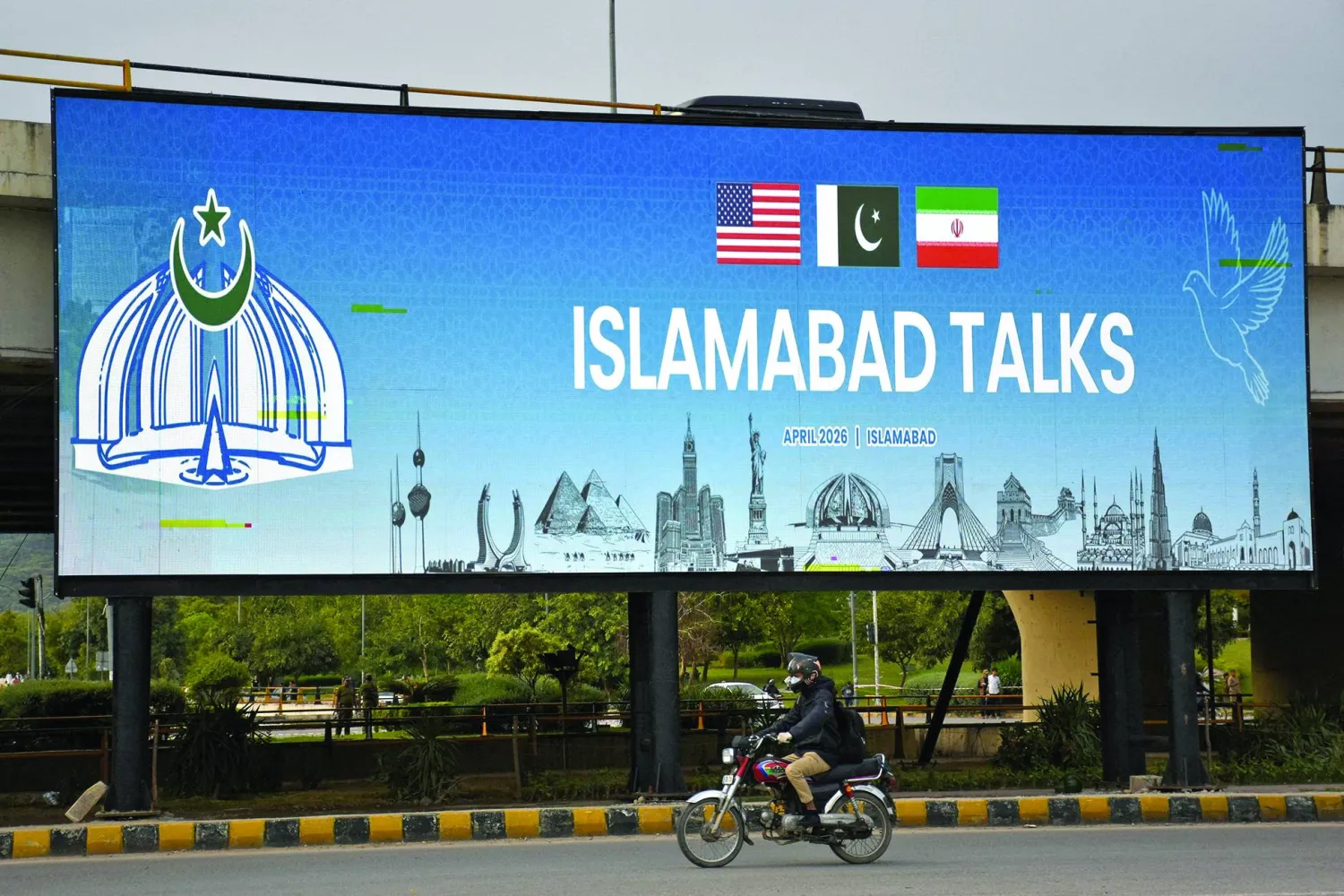
A man rides his motorbike past a billboard installed alongside a road as Pakistan prepares to host the US and Iran for peace talks, in Islamabad, Pakistan, April 10, 2026. REUTERS/Waseem Khan
TT

US-Iran Direct Talks Begin in Pakistan as War’s Fragile Ceasefire Holds

A man rides his motorbike past a billboard installed alongside a road as Pakistan prepares to host the US and Iran for peace talks, in Islamabad, Pakistan, April 10, 2026. REUTERS/Waseem Khan

The United States and Iran began face-to-face negotiations Saturday in Pakistan, days after a fragile, two-week ceasefire was announced, as the war that has killed thousands of people and shaken global markets entered its seventh week. 

The White House confirmed the direct nature of the talks. Iran's state-run news agency said three-party talks had begun after Iranian preconditions, including a reduction in Israeli strikes on southern Lebanon, were met, and after US and Iranian officials met separately with Pakistani Prime Minister Shehbaz Sharif. 

The US delegation led by Vice President JD Vance and the Iranian delegation led by Parliament Speaker Mohammad Bagher Qalibaf were discussing how to advance the ceasefire already threatened by deep disagreements and Israel's continued attacks against the Iranian-backed Hezbollah in Lebanon. 

“I cannot say whether they are sitting in the same room or in separate rooms, but talks have started and are progressing well,” said one Pakistani official with knowledge of the peace efforts, speaking on condition of anonymity because they were not authorized to talk to the media. 

Iran sets ‘red lines’ including compensation for strikes 

Iran doubled down on parts of its earlier proposal, with its delegation telling Iranian state television it had presented some of the plan’s ideas as “red lines” in meetings with Sharif. Those included compensation for damage caused by the US-Israeli strikes that launched the war on Feb. 28 and releasing Iran’s frozen assets. 

The war has killed at least 3,000 people in Iran, 1,953 in Lebanon, 23 in Israel and more than a dozen in Gulf Arab states, and caused lasting damage to infrastructure in half a dozen Middle Eastern countries. Iran's chokehold on the vital Strait of Hormuz has largely cut off the Gulf and its oil and gas exports from the global economy, sending energy prices soaring. 

Reflecting the high stakes, officials from the region said Chinese, Egyptian, Saudi and Qatari officials were in Islamabad to indirectly facilitate the talks. The officials spoke on condition of anonymity to discuss the sensitive matter. 

In Tehran, residents told The Associated Press they were skeptical yet hopeful about the talks after weeks of airstrikes left destruction across their country of some 93 million people. Some said the path to recovery would be long. 

“Peace alone is not enough for our country, because we’ve been hit very hard, there have been huge costs,” 62-year-old Amir Razzai Far said. 

Meanwhile, Israel pressed ahead with strikes in Lebanon after saying there is no ceasefire there. Iran and Pakistan have disagreed. The Lebanese state-run news agency reported at least three people killed. 

Officials posture over key issues ahead of talks  

President Donald Trump ahead of the talks accused Iran of using the Strait of Hormuz, a key artery for global energy supplies, for extortion, and told reporters Friday it would be opened “with or without them.” 

Iran’s closure of the strait has proved its biggest strategic advantage in the war. Around a fifth of the world’s traded oil had typically passed through on over 100 ships a day. Only 12 have been recorded transiting since the ceasefire. 

Iran has floated the idea of charging ships, though the idea has been widely rejected by countries including the United States and Iran’s neighbor Oman. 

On Saturday, Trump said on social media that the US had begun “clearing out” the strait, but it was unclear whether he was referring to the reported use of mines there or Iran’s broader ability to control the area. 

Iranian Foreign Minister Abbas Araghchi had said Tehran was entering negotiations with “deep distrust” after strikes on Iran during previous rounds of talks. Araghchi, part of Iran’s delegation in Pakistan, said Saturday that his country was prepared to retaliate if attacked again. 

Iran and the United States outlined competing proposals ahead of the talks. 

Iran’s 10-point proposal called for a guaranteed end to the war and sought control over the Strait of Hormuz. It included ending fighting against Iran’s “regional allies,” explicitly calling for a halt to Israeli strikes on Hezbollah. 

The United States’ 15-point proposal includes restricting Iran’s nuclear program and reopening the strait. 

Israel and Lebanon will have direct negotiations  

Negotiations between Israel and Lebanon are expected to begin Tuesday in Washington, Lebanese President Joseph Aoun’s office said Friday, after Israel's surprise announcement authorizing talks despite the countries lack of official relations. 

Israel wants the Lebanese government to assume responsibility for disarming Hezbollah, much like was envisaged in a November 2024 ceasefire. But it is unclear whether Lebanon's army can confiscate weapons from the armed group, which has survived efforts to curb its strength for decades. 

Israel’s insistence that the ceasefire in Iran does not include a pause in its fighting with Hezbollah has threatened to sink the deal. The group joined the war in support of Iran in the opening days. Israel followed up with airstrikes and a ground invasion. 

The day the Iran ceasefire deal was announced, Israel pounded Beirut with airstrikes, killing more than 300 people in the deadliest day in Lebanon since the war began, according to the country's Health Ministry. 

Energy pressures grow 

The spot price of Brent crude, the international standard for oil prices, was above $94 on Saturday, up more than 30% since the war started. 

And new pressures emerged in Europe for travelers. 

The head of Airports Council International-Europe, Olivier Jankovec, warned the European Union that a ″systemic jet fuel shortage’’ could come within three weeks because of the blockage of the Strait of Hormuz. 

Jankovec said in a letter obtained by The Associated Press that the crunch could impact the summer travel season and ″significantly harm the European economy.’′ 


Russia Says Downed 419 Ukrainian Drones

A woman walks past Russian security personnel standing guard in central Moscow, Russia June 29, 2026. (Reuters)
TT

Russia Says Downed 419 Ukrainian Drones

A woman walks past Russian security personnel standing guard in central Moscow, Russia June 29, 2026. (Reuters)

Russia shot down 419 Ukrainian drones across the country overnight, the defense ministry said Tuesday.

Kyiv has stepped up its long-range drone strike campaign against Russia in recent months, particularly against energy infrastructure to target a vital source of the Kremlin's revenue to fund its war effort, now in its fifth year.

Air defense systems "intercepted and destroyed 419 Ukrainian fixed-wing unmanned aerial vehicles" around the country, the defense ministry posted on the state-run Max platform.

It did not say if there were any deaths or injuries.

Moscow's Mayor Sergey Sobyanin said earlier that air defense forces had shot down 50 "enemy drones" overnight headed for the capital.

The swarm came days after Russia shot down 660 Ukrainian drones between Thursday and Friday, one of the highest figures since the start of the conflict.

A Ukrainian attack also caused a fire last week at a refinery in the southeast of Moscow.


Two Revolutionary Guards Killed in Attack by Unknown Gunmen in Western Iran

A handout photo made available by Sepahnews shows members of the Iranian Revolutionary Guard Corps (IRGC) during a military drill around the capital city of Tehran, Iran, 12 May 2026.  (EPA/Handout)
A handout photo made available by Sepahnews shows members of the Iranian Revolutionary Guard Corps (IRGC) during a military drill around the capital city of Tehran, Iran, 12 May 2026. (EPA/Handout)
TT

Two Revolutionary Guards Killed in Attack by Unknown Gunmen in Western Iran

A handout photo made available by Sepahnews shows members of the Iranian Revolutionary Guard Corps (IRGC) during a military drill around the capital city of Tehran, Iran, 12 May 2026.  (EPA/Handout)
A handout photo made available by Sepahnews shows members of the Iranian Revolutionary Guard Corps (IRGC) during a military drill around the capital city of Tehran, Iran, 12 May 2026. (EPA/Handout)

Two members of Iran's Revolutionary Guards were killed and two ‌others wounded ‌in what the ‌Guards ⁠described as a "terrorist" ⁠shooting in the western province of ⁠Kermanshah on ‌Monday ‌evening, state ‌media ‌reported on Tuesday.

The attackers opened fire outside ‌the Guards members' home and ⁠authorities ⁠were investigating to identify those responsible, state media reported.


Satellite Data: Over 58,000 Buildings Likely Damaged or Destroyed in Venezuela

Rescue workers search for survivors among the rubble following two earthquakes with magnitudes of 7.2 and 7.5 in Catia La Mar, La Guaira state, Venezuela, 29 June 2026. EPA/Henry Chirinos
TT

Satellite Data: Over 58,000 Buildings Likely Damaged or Destroyed in Venezuela

Rescue workers search for survivors among the rubble following two earthquakes with magnitudes of 7.2 and 7.5 in Catia La Mar, La Guaira state, Venezuela, 29 June 2026. EPA/Henry Chirinos

The powerful twin earthquakes that struck Venezuela last week damaged or destroyed more than 58,000 buildings, according to a preliminary assessment of satellite data published by US space agency NASA.

Some 1,700 people were killed and thousands remain missing following the quakes of magnitude 7.2 and 7.5 -- the strongest to hit the South American nation in more than a century.

"Approximately 58,870 buildings were likely damaged or destroyed across the affected region" based on satellite radar data gathered on June 25, the day after the earthquakes, according to researchers Corey Scher and Jamon Van Den Hoek of Oregon State University.

The duo were citing data from the European Space Agency's high-resolution radar imagery satellite Sentinel-1, AFP reported.

"This is a preliminary, rapid assessment. It reflects abrupt surface change consistent with damage," the researchers wrote, adding that the figure should only be read as an indicator and was not verified on the ground.

National Assembly President Jorge Rodriguez reported on Monday that 855 buildings have been damaged, including 189 "total collapses."

NASA said that its satellites were "providing critical support, capturing imagery and data to help teams on the ground assess impacts and guide response efforts."
