


Iranians Look at Pakistan Talks with Mixture of Skepticism, Outright Fear

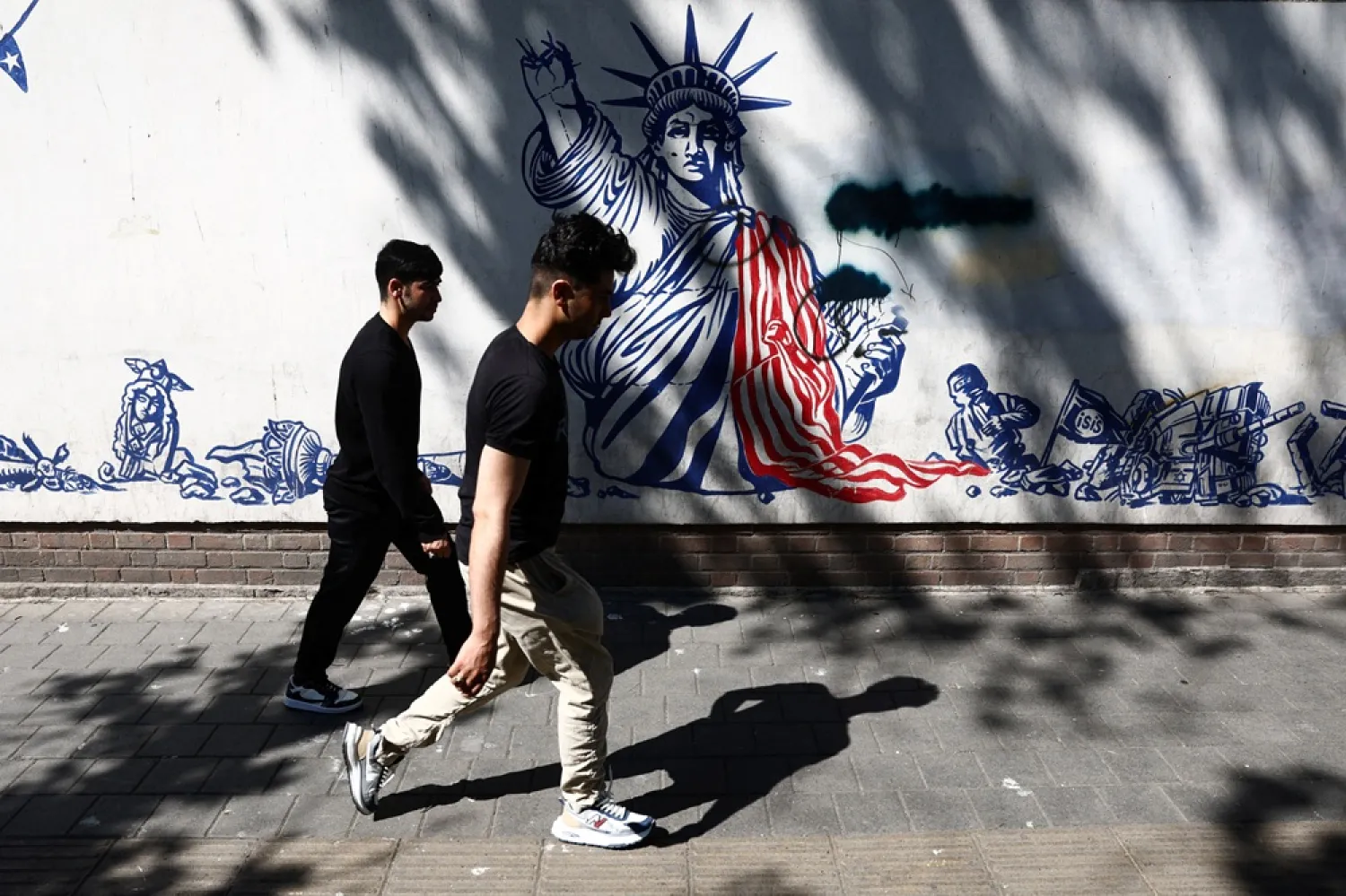
People walk past an anti-US mural on a street in Tehran, Iran, April 10, 2026. Majid Asgaripour/WANA (West Asia News Agency) via Reuters
TT

Iranians Look at Pakistan Talks with Mixture of Skepticism, Outright Fear

People walk past an anti-US mural on a street in Tehran, Iran, April 10, 2026. Majid Asgaripour/WANA (West Asia News Agency) via Reuters

Everyday Iranians are awaiting planned negotiations between Washington and Tehran with a mixture of skepticism and outright fear, caught between a government they say does not understand peace and an American president who has threatened to destroy a “whole civilization.”

Talks between the US and Iran and hosted by Pakistan were hanging in the balance on Friday, but if they go ahead they could transform a temporary ceasefire in the US-Israeli campaign against the Iranian republic into a lasting peace.

Residents of Tehran contacted by AFP from Paris – who withheld their surnames out of concern for their safety – have mixed views on that prospect and are far from optimistic, with feelings ranging from anger, to anxiety, to deep disillusionment.

Amir, a 40-year-old artist, said he did not “think this temporary agreement and negotiation will last even a week.”

Iran’s repressive apparatus is seen as having been strengthened by the war that broke out on Feb 28, making a deal all the more unlikely, according to Amir.

“The propaganda machine has delivered them such lies that they really believe they have won the war,” he said. “They cannot last in peace because they don’t understand peace.”

For Sheida, 38, the uncertainty around the talks has generated a sense of anxiety.

“We’ve got so much hardship dumped on us that we don’t even know what to worry about first,” she said. “Now that the ceasefire has started, everyone’s scrambling to settle debts and sort out financial stuff.”

A choice between the return of terrifying US-Israeli airstrikes and the preservation of the Iranian republic’s long-standing system is no choice at all, according to Sheida.

“I am scared of the war starting again, and at the same time I’m scared of the regime staying,” she said, adding that “the people in power have become even more aggressive.”

Amir said if the talks do result in an agreement, he continued, it would likely do little to serve the Iranian people.

He pointed to anti-government protests just before the war that were met with a deadly crackdown, saying he and other like-minded Iranians would keep up their opposition, adding: “We will not forgive our murderers.”

Trump’s Shifting Goals

Tehran resident Amin, 30, said it was difficult to determine what US President Donald Trump hoped to accomplish in the talks.

“I guess you shouldn’t take Trump so serious,” Amin said. “He wants to erase a civilization and he makes a ceasefire built on nothing 12 hours later.”

“Most of what he says is just pure noise,” he continued.

Sheida, meanwhile, questioned Trump’s sense of strategy, saying he must be “either crazy or inexperienced.”

“Did the US president really not realize they could get stuck if the Strait of Hormuz was closed?” she said.

Homemaker Shahrzad, 39, said she had been both terrified and disillusioned by Trump’s threat – issued before the ceasefire – that “a whole civilization will die” if Iran did not reopen the strategic Strait of Hormuz.

“I had hoped for the fall of the Islamic regime and accepted the hardships of war, but now I realize this man is playing the whole world and has no sense of humanity.”

Sara, a 44-year-old graphic designer, said Iran’s “government is an ideological one, and it’s not going to collapse easily”.

“Its mindset exists all the way down to the lowest levels, so it’s really not simple to change,” she added.

Amir said he believed the country’s surviving leaders would continue fighting. “They are prepared to destroy everything just to prevail,” he added.



North Korean Leader Kim Backs China’s Push for ‘Multi-polar World’ in Talks with FM

This picture taken on April 10, 2026 and released by North Korea's official Korean Central News Agency (KCNA) on April 11, 2026, shows Chinese Foreign Minister Wang Yi (L) shaking hands with North Korean leader Kim Jong Un at the headquarters of the Workers' Party of Korea in Pyongyang.  (KCNA / KCNA via KNS / AFP)
This picture taken on April 10, 2026 and released by North Korea's official Korean Central News Agency (KCNA) on April 11, 2026, shows Chinese Foreign Minister Wang Yi (L) shaking hands with North Korean leader Kim Jong Un at the headquarters of the Workers' Party of Korea in Pyongyang. (KCNA / KCNA via KNS / AFP)
TT

North Korean Leader Kim Backs China’s Push for ‘Multi-polar World’ in Talks with FM

This picture taken on April 10, 2026 and released by North Korea's official Korean Central News Agency (KCNA) on April 11, 2026, shows Chinese Foreign Minister Wang Yi (L) shaking hands with North Korean leader Kim Jong Un at the headquarters of the Workers' Party of Korea in Pyongyang.  (KCNA / KCNA via KNS / AFP)
This picture taken on April 10, 2026 and released by North Korea's official Korean Central News Agency (KCNA) on April 11, 2026, shows Chinese Foreign Minister Wang Yi (L) shaking hands with North Korean leader Kim Jong Un at the headquarters of the Workers' Party of Korea in Pyongyang. (KCNA / KCNA via KNS / AFP)

North Korean leader Kim Jong Un voiced support for China’s push to build a “multi-polar world” and called for deeper ties between the traditional allies during a meeting with Chinese Foreign Minister Wang Yi, state media said Saturday.

During the meeting Friday, Kim said his government will fully support Chinese efforts to achieve territorial integrity based on its “one-China principle,” a reference to Beijing’s official position that Taiwan is an inalienable part of China’s territory, according to North Korea’s official Korean Central News Agency.

Kim also outlined North Korea’s position on unspecified regional and international issues of “mutual concern” and said sustained development of ties between the two countries has become more crucial in the current geopolitical environment, KCNA said.

Wang, on a two-day trip to North Korea, said the countries’ relations were entering a “new phase” following a summit last year between Kim and Chinese President Xi Jinping.

Embracing the ideas of a “new Cold War” and a “multi-polarized world,” Kim has sought to break out of international isolation and push a more assertive foreign policy by expanding ties with governments locked in confrontations with the United States.

While Russia has been Kim’s top foreign policy priority in recent years, sending thousands of troops and large weapons shipments to support its war against Ukraine, he has also been cozying up to China, the North’s traditional main ally and economic lifeline.

Kim joined Russian President Vladimir Putin at a World War II ceremony in Beijing in September and held his first summit with Xi Jinping in six years, moves that supported his efforts to portray North Korea as part of a united front against Washington.

North Korea and China last month resumed direct flight and passenger train services, which had been suspended since the beginning of the COVID-19 pandemic in 2020.

Wang arrived in Pyongyang on Thursday in his first visit to North Korea in seven years. He earlier met with North Korean Foreign Minister Choe Sun Hui and discussed ways to facilitate further cooperation and exchanges and holding “in-depth” talks on international issues, state media from both countries said.

The state media outlets did not mention whether Wang and North Korean officials discussed issues related to the US or the ongoing war in the Middle East.

Wang’s trip to North Korea came before US President Donald Trump travels to Beijing for a rescheduled summit with Xi Jinping in May. Some South Korean officials have expressed hope the Trump-Xi meeting could provide a diplomatic opening with Pyongyang.

Kim has suspended all meaningful dialogue with the US and South Korea since the collapse of his diplomacy with Trump in 2019 during the American president’s first term. Kim has since taken a hard-line stance toward South Korea, which he now defines as his “most hostile” adversary, and rejected US offers to resume talks, calling on Washington to drop its demand for North Korea’s denuclearization as a precondition.


Taiwan Spotted Chinese Warplanes as Xi Met Opposition Leader in Beijing

 A man uses his smartphone as a giant screen broadcasts news showing Chinese President Xi Jinping shaking hands with Cheng Li-wun, chairperson of the Kuomintang (KMT), Taiwan's largest opposition party at the Great Hall of the People in Beijing, China, April 10, 2026. (Reuters)
A man uses his smartphone as a giant screen broadcasts news showing Chinese President Xi Jinping shaking hands with Cheng Li-wun, chairperson of the Kuomintang (KMT), Taiwan's largest opposition party at the Great Hall of the People in Beijing, China, April 10, 2026. (Reuters)
TT

Taiwan Spotted Chinese Warplanes as Xi Met Opposition Leader in Beijing

 A man uses his smartphone as a giant screen broadcasts news showing Chinese President Xi Jinping shaking hands with Cheng Li-wun, chairperson of the Kuomintang (KMT), Taiwan's largest opposition party at the Great Hall of the People in Beijing, China, April 10, 2026. (Reuters)
A man uses his smartphone as a giant screen broadcasts news showing Chinese President Xi Jinping shaking hands with Cheng Li-wun, chairperson of the Kuomintang (KMT), Taiwan's largest opposition party at the Great Hall of the People in Beijing, China, April 10, 2026. (Reuters)

Taiwan's defense ministry said on ‌Saturday that it spotted 16 Chinese warplanes operating near the island the previous day, around the same time China's president was meeting the Taiwanese opposition leader.

Late on Friday morning, Chinese President Xi Jinping met Cheng Li-wun, chairwoman of Taiwan's largest opposition party the Kuomintang (KMT) in Beijing, where Xi said he "absolutely would not tolerate" independence for Taiwan, which China views as its own territory.

Cheng has portrayed her visit as a reconciliation mission to lessen tensions, and told Xi ‌she looked forward ‌to the KMT and Communist Party advancing ‌the "institutionalization" ⁠of peace across the ⁠Taiwan Strait.

Taiwan's defense ministry, in its daily report on Chinese military activity in the previous 24 hours, said that 16 Chinese warplanes flew near the island from mid-morning to mid-afternoon on Friday. Xi and Cheng met at 11 am (0300GMT).

Shen Yu-chung, a deputy minister at Taiwan's China-policy-making Mainland Affairs ⁠Council, told reporters in Taipei on Saturday that ‌using military coercion against Taiwan as ‌a means of applying pressure for political negotiations has always ‌been China's "go-to tactic".

"So on one hand we see them ‌sending out messages of peace, while on the other hand they continue to use military force to pressure Taiwan without letup," he added.

China's Taiwan Affairs Office did not respond to a ‌request for comment.

In Beijing, KMT Vice Chairman Chang Jung-kung said that the key to promoting peace ⁠lies ⁠in offering Taiwan's people a choice between peace and reconciliation, or war.

Engaging with China and promoting cross-strait peace yields "peace with dignity," not the bowing of one's head to "shake hands" like Taiwan President Lai Ching-te has said, Chang added, according to a KMT statement.

Lai's office said on Friday night that what the Xi-Cheng meeting sought to highlight was that "Taiwan is part of the People's Republic of China" and to advance "the annexation of Taiwan".

"Taiwan's future can only be decided by the Taiwanese people themselves," Lai's spokesperson Karen Kuo said in a statement.


CNN: US Intelligence Indicates China Preparing Weapons Shipment to Iran

Chinese and Iranian flags raised in Tiananmen Square, Beijing - February 14, 2023 (File - Reuters)
TT

CNN: US Intelligence Indicates China Preparing Weapons Shipment to Iran

Chinese and Iranian flags raised in Tiananmen Square, Beijing - February 14, 2023 (File - Reuters)

US intelligence indicates China is  preparing to deliver new air defense systems to ‌Iran  within the ‌next few weeks, CNN ‌reported ⁠late on Friday, ⁠citing three  people familiar with recent intelligence assessments.

The network said there are indications that Beijing is working to route  ⁠the shipments  through third ‌countries ‌to  mask their origin.

The US ‌State Department, White House ‌and the Chinese embassy in Washington did not immediately respond to Reuters requests for ‌comment.

Beijing is preparing to transfer shoulder-fired anti-air missile ⁠systems ⁠known as MANPADs, CNN said, citing sources it did not name.

The US and Iran are set to hold high-level negotiations on Saturday in Pakistan's capital Islamabad, seeking ways to end their six-week-old war.
