

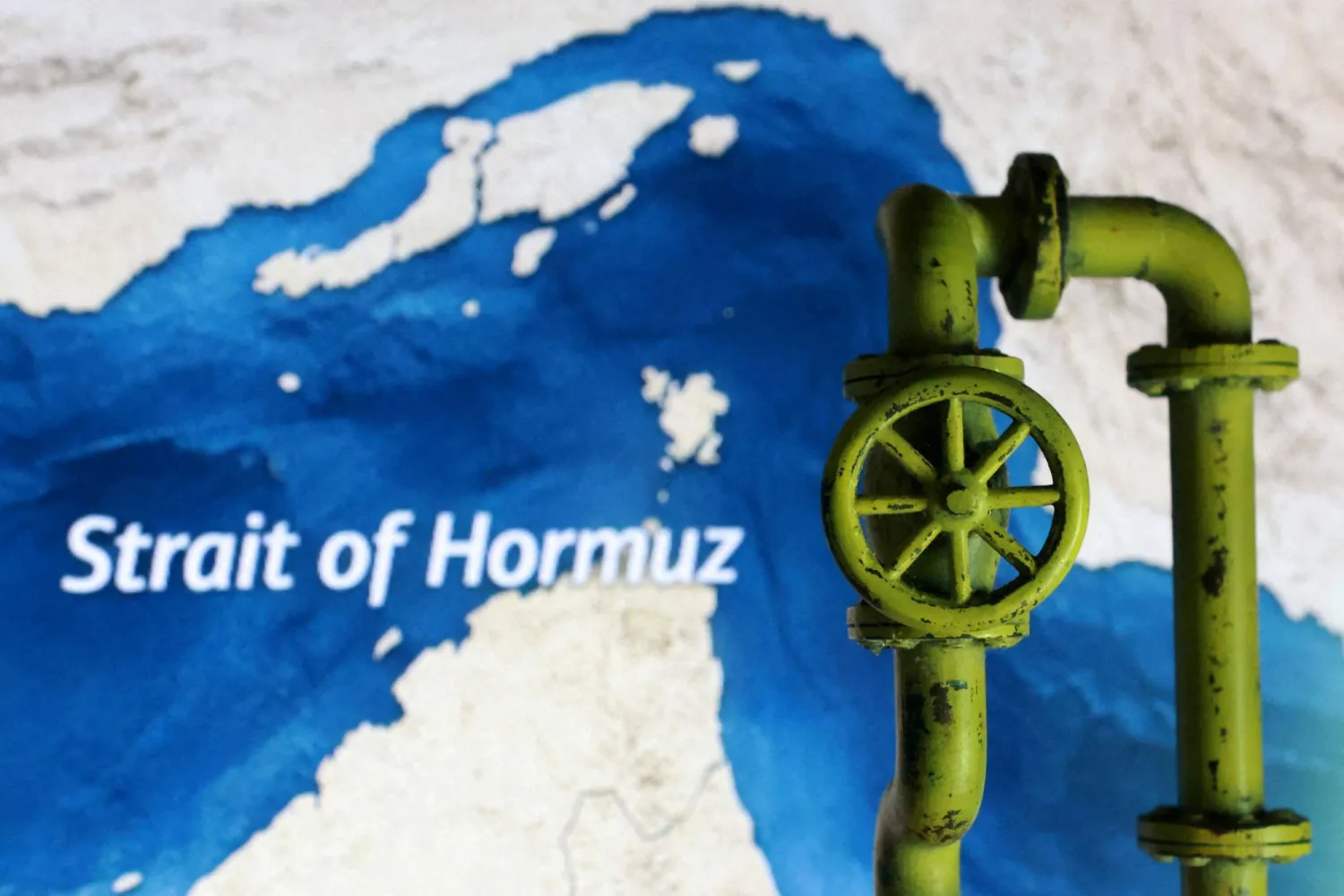

Oil Surges, Stocks Fall as Trump Says to Blockade Strait of Hormuz

FILE PHOTO: A map showing the Strait of Hormuz and a 3D printed oil pipeline are seen in this illustration taken March 23, 2026. REUTERS/Dado Ruvic/Illustration//File Photo
TT

Oil Surges, Stocks Fall as Trump Says to Blockade Strait of Hormuz

FILE PHOTO: A map showing the Strait of Hormuz and a 3D printed oil pipeline are seen in this illustration taken March 23, 2026. REUTERS/Dado Ruvic/Illustration//File Photo

Oil prices surged and stocks sank Monday after US-Iran peace talks fell apart and Donald Trump announced a blockade of the strategic Strait of Hormuz, adding to fears of energy supplies from the Middle East.

Negotiations in Islamabad at the weekend fell apart with the US delegation -- led by Vice President JD Vance -- blaming Iran's refusal to give up its nuclear program and Tehran hitting out at "maximalism, shifting goalposts, and blockade".

The news dealt a blow to hopes for an end to the six-week conflict, which has sent crude prices soaring, pushing inflation up and sending shivers through the global economy, said AFP.

Oil prices -- which tumbled last week after the United States and Iran agreed to a ceasefire -- jumped around eight percent Monday, with both contracts topping $100 a barrel.

Equities fell across Asia, with Tokyo, Hong Kong and Seoul off at least one percent, while Shanghai, Sydney, Singapore, Taipei and Jakarta were also down.

In a lengthy social media post, US President Donald Trump said his goal was to clear the strait of mines and reopen it to all shipping.

But he said that Iran must not be allowed to profit from controlling the waterway -- through which a fifth of global oil and gas usually passes.

"Effective immediately, the United States Navy, the Finest in the World, will begin the process of BLOCKADING any and all Ships trying to enter, or leave, the Strait of Hormuz," Trump wrote on Truth Social.

"Any Iranian who fires at us, or at peaceful vessels, will be BLOWN TO HELL!"

He said the blockade would only apply to vessels travelling to or from Iranian ports.

The US military said Sunday it will blockade all Iranian Gulf ports on Monday at 1400 GMT, effectively seizing control of maritime traffic.

Iran's Revolutionary Guards said its security forces had full control over the strait and warned enemies would be trapped in a "deadly vortex" in case of any "wrong move".

Iran's navy chief Shahram Irani called Trump's threat "ridiculous and funny", according to state TV.

After the talks -- the highest-level meeting between the two sides since the 1979 Iranian revolution -- Vance said Washington had made Tehran its "final and best offer," adding: "We'll see if the Iranians accept it."

Iran's Foreign Minister Abbas Araghchi said the rivals had been "inches away" from a deal, writing on X that "Iran engaged with US in good faith to end war".

But he added "we encountered maximalism, shifting goalposts, and blockade".

Nicole Grajewski, an assistant professor at the Center for International Research at Sciences Po in Paris, warned that a US blockade was "not a minor coercive signal" but would rather be considered an effective resumption of the war.

Fawad Razaqzada, a market analyst at Forex.com, said: "The fundamental issue remains trust - or rather, the lack of it - between two long-standing adversaries who still appear some distance from common ground."

Investors are also keeping an eye on attempts to resolve the conflict between Israel and Hezbollah, as Lebanese Prime Minister Nawaf Salam said he was pushing to ensure the withdrawal of Israeli forces.

"We will continue to work to stop this war, to ensure the Israeli withdrawal from all our lands, the return of all the prisoners, to rebuild our destroyed villages and towns, and the safe return of the displaced," Salam said.

The prospect of the Middle East crisis continuing for the foreseeable future ramped up inflation fears and weighed on gold amid expectations interest rates would be kept elevated.

Data Friday highlighted the impact of the conflict on prices, with the US consumer price index spiking at 3.3 percent in March, its highest since May last year.



Iraqi Oil Exports Plummet 81.3% in March Due to Hormuz Closure

The Zubair Oil Field in Basra, Iraq, April 6, 2026. REUTERS/Mohammed Aty
TT

Iraqi Oil Exports Plummet 81.3% in March Due to Hormuz Closure

The Zubair Oil Field in Basra, Iraq, April 6, 2026. REUTERS/Mohammed Aty

Iraq’s oil exports plunged in March to 18.6 million barrels, down from 99.87 million in February – a drop of 81.3 percent - due to the closure of the Strait of Hormuz, according to official figures released Monday.

The state-run Organization for Marketing of Oil said revenues also have fallen to just $1.95 billion, down from over $6.81 billion.

The figures showed that exports from the Kurdistan Region through Türkiye’s Ceyhan port also dropped to 1.27 million barrels, down from 5.55 million barrels in February.

Meanwhile, operations resumed on Monday at a major gas facility in Iraq's Kurdish region, the Emirati company running the complex said, after more than a month of disruption due to the US-Iran war.

Dana Gas announced "the resumption of production of the Khor Mor gas facility in the Kurdistan Region of Iraq, following a period of intermittent operations," according to a statement published by the Abu Dhabi stock exchange.

On February 28 the UAE company suspended natural gas supplies from the complex as war broke out, authorities in Iraq's autonomous Kurdistan region had said.

Kurdistan's electricity and natural resources ministries said the decision was made "due to the extraordinary circumstances and ongoing events in the region, and to protect employees at the Khor Mor field."

The Khor Mor complex, which supplies most of Kurdistan's power stations, has been hit several times in recent years in attacks blamed on pro-Iran armed groups in Iraq.


World Bank Chief Sounds Alarm about Looming Jobs Crisis Even after War Ends

World Bank President Ajay Banga gives remarks during a forum held at the Atlantic Council building in Washington, D.C., US, April 7, 2026. REUTERS/Aaron Schwartz
TT

World Bank Chief Sounds Alarm about Looming Jobs Crisis Even after War Ends

World Bank President Ajay Banga gives remarks during a forum held at the Atlantic Council building in Washington, D.C., US, April 7, 2026. REUTERS/Aaron Schwartz

The Middle East war will dominate global finance officials' talks this week in Washington, but World Bank President Ajay Banga is sounding the alarm about a bigger, looming crisis: a huge gap in jobs for the 1.2 billion people who will reach working age in developing countries in the next 10 to 15 years.

At current trajectories, those economies will generate only about 400 million jobs, leaving a deficit of 800 million jobs, Banga told Reuters.

The former Mastercard CEO admits that focusing people on the long-term is daunting, given a series of short-term shocks that have buffeted the global economy since the COVID-19 pandemic, the most recent being the war in the Middle East.

He says he's determined to ensure that finance officials stay focused on those longer-term challenges like creating jobs, connecting people to the electricity grid and ensuring access to clean water. "We have to walk and chew gum at the same time. ‌Short-velocity cycle is what ‌we're going through. Longer velocity is this jobs circumstance or water," Banga said in ‌an ⁠interview taped on Friday.

WAR ⁠OVERSHADOWS OTHER CONCERNS Thousands of finance officials from around the globe will gather in Washington this week for the spring meetings of the World Bank and the International Monetary Fund under the shadow of the US-Israel war with Iran that threatens to slow global growth and jack up inflation. The extent of the hit to the economy will depend on the durability of a two-week ceasefire announced by President Donald Trump last week, just hours before promised strikes that Trump said would destroy Iran's civilization. The ceasefire has halted most attacks. But it has not ended Iran's effective blockade of the Strait of Hormuz, which has caused the biggest-ever disruption to global energy ⁠supplies, or calmed a parallel war between Israel and Iran-backed Hezbollah in Lebanon.

IMPROVING JOB CREATION

The ‌World Bank's governing body, the Development Committee, outlined plans to work with developing ‌countries to streamline policy and regulatory conditions that have hampered investment and job creation for years.

Discussions will touch on transparency around permits, anti-corruption, labor ‌law, land law, impediments to opening a business, logistics, better trade systems, and non-price barriers in trade, Banga said.

He is ‌upbeat that solutions can be found to help find employment - and dignity - for young people and create opportunities for private companies catering to their needs. "I don't know that you can ever get to a situation of utopia and everybody is taken care of in the coming 15 years. I would doubt that's going to happen, but if you don't do it, the implications are quite severe in terms ‌of illegal migration and instability," Banga said. United Nations data showed more than 117 million people were displaced worldwide as of 2025.

Banga said companies in developing countries themselves were starting ⁠to expand globally, including India's ⁠Reliance Industries and the Mahindra Group, and Dangote in Nigeria.

Banga said his discussions with officials in developing countries showed their interest in creating more - and better jobs - for the next generation.

In addition to jobs, water will be a big focus. The World Bank, in conjunction with other development banks, is set to announce a push to ensure that one billion more people have secure access to clean water, adding to existing initiatives to connect 300 million households in Africa with electricity, and to improve health care.

PULLING IN THE PRIVATE SECTOR

The World Bank focused on human and physical infrastructure required for the jobs creation push during last fall's meetings of the IMF and World Bank, and will continue the cycle with an emphasis on attracting private sector investment during this fall's meetings in Bangkok, Banga said. The bank identified five sectors that would benefit from investment and are not reliant on global trade or outsourcing from developed countries: infrastructure, agriculture for small farmers, primary health care, tourism and value-added manufacturing. Those sectors are less likely to be immediately affected by advancements in artificial intelligence, he said.

"The problem is, we can't do this alone. We've got to get this snowball to roll downhill, gathering a lot of snow as it goes along, to reach that amazing number of 800 million," he said.


Gold Drops as Inflation Worries Linger on Failed US-Iran Talks

AFP a one-ounce gold bar is displayed at Witter Coins on October 07_ 2025 in San Francisco
TT

Gold Drops as Inflation Worries Linger on Failed US-Iran Talks

AFP a one-ounce gold bar is displayed at Witter Coins on October 07_ 2025 in San Francisco

Gold prices touched a near one-week low on Monday, pressured by a stronger dollar, while a surge in oil prices following failed US-Iran peace talks fueled inflation worries and dampened expectations for Federal Reserve interest rate cuts this year.

Spot gold was down 0.7% at $4,716.70 per ounce, as of 0445 GMT, its lowest level since April 7. US gold ‌futures for June ‌delivery fell 1% to $4,738.90. The dollar strengthened 0.4%, ‌while ⁠oil prices bounced ⁠back above $100 a barrel, as the US Navy prepared a blockade of the Strait of Hormuz that could restrict Iranian oil shipments, following the US and Iran's failure to reach a deal to end the war.

Iran's Revolutionary Guards responded by warning that military vessels approaching the Strait will be considered a ceasefire breach and ⁠dealt with harshly and decisively, reported Reuters.

"Ceasefire optimism has unwound ‌following the failure of the peace ‌talks, and the resulting push higher by the dollar and ‌oil prices has put gold on the back foot again," ‌said Tim Waterer, chief market analyst, KCM Trade.

Spot gold has fallen more than 11% since the US-Israeli war on Iran began on February 28. While inflation and geopolitical risks typically boost gold's appeal as a ‌hedge, elevated interest rates weigh on the non-yielding metal.

A stronger dollar also makes greenback-priced bullion more expensive ⁠for holders ⁠of other currencies.

"As soon as oil prices push back above $100, attention quickly turns to potential central bank rate hikes to curb inflation, and it is this interest rate outlook that is undermining gold's performance," Waterer said.

Traders now see little chance of a US rate cut this year, as higher energy prices threaten to feed into broader inflation and limit the scope for monetary easing.

Before the war in the Middle East began, there were expectations for two Fed rate cuts this year.

Among other metals, spot silver fell 2% to $74.35 per ounce, platinum lost 0.2% to $2,041.40, while palladium gained 0.7% to $1,530.80.