



China’s Exports Slowed in March While Imports Soared

A staff works in front of a fruit shop in Beijing, China, 14 April 2026. (EPA)
TT

China’s Exports Slowed in March While Imports Soared

A staff works in front of a fruit shop in Beijing, China, 14 April 2026. (EPA)

China's exports grew at a slower pace last month after starting the year with a surge, official data showed Tuesday, as the global economy reels from war in the Middle East.

The world's second-largest economy produced a record-breaking trade surplus last year at $1.2 trillion.

Booming overseas shipments appeared set to continue this year after jumping by more than a fifth in January and February combined.

However, China's exports grew just 2.5 percent on-year in March, according to data published Tuesday by the General Administration of Customs (GAC).

The slowdown was more pronounced than expected, with a Bloomberg survey of economists forecasting 8.6 percent growth.

Exports to the United States also plunged last month, hit by blistering tariffs launched by President Donald Trump.

Shipments to the United States tumbled 26.5 percent on-year to $29.4 billion in March, the customs data showed.

In a more positive sign, imports soared 27.8 percent, according to the figures. That was higher than a forecast of 14 percent growth by Bloomberg.

The readings come at an uncertain time for international trade, with energy costs skyrocketing as a result of war between the United States and Iran.

Analysts say China's diversified energy supply insulates it from immediate shocks, though any global economic downturn would weaken demand for its exports.

GAC deputy head Wang Jun acknowledged "many uncertainties and instabilities in the external environment", at a news conference Tuesday.

"The impact of international geopolitical conflicts on global industrial and supply chains is still evolving in a complex manner," Wang said.

- Slowing growth -

Zhiwei Zhang, president and chief economist at Pinpoint Asset Management, added that "growth to major export destinations slowed across the board".

"The uncertainty of global macro outlook driven by the conflict in the Middle East likely weighed on the demand side," he wrote in a note.

Meanwhile, China's surge in import figures last month was the result of higher energy costs, Zhang said.

"I think China's trade surplus will likely shrink this year," he said, adding that "the high energy price is likely more damaging for China's competitors, given the scale and the efficiency of China's manufacturing sector."

Beijing is due to release closely watched economic growth data for the first quarter of the year on Thursday.

Leaders are targeting overall growth this year of 4.5-5.0 percent -- the lowest in decades.

Analysts expect China's economy to have expanded at 4.8 percent in the first quarter, up from 4.5 percent in the final three months of 2025, according to the median forecast of an AFP survey.

Many economists argue that China must adopt a growth model with a greater role for consumer spending rather than traditional drivers including exports and infrastructure investment.

A years-long crisis in the property sector, once a crucial engine for activity, has weighed on growth and spooked consumers.
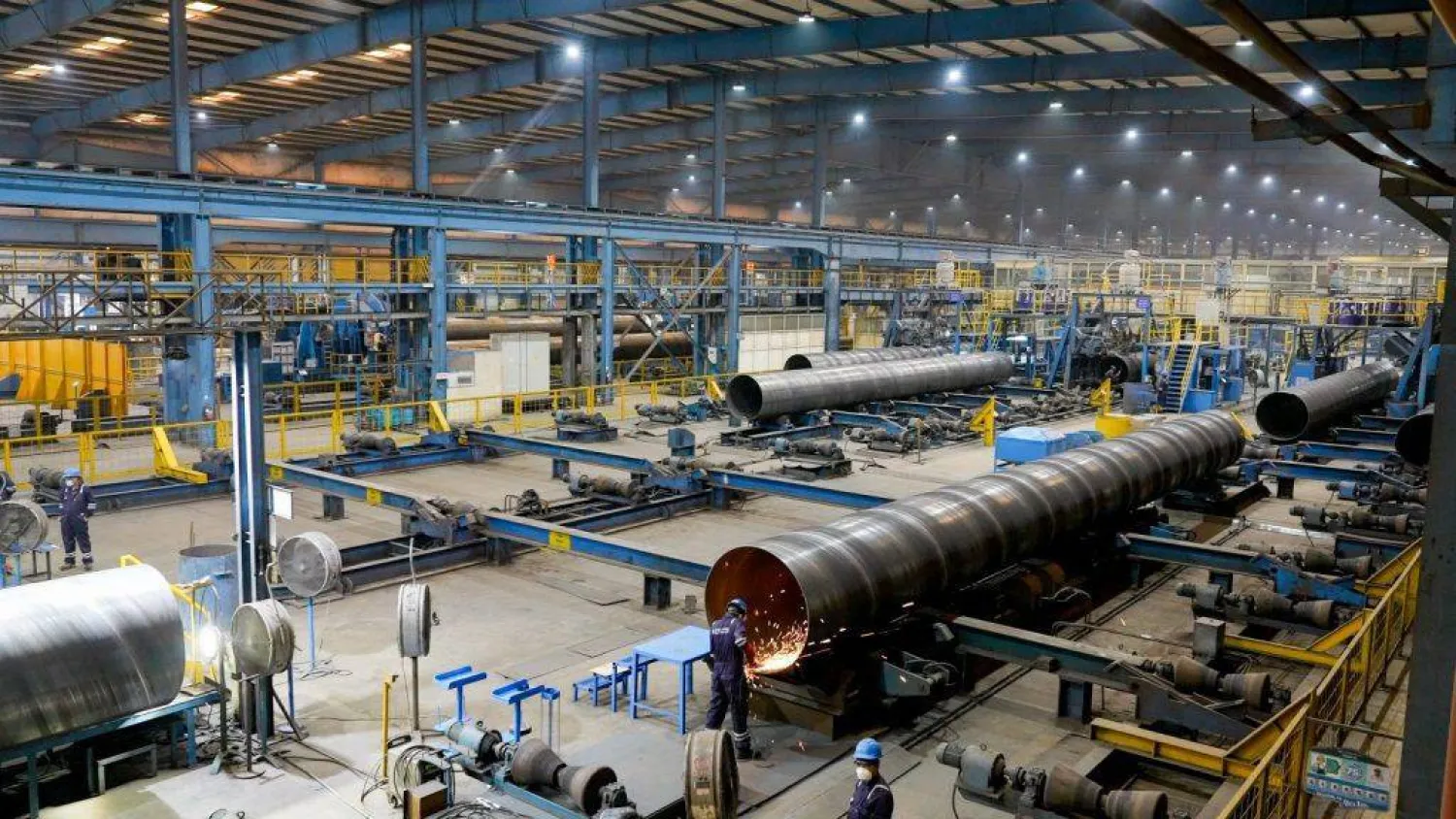



Riyadh International Industry Week 2026 to Kick Off on Sunday

Riyadh International Industry Week 2026 to Kick Off on Sunday
TT

Riyadh International Industry Week 2026 to Kick Off on Sunday

Riyadh International Industry Week 2026 to Kick Off on Sunday

Riyadh International Industry Week 2026 will open Sunday at the Riyadh International Convention and Exhibition Center (RICEC), under the patronage of the Ministry of Industry and Mineral Resources.

The event will showcase the development of Saudi Arabia’s industrial capabilities and explore opportunities for international partnerships across several industrial sectors, bringing together more than 337 exhibitors from 17 countries, SPA reported.

It also serves as a key platform for showcasing the latest industrial technologies and products from leading local and international industrial companies. The event brings together three specialized exhibitions under one roof: Saudi Plastics and Petrochem and Saudi Print and Pack, both in their 21st editions, and the 4th edition of Saudi Smart Logistics.

The week, which runs until June 24, is organized through a strategic partnership between Riyadh Exhibitions Company Ltd. and Germany’s Messe Düsseldorf. The partnership marks an important step toward strengthening links between specialized Saudi exhibitions and their global counterparts, connecting the event with three of the leading international trade fairs in plastics, packaging, and printing: K, interpack, and drupa.

Several entities from the industry and mineral resources ecosystem will take part in the exhibition and its accompanying events. The week will feature several panel discussions and specialized workshops with senior officials and local and international experts.

Key topics include industrial transformation, innovation and localization, advanced packaging solutions for the food industry, industrial enablers and their role in promoting investment and strengthening competitiveness, the latest industrial practices in plastics, packaging and printing, and plastic recycling.

Riyadh International Industry Week contributes to strengthening international industrial partnerships and drawing on the experiences of leading countries. It comes as Saudi Arabia’s industrial sector continues to grow and develop under Saudi Vision 2030, which aims to position the Kingdom as a leading regional and global industrial power.


Iraq Projects Oil Production to Return to Pre-war Levels Within Two Months

A handout picture released by Iraq's Prime Minister's Press Office on January 2, 2025, shows a partial view of the oil refinery of Baiji north of Baghdad, during the inauguration ceremony of the fourth and fifth units. (Iraq's Prime Minister's Press Office / AFP)
TT

Iraq Projects Oil Production to Return to Pre-war Levels Within Two Months

A handout picture released by Iraq's Prime Minister's Press Office on January 2, 2025, shows a partial view of the oil refinery of Baiji north of Baghdad, during the inauguration ceremony of the fourth and fifth units. (Iraq's Prime Minister's Press Office / AFP)

Iraqi authorities predict oil production will return to peacetime levels "within one to two months", state media reported, after the Middle East war caused exports to plummet.

The war and Iran's ensuing blockade of the Strait of Hormuz choked off shipments and prompted production cuts in key oil-producing countries including Iraq, shaking world energy markets.

But a deal agreed this week between Washington and Tehran to end the fighting has offered some relief, despite follow-up negotiations having stalled.

The spokesman for Iraq's oil ministry, Salim Farhoud, told the state-run Iraq News Agency (INA) late Friday that "we can return within one to two months to the previous production levels".

"The fields that reduced their production capacity have currently begun raising this capacity," he said.

Before the war broke out in late February, Iraq exported about 3.5 million barrels per day of oil, the majority of it via the Hormuz Strait.

But the OPEC founding member was forced to halt production in most of its oil fields as reservoirs filled up, limiting its exports to routes via neighbouring Türkiye and Syria.

The vital strait began reopening this week following the signing of the initial agreement between Iran and the United States.

Iraqi Oil Minister Bassem Khodeir on Friday told INA that exports "will return gradually based on the smooth flow through the Strait of Hormuz".

In April, Iraqi crude exports via the waterway declined to 10 million barrels from an average of 93 million before the war, according to authorities.

Iraq is highly reliant on crude exports, which normally account for about 90 percent of its revenues.


China's May Fuel Oil Exports Rise 42% Year-on-year

An attendant holds a petrol nozzle after refuelling a car at a PetroChina gas station in Beijing, China, March 10, 2026. REUTERS/Florence Lo
TT

China's May Fuel Oil Exports Rise 42% Year-on-year

An attendant holds a petrol nozzle after refuelling a car at a PetroChina gas station in Beijing, China, March 10, 2026. REUTERS/Florence Lo

China's exports of fuel oil, mainly for low-sulphur marine fuel bunkering, rose 42% year-on-year in May, customs data showed on Saturday.

Volumes totaled 1.76 million metric tons, or about 360,695 barrels per day (bpd), up 4% from April, according to General Administration of Customs data.

Some marine fuel demand had been diverted from regional hub Singapore to China's Zhoushan due to cheaper prices at Chinese ports during most of ⁠May, market sources ⁠said.

Fuel oil imports in May extended declines after plummeting last month to what was then the lowest level since customs data for them began in 2021.

Imports of fuel oil totaled 559,346 tons ⁠in May, down 43% from April and 57% from a year earlier.

The imports, mostly purchased by refineries for use as feedstock, remained capped this quarter as China's independent refineries trimmed runs amid weak domestic demand for products, market sources said, according to Reuters.