


Samsung Asks Court to Block Illegal Strike Activities by Unions

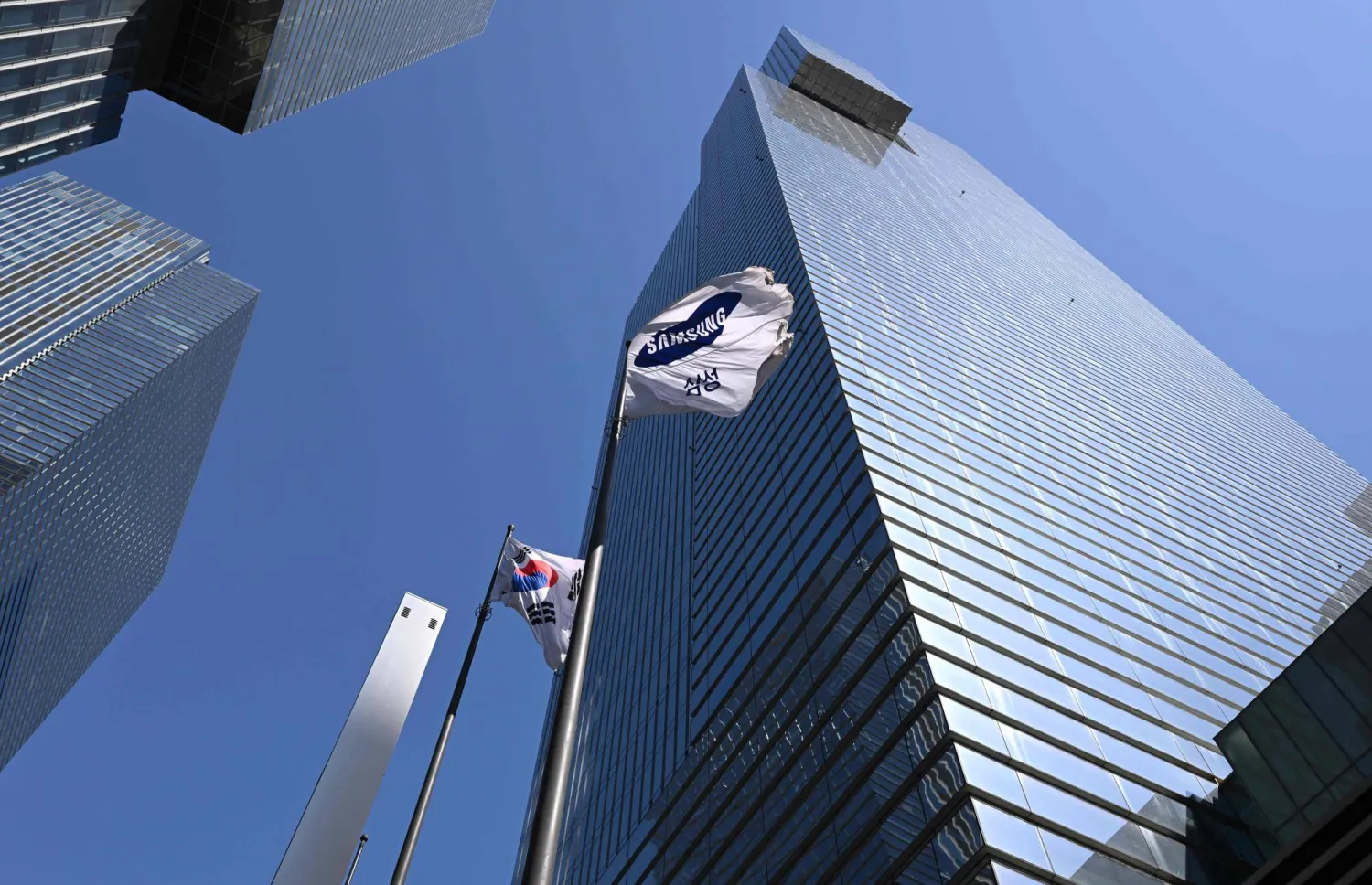
A South Korean national flag (L) and a Samsung flag (R) flutter outside the company's Seocho building in Seoul on April 7, 2026. (Photo by Jung Yeon-je / AFP)
TT

Samsung Asks Court to Block Illegal Strike Activities by Unions

A South Korean national flag (L) and a Samsung flag (R) flutter outside the company's Seocho building in Seoul on April 7, 2026. (Photo by Jung Yeon-je / AFP)

Samsung Electronics asked a court on Thursday to block its South Korean labour unions engaging in illegal activities during a planned strike, a spokesperson said, as a wage dispute threatens to disrupt operations at the world's top memory chipmaker.

Samsung did not elaborate on details of its legal action. Unions labelled it a "declaration of war," accusing the company of infringing on its right to strike, which ⁠is protected under the ⁠law.

Unionized workers at Samsung last month voted to authorize strike plans and threatened to walk out for 18 days from May 21, should they fail to agree on a wage deal with management.

The unions also plan to ⁠hold a major rally on April 23, ramping up pressure on Samsung during wage negotiations.

Samsung workers, frustrated by a pay gap with crosstown rival SK Hynix, are calling on Samsung to remove its performance pay cap and link bonuses to operating profit.

The company estimated it made an operating profit of 57.2 trillion won ($38.85 billion) for the January to March period, more than an eightfold ⁠jump ⁠from 6.69 trillion won a year earlier.

Samsung's union leader told Reuters that a potential strike could affect about half the output at Samsung's giant semiconductor complex in Pyeongtaek, south of Seoul, the capital.

A strike at the world's largest manufacturer of memory chips could worsen bottlenecks in global supply of semiconductors, stemming from robust demand for artificial intelligence data center operations that has curbed supply to industries from cars and computers to smartphones.



Apple Agrees to $250 Mn Settlement over AI Siri Claims

FILE PHOTO: A woman uses her smartphone inside the Apple store in Beijing's Sanlitun area as the new iPhone 17 series smartphones go on sale in Beijing, China September 19, 2025. REUTERS/Maxim Shemetov/File Photo
TT

Apple Agrees to $250 Mn Settlement over AI Siri Claims

FILE PHOTO: A woman uses her smartphone inside the Apple store in Beijing's Sanlitun area as the new iPhone 17 series smartphones go on sale in Beijing, China September 19, 2025. REUTERS/Maxim Shemetov/File Photo

Apple on Tuesday agreed to pay $250 million to settle a class action lawsuit accusing it of misleading millions of iPhone buyers by falsely touting artificial intelligence capabilities for its Siri voice assistant in late 2024.

Plaintiffs accused the California tech giant of having "promoted AI capabilities that did not exist at the time, do not exist now, and will not exist for two or more years" in order to boost iPhone sales, the document -- reviewed by AFP -- stated.

The Better Business Bureau's National Advertising Division, the US advertising watchdog, had also concluded that Apple falsely suggested the new AI-powered Siri was "available now."

The settlement filed Tuesday for court approval, which includes no admission of wrongdoing by Apple, covers roughly 36 million eligible devices -- the iPhone 16, as well as the iPhone 15 Pro and 15 Pro Max -- purchased in the United States between June 10, 2024 and March 29, 2025.

Each class member could receive $25 per device, a sum that could reach $95 depending on the number of approved claimants.

"We resolved this matter to stay focused on what we do best: delivering the most innovative products and services to our users," Apple told the Financial Times.

A Morgan Stanley survey cited in the complaint indicated that "enhanced Siri" was the feature that potential iPhone buyers most anticipated.

Apple had launched a major advertising campaign in 2024 to promote these capabilities, before confirming their indefinite delay and pulling its ads.

The settlement must still be approved by Judge Noel Wise of the federal district court for the Northern District of California at a hearing set for June 17, 2026.


India Approves Two Semiconductor Projects Worth $414 Million

Prime minister of India Narendra Modi leaves after the hand shake photo with President of Vietnam To Lam prior to a meeting at Hyderabad House in New Delhi, India, 06 May 2026. EPA/RAJAT GUPTA
TT

India Approves Two Semiconductor Projects Worth $414 Million

Prime minister of India Narendra Modi leaves after the hand shake photo with President of Vietnam To Lam prior to a meeting at Hyderabad House in New Delhi, India, 06 May 2026. EPA/RAJAT GUPTA

India said it had approved two new semiconductor projects worth $414 million, as the government accelerates efforts to establish the country as a global electronics powerhouse.

The projects -- an LED display facility and a semiconductor packaging unit -- were cleared late Monday, taking the total number of facilities in India to 12, with a total investment of about $17.2 billion.

New Delhi launched its push into domestic chipmaking in 2021 and has since backed a range of fabrication, design and packaging units as part of a broader strategy to cut import dependence and strengthen supply chains.

Prime Minister Narendra Modi said the two new projects were a part of "our efforts towards making India a leader in the global semiconductor value chain".

"India's advances in the world of semiconductors will boost economic transformation, technological self-reliance and encourage the innovation ecosystem," AFP quoted him as saying on social media.

The LED project will be an "integrated facility for compound semiconductor fabrication" aimed at producing mini and micro display modules, the government said in a statement.

The packaging unit will cater to automotive, industrial and electronics sectors.

The projects would provide a "significant boost" to the country's semiconductor ecosystem and "complement the growing world class chip design capabilities coming up in the country", it said.

India's chip market has risen from around $38 billion in 2023 to an estimated $45-$50 billion in 2024-2025.

The government is targeting $100-$110 billion by 2030.

Several previously approved plants have begun production, with two facilities already starting commercial shipments.


Major Publishers Sue Meta for Copyright Infringement Over AI Training

Cars drive past a sign of Meta, the new name for the company formerly known as Facebook, at its headquarters in Menlo Park, California, US, October 28, 2021. (Reuters)
TT

Major Publishers Sue Meta for Copyright Infringement Over AI Training

Cars drive past a sign of Meta, the new name for the company formerly known as Facebook, at its headquarters in Menlo Park, California, US, October 28, 2021. (Reuters)

Publishers Elsevier, Cengage, Hachette, Macmillan and McGraw Hill sued Meta Platforms in Manhattan federal court on Tuesday, alleging that the tech giant misused their books and journal articles to train its artificial intelligence model Llama.

The publishers, as well as author Scott Turow, alleged in the proposed class action complaint that Meta pirated millions of their works and used them without permission to train its large language models to respond to human prompts.

“AI is powering transformative innovations, ‌productivity and creativity ‌for individuals and companies, and courts have rightly ‌found ⁠that training AI ⁠on copyrighted material can qualify as fair use," a Meta spokesperson responded in a statement on Tuesday.

"We will fight this lawsuit aggressively.”

The publishers allege that Meta pirated works ranging from textbooks to scientific articles to novels including "The Fifth Season" by N.K. Jemisin and "The Wild Robot" by Peter Brown for its ⁠AI training.

They asked the court for ‌permission to represent a larger class ‌of copyright owners and an unspecified amount of monetary damages.

"Meta’s mass-scale ‌infringement isn’t public progress, and AI will never be properly ‌realized if tech companies prioritize pirate sites over scholarship and imagination," Maria Pallante, president of the Association of American Publishers, said in a statement.

The lawsuit opens a new front in the ongoing copyright ‌battle between creators and tech companies over AI training, in which dozens of authors, news outlets, ⁠visual ⁠artists and other plaintiffs have sued companies including Meta, OpenAI and Anthropic for infringement.

All of the pending cases will likely revolve around whether AI systems make fair use of copyrighted material by using it to create new, transformative content.

The first two judges to consider the matter issued diverging rulings last year.

Amazon- and Google-backed Anthropic was the first major AI company to settle one of the cases, agreeing last year to pay a group of authors $1.5 billion to resolve a class-action lawsuit that could have cost the company billions more in damages for alleged piracy.