Israeli Army Says Soldier Killed in Southern Lebanon

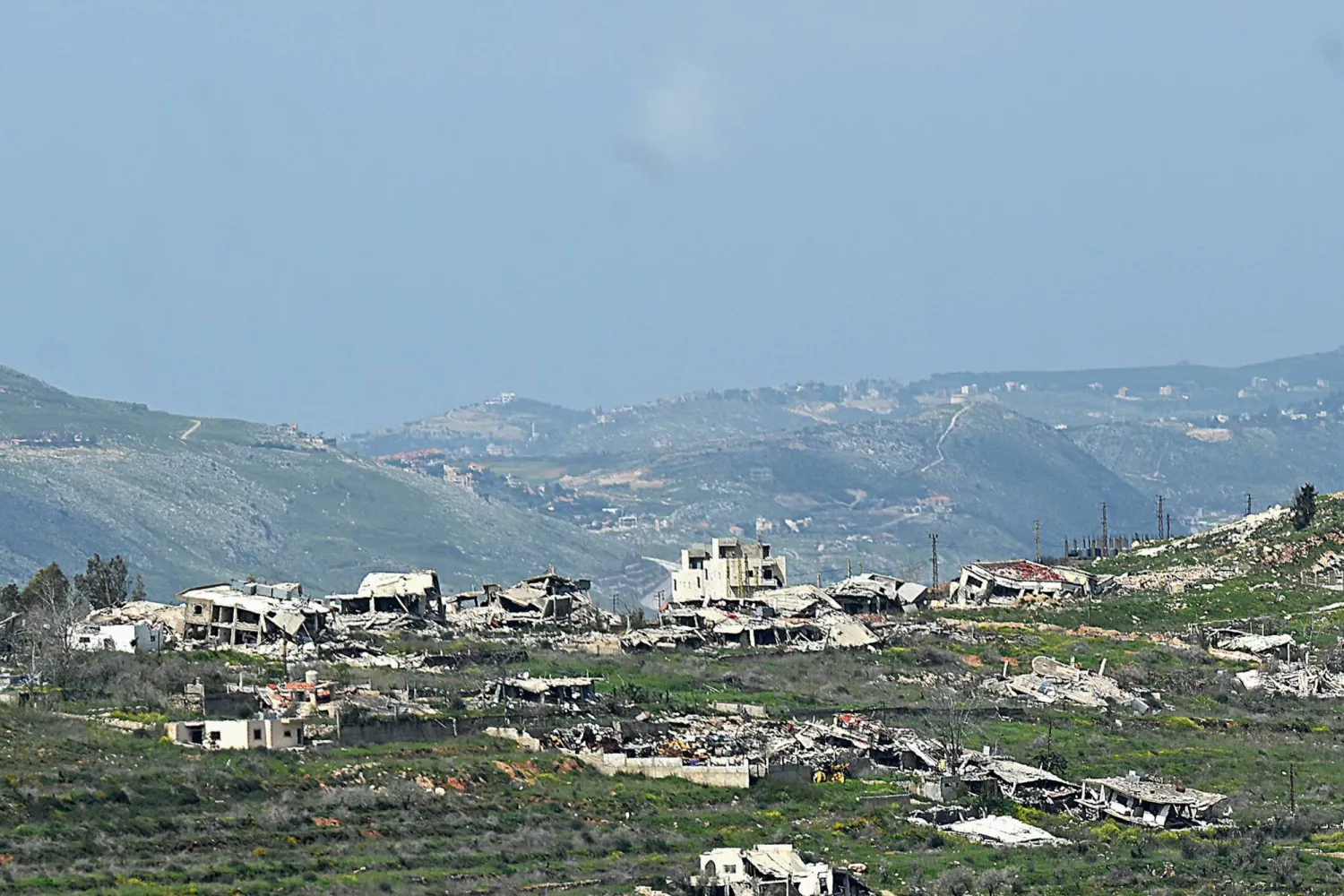
 18 April 2026, Lebanon, ---: A general view of the heavily damaged area in southern Lebanon following Israeli strikes. (dpa)
18 April 2026, Lebanon, ---: A general view of the heavily damaged area in southern Lebanon following Israeli strikes. (dpa)
TT

Israeli Army Says Soldier Killed in Southern Lebanon

 18 April 2026, Lebanon, ---: A general view of the heavily damaged area in southern Lebanon following Israeli strikes. (dpa)
18 April 2026, Lebanon, ---: A general view of the heavily damaged area in southern Lebanon following Israeli strikes. (dpa)

Israel's military said on Sunday that a soldier died during combat in southern Lebanon, where a temporary ceasefire had come into effect this week.

"Lidor Porat, aged 31, from Ashdod, a soldier in the 7106th Battalion, 769th Regional Brigade, fell during combat in southern Lebanon," the Israeli military said in a statement, without providing further details.

The total Israeli army death toll in the six-week war between Israel and Hezbollah was now 15, according to an AFP tally based on military figures.

It was the second death announced by Israel of a soldier in southern Lebanon since the start of a ten-day truce announced by the United States began on Friday -- part of wider efforts to bring a permanent end to the Middle East war.

The latest round of fighting in Lebanon -- one of the fronts in the regional war -- had begun on March 2 when Tehran-backed Hezbollah launched rocket attacks on Israel to avenge the death of its supreme leader in the opening wave of Israeli-US strikes on Iran.

Israel then responded with a strikes it said targeted Hezbollah in Beirut and the southern parts of the country where it had also launched a ground operation.


Lebanese Concern Over 'Third War' Despite Hezbollah Assurances

Lebanese President Joseph Aoun inspects military units deployed in Zawtar al-Gharbiya, southern Lebanon (File photo: Lebanese Presidency)
TT

Lebanese Concern Over 'Third War' Despite Hezbollah Assurances

Lebanese President Joseph Aoun inspects military units deployed in Zawtar al-Gharbiya, southern Lebanon (File photo: Lebanese Presidency)

Lebanese President Joseph Aoun is standing firm on negotiations as the "only path" out of the country's crisis after two wars between Hezbollah and Israel.

But the threat of a third war continues to loom large, despite fresh assurances from Hezbollah that it would stay out of any new confrontation involving Iran, the United States and Israel.

Aoun has heard such promises before. He received similar assurances ahead of the second war last March, only for Hezbollah to reverse course following the assassination of Iranian Supreme Leader Ali Khamenei.

Mindful of a Lebanese proverb warning against repeating a failed experience, Aoun is taking the latest assurances with caution. He is equally wary of a tentative dialogue recently opened with Hezbollah.

The president fears a third war could devastate southern Lebanon, particularly the Shiite community, following warnings delivered to him and other Lebanese officials.

The latest came in a telephone call with US Secretary of State Marco Rubio, who warned that Hezbollah's entry into any new conflict "would have devastating consequences."

Elections deepen negotiating deadlock

Two elections have cast a long shadow over Lebanon's negotiations with Israel: one in the United States, the sole official sponsor of the talks, and another in Israel.

Concessions from Israel were difficult to secure even under a strong government. Now, inconclusive election results in Israel threaten to prolong the negotiating deadlock.

Washington has yet to set a date for another round of political or military talks, awaiting a clearer picture of Israel's political landscape.

But Beirut does not see the impasse as proof that negotiations have failed.

Aoun continues to confront critics of his approach with a simple question: What is the alternative?

He insists negotiations remain the only way to protect Lebanon and offer its people a measure of hope after the devastating crisis they have endured.

The latest round of military-level talks in the United States underscored the deadlock.

Israeli representatives declined to respond to several Lebanese proposals, saying they needed to consult their political leadership. The talks ended without clear results.

Yet a Lebanese official source told Asharq Al-Awsat that the outcome should not be viewed as a failure.

The US side, the source said, was impressed by the Lebanese military delegation's presentation of the army's achievements, contradicting the Israeli side's initial portrayal of its performance. Israeli representatives eventually acknowledged those achievements.

The source said US General Joseph Clearfield explicitly praised the Lebanese army's presentation.

In the small village of Zawtar al-Gharbiya alone, the army carried out more than 1,200 operations to remove ammunition, weapons and military infrastructure after Israeli forces withdrew, the source said.

The village was among the "pilot zones" designated under an arrangement that was never completed because of Israel's failure to cooperate.

Dispute over who verifies disarmament

A dispute over who should verify that the pilot zones are free of weapons remains a key obstacle to resuming negotiations.

Two proposals are on the table, and neither has won agreement.

Israel wants a non-governmental organization (NGO) to carry out the verification, an option Lebanon rejects.

Lebanon instead wants the task assigned to the UN Truce Supervision Organization, whose observers have been stationed in the country since 1949. Israel opposes that proposal.

Aoun defends the army

Aoun has also moved to defend the Lebanese army against mounting criticism, praising its performance and warning against campaigns targeting an institution he considers a guarantee of national security.

Such attacks do little to strengthen domestic stability, he has told visitors, but they will not derail the army's national mission.

The president maintains that the military has "no independent position or agenda of its own" and acts strictly on instructions from the political leadership.

That includes its refusal to open direct channels with the Israeli military.

Aoun said he personally ordered the army not to establish such contact because "it is still far too early" to discuss it.

"Under the current circumstances, direct communication is impossible while the Israeli army occupies our territory and attacks it every day," he said.

Hezbollah explosives stir controversy

A Lebanese official source has played down the uproar over explosives seized by Lebanese security forces in an operation involving Hezbollah members, describing the controversy as excessive.

The case "has followed its legal course. If further steps are required once the investigations are completed, we will take them," the source said.

The remarks appeared to allude to the possibility of referring the case to Lebanon's Judicial Council.

The source stressed that the seizure was hardly unprecedented.

The Lebanese army had carried out two similar operations earlier in the week, followed by a fourth. Previous seizures had also taken place across the country, including in the Bekaa Valley, southern Lebanon and Beirut, without provoking comparable controversy.

Such operations will continue in line with the Lebanese state's commitment to ensuring that weapons remain exclusively under state control, the source said.

The source also rejected reports that Washington had pressured Beirut over the seized explosives.

During his call with Aoun, Rubio merely asked whether reports that the explosives would be returned to Hezbollah were true, the source said.

He raised no other details and requested no additional action.


Trump's Board of Peace Asks Italy to Provide Support for Gaza Security Force

Children help fill drinking water containers at a distribution point in the Nuseirat refugee camp in the central Gaza Strip on Saturday (dpa)
TT

Trump's Board of Peace Asks Italy to Provide Support for Gaza Security Force

Children help fill drinking water containers at a distribution point in the Nuseirat refugee camp in the central Gaza Strip on Saturday (dpa)

US President Donald Trump’s Board of Peace formally asked Italy to provide advisers from the police, firefighters and the carabinieri corps to help build a new security force for the Gaza Strip, according to letters seen by Bloomberg News.

The letters, sent last month to Premier Giorgia Meloni’s government, asked Rome to commit to the initiative, name a point of contact and nominate a senior officer from the carabinieri — a military police force overseen by the Ministry of Defense — to serve as the board’s deputy police program manager.

While the carabinieri have provided training to Palestinian police for years and served in European Union peace missions in the border city of Rafah in the Strip’s south, Italy’s role in Trump’s project has been tenuous.

Meloni earlier this year declined to sign the Board of Peace charter, citing constitutional constraints.

The US asked Italy to join the board’s stabilization force as a founding member, Bloomberg News reported in January, but the country has limited itself to offering police training.

Nine months after its official launch, the board has yet to deliver on the ground, with no stabilization force or Palestinian administration inside Gaza, and no reconstruction underway.

Last month, it earmarked $2.45 billion for the reconstruction of the strip, a fraction of the $71 billion the board says is needed over a decade to rebuild the war-torn territory.

A peace deal brokered in 2025 between Israel and Hamas, which the US categorizes as a terrorist organization, requires that the Palestinian group disarm, although it has yet to do so.

People familiar with the Italian government’s thinking said Rome was considering appointing a senior officer to serve as the deputy police program manager, but that questions surrounding security have complicated any decision and that no final determination has been made.

Adding to the complexities was a spat earlier this year between Trump and Meloni that temporarily strained relations between Rome and Washington, some of the people said.

Meloni is also campaigning to be re-elected as premier in next year’s general election.

The Italian government declined to comment when contacted by Bloomberg and the US State Department referred questions to the Board of Peace.

One of the board’s officials said it was in “active discussions” with several governments over how they could contribute to the reconstruction of Gaza, where at least 77,000 have died since Israel launched a counteroffensive against Hamas’s Oct. 7, 2023 attack that killed at least 1,100.

Italy has “contributed in a very positive way for several years on capacity building around police forces, and we have had very positive interactions with Italian authorities on potential support for the technocratic National Committee for the Administration of Gaza,” the official said.


Houthi Attacks Threaten Thousands of African Refugees in Western Lahj

Tens of thousands of African refugees face risks from Houthi escalation (local media)
TT

Houthi Attacks Threaten Thousands of African Refugees in Western Lahj

Tens of thousands of African refugees face risks from Houthi escalation (local media)

Escalating Houthi military operations in southwestern Yemen are putting thousands of refugees from the Horn of Africa at growing risk, with missile strikes near a refugee camp disrupting essential services, restricting movement and forcing families already displaced by conflict to seek safety elsewhere.

The United Nations refugee agency (UNHCR) warned of a deepening humanitarian crisis affecting more than 65,000 refugees and asylum seekers in Yemen, where mounting insecurity, economic collapse, dwindling resources and restrictions on aid access have left tens of thousands without safe shelter or basic necessities.

Despite the worsening conflict, thousands continue to risk their lives on perilous sea crossings from the Horn of Africa to Yemen, the agency said.

At the center of the latest concerns is Kharaz refugee camp in Lahj province, home to about 9,500 refugees from Somalia and Ethiopia and located just tens of kilometers from areas of fighting.

While no refugee casualties have been reported or confirmed, missile strikes in surrounding areas have forced some services to shut down and restricted residents' movement, deepening fear among families who had already fled violence and conflict in their home countries.

UNHCR partners, working with local authorities, have managed to deliver food aid to the camp, while healthcare and water supplies continue despite serious difficulties.

Other essential services have nearly ground to a halt. Schools have suspended classes, while legal assistance and documentation services have stopped. Soaring fuel and basic commodity prices have added to the strain, leaving refugee families struggling to meet their daily needs.

Refugees flee again

With insecurity mounting and humanitarian access increasingly restricted, refugee families have begun leaving Kharaz and other parts of western Yemen for safer areas in the south, including Aden.

But even the journey to safety carries risks. Families are forced to travel along routes used by warring parties, exposing them to further insecurity.

The deteriorating situation has also driven a rise in requests for voluntary repatriation, as growing numbers of refugees seek help returning to their home countries.

Since the Houthi offensive intensified in August, UNHCR has organized three flights from Aden to the Somali capital, Mogadishu, returning 607 Somali refugees to their homeland. More than 1,100 others have expressed a desire to return.

Yet those efforts are also under threat. UNHCR warned that continued strikes targeting airports and intensifying clashes were endangering refugees and aid workers and jeopardizing voluntary repatriation operations.

More than 134,000 arrivals

Even as years of conflict have left Yemen grappling with one of the world's most protracted humanitarian emergencies, migrants and asylum seekers continue to arrive on its shores.

More than 134,000 migrants and asylum seekers crossed by sea from the Horn of Africa in the first nine months of the year, fleeing conflict, persecution, instability and poverty, according to UNHCR.

Many hope to pass through Yemen on their way to other countries. Instead, they find themselves in a nation where deteriorating security and humanitarian conditions have made daily life increasingly precarious.

The flow is also moving in the opposite direction. Since September, about 4,200 people have left Yemen by sea for Djibouti and Somalia, with humanitarian organizations expecting departures to rise as maritime conditions improve.

The movements come as more than 300,000 Yemenis remain displaced following upheaval in recent months, adding to pressure on scarce resources and overstretched humanitarian services.

For residents, refugees and migrants alike, the overlapping crises are deepening hardship in a country already battered by years of conflict.

UNHCR warned that without urgent international action, adequate funding and unhindered humanitarian access, thousands more could be forced to flee, facing further deprivation and suffering.