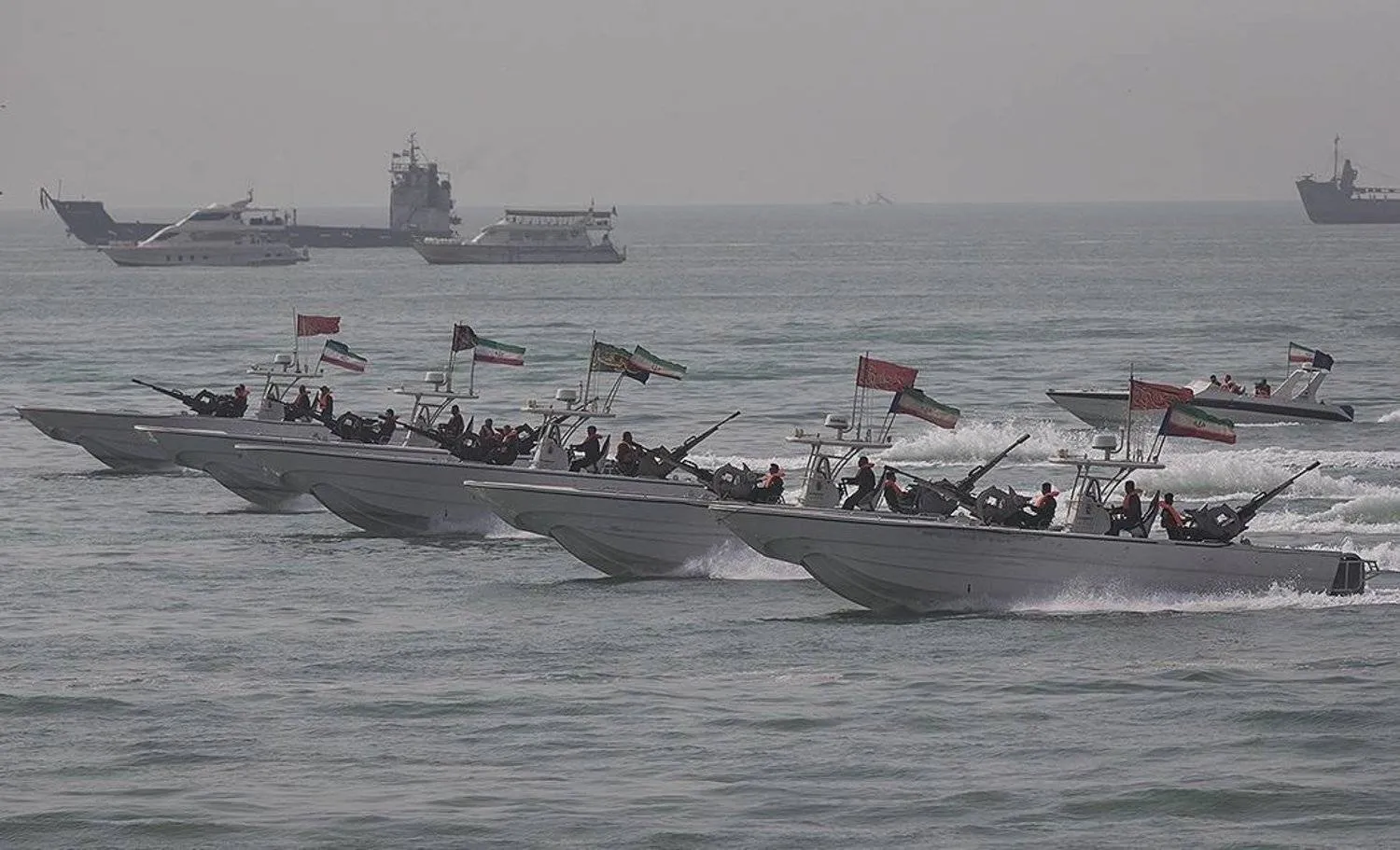

Iranian warships sunk by US and Israeli attacks litter naval harbors along the Gulf coast, but what is sometimes called a “mosquito fleet” lurks in the shadows.
It is a flotilla of small, fast, agile boats designed to harass shipping, and it forms the heart of the naval forces deployed by the Iranian Revolutionary Guards Corps, a force separate from Iran’s regular navy, reported the New York Times.
These boats, and especially the missiles and drones that the Guards navy can launch from them, or from camouflaged sites onshore, have been the main threat stymying shipping through the Strait of Hormuz.
Iran had vowed to keep the strait closed until there was a ceasefire in Lebanon. The ceasefire there took effect on Thursday. On Friday, senior Iranian officials made conflicting statements about whether that truce had prompted Iran to open the strait.
On Saturday, Iran’s military said the waterway had “returned to its previous state” and was “under strict management and control of the armed forces.”
Welcoming the initial Iranian announcement of the opening, US President Donald Trump pronounced the Hormuz situation “over,” while stressing on social media that the US blockade of Iranian ports would remain in place until a peace deal was reached.
The task of keeping the strait closed would fall to the Guards navy.
“The IRGC navy works more like a guerrilla force at sea,” said Saeid Golkar, an expert on the Guards and a political science professor at the University of Tennessee at Chattanooga.
“It is focused on asymmetrical warfare, especially in the Persian Gulf and the Strait of Hormuz,” he added. “So instead of relying on big warships and classic naval battles, it depends on hit-and-run attacks.”
During the war, at least 20 vessels were attacked, according to the International Maritime Agency, a United Nations agency.
The Guards navy rarely claimed the attacks, which analysts said were most likely carried out by drones fired from mobile launchers on land, which generate a faint footprint, difficult to trace.
On April 8, after a two-week ceasefire in the war was announced, General Dan Caine, the chairman of the Joint Chiefs of Staff, said more than 90% of the regular navy’s fleet, including its main warships, sat at the bottom of the ocean.
An estimated half of the Guards navy’s fast attack boats were also sunk, Caine said, but did not specify how many. Estimates of the overall number range from hundreds to thousands — it is difficult to count them.
The boats are often too small to appear on satellite images, and they are moored along piers within deep caves excavated along the rocky coastline, ready to be deployed in minutes, analysts said. Their arsenal poses a major threat to commercial ships in the gulf and the strait.
“It remains a disruptive force,” said Admiral Gary Roughead, a retired chief of US Naval Operations. “You never quite knew what they were up to and what their intentions were.”
Stepping in where the regular navy couldn’t
The Guards land forces were formed soon after the 1979 revolution because its leader, Khomeini, did not trust the regular army to protect the new government.
The Guards navy was added around 1986. The regular navy had proved reluctant during the Iran-Iraq war to attack oil tankers from Iraq’s financial backers, said Farzin Nadimi, a specialist on the Guards navy at the Washington Institute, a policy think tank in the US capital.
Eventually those attacks ratcheted up, and the United States then deployed warships to escort tankers. One of them, the USS Samuel B Roberts, almost sank after hitting an Iranian mine. In a subsequent battle, the US Navy scuppered two Iranian frigates and a number of other naval vessels.
Three years later, the Iranians watched as the United States laid waste to the Iraqi military during the first Gulf war.
That combination of events convinced Iran that it could never prevail in a direct confrontation with the US military, so it developed a stealth force to harass ships in the gulf, Nadimi said.
The Guards navy has an estimated 50,000 men, he said, and divides its forces into five sectors along the Gulf, including some presence on many of the 38 Gulf islands that Iran controls.
Overall, it has constructed at least 10 well-hidden, fortified bases for attack boats. One, Farur, is the center of operations for the naval special forces, whose equipment, even their sunglasses, are modeled on their US counterparts.
“The IRGC navy has always believed that it is at the forefront of the confrontation with the ‘Great Satan’, and has been in constant friction with the Americans in the Gulf,” Nadimi said.
An arsenal of small, nimble boats
Iran started by using recreational boats mounted with rocket-propelled grenades or machine guns, naval analysts said.
Over the years, it built a range of specially designed small boats, as well as miniature submarines and marine drones. Iran claims that some of those boats can reach speeds of more than 100 knots, or 115 miles per hour, experts said.
The Guards navy also recently developed larger, more sophisticated warships, many of which were targeted in the war, said Alex Pape, the chief maritime expert at Janes, a defense analysis firm.
Those damaged included its largest drone carrier, the Shahid Bagheri, a converted container ship that could also launch anti-ship missiles.
To counter a potential swarm of smaller boats, US warships have high-caliber cannons and other weaponry, experts said. Commercial vessels, though, have no way to fend off such attacks.
But the Iranians have never tested swarm attacks of small boats in combat, said Nicholas Carl, an Iran expert at the American Enterprise Institute, a think tank in Washington.
Since Trump on Monday imposed a naval blockade on ships traveling from Iranian ports, even the most powerful US warships are avoiding spending any time patrolling in the vicinity of the narrow Strait of Hormuz. There is little room to maneuver and almost no warning time to ward off a drone or a missile fired from nearby, experts said.
The US warships enforcing the blockade are likely to remain outside the strait, in the Gulf of Oman or even farther, in the Arabian Sea, where they can monitor shipping traffic but are far more difficult for the Guards to attack, experts said.
On Wednesday, Iran warned that it could expand operations into the Red Sea, another key shipping route in the region, through its proxy force in Yemen.
*Neil MacFarquhar for the New York Times