

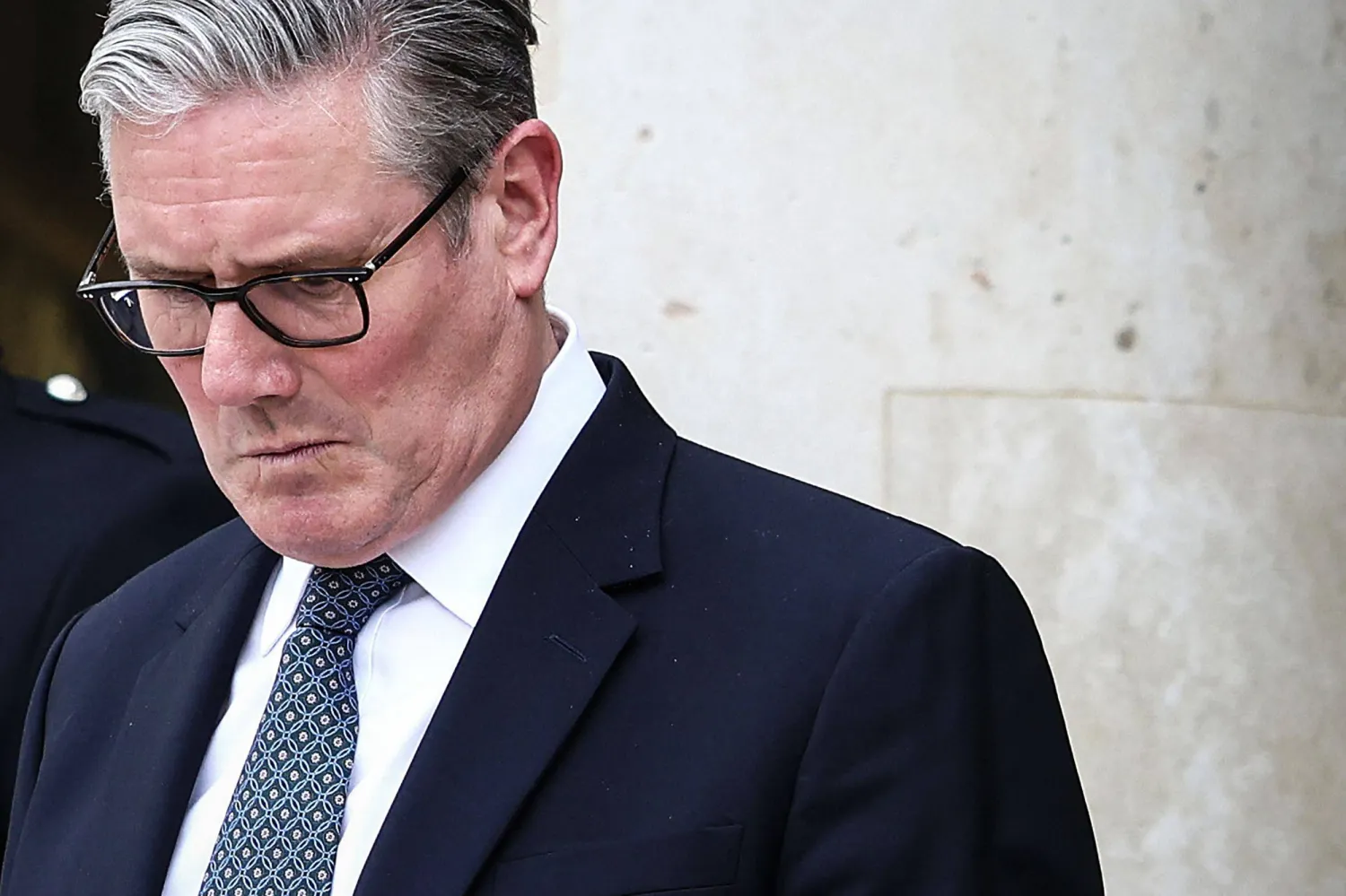

Starmer Admits Mistake in Appointing Mandelson as UK Ambassador but Resists Calls to Resign

Britain's Prime Minister Keir Starmer reacts as he prepares to leave the Elysee Presidential Palace in Paris on April 17, 2026 following an international summit on efforts to reopen the Strait of Hormuz. (AFP)
TT

Starmer Admits Mistake in Appointing Mandelson as UK Ambassador but Resists Calls to Resign

Britain's Prime Minister Keir Starmer reacts as he prepares to leave the Elysee Presidential Palace in Paris on April 17, 2026 following an international summit on efforts to reopen the Strait of Hormuz. (AFP)

British Prime Minister Keir Starmer acknowledged Monday that he made the wrong judgment when he appointed Jeffrey Epstein ’s friend Peter Mandelson as UK ambassador to Washington, but said he would not have done so if he had known Mandelson had failed security checks. 

Starmer faced a barrage of opposition calls to resign as he tried to explain why Mandelson was given the job despite failing security vetting for the UK's most important diplomatic post. Starmer brushed aside the demands, placing blame squarely on Foreign Office officials who he says failed to tell him about the security concerns. 

He said the facts about Mandelson's vetting "could and should have been shared with me before he took up his post.” 

Starmer told lawmakers in the House of Commons that “I would not have gone ahead with the appointment” had he known. Mandelson was fired in September, nine months into the job, when new details emerged about his friendship with Epstein. 

Starmer's explanation was greeted with jeers from opposition lawmakers, incredulous that the nation's leader hadn't known such a crucial piece of information. 

“I know many members across the House will find these facts to be incredible," Starmer said. "To that, I can only say they are right. It beggars belief.” 

Opposition Conservative Party lawmaker Kemi Badenoch said Starmer's lack of curiosity was hard to believe. 

“It doesn’t appear that he asked any questions at all. Why? Because he didn’t want to know," she said. 

Starmer was attempting to set the record straight after repeatedly telling lawmakers that “due process” was followed when Mandelson was appointed. He now says he’s “furious” that he wasn’t informed that an intensive vetting process had recommended Mandelson not be given security clearance. The Foreign Office, which oversees diplomatic appointments, cleared him anyway. 

Starmer fired the top Foreign Office civil servant, Olly Robbins, within hours of the revelation by The Guardian last week. But allies of Robbins say he would never have been able to share sensitive vetting information with the prime minister. 

Robbins is expected to give his own version of events to the House of Commons Foreign Affairs Committee on Tuesday. 

Badenoch said that instead of taking responsibility for his mistakes, Starmer "has thrown his staff and his officials under the bus.” 

Ed Davey, leader of the centrist Liberal Democrats, said Starmer “gives every impression of a prime minister in office but not in power. The prime minister knew that appointing Mandelson was an enormous risk. He decided that it was a risk worth taking — a catastrophic error of judgment. And now that it’s blown up in his face, the only decent thing to do is to take responsibility." 

Senior government colleagues have defended the prime minister. Deputy Prime Minister David Lammy said that if Starmer had known about the failed security vetting, “he would never, ever have appointed him ambassador.” 

But lawmakers in Starmer’s center-left Labour Party, already anxious about the party’s dire poll ratings, are restive. Starmer has already defused one potential crisis in February, when some Labour lawmakers urged him to resign over the Mandelson appointment. 

He could face a new challenge if, as expected, Labour takes a hammering in local and regional elections on May 7, which give voters a chance to pass a midterm verdict on the government. 

Critics say the Mandelson appointment is more evidence of a failure of judgment by a prime minister who has made repeated missteps since he led Labour to a landslide election victory in July 2024. Starmer has struggled to deliver promised economic growth, repair tattered public services and ease the cost of living, and has been forced into repeated policy U-turns. 

He picked Mandelson for one of Britain’s most important diplomatic jobs despite being warned by his staff that Mandelson’s friendship with Epstein, a convicted sex offender who died in prison in 2019, exposed the government to “reputational risk.” 

Mandelson’s business links to Russia and China also set off alarm bells. But his expertise as a former European Union trade chief and contacts among global elites were considered assets in dealing with President Donald Trump’s administration. 

He lasted less than nine months in the job. Starmer fired Mandelson in September 2025, after evidence emerged that he had lied about the extent of his links to Epstein. 

A trove of Epstein-related documents released by the US Department of Justice in January included emails suggesting Mandelson had passed on sensitive, and potentially market-moving, government information to Epstein in 2009, after the global financial crisis. 

British police launched a criminal probe and arrested Mandelson in February on suspicion of misconduct in public office. Mandelson has previously denied wrongdoing and hasn’t been charged. He does not face allegations of sexual misconduct. 


Macron Says France ‘Never Envisaged’ Sending Warships into Strait of Hormuz

This US Navy handout photo released on May 8, 2026 by US Central Command Public Affairs, shows the Arleigh Burke-class guided-missile destroyer USS Rafael Peralta (DDG 115) implementing a maritime blockade against the Iran-flagged crude oil tanker vessel Herby while the latter was attempting to sail toward an Iranian port, on April 24, 2026. (US Navy / AFP)
TT

Macron Says France ‘Never Envisaged’ Sending Warships into Strait of Hormuz

This US Navy handout photo released on May 8, 2026 by US Central Command Public Affairs, shows the Arleigh Burke-class guided-missile destroyer USS Rafael Peralta (DDG 115) implementing a maritime blockade against the Iran-flagged crude oil tanker vessel Herby while the latter was attempting to sail toward an Iranian port, on April 24, 2026. (US Navy / AFP)

President Emmanuel Macron on Sunday said that France had "never envisaged" a naval deployment in the Strait of Hormuz but rather a security mission that would be "coordinated with Iran".

At a news conference in Nairobi, Macron said he was sticking to his position opposing a blockade from either side, and to "reject any toll" to ensure ships are able to pass through the strategic waterway.

Iran on Sunday warned of a "decisive and immediate response" to any French or British deployments in the strait, after both announced they would send military vessels to the region.

"There was never any question of a deployment but we are ready," said Macron.

"We have put together an ad hoc mission, co-led with the British, which has brought together 50 countries and international organisations to enable, in a coordinated way with Iran and by deconflicting the situation with all the countries of the region and the United States, the resumption of maritime traffic as soon as conditions allow," he added.

Macron, in Africa for a summit in Nairobi, said the whole continent was "victim of the blockade" of the strait, through which normally passes most of the oil exported from the Middle East.

France last week announced that its aircraft carrier, the Charles de Gaulle, had passed through the Suez Canal in preparation for such a mission.


Israeli Attorney General Opposes Appointment of Next Mossad Chief

Israeli left-wing activists demonstrate in Tel Aviv's HaBima Square against the ongoing war with Iran and against the Israeli government on May 9, 2026. (AFP)
TT

Israeli Attorney General Opposes Appointment of Next Mossad Chief

Israeli left-wing activists demonstrate in Tel Aviv's HaBima Square against the ongoing war with Iran and against the Israeli government on May 9, 2026. (AFP)

Israel's attorney general on Sunday opposed the appointment of the next head of the Mossad spy agency, due to take office in June, in a letter to the Supreme Court shared with the Israeli media.

The court is due to hear multiple petitions against the appointment of Major General Roman Gofman in the coming days.

Attorney General Gali Baharav-Miara's opposition centers on a case dating back to 2022, in which she says Gofman did nothing to exonerate a teenager arrested for espionage who had in fact been secretly recruited by the military at Gofman's request.

Gofman was a military commander on Israel's northern border at the time.

According to the attorney general's letter, army officers acting "at Gofman's request" recruited 17-year-old Uri Elmakiyes outside any legal framework to conduct "information gathering and influence" operations online with citizens of enemy countries, mainly Syria.

Unaware that the teenager was acting on behalf of the military, the Shin Bet internal security agency arrested and detained him in isolation for nearly two months before moving him to house arrest for over a year.

Prosecutors eventually dropped all charges against Elmakiyes, following an investigation. He is among those petitioning the Supreme Court against the appointment.

Baharav-Miara accused Gofman of doing nothing to exonerate the young man after his arrest. Gofman initially denied any knowledge of the affair.

Prime Minister Benjamin Netanyahu selected Gofman, who currently serves as his military secretary, for the post of Mossad director in December 2025.

An advisory committee for senior appointments was tasked with issuing an opinion on the appointment.

The committee's chairman, a former Supreme Court judge, opposed the nomination, saying Gofman had lied about the affair during his hearing, raising concerns about his "moral integrity".

But he was outvoted by the committee's three other members, who are all known to be supporters of the prime minister.

Netanyahu wrote to the court requesting that the petitions be dismissed, arguing that "responsibility for the security of the state and its citizens rests with the prime minister, and with him alone".

Netanyahu has refused to assume responsibility for the October 7, 2023 attack by Hamas on Israel that sparked the two-year war in Gaza, placing the blame on the security establishment.


Iran War ‘Not Over,’ Uranium Must Be Removed, Says Netanyahu

 Israeli Prime Minister Benjamin Netanyahu speaks during a press conference, amid the US-Israel conflict with Iran, in Jerusalem, March 19, 2026. (Reuters)
Israeli Prime Minister Benjamin Netanyahu speaks during a press conference, amid the US-Israel conflict with Iran, in Jerusalem, March 19, 2026. (Reuters)
TT

Iran War ‘Not Over,’ Uranium Must Be Removed, Says Netanyahu

 Israeli Prime Minister Benjamin Netanyahu speaks during a press conference, amid the US-Israel conflict with Iran, in Jerusalem, March 19, 2026. (Reuters)
Israeli Prime Minister Benjamin Netanyahu speaks during a press conference, amid the US-Israel conflict with Iran, in Jerusalem, March 19, 2026. (Reuters)

Iran's stockpile of enriched uranium must be "taken out" before the US-Israeli war against Iran can be considered over, Israeli Prime Minister Benjamin Netanyahu said in an interview Sunday.

"It's not over, because there's still nuclear material -- enriched uranium -- that has to be taken out of Iran. There's still enrichment sites that have to be dismantled," Netanyahu said in an excerpt of an interview due to air later Sunday on CBS's "60 Minutes" program.

"You go in and you take it out," the Israeli leader said when asked how the uranium could be removed.

Netanyahu said that US President Donald Trump had a similar position.

"I'm not going to talk about military means, but the president, what President Trump has said to me -- 'I want to go in there.'"

However, Netanyahu's statement was in contrast to Trump's public position.

The 79-year-old Republican is under increasing domestic pressure to end the Iran war and he insists that Tehran's nuclear program has been contained.

In an interview aired Sunday but apparently recorded earlier, Trump said Iran was "militarily defeated" and he insisted that the uranium could be removed "whenever we want."

"We'll get that at some point, whenever we want. We'll have it surveilled," he told independent television journalist Sharyl Attkisson.

"We have that very well surveilled. If anybody got near the place we will know about it and we'll blow them up."

Asked by CBS how the uranium stockpiles could be taken out from Iran, Netanyahu said he would prefer an agreement.

"I think it can be done physically. That's not the problem. If you have an agreement and you go in and you take it out, why not? That's the best way."

Pressed on whether there are military options to seize the hidden uranium, Netanyahu said, "I'm not going to talk about our military possibilities, plans, or anything of the kind."

"I'm not going to give a timetable to it, but I am going to say that's a terrifically important mission."

In addition to the unresolved uranium stockpile issue, Netanyahu said there were several other war aims that had yet to be accomplished.

"There's still proxies that Iran supports, their ballistic missiles that they still want to produce. Now, we've degraded a lot of it, but all that is still there and there's work to be done."

Netanyahu's interview with "60 Minutes" was due to air at 7:00 pm (2300 GMT).
