


Contenders to Head Crisis-Wracked UN Face Live Grillings

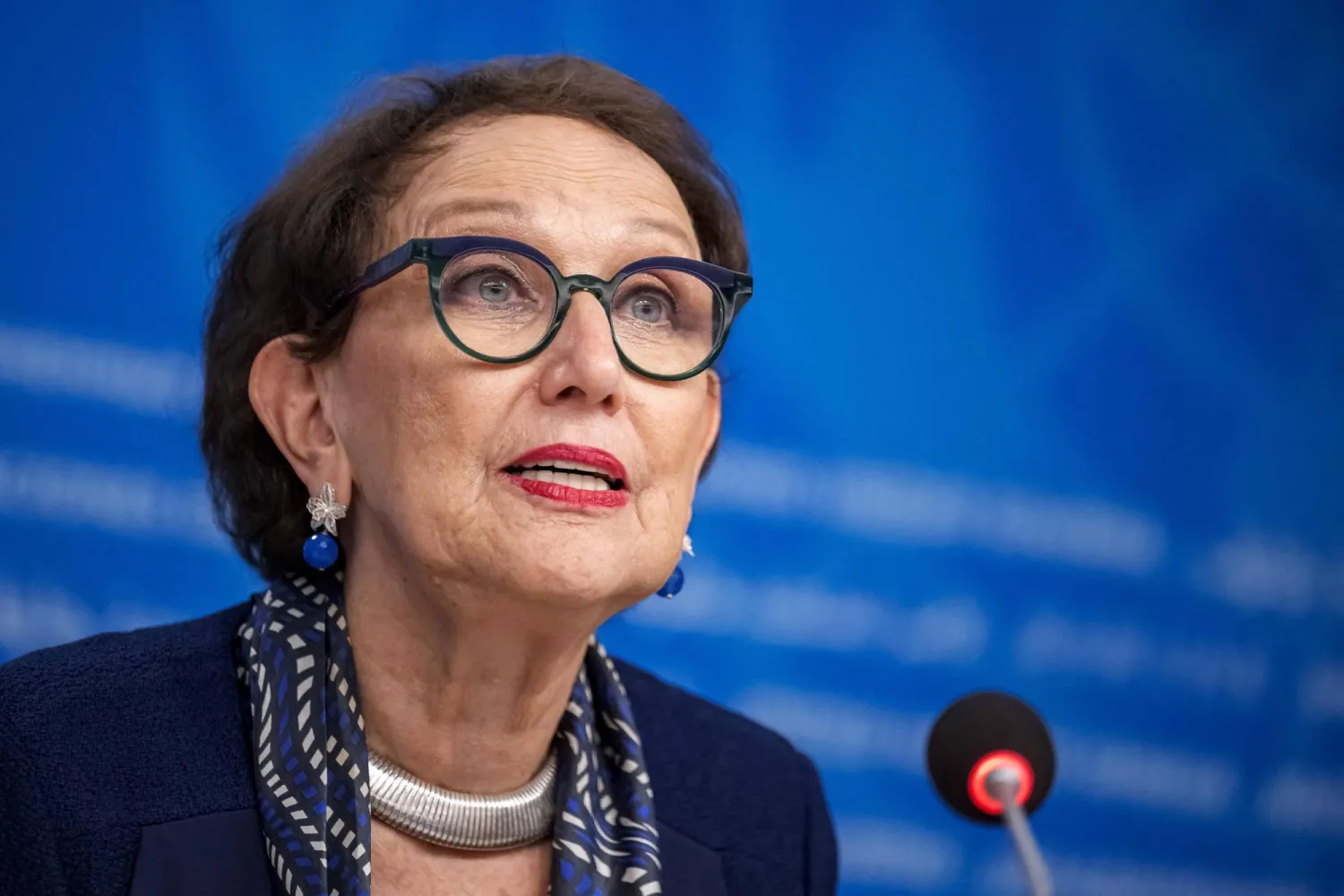
United Nations Trade and Development (UNCTAD) secretary-general Rebeca Grynspan speaks during a press conference, part of the 16th United Nations Trade and Development (UNCTAD) ministerial conference, in Geneva on October 22, 2025. (AFP)
TT

Contenders to Head Crisis-Wracked UN Face Live Grillings

United Nations Trade and Development (UNCTAD) secretary-general Rebeca Grynspan speaks during a press conference, part of the 16th United Nations Trade and Development (UNCTAD) ministerial conference, in Geneva on October 22, 2025. (AFP)

The four candidates vying to become the next United Nations secretary-general face live hearings on Tuesday and Wednesday on their bids to lead the troubled global organization from next year.

Chile's Michelle Bachelet, Argentina's Rafael Grossi, Costa Rica's Rebeca Grynspan and Senegal's Macky Sall are competing for a five-year term at the helm of the 193-member body, which can be extended for another five.

While they are the only declared candidates so far, others can join in the race in the coming months. The next UN leader will face an enormous task to revitalize an organization in crisis, whose stature has significantly diminished in recent years. Major powers, even as they increasingly flout long-held norms of international order, have pressed the UN to reform, slash costs, ‌and prove its ‌relevance.

First up for three hours of grilling at UN headquarters in New ‌York ⁠from member states ⁠and civil society representatives will be Bachelet and Grossi on Tuesday, followed by Grynspan and Sall on Wednesday. There are currently far fewer candidates for the role than in 2016, when incumbent Antonio Guterres of Portugal was chosen from a field of 13 contenders, seven of them women.

No woman has been chosen in the UN's 80-year history, despite growing calls to end this anomaly, and tradition has dictated that the role rotate between regions, with Latin America next in line.

Another unwritten rule is that a secretary-general never comes from among ⁠the five permanent members of the UN Security Council - Britain, China, France, Russia ‌and the United States - to avoid over-concentration of power, though ‌their backing is crucial in a lengthy and arcane selection process.

CRISIS REQUIRES 'PROACTIVE VISION'

"The need for a Secretary-General prepared ‌to defend a clear, proactive vision for the UN on peacemaking and crisis management could not be ‌more urgent," the International Crisis Group's Daniel Forti wrote recently.

"If candidates and member states miss this opportunity, there may be little left of the UN to defend."

Bachelet, 74, is a two-time president of Chile and a former UN High Commissioner for Human Rights.

In March, her own country withdrew its backing for her candidacy after a right-wing ‌shift in leadership, but she has retained support from Brazil and Mexico.

Bachelet has faced criticism from US conservatives for her pro-choice views and this ⁠month Washington's UN envoy ⁠appeared to torpedo her bid by saying he shared concerns about her suitability.

Grossi, a 65-year-old career diplomat and father of eight who speaks English, Spanish, French and Italian, has headed the UN nuclear watchdog for six years.

In his vision statement, Grossi declared that "even in times of division, multilateral institutions can deliver real, positive impact."

Grynspan, 70, a former vice president of Costa Rica who heads the UN Conference on Trade and Development, depicts herself as a reform-minded multilateralist with a lifelong belief in UN commitments to peace, development and human rights, who has battled gender barriers.

"I am not waiting for special treatment. I want equal treatment," she told Reuters.

Sall, 64, Senegal's president for 12 years until 2024, is a geologist and son of a peanut seller.

Soft-spoken and more comfortable in French than English, he has championed African development and support for debt-burdened countries.

"More than ever, a reinvented multilateralism remains the best way to respond to the challenges of a world in full transformation," he said on X.



US Forces Board a Sanctioned Oil Tanker in the Indian Ocean, the Pentagon Says

 Tankers and bulk carriers anchored in the Strait of Hormuz, Saturday, April 18, 2026. (AP)
Tankers and bulk carriers anchored in the Strait of Hormuz, Saturday, April 18, 2026. (AP)
TT

US Forces Board a Sanctioned Oil Tanker in the Indian Ocean, the Pentagon Says

 Tankers and bulk carriers anchored in the Strait of Hormuz, Saturday, April 18, 2026. (AP)
Tankers and bulk carriers anchored in the Strait of Hormuz, Saturday, April 18, 2026. (AP)

US forces have boarded an oil tanker previously sanctioned for smuggling Iranian crude oil in Asia, the Pentagon said Tuesday, as it puts into place a global warning to track down vessels tied to Tehran.

US forces “conducted a right-of-visit maritime interdiction” and boarded the M/T Tifani “without incident,” the Pentagon said on social media.

The Tifani was captured in the Bay of Bengal — between India and Southeast Asia — and was carrying Iranian oil, according to a US defense official who spoke on condition of anonymity to discuss an ongoing military operation. The US military will decide in the next four days what to do with the vessel, such as tow it back to the US or turn it over to another country, the official said.

It's the latest move in the US war on Iran to stop any ship tied to Tehran or those suspected of carrying supplies that could help its government, from weapons and oil to metals and electronics. The announcement comes ahead of the expiration of an already tenuous ceasefire between the US and Iran, and as Pakistan attempts to broker talks between Washington and Tehran.

It is the second vessel linked to Iran that has been interdicted by the US military. The US Navy attacked and seized an Iranian-flagged cargo ship Sunday that it said had tried to evade its blockade of Iranian ports, with President Donald Trump saying an American destroyer blew a hole in the ship’s engine room.

Targeting Iran-linked ships in international waters The Pentagon on social media described the Tifani as “stateless” despite it being a Botswana-flagged vessel.

“As we have made clear, we will pursue global maritime enforcement efforts to disrupt illicit networks and interdict sanctioned vessels providing material support to Iran — anywhere they operate,” the Pentagon announcement said, echoing previous statements from Trump administration officials. “International waters are not a refuge for sanctioned vessels.”

Gen. Dan Caine, chairman of the Joint Chiefs of Staff, said last week that the enforcement actions would extend beyond Iranian waters and the area under control of US Central Command.

US forces in other areas of responsibility, he told reporters at the Pentagon, “will actively pursue any Iranian-flagged vessel or any vessel attempting to provide material support to Iran.” He specifically pointed to operations in the Pacific and said the US would target vessels that left before the blockade began outside the Strait of Hormuz, a crucial waterway for energy and other shipments.

The military also detailed an expansive list of goods that it considers contraband, declaring that it will board, search and seize them from merchant vessels “regardless of location.” A notice published Thursday says any “goods that are destined for an enemy and that may be susceptible to use in armed conflict” are “subject to capture at any place beyond neutral territory.”

Blockades can be lawful in wartime, expert says

The US military’s actions against Iranian-linked vessels, namely the attack over the weekend on the cargo ship named the Touska, have raised questions about the two-week ceasefire.

The US and Iran are operating in “an awkward space where the law doesn’t give you a clean yes-or-no answer” on whether the ceasefire was violated, said Jason Chuah, a law professor at the City University of London and the Maritime Institute of Malaysia.

“The United States seems to take the line that the conflict never fully switched off — that is there is still a state of armed conflict,” Chuah said. “By saying that, it can keep doing things like enforcing a blockade and even using limited force at sea.”

But Iran is treating the ceasefire as a pause on all hostile acts, Chuah said. Iran’s joint military command has called the armed boarding an act of piracy and a violation of the ceasefire.

The US earlier had instituted a blockade against sanctioned oil tankers linked to Venezuela but had never fired on those vessels.

Blockades and even limited attacks on vessels can be lawful in wartime, with merchant vessels becoming legitimate targets if they contribute to military actions, carry contraband or are incorporated into enemy logistics, Chuah said.

It's harder to prove that a ship such as the Touska is realistically contributing to military action against the US, Chuah said.

“The whole dispute really turns on a deceptively simple question: Did the ceasefire actually suspend the right to use force?” Chuah said. “If it did, then firing on vessels or seizing them is very hard to square with the United Nations Charter.”

Mark Cancian, a retired Marine colonel and a senior defense adviser with the Center for Strategic and International Studies, said a violation is up for interpretation because there were no defined terms.

“Trump announced it. The Iranians agreed. But there’s no formal agreement,” Cancian said. “So whether it broke the ceasefire or not depends on your perspective. ... Nothing was written down.”

Michael O’Hanlon, a defense and foreign policy analyst at the Brookings Institution, said the US did not violate the ceasefire because it was limited to bombing Iran, not the blockade.

“We agreed to stop dropping bombs on them, and that’s the basic thing they wanted,” O’Hanlon said, adding that the US still had to enforce the blockade “if you’re going to make it mean anything.”


Russia, North Korea Connect Road Bridge Ahead of Summer Opening

This handout image released by the Russian Transport Ministry on April 21, 2026, shows a ceremony marking the connection of the two sides of the new Russia-North Korea road bridge over the Tumen River, set to open this summer. (Handout / Russian Transport Ministry / AFP)
TT

Russia, North Korea Connect Road Bridge Ahead of Summer Opening

This handout image released by the Russian Transport Ministry on April 21, 2026, shows a ceremony marking the connection of the two sides of the new Russia-North Korea road bridge over the Tumen River, set to open this summer. (Handout / Russian Transport Ministry / AFP)

Russia and North Korea held a ceremony Tuesday to mark the joining of the first road bridge connecting the countries, set to open for traffic this summer, Moscow said.

Ties between the two heavily sanctioned countries have surged amid Russia's war on Ukraine, with Moscow and Pyongyang deepening economic, political, cultural and military links.

South Korea warned last week that Chinese and Russian support was helping revive the North Korean economy, which has struggled for years under sweeping international sanctions, almost complete international isolation and huge military investment.

Moscow's foreign ministry said the opening of the bridge would "become a truly landmark stage in Russian-Korean relations. Its significance goes far beyond a purely engineering task."

The bridge, which crosses the Tumen River that marks the border between the two countries, will be able to handle up to 300 vehicles and 2,850 people a day, Russia's transport ministry said.

Russia and North Korea inked a defense treaty in 2024 that calls for military support in the case of either country being attacked.

Pyongyang that year sent thousands of troops to Russia to support its war on Ukraine. They were deployed to the western Kursk region to held fend off a months-long counter-offensive by Kyiv's troops.

Several senior Russian officials have visited North Korea recently, including the interior minister, currently in the country.

Russia's foreign ministry said the bridge would help "develop trade, economic and humanitarian exchanges" between Russia's Far East and North Korea.

North Korea does not publish official data on the size of its economy.

Its nominal gross domestic product was equivalent to about $30 billion in 2024, according to Seoul's official estimate -- a tiny fraction of the South Korean economy, one of the most developed in the world.

North Korea has long faced shortages. A famine in the mid-1990s killed hundreds of thousands of people, and reports indicate that the Covid-19 pandemic also pushed many into extreme hunger.


Germany Rejects Push to Suspend EU-Israel Cooperation Deal

 Germany's Foreign Minister Johann Wadephul speaks with the media as he arrives for a meeting of EU foreign ministers at the European Council building in Luxembourg, Tuesday, April 21, 2026. (AP)
Germany's Foreign Minister Johann Wadephul speaks with the media as he arrives for a meeting of EU foreign ministers at the European Council building in Luxembourg, Tuesday, April 21, 2026. (AP)
TT

Germany Rejects Push to Suspend EU-Israel Cooperation Deal

 Germany's Foreign Minister Johann Wadephul speaks with the media as he arrives for a meeting of EU foreign ministers at the European Council building in Luxembourg, Tuesday, April 21, 2026. (AP)
Germany's Foreign Minister Johann Wadephul speaks with the media as he arrives for a meeting of EU foreign ministers at the European Council building in Luxembourg, Tuesday, April 21, 2026. (AP)

Germany on Tuesday poured cold water on calls to suspend the EU's cooperation deal with Israel, despite rising anger over the war in Lebanon and the situation in the occupied Palestinian territories.

Spain and Ireland had put the issue of halting the agreement back on the table at a meeting of EU foreign ministers in Luxembourg.

But German Foreign Minister Johann Wadephul called the proposal "inappropriate".

"We have to talk with Israel about the critical issues," he said at the start of the meeting.

"That has to be done in a critical, constructive dialogue with Israel. That is what we stand for."

Attitudes towards Israel among EU member states, already hardened over its conduct in the war in Gaza, stiffened further after the Israeli invasion of Lebanon and a new law on the death penalty for Palestinians in the occupied West Bank.

"We need to act. We need to make sure that our fundamental values are protected," Irish foreign minister Helen McEntee said.

Facing alarm at the civilian toll exacted in the Gaza war, the EU last year already put on the table a raft of potential measures to punish Israel, including cutting trade ties or sanctioning government ministers.

But so far none of the steps laid out by Brussels has garnered enough support from member states to be put into action.

Suspending the entirety of the EU's cooperation agreement, as Spain and Ireland are pushing for, requires unanimity among the bloc's 27 countries and would almost certainly be blocked by allies of Israel.

More feasible could be suspending the part of the deal facilitating closer trade ties, a move that only requires support from a weighted majority of EU countries.

That would require a shift in position from EU heavyweights such as Germany or Italy.

Rome has already signaled a tougher line on Israel by suspending a defense agreement.

But EU officials and diplomats said it seemed there would not be sufficient support to take those actions, especially after a ceasefire was agreed in Lebanon.

"If the opinions of the member states have changed, then we can move forward with these decisions," said EU foreign policy chief Kaja Kallas.

France and Sweden meanwhile re-upped an earlier call from some other EU countries for the bloc to consider halting the import of goods from Israeli settlements in the occupied West Bank, which are considered illegal under international law.