

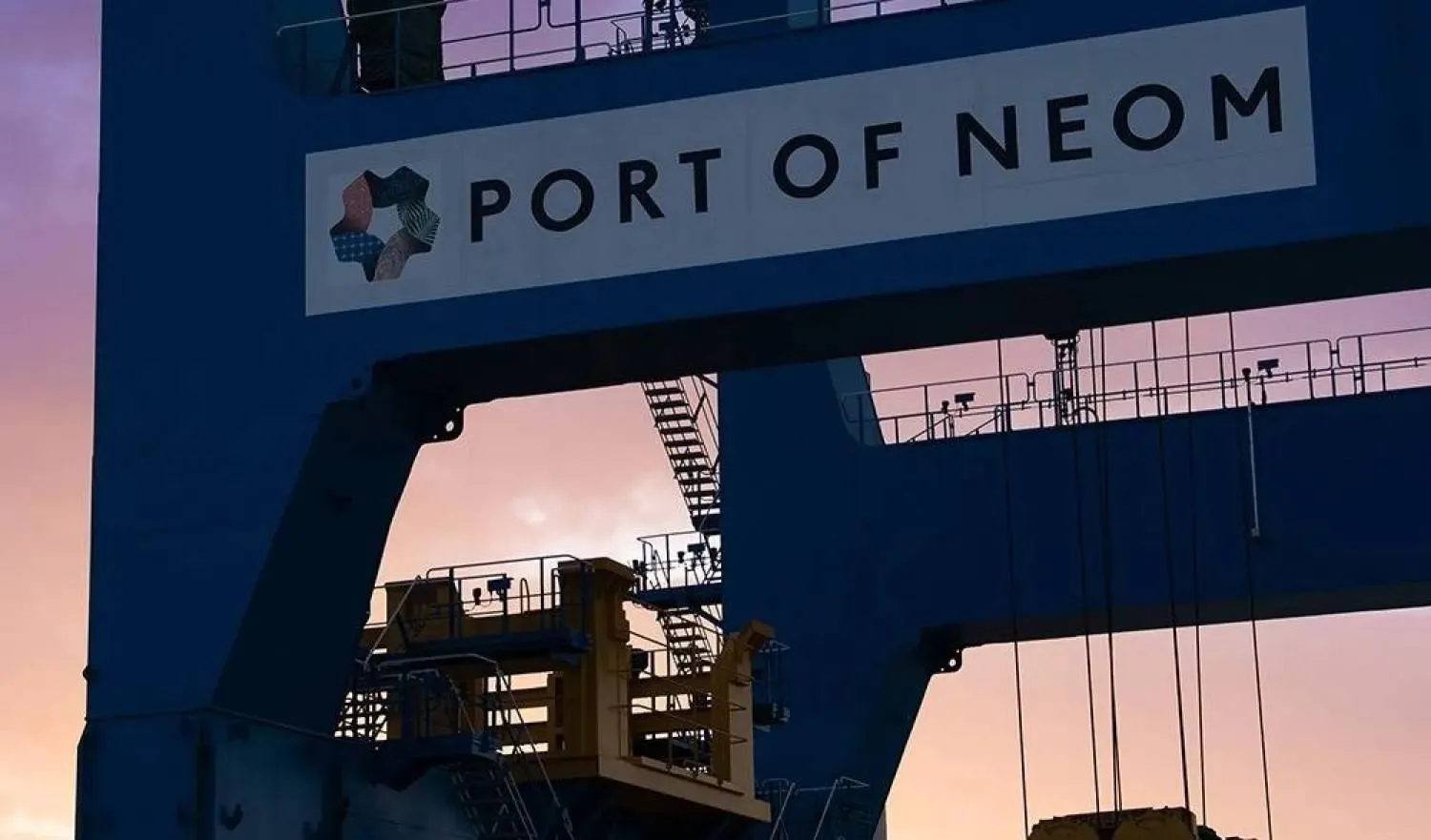

NEOM Port Reshapes Global Trade Routes from Northern Saudi Arabia

NEOM Port in Saudi Arabia (NEOM)
TT

NEOM Port Reshapes Global Trade Routes from Northern Saudi Arabia

NEOM Port in Saudi Arabia (NEOM)

On April 15, Saudi Arabia’s NEOM posted a terse but telling message on X: “Europe- Egypt- NEOM- GCC: your faster route.”

Accompanied by a map, the post traced a corridor linking Europe to Egypt’s ports of Damietta and Safaga, on to NEOM Port, then overland to Kuwait, Iraq, Bahrain, Qatar, the United Arab Emirates and Oman.

It was not a routine update. It signaled that a long-discussed trade route is now operational.

That same day, the Public Investment Fund approved its 2026-2030 strategy, outlining Saudi Arabia’s economic path to the end of the decade. NEOM said it “remains a central pillar” of that transformation, with its designation as an independent system underscoring official commitment.

The timing indicated clear alignment between the port’s rollout and the broader national strategy.

On the ground, progress is moving fast. The main container terminal, built to handle the world’s largest ships, is set to open this year with a capacity of 1.5 million twenty-foot equivalent units.

In June last year, the port received its first fully automated, remotely operated cranes, the first in the Kingdom, in what officials called a milestone for Saudi ports.

In a recent update, NEOM said the port is already operating at full capacity as a Red Sea hub, handling multiple cargo types, supported by advanced infrastructure and high operational standards. It links trade flows from the Americas, Europe and Egypt to Gulf and Iraqi markets.

A new logistics map

Abdullah Abdulrahim Almeer, an assistant professor at King Fahd University of Petroleum and Minerals and a member of the Saudi Economic Association, said NEOM’s location gives it an edge.

Unlike major Saudi ports clustered on the western coast or in the Gulf, NEOM sits at the far northwest, where Europe, the Gulf and northern neighbors converge.

He said the port can act as a “bridge port,” linking the sea and land into a single system. Its proximity to the Suez Canal and its road links to Jordan, Iraq and Gulf states strengthen its role as a future logistics hub.

“NEOM Port is not just competing with Jeddah or Dammam, it is opening a new axis that reshapes regional logistics,” he said, citing tensions in routes such as the Strait of Hormuz.

Logistics consultant Nashmi Al-Harbi said the port complements, rather than competes with, existing Saudi ports. He added that its reliance on renewable energy boosts efficiency and positions it as a sustainability leader.

Faster, leaner supply chains

Almeer said the corridor can cut shipping times by more than half. Cargo that once took 10 to 12 days to reach Gulf destinations can arrive in 4 to 6 days by combining short-sea routes with fast overland transport.

The gains come not just from distance, but from reduced waiting times, simpler procedures and less congestion.

Al-Harbi said the corridor “revolutionizes supply chain efficiency,” offering a reliable alternative amid geopolitical uncertainty.

Both said time-sensitive goods stand to gain most, including fast-moving consumer goods, fresh and refrigerated food, pharmaceuticals, spare parts, high-value electronics and advanced construction materials.

From the trial phase to the real trade

Almeer said the port has moved beyond early testing and can now support real trade flows, though it is still scaling up. He expects it to become a major regional hub as expansion continues.

Al-Harbi said the port reached an advanced operational stage in 2026, with infrastructure capable of handling regional trade, supported by advanced digital systems, automated cranes and modern road links.

Almeer pointed to the involvement of major firms such as Bahri and DFDS as evidence that global players have shifted from watching to operating, though the port is still proving itself at scale.

Al-Harbi said the interest reflects a search for safer, more reliable routes amid disruptions to global supply chains.

Driving diversification

Almeer said the Public Investment Fund’s strategy puts logistics at the heart of economic diversification. NEOM Port and the corridor directly support that goal, linking Europe, Africa and East Asia to Gulf markets by land and sea.

Supporting measures include exemptions from storage fees for up to 60 days, allowing Gulf trucks to enter empty or loaded, and launching regional storage and redistribution initiatives.

He said the impact on Tabuk will be significant, creating direct jobs in port operations and indirect roles in transport, warehousing and logistics, while opening the door for new industrial zones.

NEOM’s location near Iraq, Jordan and Kuwait strengthens its role as a regional gateway, he said, boosting Tabuk’s appeal and placing it at the center of regional and global trade.



Saudi Industry Minister Discusses Digital Transformation, Industrial Cooperation with Kazakh Ministers

Minister of Industry and Mineral Resources Bandar Alkhorayef and the Saudi delegation are seen during the meeting in Astana. (SPA)
TT

Saudi Industry Minister Discusses Digital Transformation, Industrial Cooperation with Kazakh Ministers

Minister of Industry and Mineral Resources Bandar Alkhorayef and the Saudi delegation are seen during the meeting in Astana. (SPA)

Saudi Minister of Industry and Mineral Resources Bandar Alkhorayef held two bilateral meetings in Astana with Kazakhstan’s Deputy Prime Minister and Minister of Artificial Intelligence and Digital Development Zhaslan Madiyev and Foreign Minister Yermek Kosherbayev focusing on strengthening economic ties and expanding cooperation in digital transformation, artificial intelligence, and industrial and mining innovation, reported the Saudi Press Agency on Saturday.

Attended by Saudi Vice Industry Minister for Mining Affairs Eng. Khalid Al-Mudaifer, the meeting also tackled strengthening economic ties and expanding cooperation in digital transformation, artificial intelligence, and industrial and mining innovation.

During his meeting with Madiyev, the officials explored opportunities to exchange expertise in digital technologies and AI, emphasizing the role of advanced technologies in enhancing efficiency and competitiveness in the industrial and mining sectors.

Alkhorayef highlighted the Kingdom’s efforts to develop its digital infrastructure and build an integrated innovation ecosystem that accelerates the adoption of advanced technologies.

Alkhorayef and Kosherbayev discussed ways to deepen economic cooperation, expand investment partnerships in industry and mining, and facilitate the access of Saudi exports to Kazakh markets.

The meetings were held as part of Alkhorayef’s official visit to Kazakhstan that is aimed at strengthening bilateral cooperation in industry and mining, promoting knowledge exchange in digital transformation and advanced technologies, and supporting the objectives of Saudi Vision 2030.


US Refiners Can Still Absorb More Venezuelan Oil, Energy Secretary Wright Says

US Secretary of Energy Chris Wright attends the 2026 Infrastructure Summit of government officials, corporate executives, and labor leaders, in Washington, DC, US, March 11, 2026. (Reuters)
TT

US Refiners Can Still Absorb More Venezuelan Oil, Energy Secretary Wright Says

US Secretary of Energy Chris Wright attends the 2026 Infrastructure Summit of government officials, corporate executives, and labor leaders, in Washington, DC, US, March 11, 2026. (Reuters)

US refiners can still absorb more Venezuelan crude, Energy Secretary Chris Wright said on Friday, as the South American country's output bounces following the US capture of President Nicolas Maduro in January and facilities on the Gulf Coast make adjustments to process higher volumes of heavy oil.

Venezuela is sending about half of its total exports of 1.25 million barrels a day to the US, with the remaining volumes going mainly to India and Europe, according to figures based on tanker monitoring. Wright said the exports are expected to increase in the coming months.

The country's oil ministry forecast crude output of 1.37 million bpd by year-end, which ‌would imply a ‌22% increase from the 1.12 million bpd produced in late 2025.

"It ‌takes ⁠time because you ⁠buy your crude mixes by month from slates. It's a blend from everywhere. So you don't just flip on a switch, but you'll see more and more Venezuelan crude demanded by US refineries," Wright said at an event in Port Houston, Texas.

US oil output also is expected to continue rising, with production of shale oil and gas growing modestly and stronger crude growth off the US Gulf Coast and in Alaska, according to Wright.

US crude production increased 3% last year, setting a new annual record of 13.6 million ⁠bpd. The country has become the world's largest exporter of oil and ‌fuel, sending out 10.5 million bpd.

STRAIT OF HORMUZ FLOWS

Earlier in ‌the day, Wright said 7 million bpd of oil were getting out of the Gulf with ‌US military help. Flows through the Strait of Hormuz have been largely choked off since the US-Israeli ‌war on Iran began in late February.

Asked about those comments, Wright said Iran is not currently exporting any oil or products and that the US is stepping up to fill the oil export void amid the Middle East conflict.

The International Energy Agency had estimated that Gulf supply was down by 14 million bpd, around ‌14% of world supply. But the figure could be closer to 5 million to 6 million bpd as producers find ways to keep cargoes ⁠moving.

Some 136 million barrels ⁠of non-Iranian crude moved through the Strait of Hormuz and the Gulf of Oman between early April and June 10, or about 1.9 million bpd, shipping data firm Kpler estimates.

"We have had days where we've exported well above the number I gave," Wright said when asked about the 7 million bpd passing through. "If you look at our trend right now, we'll be past replacing more than half of the lost oil."

Flows passing through Hormuz are coming from all oil exporters in the Arabian Gulf except Iran, Wright said.

Asked about gasoline prices in the US, which have climbed since the start of the Middle East conflict, Wright said President Donald Trump has been a champion of low energy prices.

"He has not changed that desire for low energy prices across the board, but he was simply unwilling to kick a 47-year conflict and a nuclear-armed Iran down to the next administration," Wright said, adding that allowing Iran to obtain nuclear weapons would lead to "massively higher" energy prices in future.


Saudi Industry Minister Discusses Mining Investment Opportunities with Kazakh Companies

Saudi Minister of Industry and Mineral Resources Bandar Alkhorayef held a series of bilateral meetings in Astana on Friday with leaders of several Kazakh mining and metals companies. (SPA)
TT

Saudi Industry Minister Discusses Mining Investment Opportunities with Kazakh Companies

Saudi Minister of Industry and Mineral Resources Bandar Alkhorayef held a series of bilateral meetings in Astana on Friday with leaders of several Kazakh mining and metals companies. (SPA)

Saudi Minister of Industry and Mineral Resources Bandar Alkhorayef held a series of bilateral meetings in Astana on Friday with leaders of several Kazakh mining and metals companies, in the presence of Vice Minister for Mining Affairs Eng. Khalid Almudaifer, the Saudi Press Agency reported.

Discussions focused on opportunities for cooperation in the mining sector, particularly in strategic minerals and rare earth elements. The talks also covered mineral exploration, geological surveying, and sustainable mining.

Participants included representatives of Tau-Ken Samruk National Mining Company, KAZ Minerals, and Kazatomprom.

The meetings are part of the Kingdom’s efforts to strengthen international partnerships and attract high-quality investments in the mining and minerals sector, in line with the goals of Saudi Vision 2030.